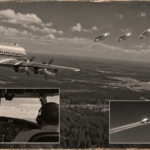
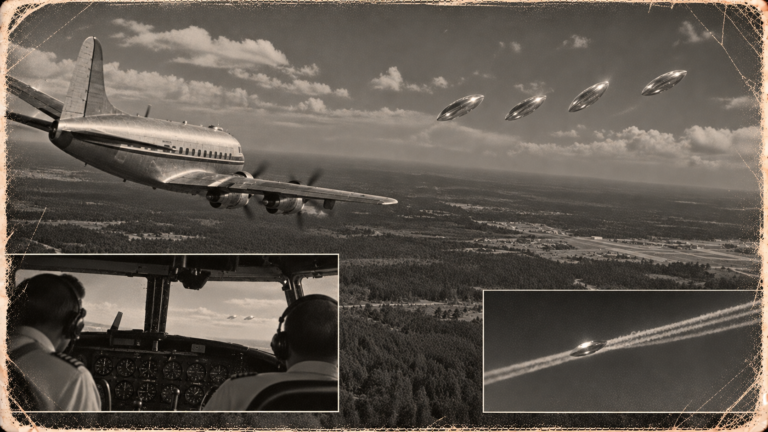
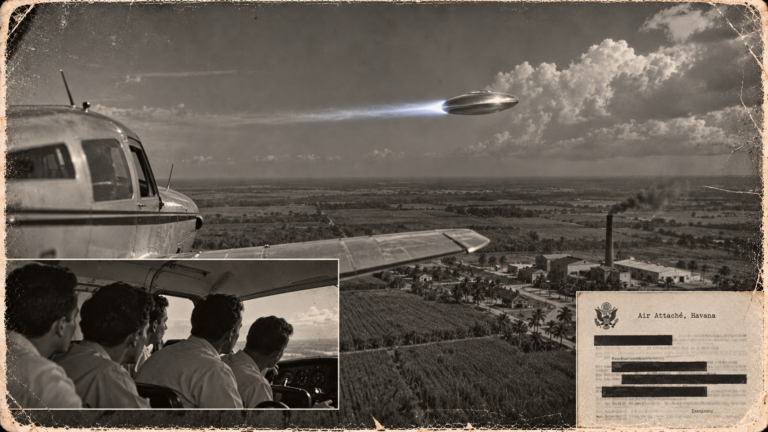
April 8, 1956: an American Airlines crew says it was told to skip Syracuse and follow this light to Lake Ontario.
THINK ABOUTIT UFO|UAP SIGHTINGS REPORT
1956: The American Airlines Chase: Capt. Raymond Ryan Follows a UFO Across New York
On the night of April 8, 1956, an American Airlines airliner full of passengers flew past its scheduled stop at Syracuse, New York. It was following a UFO. Minutes after taking off from Albany, Captain Raymond Ryan and First Officer William Neff watched a brilliant white light hang off their wingtip near Schenectady. The light then swept through a 90-degree arc at an estimated 800 to 1,000 mph and took up position ahead of them, where it blinked out and came back as an orange light. The crew radioed Griffiss Air Force Base, and observers in the Griffiss tower reported they could see the orange object. Ryan said the base then told them to abandon their Syracuse landing and follow it while jets were scrambled.
The crew followed the light for about 30 minutes, out to Oswego on the shore of Lake Ontario, and no interceptors ever arrived. Over the water the object sped away to the northwest. Eight days later, Ryan and Neff described the Air Force-directed chase on Buffalo television. In the later official inquiries, both the captain and the airline denied the flight had deviated at all. The Ryan-Neff American Airlines UFO chase is one of the clearest 1950s cases of a civilian airliner asked to pursue an unidentified object, and one of the clearest examples of a pilot’s public account being contradicted by the official record.
Date: April 8, 1956
Sighting Time: About 10:15 p.m. (EST)
Day/Night: Night
Location: Airspace over New York State, from Albany and Schenectady west past Syracuse to Oswego on Lake Ontario
Urban or Rural: Airborne (over mixed urban and rural upstate New York)
No. of Entity(‘s): Not Applicable
Entity Type: Not Applicable
Entity Description: Not Applicable
Hynek Classification: NL (Nocturnal Light), with ground visual confirmation reported. Griffiss radar was not operating at the time.
Duration: About 30 minutes
No. of Object(s): 1
Description of the Object(s): A very bright, fluorescent-looking white light, at first mistaken for an airliner with its landing lights on. It went out briefly and came back as an orange light. The crew said it had no definite shape and was just a brilliant light.
Shape/Size/Color of Object(s): No definite shape; described as a large light; brilliant white, then orange
Distance to Object(s): About 2 to 3 miles when first seen off the wingtip; about 8 to 10 miles ahead during the pursuit
Height & Speed: Low, near the airliner’s altitude of about 6,000 feet. It moved at an estimated 800 to 1,000 mph during its turn, then held position ahead of the airliner, which was flying at about 250 to 260 mph. It accelerated sharply as it left over Lake Ontario.
Number of Witnesses: Multiple. In the air: Capt. Raymond E. Ryan, First Officer William Neff and flight attendant Phyllis Reynolds. On the ground, as reported by the crew: observers in the Griffiss AFB tower, the Watertown tower, and two men in the Albany tower (one Air Force, one CAA).
Special Features/Characteristics: A 90-degree sweep at high speed; the light went out and came back orange; it held station ahead of the airliner. The Air Force reportedly directed the airliner to abandon its landing and pursue. A jet scramble was promised but no interceptors arrived. The sky was overcast, which ruled out a star or planet.
Case Status: Unexplained, with the official record disputed
Source: “Meet the Millers,” WBEN-TV Buffalo, April 16, 1956 (tape on file at NICAP); Richard Hall, ed., The UFO Evidence (NICAP, 1964), Sections V and IX; NICAP, “The Challenge of Unidentified Objects”; McDonald list (BBU)
Summary/Description: An American Airlines crew saw a brilliant light race across their path near Schenectady and turn orange ahead of them. Griffiss AFB observers reportedly saw it too, and the crew said they were told to skip their Syracuse landing and follow it to Lake Ontario. The promised jets never came, and the object sped off toward Canada.
Related Cases: 1956: April UFO|UAP & Entity Sightings Archive
Detailed Report
The flight was American Airlines’ regular evening run out of New York. It landed at Albany, then continued to Syracuse and Rochester before ending in Buffalo. On April 8, 1956, it took off from Albany heading north and turned left toward the west. Near Schenectady, about 15 air miles out, First Officer William Neff noticed a very brilliant white light that looked like an approaching aircraft with its landing lights on. The crew moved away from it, then realized it seemed to be almost standing still. Captain Raymond Ryan described it as fluorescent and very bright. The airliner passed to the south of it at a distance of perhaps 2 or 3 miles, with the light off their wingtip.
Then the light moved. The crew watched it swing through a 90-degree arc and head straight west. Ryan estimated its initial speed at 800 to 1,000 mph, much faster than a jet. About 8 to 10 miles ahead of the airliner, the light went out. For a moment the pilots knew something was out there on their course and could not see it. Then an orange light came on where the white one had been. With passengers aboard and an unknown object ahead, Ryan called Griffiss Air Force Base at Rome, New York.
Ryan had hoped Griffiss would have radar on the object, but the set was off and would have taken about 30 minutes to energize. Instead, the base asked the crew to keep the object in sight and call out their position. To pick out the airliner, Griffiss had them switch their lights off and on. The crew said the tower then reported seeing them, and asked whether the object they were watching was orange. According to the crew, the tower observers reported a definite silhouette south of the field. Neff said the Watertown tower, well to the north, could also see it, as could two men in the Albany tower, one with the Air Force and one with the CAA.
The object stayed just ahead of the airliner. Griffiss asked for the flight’s next intended landing and its aircraft identification. Ryan said the base then told them to abandon the Syracuse landing for the time being, hold their course and altitude, and keep following while jets were scrambled. Neff noted that the object was low, too low for a jet to stay there for long on its fuel, and that an overcast that night ruled out a star. The airliner, doing about 250 mph, trailed the light past Syracuse all the way to Oswego on the south shore of Lake Ontario. Neither pilot told the passengers.
The jets never came. Ryan said Griffiss reported the fighters were about to take off. Eight minutes later, when the airliner moved to the Syracuse tower’s frequency with messages still being relayed, the jets had still not launched after 10 to 12 minutes. Over the lake, the object pulled away to the northwest toward Toronto and quickly disappeared. Asked whether it had been saucer-shaped, Ryan said he couldn’t tell. Neff said it had no definite shape and was just a brilliant light.
Ryan and Neff gave this account on April 16, 1956, on “Meet the Millers” on WBEN-TV in Buffalo, together with Bell Aircraft engineer Bruce Foster. NICAP kept the tape. In the Civil Aeronautics Board and CAA inquiries that followed, Ryan and American Airlines denied that the flight had deviated to chase anything, and cited a flight log showing a normal Albany-to-Syracuse flight time. NICAP argued that the recorded television interview, in which both pilots described the Air Force order, showed the chase happened and that the log entry did not reflect it. NICAP said its request for the Air Force report was never answered.
RESEARCHER’S NOTES
Two Stories From the Same Cockpit
- Recorded close to the event: The core account comes from the pilots themselves, on tape, only eight days after the flight, before any official pressure could reshape the story. Both pilots agree on the key points: the light’s high-speed sweep, the change from white to orange, the Griffiss contact and the order to follow.
- The contradiction: In the CAB and CAA inquiries, Ryan and American Airlines denied the deviation. Either the television account overstated what happened or the official account understated it. The tape favors the television version. Directing a passenger airliner to pursue an unknown object would have broken Civil Aeronautics Board policy, which gives a plausible motive for a later denial.
- No radar: The case is often labeled “radar-visual,” but Ryan said Griffiss’s radar was off and needed about 30 minutes to warm up. The ground confirmation was visual, from tower observers, as relayed by the crew. No independent statements from the Griffiss, Watertown or Albany tower personnel are on file.
- Blue Book status unclear: The case appears on the McDonald list of Blue Book unknowns, but some summaries state it was never reported to Blue Book. An Air Force report on the Griffiss contact, which NICAP requested and never received, would settle the question.
- Conventional possibilities: Overcast skies rule out a bright planet or star. The object’s low altitude, its hovering and bursts of speed, its disappearance and reappearance in a different color, and its steady lead position over about 30 minutes don’t fit a conventional aircraft, a balloon or a meteor.
The Ryan-Neff chase is strong because the witnesses were professionals speaking on tape within days of the flight, and weak mainly because the official paper trail later went silent or contradicted them. Whatever the light over New York was, the most striking part of this case may be what happened afterward: an airline captain’s public account of an Air Force-ordered pursuit became, in the official record, a routine flight. The case remains unexplained.
“Why didn’t they get the jets up?”
Capt. Raymond Ryan, American Airlines, “Meet the Millers,” WBEN-TV Buffalo, April 16, 1956