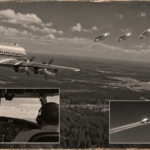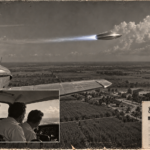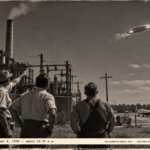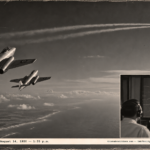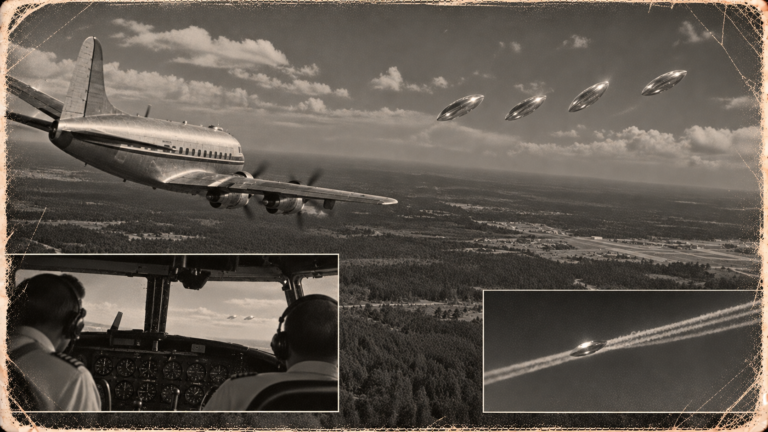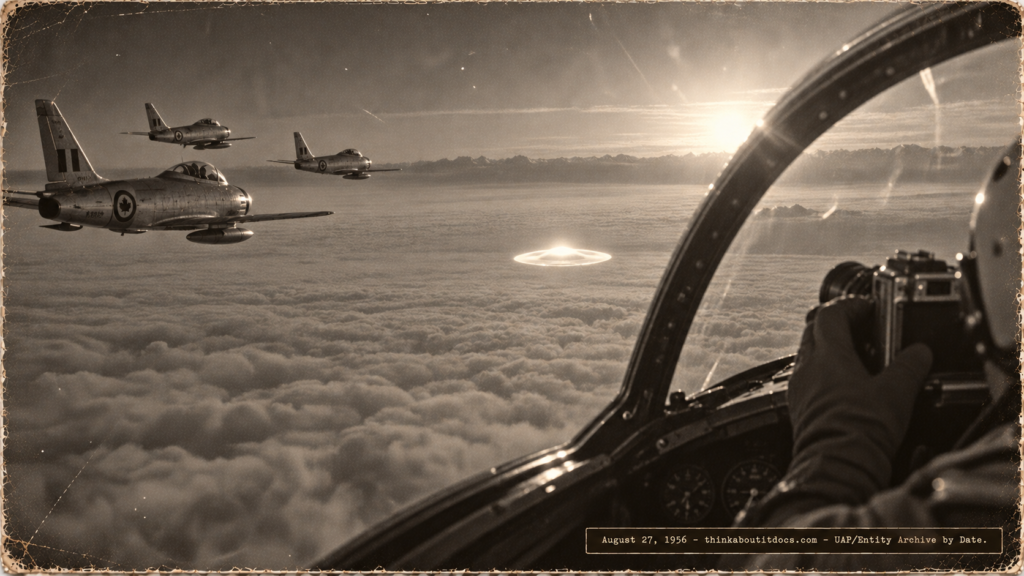
Near McLeod, Alberta, August 27, 1956: an RCAF pilot photographed this disc-shaped object below their formation at 36,000 feet; physicist Bruce Maccabee later estimated many megawatts of luminosity.
THINK ABOUTIT UFO|UAP SIGHTINGS REPORT
1956: McLeod, Alberta: RCAF Pilots Photograph a Disc Over the Rockies
About an hour before sunset on August 27, 1956, four Royal Canadian Air Force F-86 Sabre jets were cruising due west at 36,000 feet over the Canadian Rockies near McLeod, Alberta. One of the pilots noticed a bright light sitting below them, above a thick cloud deck. It was sharply defined and disc-shaped, and considerably brighter than sunlight reflecting off the clouds beneath it. He reported the observation to the flight leader. Then he took a photograph — a Kodachrome color slide.
The slide eventually reached Dr. Bruce Maccabee, a physicist who had been working on UFO photograph analysis for decades. He examined it in the context of the Sturrock Panel on physical evidence related to UFO reports and ruled out both reflected sunlight and lightning as explanations for the object’s luminosity. His estimate: many megawatts of optical output — far beyond what any reflective cloud phenomenon could produce. The McLeod photograph is one of the few Cold War military-pilot UFO photographs to receive formal scientific analysis in a peer-reviewed context, and it remains unexplained.
Date: August 27, 1956
Sighting Time: Approximately one hour before sunset (late afternoon)
Day/Night: Late afternoon (pre-sunset)
Location: Airspace over the Canadian Rockies near McLeod, Alberta, Canada
Urban or Rural: Airborne over remote mountain terrain
No. of Entity(‘s): Not Applicable
Entity Type: Not Applicable
Entity Description: Not Applicable
Hynek Classification: DD (Daylight Disc — seen in daylight, disc-shaped, photographed)
Duration: Approximately 45 seconds to 3 minutes (pilots’ estimates varied)
No. of Object(s): 1
Description of the Object(s): A bright, sharply defined disc-shaped light, described by the observing pilot as resembling “a shiny silver dollar sitting horizontal.” It was located below the aircraft but above a thick layer of clouds, and appeared considerably brighter than sunlight reflecting off the cloud surface.
Shape/Size/Color of Object(s): Disc / circular; precise size not determinable from the photograph; very bright — brighter than cloud-reflected sunlight; silver or white
Distance to Object(s): Below the formation (36,000 ft) and above the cloud deck; precise range not established
Height & Speed: Below 36,000 feet, above the cloud layer. No movement was recorded during the observation.
Number of Witnesses: At least 2 confirmed (the pilot who first saw the object and reported it; the pilot who photographed it). The other two pilots in the formation of four may also have observed it.
Special Features/Characteristics: A Kodachrome color slide photograph was taken by one of the pilots during the sighting. The photograph was subsequently analyzed by Dr. Bruce Maccabee, a physicist with expertise in UFO photographic analysis, as part of the Sturrock Panel study. Maccabee estimated the object’s luminosity at many megawatts of optical output and ruled out sunlight reflection and lightning as explanations.
Case Status: Unexplained (photograph subjected to formal scientific analysis; not identified as any known natural or man-made source)
Source: Dr. Bruce Maccabee, “The McLeod, Alberta photograph,” Journal of Scientific Exploration, Vol. 13, No. 2 (1999); The Sturrock Panel Report: “Physical Evidence Related to UFO Reports” (1999); STUDIOVNI
Summary/Description: Four RCAF F-86 Sabre pilots flying over the Canadian Rockies at 36,000 feet observed and photographed a bright disc-shaped object below them above a cloud deck. The Kodachrome photograph was analyzed by physicist Dr. Bruce Maccabee; he estimated many megawatts of luminosity and ruled out reflection and lightning.
Related Cases: 1956: August UFO|UAP & Entity Sightings Archive
Detailed Report
On the afternoon of August 27, 1956, a formation of four Royal Canadian Air Force F-86 Sabre jet aircraft was flying due west at 36,000 feet over the Canadian Rockies in the vicinity of McLeod, Alberta, about an hour before sunset. Conditions at altitude were clear. Below the formation, a solid deck of cloud covered the terrain.
One of the pilots noticed a bright light between the aircraft and the cloud deck. He described it as “a bright light which was sharply defined and disk-shaped,” resembling “a shiny silver dollar sitting horizontal.” The light appeared distinctly brighter than the reflected sunlight on the clouds below — not merely a bright patch of cloud surface, but a more intense and differently defined source. He reported the observation to the flight leader and then took a photograph using a Kodachrome color slide camera he had with him.
The observation lasted between 45 seconds and 3 minutes by the pilots’ own estimates — a relatively brief sighting at cruising speed, but long enough for a photograph to be taken and for more than one pilot to observe the phenomenon. The object did not appear to move during the observation.
The case subsequently came to the attention of Dr. Bruce Maccabee, a physicist at the U.S. Naval Surface Warfare Center who had spent many years analyzing UFO photographs. He examined the slide in the context of the Scientific Panel on Physical Evidence Related to UFO Reports, convened by Peter Sturrock of Stanford University. The panel brought together physicists, astronomers and engineers to examine physical evidence cases; Maccabee presented his analysis of the McLeod photograph as one of the panel’s case studies.
Maccabee evaluated two conventional explanations: reflection of sunlight by the cloud surface, and lightning. He found the first inadequate — the object’s luminosity substantially exceeded what sunlit cloud surfaces produce in that geometry. He found lightning insufficient as well, given the duration, shape and steadiness of the light. His calculation of the object’s optical power output arrived at “many megawatts” — a figure that has no straightforward natural or man-made explanation in the context of the observation. His full analysis appeared in the Journal of Scientific Exploration, Vol. 13, No. 2 (1999).
RESEARCHER’S NOTES
Why a Photograph and Peer Review Set This Case Apart
- Military witness quality: Four RCAF fighter pilots are among the most qualified observers available. Trained to identify aircraft and assess altitude and distance from the cockpit, they are unlikely to misidentify sunlit cloud, optical illusions or ordinary aircraft at range.
- The photograph: A Kodachrome color slide taken under controlled conditions — above a cloud layer, from a known altitude, in known lighting geometry — provides a calibrated basis for luminosity analysis. Kodachrome’s spectral response is well understood, which allows Maccabee to use the film itself as a measuring instrument.
- Peer-reviewed analysis: The Journal of Scientific Exploration is a peer-reviewed journal. The Sturrock Panel Report, while not government-commissioned, brought together credentialed scientists to examine physical evidence. Maccabee’s analysis being published in both contexts is a meaningful step above the typical UFO photograph treatment.
- What “many megawatts” means: A conventional flare, for example, produces roughly 1 to 2 megawatts of optical output. A many-megawatt source from an object below a fighter formation at high altitude, stationary above a cloud deck and disc-shaped, does not have an obvious identification in the 1956 Canadian airspace inventory.
- Pilot anonymity: The pilots are not named in any available published account. This is common for military UFO cases from the period, where career concerns frequently led pilots to report without public identification. The RCAF made no official public statement about the sighting.
The McLeod, Alberta case stands on three elements that are rarely found together in a 1950s UFO report: military witnesses of high caliber, a physical photographic record, and a formal peer-reviewed scientific analysis. Maccabee’s “many megawatts” estimate is not a claim that the object was extraterrestrial — it is a statement that no conventional optical source in that situation accounts for what the Kodachrome slide recorded. The case remains open.
“A bright light which was sharply defined and disk-shaped … resembling a shiny silver dollar sitting horizontal.”
RCAF pilot, describing the object observed over the Canadian Rockies near McLeod, Alberta, August 27, 1956 — via Dr. Bruce Maccabee, Journal of Scientific Exploration, Vol. 13, No. 2 (1999)