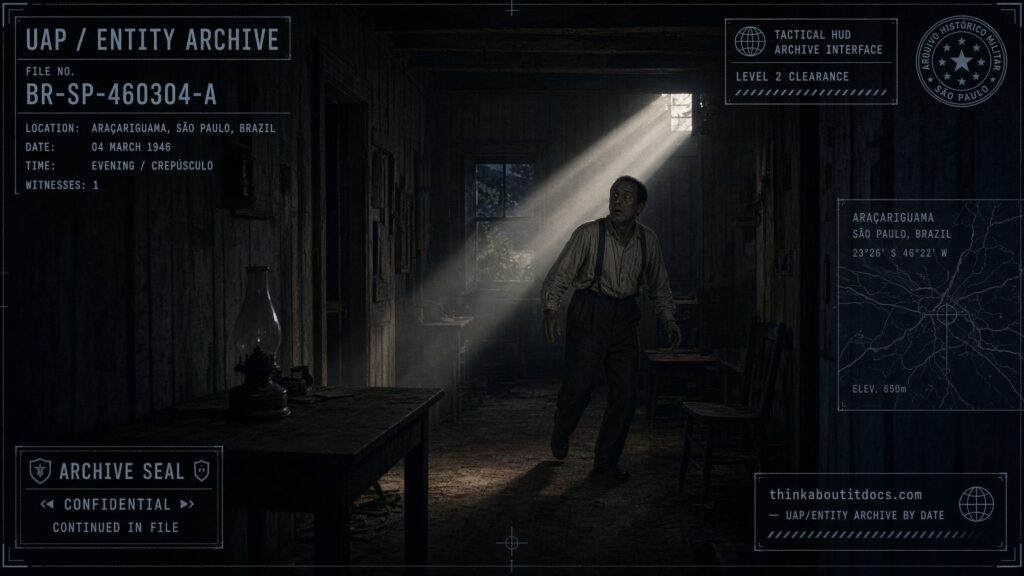
March 4, 1946 — Araçariguama, Brazil. Farmer João Prestes Filho was struck by a silent flash of light inside his own home and died within hours — an unexplained case still investigated nearly eight decades later.
THINK ABOUTIT UFO | UAP SIGHTING REPORT
1946: The Death of João Prestes Filho — Araçariguama, Brazil
A farmer came home from fishing on Carnival Monday, went to take a shower, and was struck by a silent flash of light that no one has ever explained. His flesh burned as though cooked. His clothes and hair did not. He lived long enough to describe what happened, and died within hours. Nearly eight decades later, named investigators are still trying to find out what hit João Prestes Filho — in what may be the first fatal UFO-related encounter ever recorded in Brazil.
Date: March 4, 1946 (struck), died March 5, 1946
Sighting Time: Approximately 19:00-19:30, evening
Day/Night: Night (indoors, at home)
Location: Prestes’s own farmhouse, on the outskirts of Araçariguama, a small town approximately 70 km from São Paulo, Brazil
Urban or Rural: Rural — Araçariguama in 1946 had no telephone service, running water, or resident doctor
No. of Entity(s): None directly observed
Entity Type: Not Applicable — no entity was seen; only a beam or flash of light was reported
Entity Description: Not Applicable
Hynek Classification: CE-II — Close Encounter of the Second Kind. No craft or occupant was directly observed, but the encounter produced a specific, severe physical effect on the witness — third-degree burns of a distinctive pattern — meeting the standard definition for a physical-effect close encounter even without a visible object.
Duration: The strike itself was instantaneous, described as a flash; Prestes survived approximately 9 hours afterward before dying
No. of Object(s): No object was directly seen — only the light/beam itself, with no source craft described by the primary witness
Description of the Object(s): Not Applicable in the conventional sense; the phenomenon reported was a sudden, silent flash or beam of light that crossed through the rooms of the house and struck Prestes directly.
Shape of Object(s): Not Applicable
Size of Object(s): Not Applicable
Color of Object(s): Not specified beyond “a flash of light”
Distance to Object(s): Direct contact — Prestes was struck directly by the light inside his own home
Height & Speed: Not applicable; no aerial object or flight path was described by the primary witness
Number of Witnesses: 1 direct witness (Prestes himself, who described the event before dying); additional secondary witnesses to his condition and final hours include his neighbor Maria, tax inspector/paramedic Aracy Gomide (first responder), and family members
Special Features/Characteristics: The burns were documented as third-degree, localized specifically to exposed skin — head, neck, hands, and lower limbs — while Prestes’s clothing and hair showed no scorching or damage, a pattern inconsistent with conventional fire or a directed heat source; decades later, investigating researchers Fernando Grossmann and Dr. Luiz Braga, after interviewing surviving witness Aracy Gomide directly in 1974, concluded the burn pattern resembled the indirect radiation effects observed in some survivors of the Hiroshima and Nagasaki bombings, in which radiation affected living tissue while leaving inert materials such as clothing and hair unaffected; Prestes’s brother, Emiliano Prestes, reportedly experienced a related incident months later in the same area, describing a fireball and beam of light that caused him a strong fever but no lasting harm; the case went essentially undocumented outside the immediate community for roughly 20-25 years before ufological investigators began compiling witness accounts, by which point Prestes’s house had reportedly been sealed by police and later torn down, apparently because his family would not return to what they regarded as a cursed home.
Case Status: Unexplained
Source: Flying Saucer Review, London, 1966, and March/April 1973 issue; Prof. Felipe M. Carrión, “The Terrible Death of João Prestes at Araçariguama,” Flying Saucer Review; field investigations and witness interviews conducted by Brazilian ufologists Fernando Grossmann and Walter Bühler, and physician Dr. Luiz Braga, beginning in the 1960s-70s, decades after the original event
Related Cases: 1946: March UFO & Entity Sightings Archive
Detailed Report
João Prestes Filho was a 44-year-old farmer living on the outskirts of Araçariguama, a small, centuries-old town roughly 70 kilometers from São Paulo, Brazil. In 1946 the town had no telephone service, no running water, and no resident doctor — medical emergencies were handled by Aracy Gomide, a local tax inspector who had taken paramedic courses.
On the evening of March 4, 1946 — Carnival Monday — Prestes sent his wife, Silvina Nunes Prestes, and their six children to a street carnival celebration in a neighboring town, while he went fishing on the Tietê River with a friend, Salvador dos Santos. The two men parted ways that evening, and Prestes returned to his empty, dark house alone. Tired from the day, he prepared to bathe. As he moved toward the bathroom, he later reported that a flash of light came from somewhere in the house, crossed through its rooms, and struck him directly.
His body began to burn immediately, from head to toe by his own account. In severe pain and unable to touch anything, he reportedly opened his door latch using his teeth and ran, barefoot, to seek help at a neighboring house. Aracy Gomide was summoned and treated him as best he could with the limited paramedic training and equipment available in a town with no doctor. Prestes died approximately nine hours after the incident, having survived long enough to describe what had happened to him to those who came to his aid.
The physical details of his injuries, as later documented, are what set this case apart from a simple accident narrative. His burns were third-degree and specifically localized to areas of exposed skin — his head, neck, hands, and lower limbs — while his clothing and hair reportedly showed no scorching, burning, or damage whatsoever. This pattern is difficult to reconcile with a conventional fire, electrical accident, or chemical burn, all of which would typically be expected to damage clothing and hair along with skin.
The case did not become widely known outside the immediate community for roughly two decades. By the time ufological researchers began investigating in the 1960s and 1970s, Prestes’s house had been sealed by local police and later demolished — apparently because his surviving family could not bring themselves to return to what they came to regard as a cursed home. Brazilian ufologist Fernando Grossmann, working with physician Dr. Luiz Braga, tracked down and directly interviewed Aracy Gomide — the original first responder — in 1974, nearly 30 years after the event. Based on Gomide’s firsthand account of the burn pattern, Grossmann and Braga concluded that the injuries resembled the indirect radiation effects documented in some Hiroshima and Nagasaki survivors, in which radiation exposure damaged living tissue while leaving non-living materials such as clothing and hair unaffected — though they could offer no explanation for what in rural 1946 Brazil could have produced a controlled, directed source of that kind.
Notably, the case does not appear to be entirely isolated within the Prestes family. According to later accounts collected from surviving relatives, Prestes’s brother Emiliano had his own frightening encounter months after João’s death: while walking through nearby forest, a fireball reportedly appeared above him, and when he fled toward a canyon edge, a beam of light caught up with him, surrounding him in brightness and leaving him with a strong fever, though he recovered. The family account states this experience was enough to make Emiliano avoid being out at night for some time afterward.
RESEARCHER’S NOTES
Physical Evidence Without a Visible Object
- On why this case is unusual within this archive: Most CE-II physical-effect cases in this archive’s record involve a directly observed craft or object that produces the physical effect — burned vegetation, stalled engines, electromagnetic interference. This case is different: no craft, light source, or occupant was ever seen by Prestes or any other witness. What survives is a specific, severe medical outcome — a documented burn pattern — with no observed cause. That absence of a visible triggering object is itself part of what makes the case difficult to categorize or dismiss with a conventional UFO framework, and equally difficult to explain with a mundane one.
- On the two-decade documentation gap: The roughly 20-to-25-year delay between the event and its first substantial outside investigation is significant and should be weighed honestly. On one hand, it means the earliest and most detailed accounts come from long-after-the-fact interviews with aging secondhand and tertiary witnesses (family members, neighbors, and the original first responder recalling events from decades earlier), which introduces the same memory-reliability concerns present in any delayed account. On the other hand, the case’s basic facts — a documented death, a locally known “cursed house” that was sealed and torn down, named family members who remained traceable decades later — anchor the account in verifiable local history rather than a story invented wholesale for a ufological audience.
- On the Hiroshima/Nagasaki burn-pattern comparison: Grossmann and Braga’s radiation-effect hypothesis is a serious attempt at a medical explanation, made by a physician examining firsthand witness testimony about a real, documented injury pattern — not casual speculation. But it raises an obvious and unresolved question the researchers themselves acknowledged: no known source of controlled, directed radiation existed in rural Araçariguama in 1946, a town without electricity or telephone service, let alone anything resembling nuclear technology. The comparison describes what the injury resembled, not what caused it.
- On what would strengthen or weaken the case going forward: Any surviving contemporaneous 1946 documentation — a death certificate, hospital or clinic record, police report from when the house was sealed, or period newspaper coverage from the São Paulo region — would be the single most valuable addition to this case’s evidentiary record, since everything currently available traces back through decades of retrospective interview rather than a contemporaneous primary document.
João Prestes Filho went fishing, came home, and died from injuries that still have no accepted explanation, nearly eighty years and multiple generations of investigators later. Whatever struck him in his own darkened house that Carnival Monday evening left a mark specific enough to still be studied — and mysterious enough that no one, from his own neighbors to the researchers who tracked down the last living witnesses decades later, has ever been able to say what it was.