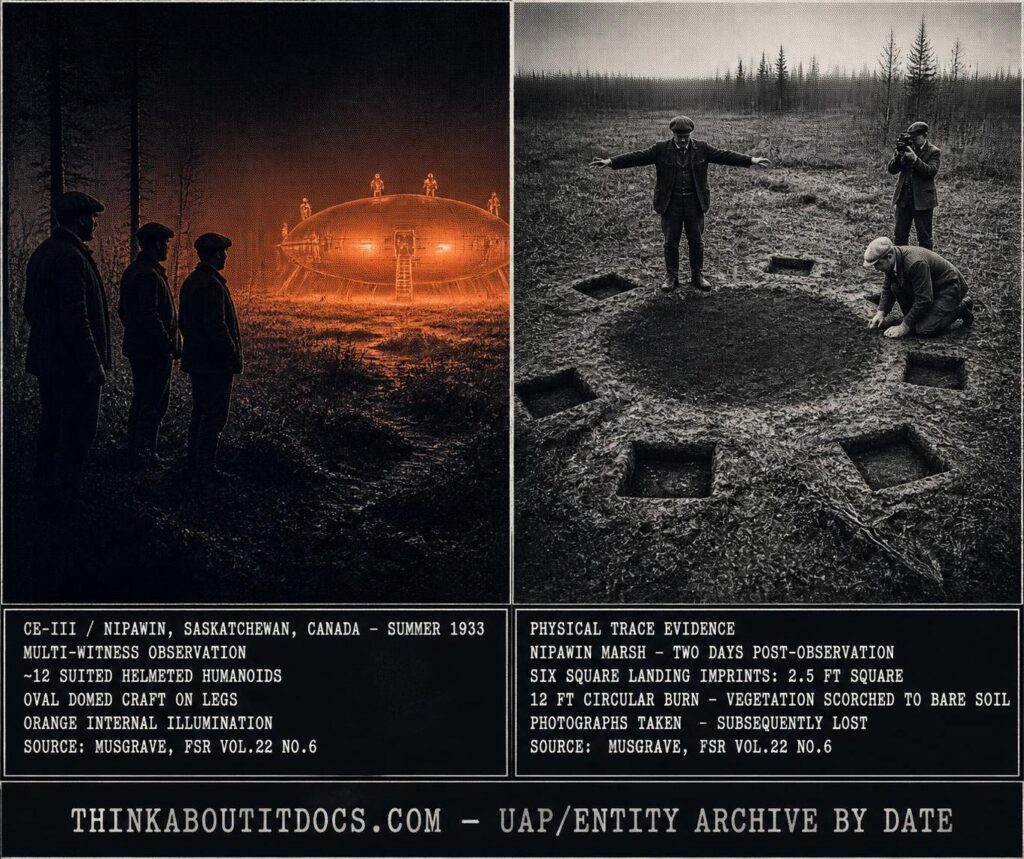
Nipawin, Saskatchewan, Summer 1933 — three witnesses observe a domed oval craft on legs in a remote marsh with approximately twelve silver-suited helmeted figures conducting silent repair activity for approximately thirty minutes. Two days later they return to find six square landing imprints (2–2½ feet square, 2–3 inches deep), a 12-foot central burn circle, and stairway base marks. Photographs taken with a Brownie box camera; lost over the following four decades. Source: John Brent Musgrave, FSR Vol. 22 #6, 1976. thinkaboutitdocs.com.
THINK ABOUTIT UFO | UAP SIGHTING REPORT
1933 UFO stops for repairs in Sasketchwan, Canada
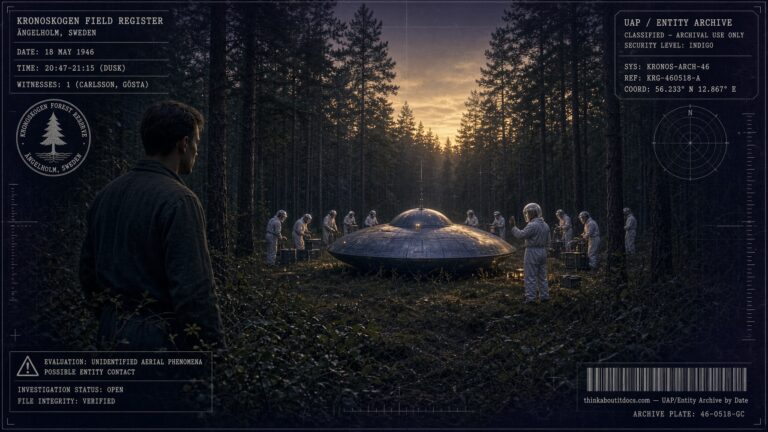
In the summer of 1933, three witnesses near Nipawin, Saskatchewan drove out after midnight toward a glow reported on the horizon for the better part of a week, and were stopped a quarter mile short by a strip of impassable muskeg — close enough to watch, for roughly thirty minutes, a large domed oval craft resting on legs in the marsh, lit by an unearthly orange glow, while approximately a dozen silver-suited, helmeted figures moved silently up and down a central ladder in what looked entirely like repair work. Two days later they returned to find the craft gone and six square landing imprints, a stairway base mark, and a twelve-foot burn circle pressed into the ground. They photographed all of it with a Brownie box camera. Every Canadian outlet they submitted the account to declined it. The photographs were lost over the following four decades.
Date: Summer 1933
Sighting Time: After midnight (initial observation); dawn (trace investigation, approximately two days later)
Day/Night: Night (observation); Day (trace investigation)
Location: Near Nipawin, Tobin Lake area, Saskatchewan, Canada
Urban or Rural: Rural — remote marsh and rolling hills northwest of Nipawin, near frontier homestead territory
No. of Entity(‘s): Approximately 12
Entity Type: Suited humanoid occupants
Entity Description: Slightly shorter than average adult male; all wore silver-colored suits or uniforms and helmets or ski-cap style headgear; all engaged in apparent repair activity, moving purposefully around and up and down the craft’s ladder; no facial detail recorded; no sound produced by the entities at any point
Hynek Classification: CE-III (Close Encounter of the Third Kind — entities observed in the vicinity of and associated with a landed craft)
Duration: Approximately 30 minutes (observation period)
No. of Object(s): 1
Description of the Object(s): Large oval-shaped object, domed at the top, slightly rounded on the bottom, supported on legs; a central doorway or hatch with a ladder-like stairway; emitted a bright orange glow of unusual quality the witnesses described as “unearthly”; completely silent throughout the observation
Shape of Object(s): Oval disc with upper dome
Size of Object(s): Large — inferred from six landing leg imprints (each 2–2½ feet square, spaced 8–10 feet apart) and a 12-foot diameter central burn circle; estimated large enough to accommodate roughly a dozen active crew on its exterior
Color of Object(s): Hull color not specified; orange glow emanated from the craft, illuminating the surrounding marsh
Distance to Object(s): A quarter mile or less, across intervening muskeg
Height & Speed: Not recorded for flight; landed on legs at marsh level throughout the observation
Number of Witnesses: 3 (two men and a woman; names known to researcher John Brent Musgrave but withheld at witness request)
Special Features/Characteristics: Complete silence throughout; orange “unearthly” glow; approximately twelve suited crew engaged in coordinated repair activity; six square boilerplate-type landing imprints 2–3 inches deep; central 12-foot diameter burn circle; stairway base ground mark; Brownie box camera photographs taken of the traces, subsequently lost over four decades; a week of prior light reports from homesteaders and a fire-tower ranger preceding the close observation
Case Status: Unexplained.
Source: John Brent Musgrave, Flying Saucer Review Vol. 22 #6 (1976), based on direct witness interviews conducted more than four decades after the event.
Summary/Description: In summer 1933, three witnesses outside Nipawin, Saskatchewan drove toward reported lights northwest of town and observed from across a muskeg strip a large domed oval craft resting on legs in a marsh, emitting a bright orange glow of unusual quality. Approximately twelve silver-suited helmeted figures were active on and around the craft via a central ladder, apparently conducting repairs, in complete silence, for roughly thirty minutes, before the witnesses returned to town for fuel. Two days later they found the craft gone but discovered six square landing leg imprints, a stairway base mark, and a central 12-foot burn circle. They photographed the traces with a Brownie box camera and attempted to publish the account with photos in Canadian newspapers and magazines; every outlet declined. The photographs were lost in the decades that followed.
Related Cases: 1935 Nipawin, Saskatchewan — a second landing-trace case with suited occupants on a ladder at the same location (Musgrave/Canadian UFO Report/FSR) | 1933 Pelican Lake, Manitoba — landed oval object with occupants | 2002 Saskatchewan saucer with legs
Detailed Report
The 1933 Nipawin, Saskatchewan case is one of the most structurally complete pre-modern CE-III cases in the Canadian record. It has three adult witnesses, an independently reported prior sighting wave by homesteaders and a forest ranger, a 30-minute close observation, physical trace evidence investigated and photographed two days later, and a named credentialed researcher who interviewed the witnesses directly more than four decades after the event. John Brent Musgrave published the account in Flying Saucer Review Vol. 22 #6 in 1976, and it subsequently appeared in Jerome Clark’s UFO Encyclopedia and Robert Bartholomew’s Ufolore as one of the canonical pre-modern Canadian cases. Musgrave knew the witnesses’ names but withheld them at their request.
The lead-up matters. Strange lights near the ground and in the sky had been reported northwest of Nipawin for the better part of a week before the three witnesses drove out. The reporters included homesteaders — credible rural observers in a frontier region where unexplained phenomena had no cultural home — and a forest fire tower ranger whose professional role required systematic atmospheric observation. That background establishes the Nipawin event not as an isolated surprise but as the close-range resolution of an ongoing anomalous presence.
The observation itself was constrained by geography. A strip of muskeg — the boggy, unstable marsh terrain characteristic of Saskatchewan’s northern lowlands — blocked the witnesses from closing the final quarter mile. They could not cross it safely at night. From the treeline they had an unobstructed view at distance. The orange glow was bright enough and steady enough to illuminate the craft’s form and the activity around it clearly. What they described — a domed oval on legs, a central hatch, a ladder, approximately a dozen silver-suited helmeted figures moving with purposive activity in complete silence — is internally consistent, structurally specific, and devoid of the embellishment typical of fabricated accounts. The silence is particularly notable. In 1933, the only machines capable of the flight described would have been loud. The Nipawin craft produced no sound whatsoever across a clear marsh on a quiet summer night.
The 30-minute observation ended not through fear or the craft’s departure, but because the witnesses ran out of time — they needed to find a way around the muskeg and realized they lacked sufficient fuel. This is an important credibility detail. They returned home, obtained more fuel, drove back, and found a cut-off trail that might have brought them closer — only to discover the craft was already gone. The trace investigation on the third morning was methodical. Six square imprints in the soil, each the same size (2 to 2½ feet square) and the same depth (2 to 3 inches), spaced 8 to 10 feet apart in what was presumably a hexagonal or bilateral pattern consistent with a multi-leg landing structure. The witnesses described the impression quality as resembling boilerplate stamped into soft ground — a specific metallurgical analogy that suggests an industrial rather than folkloric frame of reference. The central burn circle, 12 feet in diameter, indicated the primary exhaust or energy source was below the craft’s center, consistent with the rounded bottom described in the visual observation.
One of the witnesses brought a Brownie box camera on the return visit and photographed both the burn circle and the landing imprints. The witnesses then wrote up the account and submitted it — with photograph copies — to multiple Canadian newspapers and magazines. Every outlet declined. Some replied with mockery. This institutional rejection was not unusual for 1933; the cultural vocabulary for UAP did not yet exist in Canada or anywhere else. The original photographs were held by the witness who took them and, over the 40-plus years between the event and Musgrave’s 1976 publication, were lost. Musgrave noted in his FSR account that copies might still exist in an attic or photo album somewhere and that, if found, they would represent the earliest photographic documentation of a physical trace CE-III case with witnessed occupants in the record.
RESEARCHER’S NOTES
The Muskeg Margin — Nipawin 1933 and the Pre-Modern Trace Record
- Source Chain and Credibility Assessment: John Brent Musgrave is a credentialed Canadian UFO researcher whose work appears in Flying Saucer Review, the Canadian UFO Report, and multiple academic compilations of pre-modern cases. FSR Vol. 22 #6 (1976) is a legitimate primary publication. Musgrave’s methodology — interviewing witnesses directly, withholding names at request, noting the photographic evidence and its subsequent loss honestly — is consistent with field research standards. The 40-year gap between the event and the publication is the case’s primary evidentiary limitation; it cannot be overcome, but it is not unique to this case in the pre-modern record. The witness accounts were consistent across that interval, and the physical detail in the trace description (square imprints, depth measurement, separation distance, burn circle diameter) carries the specificity of direct observation rather than reconstructed narrative.
- Physical Trace Analysis: The six square landing imprints are the case’s most objectively assessable element. Square landing pads — as opposed to rounded feet — suggest a deliberate engineering choice: maximum ground-contact area for load distribution on soft terrain, consistent with a craft designed to operate on variable surfaces including marsh. The boilerplate analogy used by the witnesses is precise: thick flat iron plate, used industrially in boilers and structural applications, produces exactly the kind of clean-edged deep impression described. The 12-foot central burn circle is consistent with a downward-directed energy source at the craft’s base — whether exhaust, propulsion, or landing stabilization. The absence of footprints around the burn site despite the apparent crew activity is harder to explain; the witnesses noted only scuffling of surrounding vegetation, not discrete footprints, possibly because the soft ground around the burn circle had been disturbed more broadly or because the crew operated primarily on the craft’s exterior above ground level.
- The Lost Photographs — Significance and Implications: Musgrave’s observation that the lost Brownie photographs, if recovered, would represent the earliest documented physical-trace CE-III photographic evidence in the record remains accurate. The Brownie box camera was a standard consumer device in 1933 — its images would have been silver gelatin prints of modest resolution but adequate for establishing the scale and nature of the impressions. The attempt to publish them in 1933 means copies were submitted to multiple Canadian media organizations; institutional archives from that period have not been comprehensively searched for rejected submission material. This is an open archival lead.
- Pattern Context — Nipawin as a Recurring Location: The same Nipawin, Saskatchewan area produced a second documented CE-III landing trace case in 1935 — three witnesses observing approximately a dozen suited helmeted occupants on a ladder, square landing imprints, and scorched ground, photographed the following day — reported in The Canadian UFO Report and Flying Saucer Review (Musgrave, 1976). The structural identity between the 1933 and 1935 cases — same location, same entity description (silver-suited, helmeted, approximately a dozen, on a ladder), same physical trace type (square imprints, burn) — is either a remarkable coincidence, a second independent encounter with the same or a similar craft in the same operational area, or the result of a single event being recalled with date uncertainty by witnesses. Musgrave treated them as separate events; this archive retains both but flags the coincidence.
The Nipawin muskeg case is what the pre-modern record looks like at its most honest. Three witnesses, a week of prior reports, thirty minutes of clear observation across boggy terrain, a return visit with a camera, photographs taken and lost to time, a publication attempt that failed because the world was not ready for the question. John Brent Musgrave found the witnesses four decades later and put it in Flying Saucer Review. The square imprints were real. The burn circle was real. The photographs existed. The craft and its crew of twelve silver-suited silent workers in the Saskatchewan marsh were, for thirty minutes on a summer night in 1933, as real as the muskeg that kept three people from getting any closer.
“Not a sound carried across the muskeg. The three of them stood and watched for about thirty minutes without speaking, then turned back to town for more fuel. When they returned two days later the craft was gone. In its place: six large square landing imprints, a stairway base mark, and a central burn circle approximately 12 feet in diameter.”
Case summary describing the summer 1933 Nipawin, Saskatchewan encounter, as documented by John Brent Musgrave, Flying Saucer Review, 1976