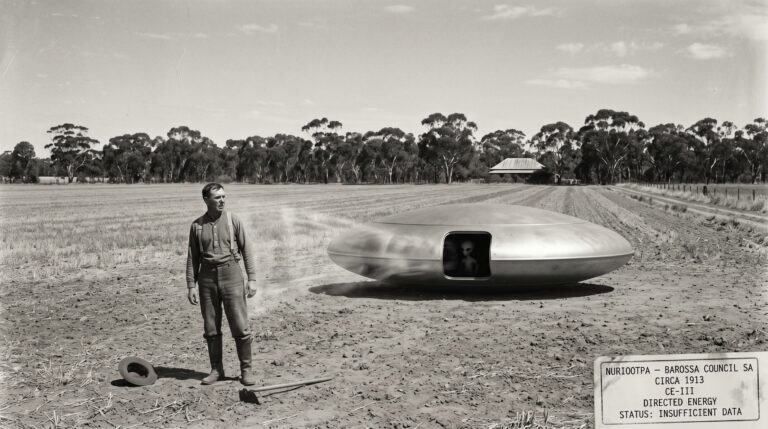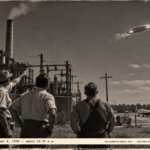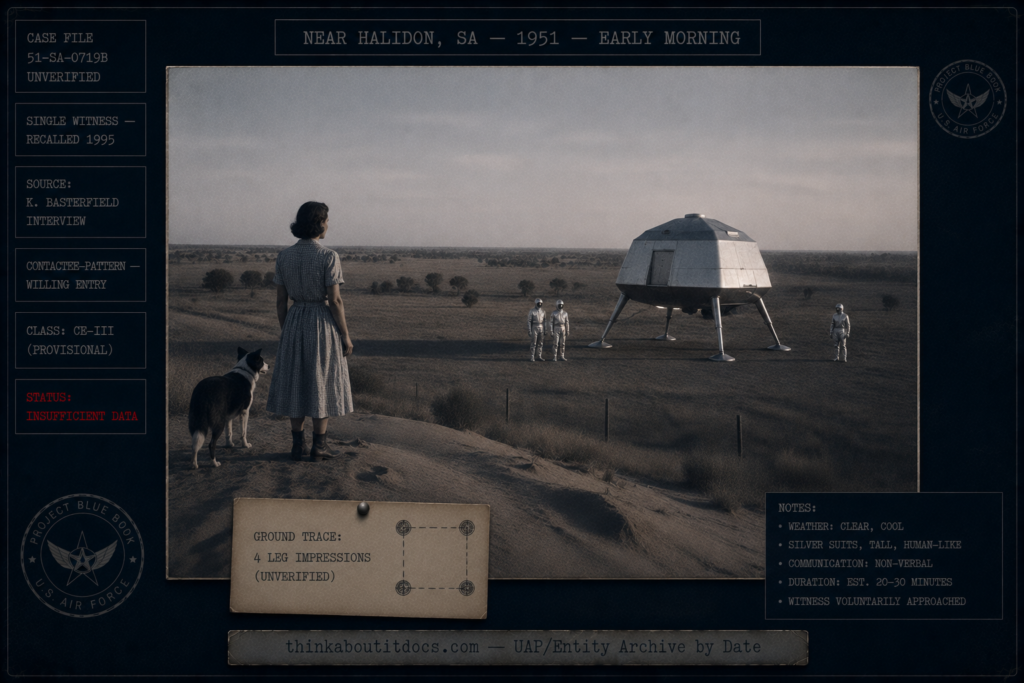
The 1951 Halidon encounter — a farm wife's account, recalled to researcher Keith Basterfield in 1995, of silver-suited men beside a landed craft. Credibly sourced but unverifiable; logged Insufficient Data. (thinkaboutitdocs.com — UAP/Entity Archive by Date)
THINK ABOUTIT UFO|UAP|ENTITY SIGHTINGS REPORT
1951: Halidon, South Australia Encounter
It is one of the gentlest close-encounter accounts in the Australian files, and one of the saddest. A young farm wife, out at dawn rounding up cattle on a vast property north of Murray Bridge, climbs a sand dune and finds a house-sized craft resting on four legs. Three tall, human-looking men in silver suits float down to meet her; she feels no fear, goes willingly aboard, sees a being working a console without touching it, and is told — by men who somehow already knew her infant had recently died — that things would be all right. Then she floats back to the ground, where round impressions mark where the legs had stood. The account is credible in its sourcing: it comes from veteran Australian researcher Keith Basterfield, who interviewed the woman in 1995 and protected her name. But it was recalled forty-four years after the fact, rests on her testimony alone, and carries the unmistakable shape of the benevolent-contact story. The archive keeps it, with respect, and tells it straight.
Date: 1951 (specific date not recorded)
Sighting Time: Early morning
Day/Night: Day (early morning)
Location: Rural property near Halidon, north of Murray Bridge, South Australia
Urban or Rural: Rural
No. of Entity(‘s): 3 seen outside, plus at least 1 more aboard the craft
Entity Type: Human-appearing — a “Nordic”-style benevolent-contact type
Entity Description: Male, of normal human height and appearance, with normal facial features and very clear blue eyes; smooth, delicate, unwrinkled skin; clad in tight-fitting silver suits with silver boots and a hood
Hynek Classification: CE-III (animate beings associated with the object) — provisional; the witness entered willingly and was returned, placing the encounter closer to the contactee pattern than to an involuntary CE-IV abduction
Duration: Not recorded
No. of Object(s): 1
Description of the Object(s): A structured craft about the size of a two-bedroom house, resting on four legs, with a door on the underside; the witness reported entering and leaving by “floating,” as if on an invisible lift; inside were a console operated without physical touch (lights responding to hand movements) and a screen resembling a television
Shape of Object(s): Structured object on four legs (specific outline not described)
Size of Object(s): About the size of a two-bedroom house
Color of Object(s): Not recorded
Distance to Object(s): Close — the witness approached and entered the craft
Height & Speed: Not recorded (object at rest on the ground)
Number of Witnesses: 1 (anonymous; “Mrs A.”)
Special Features/Characteristics: Willing entry and return by “floating”; touch-free console and TV-like screen; communication in English with a sense of accompanying telepathy (“talked without talking”); the beings’ apparent foreknowledge of the witness’s recent bereavement and their reassurance; round ground impressions reported where each leg had rested (an uncorroborated physical-trace claim)
Case Status: Insufficient Data
Source: Keith Basterfield, from his January 1995 interview with the anonymous witness “Mrs A.” (Basterfield’s catalogue of Australian UAP reports, Project 1947 archive)
Summary/Description: Australian researcher Keith Basterfield interviewed an anonymous woman (“Mrs A.”) in January 1995 about an experience she placed in 1951, when she was a young married woman living on a 3,500-acre property near Halidon, north of Murray Bridge, South Australia, shortly after the death of her infant. Out rounding up cattle at dawn, she found a house-sized craft on four legs, met three human-looking men in silver suits who floated down from it, willingly went aboard, observed a touch-free console and a screen, and was told by the beings — who seemed to know of her loss — that things would be fine, before floating back to the ground beside round leg impressions. The account is single-witness, recalled decades later, and follows the benevolent-contact pattern; it is logged as Insufficient Data.
Related Cases: 1933: Western Australia Abduction | 1913: Barossa Council, South Australia | the broader 1950s benevolent-contact (“Nordic”) encounters
DETAILED REPORT
The account was given in January 1995, when the Australian researcher Keith Basterfield interviewed a woman he agreed to identify only as “Mrs A.” She described herself as having been, in 1951, a young married woman living on a 3,500-acre property near Halidon, north of Murray Bridge in South Australia. Her husband, a retired policeman, was away from the farm at the time, and — a detail central to her own telling — her baby had recently died. Early one morning she was out with her dog rounding up cattle and climbed a sand dune to scan the country for them. From the top she saw an object resting on the ground on four legs, about the size of a two-bedroom house.
She watched briefly, then walked toward it. Three figures appeared from a door on the underside and floated down to the ground. They were, she said, male, of normal human height and appearance, with ordinary features, very clear blue eyes, and smooth, delicate, unwrinkled skin, dressed in tight-fitting silver suits with silver boots and a hood. She felt no fear. She entered the craft willingly, floating upward as if on an invisible lift. Inside she saw a being at what she would later describe as a computer console, moving its hands above the panel without touching it while lights flickered in response, and a screen like a television. The men spoke with her in English, though she sensed they could also communicate telepathically — at first, she said, they “talked without talking.” By 1995 she retained little of the conversation’s content, except its most striking element: the beings seemed to know that she had recently lost a child, and reassured her that things would be fine. She could not understand how they knew. Eventually she floated back down to the ground, where a round impression marked the spot beneath each of the craft’s legs. When she tried to tell people, they scoffed.
Two things must be said about this account, and they pull in opposite directions. The first is that it is unusually well-sourced for a single-witness story: it comes not from an anonymous catalogue line but from a named, experienced investigator — Basterfield was for years the Australian and New Zealand coordinator for the Mutual UFO Network and has worked with the J. Allen Hynek Center for UFO Studies — who interviewed the witness directly and recorded the case in his own catalogue. The woman sought no publicity, kept her name out of it, and described being mocked rather than believed. Those are not the usual marks of invention.
The second is that the account was recalled forty-four years after the event, rests entirely on one person’s memory, and follows the benevolent-contact template closely. Tall, handsome, human-looking beings in silver suits; an absence of fear; telepathic communication; a reassuring message; effortless floating in and out of the craft — these are the recurring features of the “Nordic” contact narrative that developed through the 1950s and after, not the clinical-examination abduction pattern. The detail that gives the story its emotional core, the beings’ knowledge of her dead child and their comfort, is also the detail most shaped by the griever’s own longing; a bereaved young mother’s recollection, retold across four decades, is exactly the kind of memory that reorganizes itself around meaning. None of this establishes that nothing happened on that dune in 1951. It establishes that the account cannot be verified and that its form is culturally familiar.
The one element that points beyond pure testimony is physical: the round impressions she said were left under each leg of the craft. As reported, this is a landing-trace claim — the kind of detail that, if it had been examined and documented at the time, could have lent the case real evidential weight. But it was not; it survives only within her later account, with no contemporaneous record, photograph, or independent witness. It is noted here as part of her testimony, not as established physical evidence.
RESEARCHER’S NOTES
The Halidon Visitation — South Australia 1951 and a Memory Forty-Four Years On
- Classification, held but reframed: The prior page filed this as CE-III, and that stands as the nominal class — an encounter with animate beings associated with a craft. But two qualifications matter. First, it is provisional, resting on a single uncorroborated recollection. Second, the encounter does not fit the involuntary-abduction profile that would push it toward CE-IV: the witness approached the craft of her own accord, entered willingly, felt no fear, and was returned. In substance this is closer to a contactee experience than to an abduction, and the page’s “ABDUCTION REPORT” framing slightly overstates it. CE-III with a contactee character is the honest description.
- Source-chain assessment: This is the rare single-witness case with a genuinely respectable provenance. It originates with Keith Basterfield, a methodical, long-active Australian investigator, from a direct 1995 interview, and is preserved in his own catalogue of Australian reports rather than in an anonymous compilation. The witness was anonymized at her request and sought no attention. That sourcing is why the case deserves to be kept and taken seriously as testimony — while still being labeled for what it is, a recollection rather than a documented contemporaneous event.
- The forty-four-year gap and the shape of the memory: The decisive analytical point is temporal. The event is dated 1951; the account was given in 1995. A four-decade interval, with no contemporaneous report, places this firmly among recalled rather than recorded cases, and recalled trauma is reconstructive. The narrative’s benevolent-contact features — silver-suited Nordics, telepathy, reassurance — belong to a template that postdates or coincides with the cultural spread of such imagery, and the emotional center of the story, the beings’ knowledge of her lost child, is precisely where memory and need are most likely to have shaped the telling. This is said without disrespect to the witness, whose sincerity Basterfield evidently credited; it is simply the proper weighting of a long-delayed single account.
- Evidentiary weight and why Insufficient Data: For the case: a credible investigator, a sincere and self-effacing witness, and a reported physical trace. Against it: one witness, no corroboration, no contemporaneous record, a forty-four-year recall gap, and a narrative conforming to a familiar template. There is no positive evidence of fabrication, and none of an external anomaly. That balance is Insufficient Data exactly — too well-attested as testimony to dismiss, too unverifiable and too late-recalled to call Unexplained. The honest course is to preserve it, name its respectable source, reframe it accurately as a contactee-type encounter, and treat the ground-trace as a claim rather than proof.
The Halidon encounter sits at the humane edge of the abduction literature: not a frightening seizure but a grieving young woman’s account of being met with kindness by silver-suited men who seemed to know her sorrow. It reaches the archive through a serious investigator and an anonymous, unassuming witness, which is why it is kept and respected. But it reaches us forty-four years late, on one voice, in the well-worn shape of the benevolent-contact story, with its one physical detail unrecorded at the time. Told straight, it is neither dismissed nor inflated: a sincerely related, unverifiable recollection, reframed as the contactee-type experience it resembles, and filed as Insufficient Data.