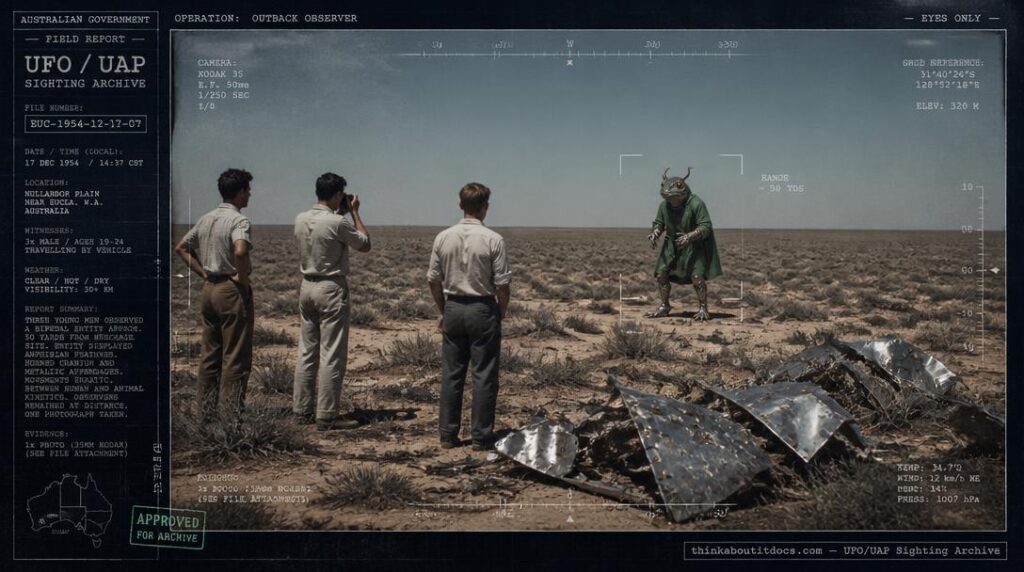
Three witnesses near Eucla, on the Western Australia/South Australia border, described a frog-like, horned entity near scattered wreckage in August 1955.
THINK ABOUTIT CRASH REPORT
1955 Eucla, Australia Crash: The Frog-Man Entity Encounter
In August 1955, a Sydney newspaper ran an almost-forgotten story: three young men returning to Melbourne claimed they’d watched a shiny object fall from the sky near Eucla, found scattered metal wreckage, and spent 25 minutes observing a frog-like, horned figure in a green cloak — before it allegedly disintegrated in front of them. It’s one of the strangest entity reports in the Australian record, and also one of the least verified.
Editor’s Note: This case has never been independently substantiated. Australian researchers who have examined it describe it as “a rather queer and absurd story, which has not been substantiated,” and there is a documented, unresolved question in the wider ufology literature about whether this 1955 report is being conflated with a separate 1954 Eucla-area photography incident involving the same three names. See Researcher’s Notes for the full picture before treating this as a confirmed event.
Date: 1955 (specifically reported August 2, 1955)
Sighting Time: Not documented
Day/Night: Daytime
Location: Approximately 14 miles from Eucla, on the Western Australia/South Australia border
Urban or Rural: Rural
No. of Entity(‘s): 1
Entity Type: Semi-amphibian/semi-human humanoid
Entity Description: Described as frog-like from the back and semi-human from the front, wearing a green cloak reaching to roughly knee length. Two curved horns projected from each side of its head, giving what witnesses called a devilish appearance. Its hands and feet appeared armor-plated, and it moved with a wriggling, swaying motion described as resembling “a fish out of water.” (Note: source material gives conflicting detail on whether the cloak reached to just above or just below the knees — see Removed/Unresolved Claims below.)
Hynek Classification: Crash/Retrieval with Entity Encounter — falls outside standard Hynek taxonomy per network convention (crash-retrieval cases are not assigned a CE tier). The original source material duplicates and mislabels this as “CE3 CE-III”; that label is not used here
Duration: Approximately 85 minutes total (roughly an hour searching for the crash site, followed by about 25 minutes observing the entity)
No. of Object(s): 1
Description of the Object(s): A shiny object was seen falling to the ground from a distance of roughly three miles. No intact object was found — witnesses instead located jagged pieces of shining metal at the site, consistent with wreckage rather than a whole craft
Shape of Object(s): Not documented — no intact shape was observed, only scattered metal fragments
Size of Object(s): Not documented
Color of Object(s): Shiny/reflective metal
Distance to Object(s): The falling object was first seen roughly three miles away; the wreckage site and entity were found after an hour’s search, with the entity observed from approximately 50 yards
Height & Speed: Not documented
Number of Witnesses: 3 — Max Clow (23), Alex Rose (29), and Peter Johnson (25)
Special Features/Characteristics: Witnesses reported the entity appeared to disintegrate before their eyes at the end of the encounter; a photograph was reportedly taken by Alex Rose during the sighting, though its authenticity has never been independently confirmed; the case has an unresolved connection to a separate, better-documented 1954 Eucla-area photography incident involving witnesses of the same names (see Researcher’s Notes)
Case Status: Insufficient Data — an uncorroborated newspaper account with no independent verification, an unauthenticated photograph, and a documented history of confusion with a separate case in the wider research literature
Source: Daily Telegraph, Sydney, August 2, 1955
Summary/Description: Three young men driving near Eucla reported seeing a shiny object fall from the sky, then finding scattered metal wreckage and a moving, frog-like humanoid entity, which they observed for roughly 25 minutes before it reportedly disintegrated. The story ran once in a Sydney newspaper in 1955 and has never been independently substantiated.
Related Cases: None documented on this site — see Researcher’s Notes for a related but distinct 1954 Eucla photography case referenced in outside research literature
Detailed Report
On August 2, 1955, the Sydney Daily Telegraph published a brief, unusual story under a headline suggesting three young men had returned to Melbourne with a photograph of what they described as a flying saucer pilot. The witnesses were named as Max Clow, 23, Alex Rose, 29, and Peter Johnson, 25. According to the account, one of the three took the photograph roughly 14 miles from Eucla, near the border between Western Australia and South Australia.
The men said they were driving through flat, scrub-covered country when they heard a noise they initially took for a tire blowout and stopped to check their vehicle. It was then that Johnson reportedly spotted a shiny object falling to the ground about three miles away. After searching the area for roughly an hour, the group found jagged pieces of shining metal scattered at the site — but no intact object — and then noticed a moving figure approximately 50 yards away.
The men approached and watched the figure for about 25 minutes. Clow described it as resembling a frog from behind and something closer to human from the front, wearing a green cloak reaching to roughly knee height. Two curved horns projected from either side of its head, which the witnesses said gave it a devilish look. Its hands and feet appeared armor-plated, and it moved with an odd wriggling, swaying motion that Clow compared to a fish out of water.
According to the account, Rose eventually worked up the nerve to move closer and take photographs of the figure. The story concludes with Clow’s statement that the entity then began to disintegrate in front of them, ending the encounter.
No further named witnesses, physical evidence beyond the newspaper’s photograph, or follow-up investigation are documented in connection with this specific published account. Researchers cataloguing the case decades later have noted it survives essentially as a single newspaper story that was never substantiated further.
Researcher’s Notes
The Eucla Crash — 1955 and a Case Tangled in Its Own History
- This case has never been substantiated, and researchers have said so directly. Investigators examining this story in later decades have described it as “a rather queer and absurd story, which has not been substantiated” — noting that what survives is a fragmentary newspaper account paired with a low-quality photograph, with no independent confirmation of any element.
- There is a documented, unresolved conflation with a separate 1954 case. Outside research catalogues also record an Easter 1954 incident near Eucla involving photographers named Max Clow, Alex Rose, and (possibly) Peter Johnson — the same names — who reportedly took roughly 200 photographs and cine footage across five cameras of an object, with claims of military interception and confiscated film. Researchers examining both stories have explicitly noted the two accounts differ in many respects, and it remains genuinely unclear whether the 1955 Daily Telegraph story is a garbled retelling of the 1954 event, a separate incident involving the same men, or something else entirely. This page covers only the 1955 entity-encounter account as published; it does not merge in details from the 1954 photography case.
- Crash/retrieval status, not a standard Hynek tier. Per network convention, cases involving claimed wreckage recovery are tracked separately from the standard Hynek close-encounter taxonomy rather than being forced into a CE tier. The original source material’s “CE3 CE-III” label is not used here for that reason, even though an entity was observed at close range.
- The disintegration claim is a significant credibility flag. An entity reportedly dissolving in front of three witnesses, with no described mechanism, residue, or further physical trace, is an extraordinary claim even by the standards of 1950s entity reports, and it isn’t corroborated by any secondary account.
- The photograph’s authenticity was never established. The newspaper account is built around a photograph presented as evidence of the entity, but no chain of custody, negative, or independent examination of that image is documented anywhere in the available source material.
The Eucla case remains one of the more visually striking entity reports in the Australian archive — a genuinely unusual, well-remembered description — but it also stands as a clear example of a story that exists almost entirely as a single, unverified newspaper account, tangled with a separate case in the wider research record. It’s preserved here as reported, with its evidentiary limits stated plainly rather than smoothed over.
“Then to our amazement, it began to disintegrate before our eyes.”
— Max Clow, August 1955