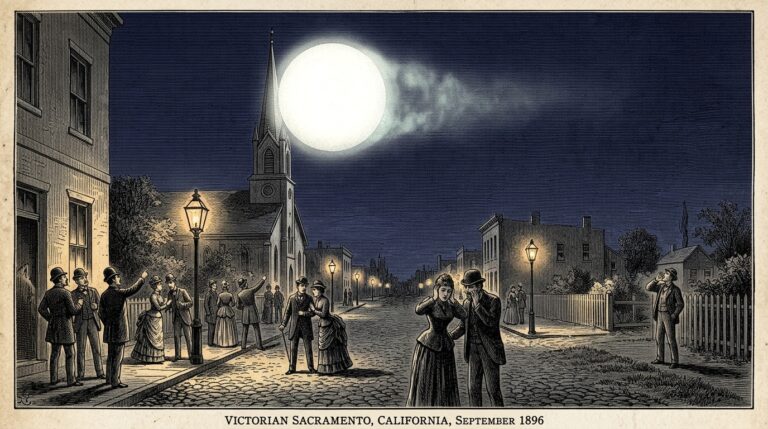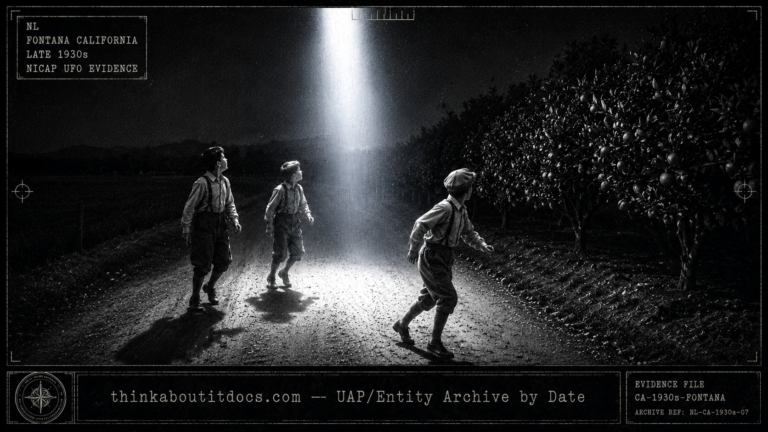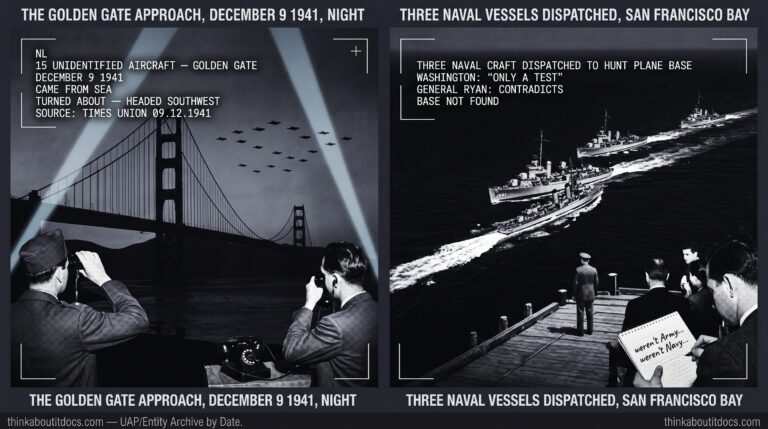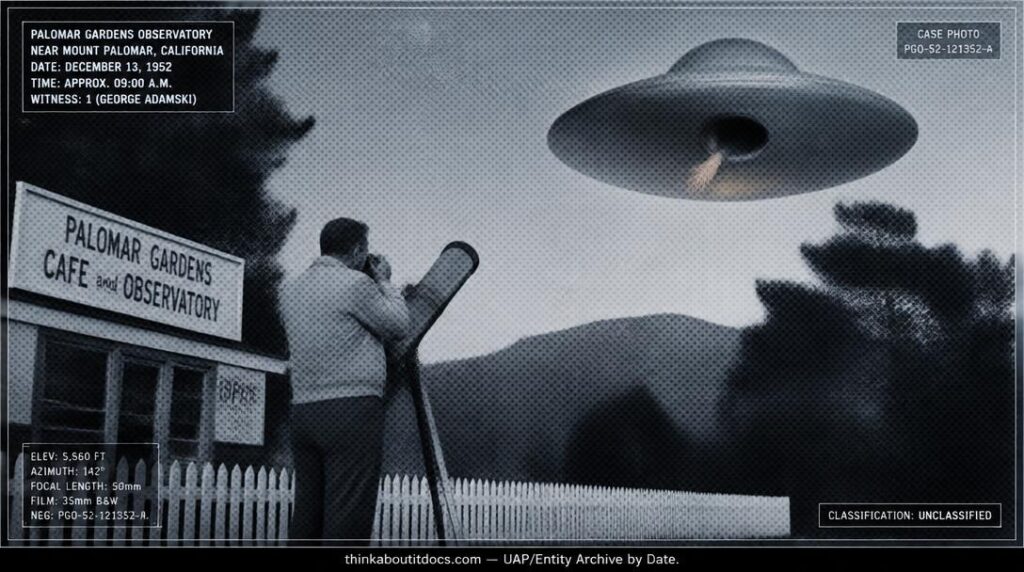
Archival rendering of George Adamski's claimed December 13, 1952 Palomar Gardens session, the same date tied to his most extensively analyzed and subsequently identified photograph.
THINK ABOUTIT UFO|ENTITY ENCOUNTER REPORT
1952 Palomar Gardens, California:
Adamski’s Film-Plate Session and the Chicken Brooder Photograph
On the morning of December 13, 1952, George Adamski stood at his telescope at Palomar Gardens, the small café and observatory he ran near Mount Palomar, California, and claims to have photographed a saucer-shaped craft closing to within 100 feet of him. A porthole opened, a hand emerged, and a film holder Adamski said his “spaceman friend” had carried off during their November 20 meeting was dropped to the ground. When developed, the plate showed not the saucer photograph Adamski expected, but a series of unexplained blurred symbols. This is also the date attached to Adamski’s single most examined piece of physical evidence — the photograph that photographic and materials analysts later identified as a modified chicken-egg incubator brooder.
Editor’s Note: This case is a direct continuation of the November 20, 1952 Desert Center contact claim documented elsewhere on this archive, and shares its evidentiary problems. The photograph most closely associated with this December 13 session was independently examined by rocket engineer Walther J. Riedel and later analysts, who identified it as a modified chicken-egg incubator brooder top with General Electric light bulbs standing in for landing struts — not a distant spacecraft. See the companion November 20, 1952 case entry for the full evidentiary discussion, including the finding that Adamski’s books were ghostwritten and that a photography expert he cited as validating his images denied having done so. This entry is preserved as historical record of the claim, not as an endorsement of its authenticity.
Date: December 13, 1952
Sighting Time: Approximately 9:00 a.m.
Day/Night: Day
Location: Palomar Gardens, near Mount Palomar, California (Adamski’s own café and observatory site; distinct from the Palomar Observatory itself)
Urban or Rural: Rural
No. of Entity(s): 1 (partial — only a hand was reportedly observed)
Entity Type: Humanoid, claimed by Adamski to be the same “spaceman” from the November 20, 1952 Desert Center contact
Entity Description: No full description given in this account; only a hand extending from a partially opened porthole is reported
Hynek Classification: CE-III — Close Encounter of the Third Kind. Close observation of an animate being (a hand extending from the craft) associated with the object.
Duration: Undocumented
No. of Object(s): 1
Description of the Object(s): A saucer-shaped craft, described by Adamski as the same type of scout ship photographed and encountered during the November 20 contact, approaching to close range before a porthole opened
Shape of Object(s): Saucer
Size of Object(s): Undocumented
Color of Object(s): Undocumented
Distance to Object(s): Approached to within 100 feet
Height & Speed: Undocumented
Number of Witnesses: 1 (George Adamski, alone)
Special Features/Characteristics: Adamski reported taking three photographs of the craft as it approached; a film holder he said had been carried off by the entity on November 20 was returned via the opened porthole; when developed, the returned plate reportedly showed blurred, unexplained symbols rather than the original photographic exposure
Case Status: Explained — documented photographic hoax. The photograph associated with this session has been independently identified by multiple analysts as a modified chicken-egg incubator brooder; see companion November 20, 1952 case for full analysis.
Source: George Adamski & Desmond Leslie, Flying Saucers Have Landed (1953)
Summary/Description: At Palomar Gardens, where Adamski had set up his telescope, he reported photographing a saucer three times as it approached to within 100 feet. A porthole opened slightly, a hand extended, and a film holder Adamski said his “spaceman friend” had carried away on November 20 was dropped to the ground. When developed, the plate showed not the original saucer photograph but numerous unexplained blurred symbols.
Related Cases: 1952: George Adamski’s Desert Center/Blythe California Contact (companion case, same claimed entity relationship; full hoax evidence documented there)
Detailed Report
According to the account published in Flying Saucers Have Landed, Adamski was at his telescope at Palomar Gardens on the morning of December 13, 1952, when a saucer-shaped craft approached and came within roughly 100 feet of his position. He stated he was able to take three photographs of the object as it closed the distance. As it hovered near him, one of its portholes reportedly opened slightly, a hand extended from the opening, and a film plate holder was dropped to the ground — the same holder Adamski said the entity he called Orthon had carried away during their initial contact three weeks earlier, on November 20.
When Adamski developed the returned plate, he reported it did not show the original photograph he had taken that day in November. Instead, the plate showed a series of blurred symbols he could not explain, which he and later contactee-movement writers interpreted as some form of message or communication left by the entity.
This session is significant beyond the narrative itself: December 13, 1952 is the date most consistently associated in the historical record with Adamski’s single most scrutinized photograph — the image widely reproduced in later decades as evidence of his claims. German rocket engineer Walther J. Riedel, associated with Wernher von Braun’s team, examined the photograph and identified visual artifacts inconsistent with a distant craft. Later independent analysis, conducted separately by multiple parties, identified the object in the image as the top assembly of a chicken-egg incubator brooder, with the “landing struts” identified specifically as General Electric light bulbs, in some analyses with the manufacturer’s markings still visible under magnification. Astronomer J. Allen Hynek, then serving as scientific consultant to Project Blue Book, characterized Adamski’s photographic evidence more broadly as crude fabrications.
RESEARCHER’S NOTES
The Palomar Gardens Session — 1952 and the Anatomy of a Physical-Evidence Hoax
- This is the source date for Adamski’s most examined photograph. Unlike the November 20 contact claim, which rests on witness testimony, this December 13 session produced the actual physical artifact — the photograph — that was later subjected to direct materials analysis and identified as a chicken-egg incubator brooder. It is the rare case in this archive where the disputed evidence itself, not just the surrounding narrative, has been forensically examined.
- Sole witness, no corroboration at all. Unlike the November 20 session, which had six companions present at a distance, this encounter has exactly one witness: Adamski himself. There is no independent observation of the craft, the porthole, the hand, or the film exchange — the entire account depends on Adamski’s own report and his own photographic evidence, the latter of which has been directly contradicted by physical analysis.
- Narrative continuity as a storytelling device. The film-plate exchange links this session directly back to the November 20 contact, reinforcing the overall narrative arc across Adamski’s published account. This kind of serialized continuity is a recurring feature of contactee-era literature and should be read as a structural element of the genre rather than as independent corroborating detail.
- The “blurred symbols” plate was never independently examined. While the primary saucer photograph from this period was directly analyzed and identified, the separate claim of a returned plate bearing unexplained symbols has not been subjected to the same scrutiny in the sources reviewed for this entry — it exists only as Adamski’s description, with no surviving independently verified image located.
This session’s evidentiary record is unusually direct for a contactee-era claim: the photograph it produced has been physically examined and identified as a fabricated prop, not merely disputed on witness-credibility grounds. It is preserved here as the companion piece to the November 20, 1952 contact claim, both maintained for their historical role in the origins of the contactee movement rather than as credible physical encounters.
“One of the portholes was opened slightly, a hand was extended, and the film holder which my spaceman friend had carried away on November 20 was dropped to the ground.” — George Adamski, describing the claimed December 13, 1952 Palomar Gardens session