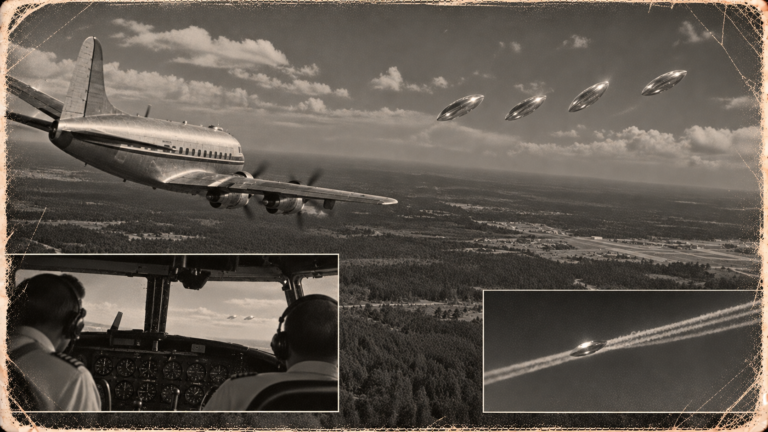
Archival rendering of George Adamski's claimed November 20, 1952 contact with the entity he called Orthon, a case later undermined by independent analysis of its central photographic evidence.
THINK ABOUTIT UFO|ENTITY ENCOUNTER REPORT
1952 George Adamski Desert Center Contact
The Orthon Case, Documented and Debunked
On November 20, 1952, George Adamski told the world he had done what no one else claimed to have done before: shaken hands, by sign language, with a man from Venus. The location, the desert flats east of Palm Springs, would go on to become one of the most famous coordinates in UFO history — and one of the most picked-apart. Adamski’s account of meeting the golden-haired “Orthon” launched the entire contactee movement, sold hundreds of thousands of books, and was, within a few years, substantially dismantled by the very photographic evidence Adamski offered to support it.
Editor’s Note: This case is preserved as a matter of historical record because of its foundational role in contactee-era ufology, not because the archive regards it as credible. Adamski’s central “scout ship” photograph was independently examined by rocket engineer Walther Riedel and later analysts, who identified it as a modified chicken-egg incubator brooder top fitted with General Electric light bulbs standing in for landing struts. James W. Moseley’s 1955 investigation additionally found that Adamski’s books were ghostwritten from his dictation rather than authored by him as claimed, and that a photography expert Adamski cited as validating his images denied ever having done so. Every witness besides Adamski himself was a personal associate who, by their own later statements, only saw him meeting someone at a distance — none corroborated the entity contact directly. This entry documents the claim as Adamski presented it while flagging the evidentiary record plainly, consistent with this archive’s standard for contactee-era hoax cases.
Date: November 20, 1952
Sighting Time: Approximately 11:00 a.m.
Day/Night: Day
Location: Desert flats near Desert Center, Riverside County, California (this site’s legacy title references nearby Blythe, California, roughly 60 miles to the east; the location is universally documented in ufology literature, including Adamski’s own account, as Desert Center — flagged here as a naming discrepancy rather than silently corrected)
Urban or Rural: Rural
No. of Entity(s): 1
Entity Type: Humanoid, claimed by Adamski to be Venusian
Entity Description: Described by Adamski as a man of medium height wearing a seamless, one-piece brown coverall, with shoulder-length hair and an unusually high forehead
Hynek Classification: CE-V — Close Encounter of the Fifth Kind. Claimed voluntary, bilateral, communicative contact between a human witness and a claimed extraterrestrial being.
Duration: Approximately 1 hour
No. of Object(s): 2
Description of the Object(s): A large cigar-shaped craft observed hovering before departing, followed separately by a smaller saucer-shaped “scout ship” described as translucent and hovering close to the ground
Shape of Object(s): Cigar-shaped (first object); saucer-shaped (second object)
Size of Object(s): Undocumented
Color of Object(s): Undocumented
Distance to Object(s): Undocumented for the first craft; the scout ship was approached to close range by Adamski, though he stated he was not taken inside
Height & Speed: Undocumented
Number of Witnesses: George Adamski and 6 companions, identified in later accounts as including Alice K. Wells, Lucy McGinnis, George Hunt Williamson, and Alfred and Betty Bailey
Special Features/Characteristics: Claimed partly telepathic, partly sign-language communication; footprints allegedly left by the entity containing unexplained symbolic markings; a photographic plate Adamski said the entity later returned bearing additional symbols
Case Status: Explained — documented photographic hoax. Adamski’s principal supporting photograph was independently identified by multiple analysts as a modified chicken-egg incubator brooder, and the books presenting the account were shown to be ghostwritten rather than authored as claimed.
Source: George Adamski & Desmond Leslie, Flying Saucers Have Landed (1953); James W. Moseley investigation (1955); Walther J. Riedel photographic analysis (1953)
Summary/Description: Attempting to establish contact, George Adamski and six companions drove into the California desert and were eating lunch when a cigar-shaped object was seen hovering. It departed, but after the group drove roughly half a mile and got out, a saucer-shaped object appeared hovering nearby, which Adamski photographed. He then reported seeing a man beckoning from about a quarter mile away and walked to meet him. The being, by sign language, indicated he came from Venus and communicated concern over atomic weapons testing. Adamski was led near the scout ship but said he was not taken aboard; he was separated from his companions for about an hour, during which they observed him at a distance through binoculars.
Related Cases: None documented
Detailed Report
According to Adamski’s own account, first published in Flying Saucers Have Landed (1953, co-written with Desmond Leslie), he and six companions drove into the Colorado Desert on the morning of November 20, 1952, specifically hoping to make contact with a UFO occupant. While the group ate lunch, a large cigar-shaped craft was seen hovering in the distance before it departed. The group then drove roughly half a mile further and stopped; shortly afterward, a saucer-shaped object appeared, hovering close to the ground, which Adamski photographed with a telescope-mounted camera.
Adamski stated he then saw a man beckoning to him from about a quarter mile away and walked out alone to meet him, leaving his companions behind. He described the figure as wearing a seamless one-piece brown coverall, with shoulder-length hair and a notably high forehead. Communicating by sign language and what Adamski described as a partly telepathic exchange, the being reportedly indicated — by pointing to the second position from the sun and speaking the word “Venus” — that he had come from that planet. Adamski recounted that the being expressed concern over atomic weapons testing and conveyed that the visit was intended as friendly.
Adamski said the being’s footwear left behind markings containing unfamiliar symbols, and that he was led toward the translucent scout ship — though not taken aboard it — before the being returned to the craft, which then departed. Adamski was separated from his six companions for approximately one hour; those companions later stated they could observe him, from a distance and by binoculars, apparently meeting with someone in the desert, though none reported seeing the entity directly themselves.
The case became public in 1953 with the publication of Flying Saucers Have Landed, which became a bestseller and established the template for the “contactee” narratives that proliferated through the remainder of the decade. It also drew immediate and sustained scrutiny. German rocket engineer Walther J. Riedel, associated with Wernher von Braun’s team, examined Adamski’s key photograph and identified visible artifacts consistent with a small studio-built model rather than a distant craft. Investigator James W. Moseley’s 1955 inquiry found that a photographic expert Adamski had cited as authenticating his images denied ever having examined them in the manner claimed, and separately established that Adamski’s published books were ghostwritten from his dictation. Later analysis by multiple independent parties identified the object in Adamski’s most widely circulated photograph as the top assembly of a chicken-egg incubator brooder, with its “landing struts” identified as General Electric light bulbs. Astronomer J. Allen Hynek, serving as scientific consultant to the U.S. Air Force’s Project Blue Book, characterized Adamski’s photographic evidence as crude fabrications.
RESEARCHER’S NOTES
The Desert Center Contact — 1952 and the Birth of the Contactee Movement
- Foundational status, not evidentiary strength. This is the case that established the contactee genre outright — the friendly Space Brother, the concern over nuclear weapons, the sign-language first contact — and nearly every subsequent contactee claim through the 1950s and 1960s borrows directly from its structure. Its historical importance to the field is not in question. Its evidentiary weight is a separate matter entirely.
- The photographic record is the case against itself. Unlike many disputed sightings where the physical evidence is simply absent, this case is unusual in that its central photographic evidence was directly examined and identified: a chicken-egg incubator brooder top with GE light bulbs standing in for landing gear, confirmed by more than one independent analyst working separately. This is one of the more thoroughly documented photographic hoax identifications in ufology.
- Witness corroboration does not extend to the entity contact. The six companions present were Adamski’s own associates. Their later statements confirm only that they saw Adamski at a distance, apparently interacting with someone — none reported independently observing the entity, its appearance, or its communication with Adamski. The core contact claim rests entirely on Adamski’s uncorroborated word.
- Authorship itself was misrepresented. James W. Moseley’s 1955 investigation found that Adamski’s books, presented to the public as his own writing, were ghostwritten from his dictation. A cited photography expert also denied Adamski’s claim that he had authenticated the images. Both findings independently undercut the credibility of the account’s presentation, separate from the photographic hoax finding itself.
- Geographic naming discrepancy flagged, not silently corrected. This site’s legacy title references “Blythe, California.” Every mainstream ufology source, including Adamski’s own original account, places the 1952 contact at Desert Center, California, roughly 60 miles to the west of Blythe. Per this archive’s legacy-content standard, the original title is preserved as the site’s established record while the location field above reflects the documented site of the claimed event.
The record on this case is unusually clear for contactee-era ufology: the central photographic evidence has been independently identified as a fabricated prop, the corroborating witnesses corroborate only a distant meeting and not the entity contact itself, and the books presenting the story were not written the way they were presented. It remains preserved here for its outsized historical influence on the genre it helped create, not as a credible physical encounter.
“He made me understand that their coming was friendly.”
— George Adamski, describing the claimed 1952 Desert Center contact