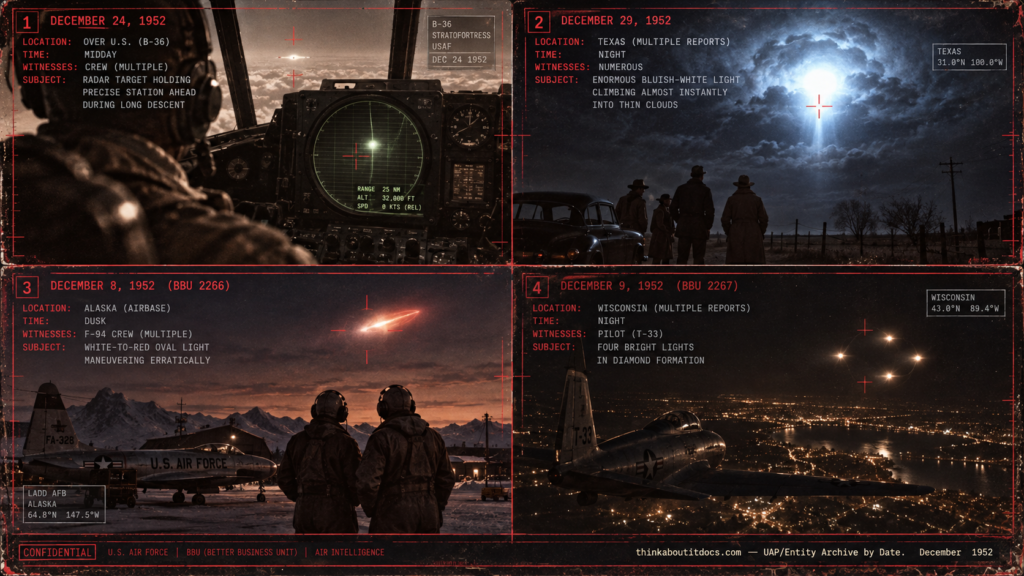
Four documented cases from December 1952.
1952: December UFO|UAP & Entity Sightings Archive
December closes out 1952‘s great flap with two of the year’s most technically documented radar cases — a B-36 crew that tracked an object on gun-camera and navigation radar for thirty minutes as it held station just ahead of their descending bomber, prompting an Air Intelligence report to conclude “something intelligent was guiding it,” and a Texas-New Mexico border sighting where a B-26 crew watched an object climb 7,000 feet in five seconds, an acceleration curve exceeding 2,000 mph. The month also carries the famous Palomar Gardens, California contact case, already documented on its own page.
Date: December 4, 1952
Location: Colorado Springs, Colorado
Time: Not recorded
Summary: Unknown — no further detail survives in the sourced record.
Source: McDonald list
Date: December 4, 1952
Location: Congaree AFB, South Carolina
Time: 8:42 a.m. EST
Summary: An AN/MPS-5 radar detected an object roughly 100 miles NE of the base, traveling at an estimated 6,000 mph on a southern course. Per A/1C Clarence W. Ives, the object stopped for one minute, then reversed directly back along its original path. Duration about 5 minutes.
Source: Dan Wilson
Date: December 4, 1952 (Chop Clearance List Item #1)
Location: Laredo, Texas
Time: 8:46–8:53 p.m.
Summary: USAF pilot Lt. Robert Arnold, flying a T-28 trainer at 6,000 ft, saw a bright bluish-white glowing object below him climb rapidly to his altitude, showing no navigation lights. As Arnold tightened his turn to track it, the object climbed to 9,000 ft in seconds, then dropped back to his level heading east, stopping and hovering about 6 miles SE of the base. When Arnold pursued, the object suddenly turned toward him on a collision course at high speed, wavering as if choosing which side to pass, before crossing his left wing at roughly 150 ft as a blurred reddish-bluish haze — all too fast for evasive action. Shaken, Arnold cut his running lights and spiraled down to 1,500 ft while keeping the object in view as it dove toward him again, then pulled up and climbed out of sight. Duration about 7 minutes.
Source: NARCAP
Date: December 5, 1952
Location: Lackland AFB, Texas
Time: 8:48 p.m.
Summary: A USAF T-28 pilot saw a blue light maneuver in a counterclockwise orbit, then climb away.
Source: Project 1947
Date: December 6, 1952: B-29 Radar, Visual, Multiple Witnesses
Date: December 6, 1952
Location: Angoon, Alaska
Time: 9:15 a.m. AHST
Summary: An Air National Guard pilot saw two shiny spheres, connected by a solid rod, heading south.
Source: BB Status Report
Date: December 8, 1952 (BBU 2266)
Location: Ladd AFB, Alaska
Time: 8:16 p.m.
Summary: USAF pilot 1st Lt. D. Dickman and radar operator 1st Lt. T. Davies, in an F-94 jet interceptor (s/n 49-2522), saw a white oval light that turned red at higher altitude, flying straight and level on a 240° heading for 2 minutes before climbing at phenomenal speed on an erratic path. After they landed, the object could still be seen moving erratically without sound for 3 more minutes, then took up a 160° heading, gaining speed while descending and growing brighter red. Duration about 10 minutes.
Source: Berliner; cf. Hynek-CUFOS re-evaluation; Jan Aldrich
Date: December 8, 1952
Location: Chicago, Illinois
Time: Not recorded
Summary: An aircraft was paced by a row of unidentified lights (Thorpe/Plowe).
Source: UFOE, V
Date: December 9, 1952 (BBU 2267)
Location: About 10 miles south of Madison, Wisconsin
Time: 5:45–5:55 p.m.
Summary: USAF Capt. Bridges and 1st Lt. Johnson, flying a T-33 jet trainer, saw four bright lights in diamond formation heading southwest at roughly 400 mph and 8,000 ft. They pursued at 450 mph, overtaking the objects near Janesville, Wisconsin, then radioed the 755th AC&W radar site “Soapberry,” which could detect only the T-33, not the objects. The lights continued east and the T-33 followed until breaking off due to low fuel near Racine. No silhouette was visible even when the objects passed in front of the Milwaukee city lights. Duration about 10 minutes.
Source: Berliner; cf. Hynek-CUFOS re-evaluation; Jan Aldrich
Date: December 10, 1952
Location: Pope AFB, South Carolina (with cross-detection at Fort Bragg, North Carolina)
Time: 9:20 a.m. to 5:15 p.m. EST
Summary: A bright circular object was tracked on a CPS/5D radar’s PPI scope at 155° azimuth and 8,000 ft altitude, showing a slight circular movement; it was independently confirmed on the search and height-finding radars of the 728th AC&W Squadron at Fort Bragg. An F-51 sent to investigate visually saw nothing unusual.
Source: McDonald list
Date: December 10, 1952
Location: Hungnam, Korea
Time: Not recorded
Summary: A U.S. Navy pilot had a near-collision with an orange fireball.
Source: Weinstein; BB files
Date: December 10, 1952
Location: Between Odessa and Hanford, Washington
Time: 7:15–7:30 p.m. PST
Summary: An F-94 crew, flying at 26,000–27,000 ft, spotted and approached a light to identify it. The object appeared large, round, and white, with reddish light coming from two “windows,” and came at the F-94 on a collision course; the crew banked to avoid impact. Radar contact and lock-on were made multiple times on the aircraft’s ARC-33 radar. Duration about 15 minutes.
Source: Ruppelt p. 43; NARCAP
Date: December 13, 1952: Palomar Gardens, California Sighting
Date: December 14, 1952
Location: Charlottesville, Virginia
Time: 11:45 a.m. EST
Summary: An aeronautical engineer and former test pilot saw a light-orange, elliptical-shaped object hover, then move northeast at an estimated 1,000+ mph. The object gave off a discharge that changed brightness as it moved, apparently lofting debris into the air.
Source: Hynek-CUFOS re-evaluation; Jan Aldrich
Date: December 15–16, 1952 (Chop Clearance List Item #7)
Location: Goose Bay, Labrador, Canada
Time: 7:15 p.m.
Summary: Two Air Force crews got a momentary radar lock on an unidentified object after being vectored to the target by Ground Control Approach; visual contact was made by two aircraft, a T-33 and an F-94. One of the pilots reported having seen a similar object before, on November 26, 1952 (see this archive’s November record). This USAF Intelligence Report was item #7 on the official clearance list of sightings released to Maj. Donald Keyhoe by Air Force Press Desk officer Al Chop.
Source: Fran Ridge
Date: December 15, 1952
Location: Honshu, Japan (Early Warning Ground Radar Site #24)
Time: 8:54 p.m.
Summary: An AN/TPS-1C radar picked up a large, unidentified track estimated to represent more than one target, moving at roughly 1,320 mph. The target was visible on the first, second, and fourth antenna sweeps at 2 rpm.
Source: Dan Wilson; McDonald list
Date: December 15, 1952
Location: Greensboro (or Hartsville), South Carolina
Time: 9:15 a.m.
Summary: A USAF RF-80 pilot saw a bright, circular or spherical, silvery object losing and gaining altitude.
Source: Project 1947
Date: December 17, 1952
Location: San Diego, California
Time: Not recorded
Summary: Four members of the U.S. Navy Electronics Laboratory observed two or more cigar- or disc-shaped objects emanating bright light in smooth flight, at speeds ranging from that of a contemporary jet up to roughly 1,500 mph. One witness later reported seeing five or six of these objects orbiting in a small area.
Source: Unknown
Date: December 18, 1952
Location: Itazuke AFB, Japan
Time: 8:28 a.m.
Summary: Five plots were recorded on an AN/MPS-5 radar scope, averaging 710 knots, on a course varying between 270° and 312°. Target size matched a B-29-type aircraft. Successive tracks showed the speed increasing from roughly 300 knots at initial pickup to an estimated 1,040 knots by the fourth pickup. Duration about 9 minutes.
Source: Dan Wilson
Date: December 18, 1952
Location: Oak Ridge, Tennessee
Time: Not recorded
Summary: Cataloged as “Cat 9” — a radar-visual case (NICAP source).
Source: NICAP
Date: December 19, 1952
Location: Anderson AFB, Guam
Time: 6:50 (or 8:50) a.m.
Summary: The USAF crew of a B-17 bomber and ground witnesses saw a silvery, cylindrical object.
Source: BB Status Report
Date: December 22, 1952: Technician Watches UFO Near Larson AFB
Date: December 24, 1952
Location: Camp Carson, Colorado
Time: 4:17 p.m. MST
Summary: Three airmen of the 3924th Air Police Squadron observed a silver, circular object hovering at an estimated 2,000 ft altitude and 4 miles distance for roughly 2–3 minutes, before it disappeared at high speed.
Source: McDonald list; Dan Wilson; BB files
Date: December 24, 1952
Location: East to northeast of Dallas, Texas (40–80 miles out)
Time: 12:15 p.m. CST
Summary: An object was detected on both an AN/APG-41 gun-laying radar and an AN/APS-23 navigation radar aboard an airborne B-36, tracked at 2,000–4,000 yards distance as the object held station roughly ahead of the bomber during its descent from 40,000 to 15,000 ft. The AN/APS-23 presentation was noted as similar to recent PPI photographs from the Washington, D.C. sightings. The gun-laying radar was instrumented with a camera; the resulting film, though unclear, indicated the target’s presence and trackability. The Air Intelligence Information Report on the incident stated the object’s behavior — remaining 2,000–4,000 yards ahead of the B-36 through the entire descent — “was unexplainable, and seemed to indicate that something intelligent was guiding it.” Duration about 30 minutes; the AN/APS-23 operator noted the target returns were consistently sharp compared to other contacts made that day.
Source: Dan Wilson; BB files
Date: December 27, 1952
Location: Borger, Texas, and Albuquerque, New Mexico
Time: 11:09 p.m.
Summary: A military pilot saw an elongated, cigar-like object, roughly the size of a medium bomber, traveling east to west. Duration about 12 seconds.
Source: BB Status Report; FUFOR Index
Date: December 28, 1952 (BBU 2302)
Location: Marysville, California
Time: Not recorded
Summary: Civilian witnesses reported a sighting; the underlying case file is missing from the record.
Source: NARA
Date: December 28–29, 1952 (Chop Clearance List Item #13)
Location: Chitose AFB (or possibly Misawa AFB, Hokkaido), Japan
Time: Approximately 7:30–7:48 p.m.
Summary: USAF crews aboard a B-26 (Ashley and Wood) and an F-84G (Col. Howard Blakeslee) saw an object emitting three beams of light, which was also tracked on airborne radar. Duration about 7 minutes.
Source: Weinstein; FUFOR Index
Date: December 29, 1952
Location: About 35 miles west of Amarillo, near Vega, Texas, and east-southeast of Tucumcari, New Mexico
Time: 9:05 p.m. CST
Summary: USAF Capt. William T. Bowley and Capt. Herbert T. Lange of Perrin AFB, Texas, piloting a B-26 on a training flight west at 6,000 ft and 250 knots, saw an extremely large, intense, bright bluish-white light with frequent green tints — no trail, exhaust, or aerodynamic features — roughly three times the size of a C-54 (about 350 ft), an estimated 40 miles off at their 11 o’clock position, paralleling their course and slowly closing. After about 5 minutes the object suddenly climbed 7,000 feet in 5 seconds — an average rate of roughly 1,400 ft/sec, or a peak velocity near 2,000 mph at an estimated 17 g’s — disappearing into thin broken overcast at 13,000 ft and causing the clouds to glow as if lit by a searchlight. Bowley radioed the CAA controller at Tucumcari, who was unable to spot the object (likely looking in the wrong direction or obscured by cloud). About two minutes later the object reappeared beneath the clouds before climbing west and vanishing for good. Duration 7–10 minutes.
Source: Jan Aldrich
Date: December 30, 1952
Location: Terrigal, New South Wales, Australia
Time: 12:00 (noon)
Summary: RAAF Wing Commander Tomkins, his wife, and child (Alexander) saw an extremely brilliant, carbon-arc-bright object to the east at roughly 7.5° elevation, moving slowly north for about a minute across roughly 8° of arc, estimated at 2,000 ft altitude and 2 miles distance. The object then turned east and departed at high speed, disappearing within about 20 seconds. Duration about 1 minute 20 seconds.
Source: Jan Aldrich; FUFOR Index
Date: December 31, 1952
Location: Northeast of Ramey AFB, Puerto Rico
Time: 4:45 a.m. local time
Summary: Aircraft Commander Capt. Robert P. Gennrich, First Pilot 1st Lt. John C. Moore, and left scanner A/1C Anthony A. Eakovich of RB-36 #2007 sighted a spherical, reddish-orange object roughly 8 ft in diameter, first seen on the horizon approaching the aircraft (flying level at 8,000 ft on a 73° course). It passed over the left wing at an estimated 300+ ft distance, then departed from the tail at high speed and climbed out of sight. Eakovich, watching from the tail position, separately reported the object directly behind the aircraft before it veered right and climbed sharply out of sight.
Source: Weinstein; FUFOR Index
EXECUTIVE SUMMARY
A Year of Flap Ends With Radar’s Best Evidence
December 1952 closes the year’s extraordinary UFO flap with two of its most rigorously documented radar cases. On December 24, a B-36 crew tracked an object on gun-camera-instrumented radar for thirty minutes as it held a precise, unexplainable position ahead of their descending bomber — prompting Air Intelligence’s own report to suggest deliberate guidance. Five days later, near the Texas-New Mexico border, a B-26 crew watched an enormous light execute a near-instantaneous climb corresponding to roughly 2,000 mph and 17 g’s, glowing bright enough to illuminate the clouds it vanished into. The month also carries the famous Palomar Gardens, California contact case, already documented in full on its own page — a fitting close to the year that put UFOs permanently on the American public’s radar.
“Its behavior… was unexplainable, and seemed to indicate that something intelligent was guiding it.”
— Air Intelligence Information Report, near Dallas, Texas, December 24, 1952