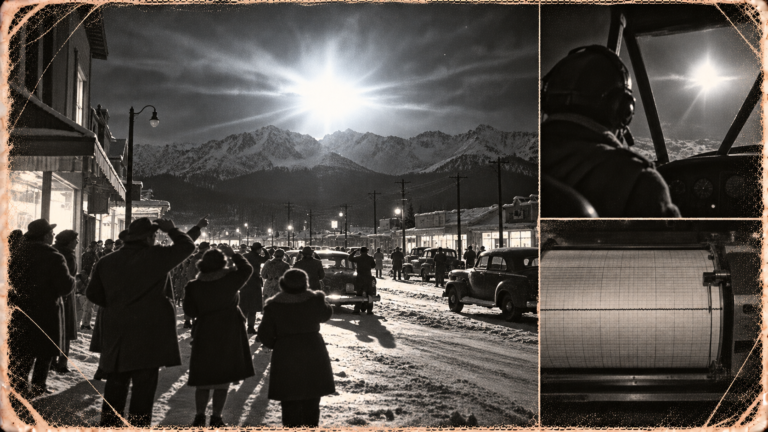
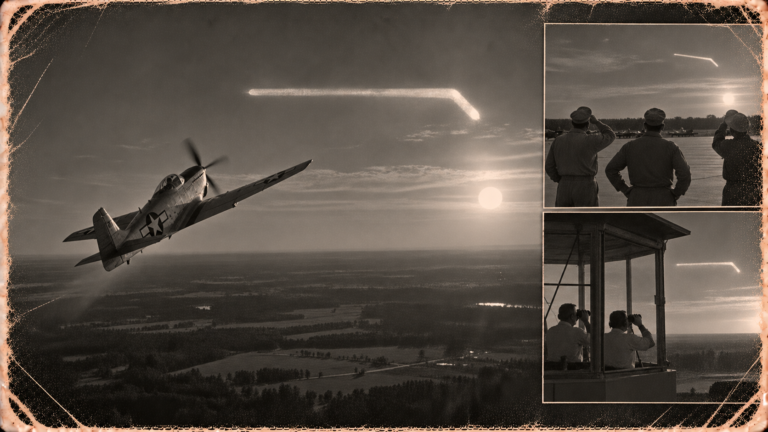
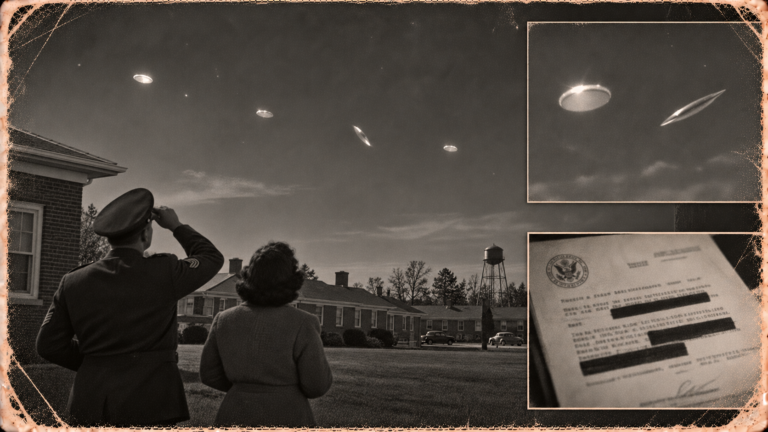
"An artist's impression of the 'great blue sign' described in the chronicles of Grigore Ureche".
THINK ABOUTIT UFO SIGHTING REPORT
1517: Western Moldavia Sighting
On the night of November 8, 1517, in the western sky over Moldavia — the medieval principality that straddles what is now eastern Romania and the Republic of Moldova — witnesses observed something that a 16th century chronicler found unusual enough to preserve in the official state history of the region. A great blue sign appeared in the sky, shining like the face of a man. It remained in the same position for a considerable time. Then it hid itself in the sky again and was gone. The description is spare and precise — the hallmark of genuine chronicle documentation rather than embellished folklore. The historian who preserved it, Grigore Ureche, was one of the most important chroniclers of medieval Moldavian history. His Letopișețul Țării Moldovei — the Chronicle of the Land of Moldavia — is a foundational document of Romanian historiography. He did not record fairy tales. He recorded what was documented as having actually occurred in the sky over the principality he was chronicling.
Date: November 8, 1517
Sighting Time: Not recorded — described as night
Day/Night: Night
Location: Western Moldavia — Principality of Moldavia (present-day eastern Romania / Republic of Moldova)
Urban or Rural: Not recorded — described as visible over the region
No. of Entity(s): N/A — luminous phenomenon with anthropomorphic characteristics
Entity Type: N/A — classified as NL with humanoid facial characteristics
Entity Description: A great blue sign in the sky described as shining like the face of a man. The blue coloration is specifically noted — unusual for 16th century omen descriptions which typically used warmer red and gold tones.
Hynek Classification: NL — Nocturnal Light; point or extended luminous source observed at night; the anthropomorphic description — shining like a face — places this case at the boundary between NL and CE-III
Duration: Quite a long time — sufficient duration for multiple witnesses to observe and the event to be recorded as significant
No. of Object(s): 1
Description of Object(s): A great blue sign in the western sky shining with the appearance of a human face
Shape of Object(s): Face-like — described as shining like the face of a man
Size of Object(s): Great — large enough to be described as a great sign visible across the region
Color of Object(s): Blue — specifically noted as an unusual coloration for the period
Distance to Object(s): In the sky — aerial observation
Height & Speed: Aerial — stationary for extended period before disappearing
Number of Witnesses: Multiple — the event was deemed worthy of preservation in official state chronicles indicating it was a significant public observation
Special Features/Characteristics: The specific blue coloration is analytically notable — 16th century chronicle accounts of aerial phenomena almost exclusively describe red, gold, or fiery colors; a blue luminous object shining with a facial appearance is unique in the Moldavian record; the object’s departure — described as hiding itself in the sky — suggests a deliberate concealment rather than simple fading; preserved in the foundational chronicle of Moldavian history
Case Status: Unexplained
Source: Grigore Ureche, Letopișețul Țării Moldovei, as published by E. Picot, Chronique de Moldavie depuis le milieu du XIVe Siècle jusqu’à l’an 1594 (Paris: E. Leroux, 1878); USSR UFO History, Vol. 1, No. 2
Summary/Description: On the night of November 8, 1517, a great blue luminous sign appeared in the western sky over Moldavia, described as shining like the face of a man. It remained stationary for a considerable period before hiding itself in the sky and disappearing. The event was recorded by Moldavian chronicler Grigore Ureche in the Letopișețul Țării Moldovei — the Chronicle of the Land of Moldavia — one of the foundational documents of Romanian historical literature.
Related Cases: 1344 CE Feldkirch Austria Fiery Bucket — Self-Powered Ground Landing | 1092 CE Polotsk Belarus Great Circle in the Sky | Eastern European Aerial Phenomena Archive
DETAILED REPORT:
The year is 1517. The Principality of Moldavia is navigating one of the most precarious periods in its history — caught between the expanding Ottoman Empire to the south, the Polish-Lithuanian Commonwealth to the north, and the Hungarian Kingdom to the west. The reign of Bogdan III the One-Eyed is drawing to its close. The principality that Ștefan cel Mare had defended for decades through brilliant military command is under sustained external pressure.
Into this context, on the night of November 8th, something appeared in the western sky.
The description that survived into the permanent historical record through Grigore Ureche’s chronicle is precise in the way that genuine observed phenomena tend to be — not embellished, not elaborated with theological interpretation, not fitted into the standard vocabulary of celestial omens. A great blue sign. Shining like the face of a man. It remained in the same place for quite a long time. Then it hid itself in the sky.
Three analytical details stand out in this economical description.
The first is the color. Blue. In the entire corpus of 16th century Central and Eastern European chronicle accounts of aerial phenomena — and there are many — blue is almost never the reported color. The vocabulary of aerial omens in this period defaults overwhelmingly to red, gold, fiery, blood-colored, or pale white. These are the colors of fire, of comets, of lightning, of phenomena the medieval and early modern European mind associated with divine warning. Blue had different associations — with sky, with distance, with cold, with a quality of light that did not fit the conventional omen vocabulary. The chronicler preserved the word blue because that was the accurate description, not because it fit a standard template.
The second is the shape. Not a sphere, not a disc, not a pillar, not a cross — the most common geometric forms in the aerial phenomena record of this period. The sign was described as shining like a face. A human face. Luminous, blue, aerial, and anthropomorphic — hanging in the western sky over Moldavia for an extended period while whatever population was awake and outdoors observed it.
The face-shaped luminous aerial object is one of the rarest morphologies in the pre-modern record. It appears in scattered accounts across different cultures and centuries but never achieves the commonality of sphere, disc, or pillar descriptions. Its rarity is part of its analytical significance — it is not the shape that 16th century Moldavian imagination would have produced if it were inventing an omen. It is the shape that was actually seen.
The third is the departure. The object did not fly away. It did not fade like a light being extinguished. The chronicle says it hid itself in the sky. This phrasing — deliberate, purposeful, implying agency in the act of concealment — is the same language applied to the 1344 Feldkirch Austria object that rose perpendicularly and became invisible at extraordinary height. It is not the language of natural phenomena ending. It is the language of something choosing not to be seen anymore.
Grigore Ureche compiled the Letopișețul Țării Moldovei in the early 17th century working from earlier documents and records. He was one of the most important historians of medieval Moldavian culture — his chronicle is a primary source of Romanian historiography that scholars have studied continuously since its publication. He preserved the November 8, 1517 blue sign account because it was in his source material as a documented event in the official record of the principality. It was not folklore. It was not legend. It was something that happened over Moldavia on a specific date and was considered significant enough by the people who witnessed it to be recorded in the permanent state chronicle.
RESEARCHER’S NOTES: The Moldavian Blue Sign — Anthropomorphic Luminosity and the Historian Who Preserved It
- The Blue Coloration Anomaly: The specific description of blue luminosity in a 16th century Eastern European chronicle account is analytically significant precisely because it departs from the standard vocabulary of aerial phenomena in the period. Chronicle writers documented what they were told, and they used the words their sources provided. The preservation of blue rather than red, gold, or white suggests that the witnesses used that word specifically because no other color was accurate — the object was genuinely blue in a way that was memorable and worth recording.
- Anthropomorphic Shape Classification: The description of the sign as shining like the face of a man places this observation in a rare category of aerial phenomena with humanoid characteristics. Face-shaped luminous objects are documented in scattered pre-modern accounts but are sufficiently unusual that their appearance in a sober chronicle account carries significant analytical weight. The shape was specific enough that Ureche’s source preserved it as the defining characteristic of the observation.
- Deliberate Concealment Language: The phrase hiding itself in the sky rather than disappearing, fading, or flying away implies volition in the act of departure. This language pattern — appearing in multiple unrelated chronicles across different centuries and cultures — is one of the most consistent subtle indicators of genuine anomalous aerial phenomena in the pre-modern record as distinguished from natural phenomenon descriptions.
- Primary Source Credibility: Grigore Ureche’s Letopișețul Țării Moldovei is a foundational document of Romanian national historiography — studied, annotated, and cited by Romanian scholars continuously for nearly four centuries. His inclusion of the 1517 blue sign in a chronicle otherwise devoted to political and military history indicates that the event had sufficient documentary support in his source materials to warrant inclusion in a serious historical work. He was not writing a compendium of wonders. He was writing the history of Moldavia.
On November 8, 1517, something blue and face-shaped hung in the western sky over Moldavia for a considerable time and then hid itself from view. Grigore Ureche found it in his source materials and put it in the official chronicle of the land. The description is eight words in its essential form: a great blue sign shining like a face. Eight words that survived the destruction of the Moldavian principality, the Ottoman occupation, the Soviet era, and five centuries of political upheaval to reach this archive. Whatever appeared over Moldavia that night was blue, was face-shaped, was present long enough to be definitively observed, and chose when to stop being visible. The archive holds what the chronicler preserved. The questions the witnesses could not answer remain open.