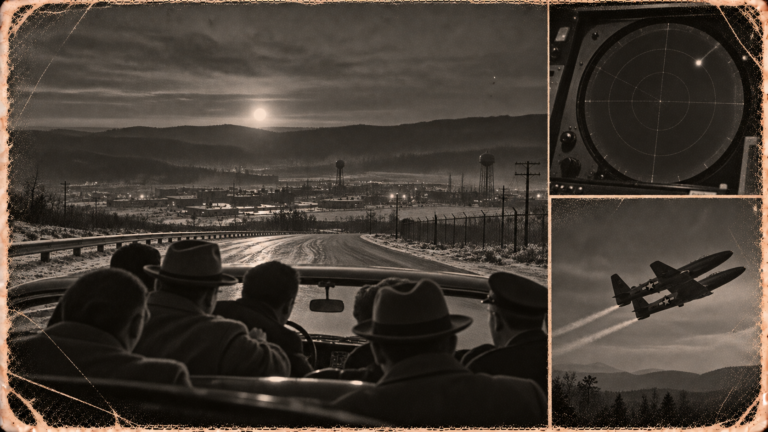
"An artist's impression of the celestial ships witnessed by the teacher Lu Yu and ten scribes in 1523".
THINK ABOUTIT UFO|ENTITY ENCOUNTER REPORT
1523: Yugiu, Jiangsu, China Sighting
During a torrential rainstorm in 1523 in the village of Yugiu, Jiangsu Province, China, a teacher named Lu Yu was standing outside his home when he looked up and saw two ships sailing on top of the clouds. Not through them. On top of them. The ships were each more than ten arms in length, and on their decks stood several tall men wearing hats and multicolored clothing, each holding a pole as the vessels moved quickly overhead. Lu Yu called ten well-read scribes to come and observe with him — and they did, all eleven witnesses watching together as the ships descended over the group. Then the men on the ships passed their hands over the mouths of the ten scribes, and the scribes could not speak. A figure appeared on one of the ships escorted like a Mandarin official, accompanied by a monk. The ships flew away into the clouds and descended about a kilometer distant near a cemetery. When they had gone, the ten scribes recovered their speech. Five days later, Lu Yu died of unknown causes.
Date: 1523 CE — during the reign of the Jiajing Emperor, Ming Dynasty
Sighting Time: Not recorded — daytime, during torrential rain
Day/Night: Day
Location: Yugiu village, Jiangsu Province, China
Urban or Rural: Rural village
No. of Entity(s): Multiple — several tall men on each vessel plus a Mandarin-like figure and a bonze (Buddhist monk)
Entity Type: Humanoid — tall men in multicolored clothing; additional figure of apparent authority Entity Description: Several tall men on each of the two ships, wearing hats and multicolored clothing, each holding a pole in each hand as the ships moved. A separate figure of authority appeared on one vessel — escorted in the manner of a Mandarin official and accompanied by a Buddhist monk/bonze.
Hynek Classification: CE-V — Close Encounter of the Fifth Kind; voluntary bilateral contact between the craft occupants and the human witnesses; the occupants actively interacted with the witnesses by silencing them with a hand gesture
Duration: Not recorded — from the initial sighting through the departure and landing approximately one kilometer distant
No. of Object(s): 2
Description of Object(s): Two ship-shaped craft sailing on top of the clouds during torrential rain, each measuring more than ten arms in length, moving quickly overhead and capable of descending to interact directly with ground-level witnesses before departing to a cemetery approximately one kilometer away
Shape of Object(s): Ship — vessel morphology
Size of Object(s): More than ten arms in length — approximately 15–20 feet per vessel
Color of Object(s): Not recorded
Distance to Object(s): Close — descended directly over the eleven witnesses during the interaction
Height & Speed: Initially atop clouds; descended to interaction altitude over witnesses; departed quickly back through clouds to cemetery location approximately one kilometer away
Number of Witnesses: 11 — teacher Lu Yu and ten well-read scribes
Special Features/Characteristics: Witnesses were deliberately rendered speechless by a physical gesture from craft occupants — hands passed over mouths; speech was restored when the ships departed; the deliberate selection of scribes — literate, educated witnesses — as the target of the silencing gesture is analytically significant; appearance of a hierarchically superior figure accompanied by a religious functionary on one vessel during the encounter; the ships landed near a cemetery approximately one kilometer away; primary witness Lu Yu died of unknown causes five days after the encounter; classified CE-V due to the occupants initiating direct interaction
Case Status: Unexplained
Source: Shi Bo, China and the Extraterrestrials (1983)
Summary/Description: In 1523 CE in Yugiu village, Jiangsu Province, China, teacher Lu Yu observed two ship-shaped craft sailing atop storm clouds during torrential rain. He summoned ten scribes who confirmed the observation. As the ships descended over the group, the craft occupants — tall men in multicolored clothing holding poles — passed their hands over the mouths of the ten scribes, rendering them unable to speak. A Mandarin-like figure accompanied by a Buddhist monk then appeared on one vessel. The ships departed through the clouds and descended near a cemetery approximately one kilometer distant. The scribes recovered their speech upon the ships’ departure. Five days later Lu Yu died of unknown causes.
Related Cases: 1207 CE Gravesend Kent England Sky Ship Anchor | 1211 CE Cloera Ireland Church Anchor Sky Ship | Chinese Sky Ship Archive
DETAILED REPORT:
The year is 1523. The Ming Dynasty is in the reign of the Jiajing Emperor — a period of relative cultural stability in which China’s Confucian scholarly class is at the height of its institutional influence. Jiangsu Province, in the lower Yangtze River delta, is one of the most prosperous and literate regions in the empire. The village of Yugiu sits in this world of educated men and classical scholarship.
Lu Yu is a teacher. His ten companions are described as well-read men — scribes, educated individuals, the kind of people whose testimony would be taken seriously by the scholarly culture of Ming Dynasty China. This matters. Whatever happened at Yugiu in 1523 happened to eleven educated witnesses simultaneously, in daylight, during a storm that provided dramatic natural context but also perfect visibility for what appeared above the clouds.
The rain is torrential. Lu Yu is standing outside his home. He looks up.
Two ships are sailing on top of the clouds.
This is a specific spatial relationship worth dwelling on. Not through the clouds. Not emerging from the clouds. On top of them — riding the cloud layer the way a boat rides water, with the cloud surface as their medium. The ships are large — each measuring more than ten arms in length, roughly fifteen to twenty feet. On their decks, tall men in hats and multicolored clothing move about, each holding a pole, as the vessels travel quickly overhead.
Lu Yu does not stand alone. He calls his ten scribes.
All eleven of them are now watching. A teacher and ten educated men, standing in the rain in Yugiu village, watching two ships sail on clouds above their heads. There is no ambiguity in the account about what they observed — all eleven saw the same thing, and the account preserves this group confirmation as a foundational element.
Then the ships descended.
They came down toward the eleven witnesses — not landing, but coming close enough for direct interaction. And the men aboard the ships did something deliberate and extraordinary: they passed their hands over the mouths of the ten scribes.
The ten scribes could not speak.
This is one of the most precisely described acts of technological interference with human biology in the pre-modern Asian record. The gesture was targeted — the hands passed over mouths, the result was muteness — and it was selective. The ten scribes were silenced. The account does not state explicitly whether Lu Yu retained his speech, but the fact that the encounter was documented at all suggests that the primary witness was able to record or report what occurred.
At this point in the encounter a new figure appeared on one of the ships. He was described as escorted in the manner of a Mandarin — a Chinese government official of rank — and accompanied by a bonze, a Buddhist monk. These are the authority markers of Ming Dynasty China. Whatever the encounter participants were communicating through the structure of their appearance, they chose to present a recognizable hierarchy: ordinary crew members in multicolored clothing, and a figure of apparent authority with a religious functionary. This is not random. This is presentation.
The ships then flew away — back into the clouds — and descended approximately one kilometer away near a cemetery on the edge of the village.
When the ships were gone, the ten scribes could speak again. The silencing was a function of the craft’s proximity, not a permanent effect. Distance ended it as abruptly as proximity had imposed it.
Five days later, Lu Yu died.
The cause of death is recorded only as unknown. In the five days between the encounter and his death, no illness, accident, or injury is mentioned. He simply died — at an age and in circumstances that the account preserves as unexplained. Whether the encounter was the cause, a contributing factor, or a coincidence, the account preserves the connection as part of the record.
RESEARCHER’S NOTES: The Yugiu Encounter — Eleven Witnesses, Selective Silencing, and the Death of Lu Yu
- The Scribes as Deliberate Targets: The silencing of the ten scribes specifically — the most educated and literate witnesses present — is the most analytically provocative element of the 1523 Yugiu encounter. These were the men most capable of producing a detailed written record of what they observed. The act of rendering them temporarily speechless during the encounter’s most significant phase — the descent and close approach — may represent an intentional limitation on the quality of testimony the most capable witnesses could subsequently provide. The gesture was precise, targeted, and temporary.
- Hierarchical Presentation: The appearance of a Mandarin-like authority figure accompanied by a Buddhist monk during the encounter suggests that the craft occupants were either mimicking the political and religious hierarchy of Ming Dynasty China or were deliberately presenting themselves in a framework their witnesses would recognize. Either interpretation implies an awareness of Chinese social structure that goes well beyond coincidental resemblance.
- The Cemetery Destination: The ships’ departure to a location approximately one kilometer away — specifically identified as near a cemetery — is a detail that has no obvious functional explanation and multiple interpretive possibilities. Cemeteries in Chinese tradition carry significant spiritual associations with the boundary between living and dead. Whether the destination was chosen for practical, symbolic, or observational reasons, the account preserves it as a specific identified endpoint of the departure.
- Lu Yu’s Death: The death of the primary witness five days after the encounter, from unknown causes, connects this case to a small but consistent pattern in the CE-V and close encounter record in which the lead witness experiences severe physiological consequences in the days following close contact. The account’s preservation of the timing — five days — and the cause — unknown — treats it as part of the encounter record rather than coincidental biographical detail.
Eleven educated men stood in the rain in Yugiu village in 1523 and watched two ships sail on top of storm clouds. The ships came down. The tall men aboard silenced ten of the eleven witnesses with a gesture. A figure of authority appeared with a religious escort. The ships flew away to a cemetery. The ten scribes recovered their speech. The teacher who had called them to witness was dead within five days of unknown causes. Shi Bo documented it in 1983. The archive holds it now. Whatever sailed above the storm clouds of Jiangsu Province in 1523, it knew which witnesses to silence, how long to silence them, when to stop, and where to go when it was finished. Lu Yu knew what he saw. He had five days to think about it.