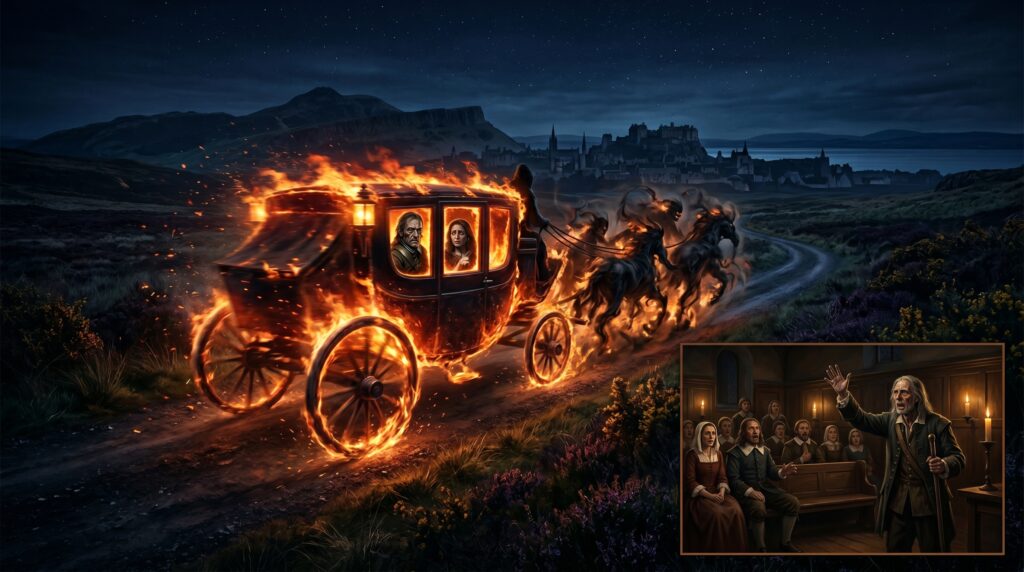
1648 CE — Edinburgh to Musselburgh, Scotland. Major Thomas Weir, Captain of Edinburgh's Town Guard and respected Covenanter preacher, was transported with his sister Jane in a fiery coach by strange entities. He confessed voluntarily in 1670 — screaming on the scaffold that he was already tormented enough — because he believed every word of what he had experienced.
THINK ABOUTIT CLOSE ENCOUNTER REPORT
1648: Edinburgh, Scotland Close Encounter
In the spring of 1670, Major Thomas Weir — Captain of the Town Guard of Edinburgh, a highly respected Covenanter preacher, an active member of one of the strictest Protestant sects in Scotland, a man who had been a pillar of Edinburgh society for as long as anyone could remember — walked into a meeting of his congregation and confessed. What he confessed was extraordinary in its specificity and its horror. Sex crimes came first. Then came what truly alarmed the authorities: he and his sister Jane had been transported on multiple occasions in fiery coaches by entities he identified as demons and fairies. In 1648 they were carried from Edinburgh to Musselburgh in a fiery coach driven by strange entities. On another occasion they were taken from their house in the West Bow — the Z-shaped street near Edinburgh Castle — to Dalkeith in a similarly fiery chariot. The Devil appeared to Jane in the guise of a midget-like woman. Both siblings had been in contact with non-human entities for years. Weir confessed all of this voluntarily, without coercion, because the guilt of having betrayed God was — for this devout man — his least forgivable crime. He was executed in 1670. He went to the scaffold refusing to repent, screaming that he was already tormented enough. He believed every word he had confessed was literally true.
Date: 1648 CE — specific incident of transport between Edinburgh and Musselburgh; additional transport incidents across multiple years
Sighting Time: Not recorded
Day/Night: Not recorded
Location: Edinburgh to Musselburgh, Scotland — approximately 6 miles east; also West Bow Edinburgh to Dalkeith, approximately 7 miles south
Urban or Rural: Urban origin — Edinburgh city; rural transit to outlying towns
No. of Entity(s): Multiple — fiery coach drivers described as strange entities; Devil appeared to Jane Weir as a midget-like woman
Entity Type: Multiple — transport entities operating fiery coach/chariot; small female entity appearing to Jane Weir; described collectively within the available theological framework as demons and fairies
Entity Description: Strange entities operating a fiery coach capable of rapid transport between Edinburgh and Musselburgh. A separate entity described as a midget-like woman appeared to Jane Weir in the guise of the Devil. Both Weirs described repeated contacts with beings they identified as demons and fairies over an extended period.
Hynek Classification: CE-IV — Close Encounter of the Fourth Kind; physical transport of two witnesses in an anomalous craft on multiple occasions; direct entity contact including a small female entity visitor to Jane Weir
Duration: Multiple incidents over years — the 1648 Edinburgh to Musselburgh transport is the specifically dated incident; additional transports occurred on other occasions
No. of Object(s): 2 documented transports — fiery coach Edinburgh to Musselburgh 1648; fiery chariot West Bow to Dalkeith on separate occasion
Description of Object(s): Fiery coach — a vehicle described as fiery in appearance, operated by strange entities, capable of transporting two human passengers over distances of 6–7 miles; separately described as a fiery chariot. Both descriptions use vehicle terminology — coach and chariot — rather than supernatural or celestial imagery.
Shape of Object(s): Coach / Chariot — vehicle morphology
Size of Object(s): Large enough to carry at least two passengers
Color of Object(s): Fiery — luminous, described as burning or fire-colored
Distance to Object(s): Direct transport — Weirs were inside the craft
Height & Speed: Not recorded — transit covered 6–7 miles; speed sufficient to surprise the witnesses with the journey’s brevity
Number of Witnesses: 2 — Major Thomas Weir and his sister Jane Weir; confession corroborated by both independently
Special Features / Characteristics: Voluntary confession under no coercion — Weir came forward of his own accord driven by guilt; corroborated by sibling — Jane Weir independently confirmed the contact and transport accounts; Weir’s social standing — as Captain of the Town Guard and respected Presbyterian preacher he had every social incentive to conceal rather than reveal; multiple transport incidents over extended years; the Devil appearing to Jane as a midget-like woman — consistent with the small female entity pattern in Scottish encounter records; Weir’s scaffold behavior — refusing to repent, screaming he was already tormented enough, claiming he had lived as a beast and must die as one, is consistent with a man who believed he had genuinely experienced what he confessed; documented by Charles Mackay in 1841 from Edinburgh court and execution records
Case Status: Unexplained
Source: Charles Mackay, Memoirs of Extraordinary Popular Delusions and the Madness of Crowds (1841); Edinburgh court and execution records
Summary/Description: In 1648, Major Thomas Weir — Captain of Edinburgh’s Town Guard and respected Covenanter preacher — and his sister Jane were transported between Edinburgh and Musselburgh in a fiery coach operated by strange entities. Additional transport incidents occurred on other occasions including a fiery chariot from the West Bow to Dalkeith. The Devil appeared to Jane as a midget-like woman. Both Weirs had prolonged contact with beings they identified as demons and fairies. In 1670 Weir voluntarily confessed to all of this, was executed alongside his sister, and went to the scaffold refusing to repent and screaming that he was already tormented enough. Documented by Charles Mackay.
Related Cases: 1586 CE Grangemuir Scotland Alison Pearson Good Neighbors | 1645 CE St Teath Cornwall Anne Jeffries CE-IV | 1613 CE Perth Scotland Fairy Kingdom Abduction | Scottish CE-IV Archive
DETAILED REPORT:
Major Thomas Weir was not an obvious candidate for a confession of diabolical transport.
Born around 1596, he had spent his adult life in positions of military and religious authority in Edinburgh. As Captain of the Town Guard he was responsible for the security of the city. As a preacher and active member of the Covenanters — the strict Presbyterian movement that had reshaped Scottish religious and political life — he was a figure of substantial moral standing. He led prayer meetings. He was known for the power and fervor of his preaching. His house in the West Bow, the Z-shaped street running from the Lawnmarket down toward the Grassmarket near Edinburgh Castle, was a gathering place for the devout.
In the spring of 1670, at approximately 74 years of age, Weir called his congregation together and confessed.
The sex crimes he described were serious enough to shock Edinburgh. But when his confession moved to his dealings with demons and fairies — with entities who had transported him and his sister Jane in fiery vehicles to locations outside the city, with a small female entity who appeared to Jane in the guise of the Devil — the authorities crossed from shocked to genuinely alarmed.
The 1648 incident is the specifically dated entry in Weir’s confession. He and Jane were carried from Edinburgh to Musselburgh — approximately six miles east along the Firth of Forth coast — in a fiery coach operated by strange entities. Musselburgh was a significant journey from Edinburgh by ordinary means — on foot, by horse — requiring real time. The description of a fiery coach does not suggest a conventional vehicle operating at ordinary horse speed. It suggests a rapid transit that covered the distance in a manner the Weirs experienced as anomalous.
On a separate occasion they were taken from their West Bow house to Dalkeith — approximately seven miles south of Edinburgh — in a similarly fiery chariot. Again: a vehicle described in terms of fire and strangeness, operated by entities, transporting two passengers over a significant distance by means that clearly registered to the witnesses as extraordinary.
Jane Weir’s encounters included something additional. The Devil appeared to her in the guise of a midget-like woman. This specific description — a small female entity presenting itself in connection with the same contact framework that produced the fiery transports — places Jane’s experience in the same category as the 1586 Grangemuir encounter with the Good Neighbors and the broader Scottish tradition of small non-human female beings making contact with human witnesses.
The authorities in Edinburgh had an unusual problem. Weir was so well-known and so respected that at first they had genuine difficulty believing he was serious. He was old. He was sick. He had no obvious motive to fabricate. They initially tried to dismiss his confession as the delusions of a sick elderly man. He insisted they take it seriously. He demanded to be arrested. He would not stop confessing.
Eventually both Weirs were remanded in custody. The legal outcomes were asymmetric in the way that 17th century Scottish justice could be — Jane was convicted of witchcraft while Thomas was convicted of fornication, incest, and bestiality, crimes whose legal category did not technically include diabolical dealings. Jane was hanged and burned at the Grassmarket on April 12, 1670. Thomas was executed the day before.
Neither repented.
Jane’s final words maintained her position. Thomas, asked to pray on the eve of his execution, screamed: “Torment me no more — I am tormented enough already.” On the scaffold, asked to beg God for mercy, he replied: “Let me alone — I will not — I have lived as a beast, and I must die as a beast.”
These are not the words of a man performing remorse for crimes he had fabricated. They are the words of a man who genuinely believed — with every certainty that his 74 years of life and faith and guilt could produce — that what he had confessed was real. He did not recant. He did not retreat into theological formulae. He screamed that he was already tormented. He accepted his execution as a beast’s execution because he believed he had been a beast.
Charles Mackay documented the case in 1841 from Edinburgh court and execution records. The archive holds what Mackay preserved — the fiery coach, the fiery chariot, the midget-like woman who appeared to Jane, the confession that no one asked for, and the scaffold that could not produce a repentance because the man on it had already been tormented past the point where God’s mercy felt available to him.
RESEARCHER’S NOTES:
Major Weir — Voluntary Confession, Sibling Corroboration, and the Scaffold That Proved He Believed
- Voluntary Confession as Evidentiary Standard: Thomas Weir had every social, professional, and theological incentive to remain silent about his experiences. He was Captain of the Town Guard and a respected preacher with a lifetime of social capital invested in his respectability. He confessed voluntarily, without coercion, driven by guilt — and when the authorities tried to dismiss him as deluded, he insisted on being taken seriously. The voluntary nature of the confession removes the primary mechanism by which false confessions are produced — external pressure — and leaves only internal conviction as its explanation.
- Sibling Corroboration: Jane Weir independently confirmed the contact and transport accounts her brother described. Independent corroboration by a second witness with no obvious motive to fabricate the same specific details — the fiery coach, the fiery chariot, the entity contacts — provides the same corroborative structure that makes multi-witness UAP cases analytically stronger than single-witness accounts.
- The Scaffold Behavior as Psychological Evidence: Weir’s refusal to repent, his screaming that he was already tormented enough, and his explicit identification of himself as a beast who must die as a beast are psychologically consistent with a man who genuinely believed he had had the experiences he described and considered himself genuinely damned by them. Fabricators of confessions in 17th century Scotland typically recanted under the pressure of imminent execution — the promise of repentance and divine mercy was the standard scaffold narrative. Weir’s refusal of that narrative, at the cost of his immortal soul by the theological framework he believed in with absolute sincerity, is the most powerful evidence available that he experienced what he claimed.
- The Midget-Like Woman Pattern: The Devil appearing to Jane Weir in the guise of a midget-like woman connects this case directly to the Scottish small female entity tradition — the same pattern documented in the 1586 Grangemuir encounter with Alison Pearson and the Good Neighbors, and the broader Celtic tradition of small female beings making contact with humans in the British Isles. Whatever Jane Weir encountered, it appeared in a form consistent with a documented pattern of small female non-human entity contacts across centuries of Scottish history.
Major Thomas Weir, Captain of the Edinburgh Town Guard and respected Covenanter preacher, confessed in 1670 that he and his sister Jane had been transported in fiery coaches by strange entities across the Edinburgh countryside since at least 1648. He confessed because the guilt of having betrayed God was the one crime he could not live with any longer. He went to the scaffold refusing to repent — screaming that he was already tormented enough — because he genuinely believed he had lived as a beast. Jane went with him. Neither recanted. Charles Mackay preserved the case from Edinburgh’s court records. The archive holds the fiery coach, the midget-like woman, the West Bow house, the Grassmarket scaffold, and the final words of a man who believed every word of what he confessed. Four centuries later the question remains: what drove the fiery coach between Edinburgh and Musselburgh in 1648 that tormented Thomas Weir so completely that he could not die without confessing it?