THINK ABOUTIT CLOSE ENCOUNTER REPORT
1746: Human Headed Dragon over Culloden, Scotland
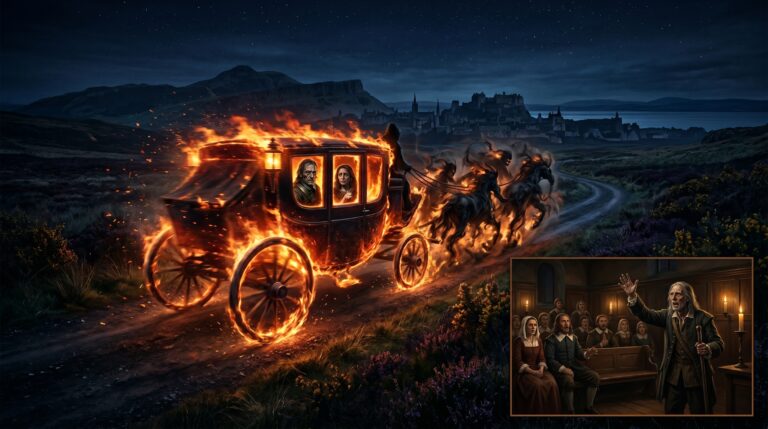
In 1746, just before the Battle of Culloden — the last battle fought on British soil, the catastrophic defeat that ended the Jacobite Rising and destroyed the Highland clan system — a winged creature with a human head and red glowing eyes appeared over the moor and hovered above a detachment of soldiers on black leathery wings, emitting spine-chilling shrieks. The soldiers were paralyzed with primal dread. They could not look away from the human-like quality of the head — the face that seemed to mock the impending carnage with the intelligence and deliberateness of something that knew what was about to happen on this moor. The red glow of its eyes was visible through the thick morning mist of the Scottish Highlands. Whatever appeared above Culloden Moor in 1746 belongs to a documented pattern that the 20th century would give a name — the Mothman — but which the archive traces back centuries further: a large winged being with human facial characteristics and glowing eyes, appearing to military witnesses immediately before catastrophic loss of life, leaving them psychologically shattered before a single shot is fired. At Culloden on April 16, 1746, approximately 1,500 Jacobite soldiers died in less than an hour. Whatever appeared above those soldiers in the mist before the battle began, it arrived at the right place for the wrong reasons.
Date: 1746 — just before the Battle of Culloden, April 16, 1746
Sighting Time: Unknown — morning mist conditions implied; pre-battle
Day/Night: Morning — thick morning mist of the Highlands described
Location: Culloden Moor, Scotland — the site of the Battle of Culloden
Urban or Rural: Rural — open moorland
No. of Entity(s): 1
Entity Type: Winged humanoid — large creature with black leathery wings and a human head; red glowing eyes
Entity Description: A horrifying winged creature with a human head and red glowing eyes hovering on black leathery wings over a detachment of soldiers. The human-like quality of the head was specifically noted by witnesses — described as seeming to mock the impending carnage. Emitted spine-chilling shrieks. The red glow of its eyes was visible through thick morning Highland mist. Soldiers described as paralyzed with primal dread during the encounter.
Hynek Classification: CE-III — Close Encounter of the Third Kind; close observation of an animate non-human being at close range by multiple military witnesses; witness paralysis documented
Duration: Not recorded — sufficient for the soldiers to be paralyzed with dread and to observe the human-like head, red eyes, and black leathery wings in detail through mist
No. of Object(s): None — no associated craft; the entity itself was the aerial phenomenon
Description of Object(s): N/A
Shape of Object(s): N/A
Size of Object(s): Large — sufficient to hover over a detachment of soldiers and be observed through morning mist
Color of Object(s): Black — leathery wings; red — glowing eyes
Distance to Object(s): Close — directly above the detachment; close enough for the human-like quality of the head to be clearly observed
Height & Speed: Hovering — aerial, stationary or slow-moving above the soldiers
Number of Witnesses: Multiple — a detachment of soldiers; exact count not recorded
Special Features / Characteristics: Disaster-precursor pattern — appeared immediately before the most catastrophic battle in Scottish history; witness paralysis — soldiers described as paralyzed with primal dread rather than fleeing; the human-headed morphology — a winged entity with a recognizably human face is one of the most unusual and consistent morphologies in the winged entity record across cultures; the shrieking acoustic signature — consistent with the acoustic element documented in Mothman sightings and other winged entity encounters; red glowing eyes visible through mist — the red glowing eye characteristic is one of the most consistent features across the global winged entity record; the entity appeared to mock the carnage — witnesses interpreted deliberate intelligence in its presence; Karl P. N. Shuker documented this case in Fate magazine September 1994; connects directly to the Mothman tradition documented at Point Pleasant West Virginia 1966 and other disaster-precursor winged entity accounts; the Culloden battlefield has documented anomalous activity both before (this encounter) and after (the 1748 three spheres sighting) the battle; one year and one day after the 1744 Knott aerial army sighting at the same geographic zone
Case Status: Unexplained
Source: Karl P. N. Shuker, Fate No. 534, September 1994
Summary/Description: Just before the Battle of Culloden on April 16, 1746, a detachment of soldiers on Culloden Moor observed a large winged creature with a human head and red glowing eyes hovering above them on black leathery wings, emitting spine-chilling shrieks. The soldiers were paralyzed with primal dread. The entity’s human-like head appeared to mock the impending carnage. Its red eyes were visible through the thick Highland morning mist. Documented by Karl P. N. Shuker in Fate No. 534, September 1994. The case connects to the Mothman-type disaster-precursor winged entity pattern documented across global records.
Related Cases: 1748 CE Culloden Scotland Three Spheres | 1744 CE Knott Scotland Aerial Troops | Point Pleasant West Virginia 1966 Mothman | Winged Entity Archive | Disaster-Precursor Entity Archive
DETAILED REPORT:
April 1746. Culloden Moor, near Inverness in the Scottish Highlands. The Jacobite Rising of 1745 — which had looked briefly possible with the Highland army’s march as far south as Derby — has been reversed. The Jacobite forces are exhausted, ill-fed, and tactically cornered on a flat exposed moor that gives every advantage to the Duke of Cumberland’s government forces. The Jacobite commanders know this. Their men know this. Some among them slept through the night of April 15th when they should have been attempting a night attack. The morning of April 16th arrives cold and misty on the moor.
Before the battle begins, something appears.
A detachment of soldiers — Jacobite, government, or both the account does not specify — encounters a creature hovering above them in the mist. It is large. It has wings — black and leathery, the wings of a bat or a dragon rather than a bird. It hovers. And it has a human head.
The human head is the most analytically significant morphological feature of the Culloden 1746 entity. The pre-modern record contains many winged aerial beings — from Ezekiel’s cherubim through the European dragon tradition through the 1582 Siberia winged warriors. What distinguishes the Culloden entity is the specifically human facial characteristics: a head recognizable as human, with a human face, on a winged body that was not. The soldiers who observed it focused specifically on this feature — the human-like quality of the head that seemed to look at them with something beyond animal intelligence.
It was looking at them with red glowing eyes.
The red glow was visible through the thick morning Highland mist — which establishes that the luminosity of the eyes was significant, self-generated rather than reflected, bright enough to penetrate atmospheric obstruction. This specific characteristic — red glowing eyes on a large winged entity — is one of the most cross-culturally consistent features in the global winged entity record. It appears in the 1966 Point Pleasant West Virginia Mothman accounts, in dozens of subsequent winged entity sightings worldwide, and here in 1746 Scotland, two centuries before the Mothman became a recognized research category.
The entity shrieked.
The acoustic signature — spine-chilling shrieks — is the second cross-cultural consistency in winged entity accounts. Whatever generates the sound that witnesses across centuries and continents describe as spine-chilling, it is a consistent feature of encounters with this class of being. The soldiers on Culloden Moor heard it through the mist in the pre-battle hours of April 16, 1746.
They were paralyzed with primal dread.
Not fear in the ordinary sense — primal dread. The account specifically distinguishes the quality of the soldiers’ response from normal combat fear or even ordinary terror. Primal dread is a specific psychological state — the innate biological fear response that predates rational cognition, the response that activates before the thinking brain can process what the seeing brain has registered. Soldiers who are about to fight a battle are in a state of managed controlled fear — trained out of the primal response by drill and discipline and unit cohesion. Whatever appeared above them on Culloden Moor bypassed all of that training and activated something older.
At Culloden on April 16, 1746, the battle lasted less than an hour. Approximately 1,500 Jacobite soldiers died. The Highland clan system was effectively destroyed by the Act of Proscription that followed. The Scottish Highlands were never the same. Whatever appeared above those soldiers in the mist before those events is the Culloden case’s most irreducible element: it appeared at the right place at the right time for the wrong reasons.
Karl P. N. Shuker — one of the most credible and systematic cryptozoological and high strangeness researchers of the late 20th century — documented this case in Fate magazine’s September 1994 issue. His inclusion of it in his systematic research into anomalous creature reports reflects the case’s genuine historical documentation rather than mere anecdotal tradition.
The disaster-precursor pattern that this case exemplifies — a large winged entity with red glowing eyes appearing to witnesses immediately before catastrophic events involving mass death — is documented with sufficient consistency across independent cultures and centuries to constitute a recognizable encounter type in the archive. The Mothman of Point Pleasant appeared before the Silver Bridge collapse. The Flatwoods Monster appeared during a period of heightened Cold War anxiety. The Culloden human-headed dragon appeared before the last battle on British soil. The pattern is not a theory. It is a documented behavioral consistency.
RESEARCHER’S NOTES:
The Culloden Dragon — Mothman Precursor, Human-Headed Morphology, and the Disaster Pattern
- The Mothman Precursor Pattern: The Culloden 1746 account predates the 1966 Point Pleasant Mothman by 220 years and describes the same essential entity: large, winged, human-headed or humanoid-featured, red glowing eyes, acoustic shrieking, witness paralysis, immediate pre-disaster appearance. The specificity of the morphological and behavioral match across 220 years and two continents argues for a genuine recurring entity type rather than cultural cross-contamination. The archive treats the Culloden dragon as the pre-modern British entry in the disaster-precursor winged entity series.
- Human-Headed Morphology as Classification Feature: The specifically human quality of the entity’s head is the most analytically unusual feature of the 1746 Culloden account and the feature that distinguishes it from conventional dragon or winged-beast descriptions. A winged creature with a human face is not the standard morphology of 18th century British cryptid tradition or theological monster classification. It is specific, unusual, and consistent with a documented subset of the winged entity record that includes human-headed or human-faced aerial beings across multiple cultures.
- Red Glowing Eyes Through Mist: The visibility of red glowing eyes through thick Highland morning mist establishes a minimum luminosity threshold for the entity’s eye emission — bright enough to penetrate atmospheric moisture at close range. This is not reflected light or bioluminescence of low intensity. It is a significant self-generated emission. The red glowing eye characteristic in winged entity accounts is cross-cultural and cross-century — from Aztec entity descriptions through Medieval European dragon accounts through 20th century cryptid reports.
- The Culloden Zone as Anomalous: The Culloden battlefield is the site of two documented anomalous entity and aerial encounters in the archive — this 1746 pre-battle human-headed dragon and the 1748 three spheres sighting two years after the battle. A specific geographic location producing multiple independent anomalous observations across a short time window is one of the defining characteristics of an anomalous zone in the archive’s classification framework.
Something with a human head and red eyes hovered on black leathery wings above soldiers on Culloden Moor in the morning mist before the last battle on British soil and shrieked at them until they were paralyzed with primal dread. Then the battle happened. Then 1,500 people died in less than an hour. Then the Highland clan system was destroyed. Karl Shuker found the account in Fate. The archive holds it now alongside the 1744 Knott aerial army that appeared one year before and the 1748 three spheres that appeared two years after — three anomalous events at the same geographic location across four years of Scotland’s most consequential period. Whatever appeared above Culloden Moor before the battle came for the soldiers who were about to lose everything. It knew what the morning mist was hiding. The soldiers saw its face and were paralyzed. The archive records the face. The rest is Scottish history.