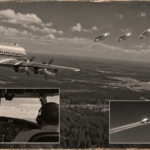
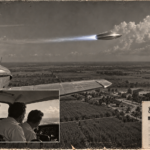
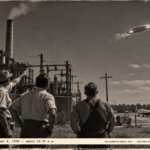
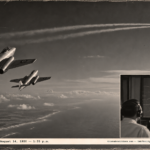
Ron Sullivan reported his car's headlight beams bending near a glowing cone-shaped light display at Burkes Flat, Victoria, April 4, 1966.
THINK ABOUTIT UFO ENCOUNTER REPORT
1966 Burkes Flat “Bent Headlight Beams” UFO Case: The Full Story
On the night of April 4, 1966, steel contractor Ron Sullivan was driving a rural road near Burkes Flat, Victoria, when his car’s headlight beams appeared to bend to the right, as if pulled by an unseen force. He swerved to compensate and nearly hit a tree — then noticed a strange, glowing cone of colored light standing in a nearby paddock. It became one of Australia’s most closely studied UFO cases, investigated across three decades by researcher Bill Chalker and physicist Dr. James McDonald. It’s also a case whose own details shifted significantly every time Sullivan retold it, and one for which a specific, well-matched conventional explanation has since been proposed.
Editor’s Note: The version of this case previously on this site was missing its defining detail entirely — the bent headlight beams that give the case its name. That detail has been restored here from Bill Chalker’s original investigative reporting. At the same time, deeper research into this case turned up serious, well-documented reliability problems: a disputed sighting date, physical evidence that grew in size across retellings, a departure description that changed over time, and a specific competing explanation involving a nearby lit festival tower. This page presents the full picture — the account as reported, and the case against taking it at face value — rather than either the sanitized original or an uncritical retelling.
Date: April 4, 1966 (as originally and most consistently reported by the witness; see Researcher’s Notes regarding a documented date discrepancy)
Sighting Time: Approximately 8:00–8:30 p.m.
Day/Night: Night
Location: Dunolly–St Arnaud road, near Burkes Flat, Victoria, Australia
Urban or Rural: Rural
No. of Entity(‘s): None documented
Entity Type: None documented
Entity Description: None documented
Hynek Classification: CE-II (Close Encounter II) — retained as originally classified, based on the reported electromagnetic-type effect on the witness’s car headlights. See Researcher’s Notes regarding a serious alternative explanation for the “bending” effect
Duration: Reported as 4 to 5 seconds in the earliest accounts; later retellings extended this to as much as 25 seconds — a discrepancy addressed in Researcher’s Notes
No. of Object(s): 1
Description of the Object(s): Initially a white phosphorescent light on the ground, roughly 15 feet in diameter, which opened upward into a cone-shaped structure of colored light — described as containing tube-like shafts of red, blue, indigo, and purple light moving up and down between the ground-level oval and a wider oval at the top — before the structure closed back down to a single point of light and disappeared
Shape of Object(s): A changing, cone-like form — described by the witness in later retellings as resembling an inverted ice cream cone
Size of Object(s): As given in this site’s original record: approximately 15 feet in diameter at ground level, rising to a cone roughly 30 feet high with a 15-foot bottom diameter and 20-foot top diameter. Bill Chalker’s investigative reporting gives different figures — a column roughly 25 feet high, 3 feet wide at the base and 10 feet wide at the top — a discrepancy that is itself notable (see Researcher’s Notes)
Color of Object(s): White phosphorescent base light; internal tubes of red, blue, indigo, and purple light in motion
Distance to Object(s): Object was in a pasture beside the road, at roadside proximity as the witness drove past
Height & Speed: Not documented in numeric terms; the witness was driving normally before slowing to observe the object
Number of Witnesses: One primary named witness, Ron Sullivan. A second vehicle following Sullivan was mentioned only in a 1984 retelling, 18 years after the event, and not in his original 1966 or 1967 accounts. A separate, anonymous phone call reporting a matching sighting near the related fatal crash was received by a UFO research group days after the story broke, but the caller was never identified and the report was never corroborated
Special Features/Characteristics: The witness’s car headlight beams reportedly bent to the right for approximately two seconds, as if pulled by an unseen force, causing him to swerve left and nearly collide with a roadside tree; he had his headlights inspected afterward and found them mechanically normal; a shallow depression, roughly 3 to 4 feet across and a few inches deep, was found in the paddock days later, though similar depressions can be produced by native wildlife such as malleefowl or kangaroos; a fatal car crash involving a local teenager occurred at a location Sullivan later identified as the same site, a few days after his reported sighting, though the exact date and site alignment are themselves disputed; Bill Chalker’s 1984 forensic examination of the headlight housing, conducted with a scientist from the Australian Atomic Energy Commission, found no evidence of exposure to a sustained strong magnetic field
Case Status: Insufficient Data — despite serious, decades-long investigation by credentialed researchers, the witness’s account changed in significant ways across retellings (sighting date, object dimensions, encounter duration, and manner of departure), and a specific, well-matched conventional explanation — a nearby lookout tower illuminated for an annual Easter festival — has been proposed and not conclusively ruled out
Source: Original witness report (site record, source uncited); Bill Chalker, “The Bent Headlight Beam Case Revisited,” UFO Research Newsletter (UFORAN), Vol. 5 No. 3, May–June 1984, also published in Flying Saucer Review; Ron Sullivan’s original letter to VFSRS, April 18, 1966; Dr. James McDonald’s 1967 recorded interview with Sullivan; investigative analysis by researcher Charlie Wiser, Metabunk, June 2024
Summary/Description: Steel contractor Ron Sullivan reported that his car’s headlight beams bent to the right while driving near Burkes Flat, Victoria on the night of April 4, 1966, coinciding with a strange cone-shaped light display he observed in a roadside paddock. Decades of investigation followed, including forensic examination of his headlight and interviews by physicist Dr. James McDonald, but the case’s details shifted substantially across retellings, and a specific conventional explanation involving a nearby festival lookout tower has since been proposed.
Related Cases: None documented — occurred two days before the well-known Westall UFO mass sighting near Melbourne (April 6, 1966); some researchers have noted the timing but no confirmed connection between the two cases exists
Detailed Report
At approximately 8:00 to 8:30 p.m. on April 4, 1966, Ron Sullivan, a steel contractor from Maryborough, Victoria, was driving a familiar route he traveled twice weekly for work, along a sealed section of the Dunolly–St Arnaud road near Burkes Flat, in Victoria’s central farming country. According to his account, his car’s headlight beams suddenly appeared to bend to the right for about two seconds, as though pulled by an unseen force. Believing he was drifting off the road, Sullivan swerved left to compensate — and found himself now heading directly toward a tree on the opposite side of the road, which he narrowly avoided.
As he slowed and looked around, Sullivan noticed an unusual light in a pasture off to his right, which he initially mistook for a tractor engaged in night plowing. As he drew closer and passed the field slowly, he saw a white phosphorescent light on the ground that he estimated at roughly 15 feet in diameter. This light opened upward into a cone-shaped structure of colored light, with tube-like shafts of red, blue, indigo, and purple light appearing to travel up and down between the ground-level oval and a wider oval at the top of the structure. The entire display lasted, by Sullivan’s earliest account, only 4 to 5 seconds before the cone closed back down into a single point of light and vanished.
Sullivan did not report the sighting immediately. He has stated in different interviews that he told only his wife at first, reluctant to risk public ridicule. Several days later, following news of a fatal car accident involving a local teenager at a site Sullivan came to identify as the same location, he contacted a reporter friend and later the police. When investigators visited the paddock, they found a shallow depression in the ground roughly 3 to 4 feet across and a few inches deep — though similar ground disturbances can also result from native wildlife activity in the region. The story reached the press on April 12, 1966, and prompted a wave of local and national interest.
The case drew sustained attention from Australian UFO researcher Bill Chalker, who interviewed Sullivan in 1984 — 18 years after the sighting — for a detailed retrospective report published in the UFO Research Newsletter. As part of that investigation, Chalker arranged for a scientist at the Australian Atomic Energy Commission’s Lucas Heights facility to examine Sullivan’s original headlight housing for residual magnetism, using chalk markings to trace the direction of the metal’s internal magnetic force lines. The lines were found running in relatively random directions rather than a single consistent alignment — a result that ruled out exposure to a strong, sustained magnetic field, without explaining what, if anything, had caused the reported bending effect. Physicist Dr. James McDonald, known for his rigorous approach to credible witness testimony, also interviewed Sullivan directly in 1967, a year after the sighting.
Researcher’s Notes
The Burkes Flat Case — 1966 and the Story That Changed Every Time It Was Told
- The original site record was missing the case’s defining detail. The bent headlight beams are what gave this case its name and its documented investigative history, yet the version previously on this site contained no mention of them at all. That omission has been corrected here using Bill Chalker’s original reporting.
- The sighting date is itself disputed, and the discrepancy matters. Sullivan consistently reported the date as April 4 in his contemporary 1966 accounts, but in his 1967 interview with Dr. James McDonald, he twice stated the date as April 7 — Easter Thursday, and the same night as the fatal crash later linked to the case. April 7 is also the first night each year that a nearby lookout tower is traditionally illuminated for an annual Easter festival. Whether this was a simple misstatement or reflects something more significant about what Sullivan actually witnessed and when is unresolved.
- Key details grew across nearly six decades of retelling. The reported duration of the sighting expanded from 4–5 seconds in the earliest account to as much as 25 seconds in a 2014 retelling. The ground depression, measured at 3–4 feet across shortly after the event, was described as roughly 10 feet wide in later versions. The object’s departure changed from simply rising and disappearing to a more elaborate description of the cone visibly closing in on itself before departing. A second vehicle following Sullivan was introduced only in the 1984 interview, absent from his original 1966 and 1967 accounts. None of this proves fabrication, but it is a documented pattern of embellishment that any evaluation of the case has to account for.
- A specific, well-matched conventional explanation has been proposed and not ruled out. The Mt Tarrengower lookout tower near Maldon, roughly 50–60 km from the sighting area, has been illuminated for an annual Easter festival since 1926, visible from as far as 50 km away, with wound strings of lights around its frame and lit platforms at its top and base — a striking match to Sullivan’s description of a lit cone with a base, a top, and internal shafts of moving light. If Sullivan’s sighting was actually on Easter Thursday, as his own 1967 statement suggests, this explanation becomes considerably more plausible, though it does not account for every detail of his account, including the reported colors and the headlight effect.
- The “bent” headlight beam presents a real physics problem worth noting plainly. Some researchers examining this case have pointed out that if light were genuinely bent in one direction by an external field, the same field would need to bend the light reflecting back toward the driver in the same way, which would tend to cancel out any visible distortion — meaning a true optical “bending” of this kind is difficult to reconcile with how light actually behaves. An unusual road surface or camber causing Sullivan to misjudge his steering, which he then reinterpreted as his headlights bending, has been suggested as a more physically consistent explanation, though this remains speculative as well.
- The link to the fatal crash is asserted by Sullivan, not independently established. The connection between Sullivan’s sighting location and the site of a local teenager’s fatal car accident days later rests entirely on Sullivan’s own identification of the crash site as matching his sighting location, made while being driven there specifically to see it by a reporter friend. No independent record confirms the two locations are the same, and the official explanation for the fatal crash — the driver falling asleep at the wheel after drinking — was never revised.
The Burkes Flat case remains genuinely difficult to resolve either way. It has been treated seriously enough to draw sustained attention from two credentialed investigators across three decades, and the forensic examination of Sullivan’s headlight is a rare piece of physical follow-up for a case of this age. At the same time, the documented growth of key details over nearly sixty years of retelling, the disputed date, and a specific festival-lighting explanation that fits much of the description make this a case where the honest conclusion is uncertainty, not confirmation.
“What in bloody hell was that?”
— Ron Sullivan, describing his reaction, April 1966