August 15, 1663 CE — Robozero Lake, Vologda region, Russia. A 40-meter flaming sphere with forward directional beams and blue side smoke hovered over Robozero Lake for 90 minutes during the Feast of the Assumption, burning fishermen who tried to approach, illuminating the lake to 30-foot depth, driving fish to shore, and leaving rust on the water. Documented by Ivan Rzhevsky, confirmed by local priests, published by the Russian Archaeological Commission in 1842, and followed up by a Soviet magnetometric expedition in 1982 that found anomalous field readings at the site.
THINK ABOUTIT UFO|UAP SIGHTING REPORT
1663: Robozero, Russia Sighting
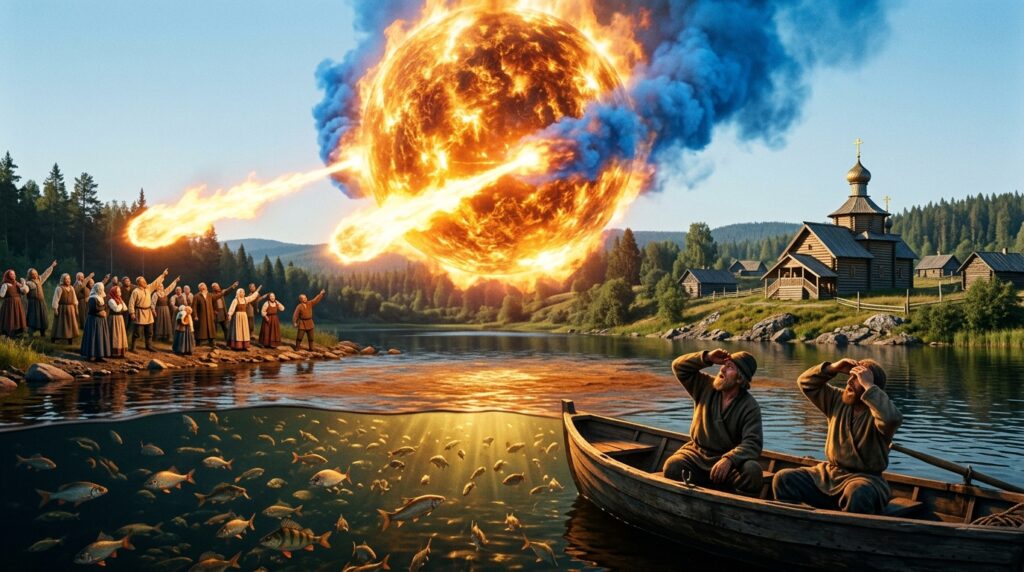
On the morning of August 15, 1663 — the Feast of the Assumption of the Virgin Mary — the faithful of the Belozersk district had gathered in great numbers at the parish church on the shore of Robozero Lake in the Vologda region of Russia. The prayer singing had just begun when a great noise resounded in the heavens and the congregation rushed outside. From the north, out of a perfectly clear sky with no clouds and no storm, appeared a huge flaming sphere no less than forty meters in diameter — as tall as a fifteen-story building. From its fore part projected two beams of fire extending forty meters ahead of it. From its sides poured blue smoke. It hovered over Robozero Lake. Fishermen in a boat on the lake attempted to approach it — the scorching heat drove them back. The light from the object penetrated the water to a depth of thirty feet and the fish fled to the shoreline. Where the object had been over the water, a brown rust-like film appeared on the surface and was then dispersed by the wind. The sphere disappeared, reappeared half a kilometer away, disappeared again, reappeared a further half kilometer to the west — brighter and more terrifying each time — and then moved westward and was gone. Total duration: an hour and a half. Total witnesses: the congregation of an entire regional church plus fishermen on the lake. Total documentation: a formal deposition by Ivan Rzhevsky, corroborated by a second eyewitness, confirmed in writing by the local priests, preserved in the Archives of the St. Cyril of Belozersk Monastery, published by the Russian Archaeological Commission in 1842, authenticated by the St. Petersburg branch of the Institute of History, and followed up by a Soviet scientific expedition in 1982 that found anomalous magnetic field readings at the site. The Robozero case is the most famous and most thoroughly documented UAP event in Russian history.
Date: August 15, 1663
Sighting Time: Between 10:00 AM and noon
Day/Night: Day
Location: Robozero Lake, Belozersk district, Vologda region, Russia — approximately 50 km southwest of Belozersk
Urban or Rural: Rural — small lakeside village; parish church on the lake shore
No. of Entity(s): None observed
Entity Type: N/A
Entity Description: N/A
Hynek Classification: DD — Daylight Disc; a massive metallic or luminous sphere with defined structural features — forward-projecting beams and lateral blue smoke — observed in full daylight over water for an extended duration with multiple physical environmental effects
Duration: Approximately one hour and thirty minutes — total from first appearance through three re-appearances and final westward departure
No. of Object(s): 1
Description of Object(s): A huge flaming sphere no less than 40 meters in diameter — approximately 130 feet across, the height of a 15-story building. Two beams of flame or fire projected approximately 40 meters from its fore part — functioning as forward searchlights or directional emitters. Blue smoke poured from its sides. The sphere appeared three separate times, moving progressively westward, each reappearance approximately 500 meters west of the previous location, with the third appearance described as more terrifying in width — larger and brighter — before final departure.
Shape of Object(s): Sphere — defined round form, no ambiguity in shape description
Size of Object(s): No less than 40 meters in diameter — approximately 130 feet
Color of Object(s): Flaming — luminous fire coloration; blue smoke from sides; rust-like brown coloration transferred to water surface beneath object
Distance to Object(s): Over the lake — fishermen attempted to approach but were burned by heat and driven back; the object was close enough to illuminate the lake bottom to 30 feet depth
Height & Speed: Low altitude over the lake surface — fishermen attempted to approach by boat; moved westward in three progressive reappearances approximately 500 meters apart
Number of Witnesses: Multiple — the entire Assumption Day congregation plus fishermen on the lake; the account references a multitude of people
Special Features / Characteristics: Forward beam projection — two directed beams of fire extending 40 meters ahead; lateral blue smoke emission from sides — distinct from the main luminosity; lake water illuminated to 30-foot depth — indicating enormous downward light penetration; fish fled to shore from beneath the object; rust-colored water surface film beneath the object, later dispersed by wind — physical chemical residue; fishermen burned by heat when attempting approach — physical injury; three sequential reappearances moving progressively westward with increasing brightness; formal deposition by Ivan Rzhevsky with second eyewitness corroboration and written confirmation from local priests; document published 1842 by Russian Archaeological Commission; authenticated in St. Petersburg Institute of History archives; 1982 Soviet scientific IZMIRAN expedition found anomalous magnetic field readings at site; Yuri Roszius’s analysis connected the brightness increase on the third appearance to possible engine firing before westward departure; all conventional explanations — meteorite, ball lightning — ruled out by documented characteristics
Case Status: Unexplained — authenticated; conventional explanations eliminated
Source: Ivan Rzhevsky deposition, 1663; published in Akty Istoricheskie, Russian Archaeological Commission (St. Petersburg, 1842), vol. IV, pp. 331–332; Yuri Roszius analysis, Aura-Z 4 (1994); Philip Mantle and Paul Stonehill, UFO-USSR
Summary/Description: On August 15, 1663, between 10 AM and noon, a flaming sphere approximately 40 meters in diameter with two forward projecting beams and blue smoke from its sides appeared from a clear sky over Robozero Lake, Vologda region, Russia, hovering for an hour and a half and reappearing three times with increasing brightness before departing westward. Fishermen were burned by its heat. The lake was illuminated to 30 feet depth, fish fled to shore, and a rust-colored film appeared on the water surface. Formally documented in a deposition by Ivan Rzhevsky, corroborated by eyewitness Levka Fedorov, confirmed in writing by local priests, preserved in monastery archives, and published by the Russian Archaeological Commission in 1842. The most famous and most thoroughly documented UAP case in Russian history.
Related Cases: September 1, 1808 CE Moscow Kremlin Luminous Plate | 1650 CE Volga Russia Giant Encounter | August 15, 1663 CE Robozero Archive Entry | Russian UAP Archive
DETAILED REPORT:

August 15, 1663. The Feast of the Assumption of the Virgin Mary. Robozero is a small lake in the Vologda region of northern Russia, approximately 50 kilometers southwest of the town of Belozersk — remote, forested, the kind of place where the population gathered at its parish church for major holy days because the church was the center of communal life. On this particular holy day, the faithful from multiple surrounding villages have gathered at the parish church on the lakeshore. It is a full congregation, a multitude of people assembled for Mass on one of the most important feast days in the Orthodox calendar.
The prayer singing has just begun.
A great noise resounds in the heavens.
The congregation comes outside.
From the north, out of a perfectly clear sky — no clouds, no storm, no atmospheric conditions that could produce any known natural phenomenon — appears a huge flaming sphere. The witnesses document its size in terms they can verify: no less than 40 meters in diameter, the height of a 15-story building. From its fore part — the front of the sphere, in its direction of movement — project two beams of fire extending approximately 40 meters ahead of it. These are not random light emissions. They are directed, forward-projecting beams consistent with searchlights or navigational emitters. From its sides pour blue smoke — distinct from the flaming main body, a specific lateral emission.
The sphere moves over Robozero Lake.
Fishermen in a boat on the lake try to approach it. The heat stops them — burning them, driving them back. The light from the object penetrates the water downward, illuminating the lake to its full depth of approximately 30 feet. The fish beneath the object flee to the shoreline. These are the responses of living organisms to an intense heat and light source at close range. Where the object passes over the water, a brown rust-like film appears on the surface — a chemical residue deposited by the object’s emissions. The wind later disperses it and the water becomes clean again.
Then the object disappears.
But it returns — approximately 500 meters from where it was, now to the west. Then it disappears again. Then it returns a third time — a further 500 meters west, and this third appearance is more terrifying in width, brighter, more intense than the previous two. Yuri Roszius, who analyzed the original document in the 1990s, connected this third appearance’s increase in brightness to a possible propulsion system activation — the brightness increase preceding the final westward departure consistent with what he described as the firing-up of cruise engines.
Then the object moves westward and does not return.
Total hover time over Robozero: an hour and a half.
Ivan Rzhevsky — a laborer administrator for the St. Cyril of Belozersk Monastery — did not immediately submit his report. He first sent a message to the priests of the Robozero district, asking them to confirm the date and the event. They responded in writing: they had indeed observed such a sign on that date. Only then did Rzhevsky report to his superiors. His document names the primary eyewitness — Levka Fedorov, a farmer from the village of Mys in the Antusheva estate — and provides the formal deposition structure. The document was preserved in monastery archives, collected by the Russian Archaeological Commission, and published in volume IV of Akty Istoricheskie in 1842 — one of the most credible publication chains for a pre-modern Russian UAP document in the archive.
The Russian astronomer D. Svyatski proposed a meteorite in his 1915 book on astronomical phenomena in Russian chronicles. Meteorites do not hover. They do not appear three times in progressive westward sequence. They do not burn fishermen who try to approach them from a boat. They do not illuminate lake bottoms and drive fish to shore. Ball lightning was proposed — but there was no storm that day, ball lightning does not reach 40 meters in diameter, and it does not project forward directional beams.
In the summer of 1982, a Soviet scientific expedition led by physicist E. Gorshkov — science secretary of the Leningrad Commission for Anomalous Phenomena of the Geographic Society of the USSR and a participant in the SETKA secret Soviet UAP research program — surveyed Robozero with magnetometric equipment. The expedition found anomalous magnetic field readings at the site. The Robozero phenomenon had left a detectable physical signature in the earth beneath the lake, 319 years after the congregation of the Assumption Day service came outside to see what the noise was.
RESEARCHER’S NOTES:
The Robozero Phenomenon — Directional Beams, Chemical Residue, and Russia’s Gold Standard UAP Document
- The Document Authentication Chain: The Robozero deposition has one of the strongest authentication chains of any pre-modern Russian UAP document. Rzhevsky obtained independent written confirmation from local priests before submitting his report. The document was preserved in the St. Cyril Monastery archives. It was published by the Russian Archaeological Commission in 1842. It was located in the St. Petersburg branch of the Institute of History archives. Yuri Roszius found and photographed the original in 1994. Each institutional link in this chain independently validates the document’s authenticity. The combination is unmatched in the pre-modern Russian UAP record.
- Forward Beam Projection as Structural Feature: The two forward-projecting beams extending 40 meters ahead of the sphere are the most analytically significant structural feature of the Robozero object. Random luminosity does not project directional beams. The beam structure implies a designed optical or energy emission system oriented in the direction of movement — consistent with searchlights, navigational aids, or directional energy systems on a constructed vehicle. This structural feature alone eliminates every natural atmospheric phenomenon as an explanation.
- Chemical Residue as Physical Evidence: The rust-colored film that appeared on the water surface where the object passed is a physical chemical residue — the only material evidence of the Robozero event beyond witness testimony. A 1982 Soviet magnetometric expedition found anomalous magnetic field readings at the site 319 years after the event — suggesting the object’s interaction with the lake left a persistent geophysical signature. Physical residue plus persistent geophysical anomaly is a stronger physical evidence baseline than most modern UAP cases in the current government record.
- Roszius’s Brightness-Increase Analysis: Yuri Roszius’s identification of the third appearance’s brightness increase as potentially corresponding to propulsion system activation — analogous to engines firing before departure — is one of the earliest analytical observations in the Russian UAP research tradition that applies modern propulsion physics to a historical UAP account. Whether his interpretation is correct or not, the methodology represents a significant advance in how historical UAP events are analyzed.
The congregation of Robozero came outside in the middle of the Feast of the Assumption on August 15, 1663 and watched a 40-meter flaming sphere with forward projecting beams hover over their lake for an hour and a half, burn the fishermen who tried to approach it, drive the fish to shore, illuminate the lake bottom, and leave rust on the water. Ivan Rzhevsky checked the story with the local priests before reporting it. The priests confirmed it in writing. The document went into the monastery archive. The Archaeological Commission published it in 1842. The Institute of History verified it. Yuri Roszius photographed the original. A Soviet physics expedition found the magnetic anomaly in 1982. Every conventional explanation has been eliminated by the documented characteristics. The Robozero case is Russia’s gold standard UAP event — authenticated across 319 years of institutional documentation chains, physically evidenced in the chemistry of the lake water and the magnetism of the earth beneath it. Whatever hovered over Robozero for an hour and a half on a clear August morning has not been explained. The archive holds what Rzhevsky wrote down. The lake held what the object left behind.