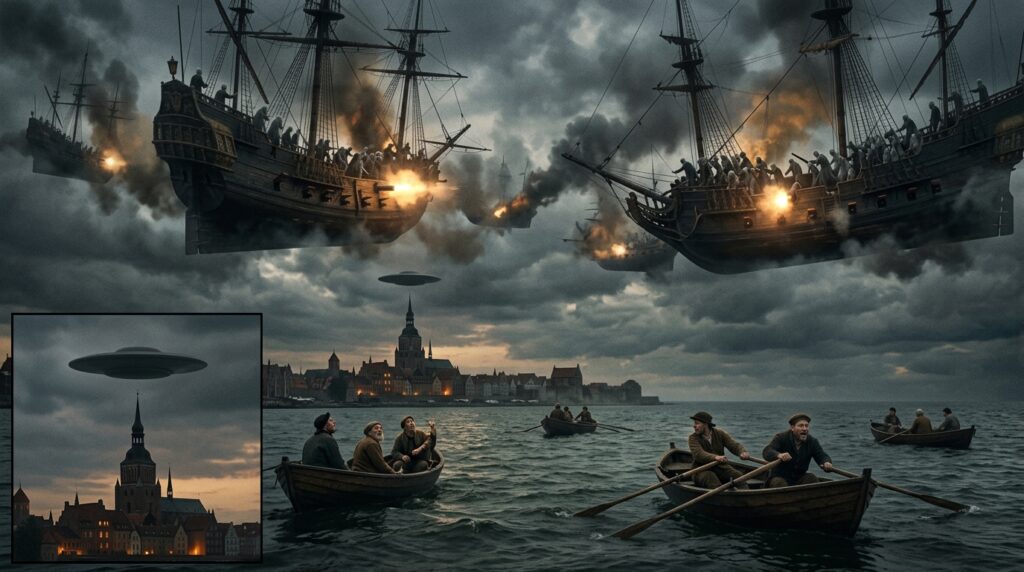
April 8, 1665 CE — Baltic Sea off Stralsund, Germany. Six fishermen watched flocks of birds transform into aerial warships with ghostly crew engaged in thunderous combat for hours, followed by a dark grey flat round disc appearing above St. Nicholas Church. All six trembled with pain the following day. The subject of a major 2023 Kunstbibliothek Berlin exhibition finding that 1665 UAP media reporting strategies are structurally identical to those used today.
THINK ABOUTIT UFO|UAP SIGHTING REPORT
1665: Stralsund, Germany Sighting
At two o’clock in the afternoon on April 8, 1665, six fishermen hauling herring nets off the Baltic Sea coast near Stralsund, Germany watched the sky transform. Flocks of birds became warships. The warships engaged in thunderous aerial combat. Ghostly figures swarmed on their decks. The fishermen watched an aerial battle — a sustained, organized, ship-versus-ship engagement in the sky above the Baltic — until the light began to fail. Then, as evening broke over the city of Stralsund, something appeared above the Church of St. Nicholas: a flat, round shape like a plate — dark grey, distinct, unmistakable. The six fishermen fled. The next day all six were trembling all over and complaining of pain — physical symptoms consistent with the physiological aftermath of close encounter with an intense energy or radiation source. The news spread through the media of 1665 Germany like wildfire. Broadsheets competed with newspapers competed with pamphlets for the most detailed and most dramatic version of what six herring fishermen had seen above the Baltic. Three hundred and fifty-eight years later, the Kunstbibliothek — the Art Library of the Staatliche Museen zu Berlin — mounted a major exhibition specifically examining this event, its media coverage, and what it reveals about how UAP reporting has remained structurally unchanged from 1665 to the present day. The Air Battle of Stralsund is not a footnote in the pre-modern UAP archive. It is a landmark.
Date: April 8, 1665
Sighting Time: 14:00 — continuing until evening
Day/Night: Afternoon into evening
Location: Baltic Sea off the coast of Stralsund, Pomerania, Germany — above the city of Stralsund toward evening
Urban or Rural: Maritime — at sea off the coast; aerial phenomena visible over the city of Stralsund
No. of Entity(s): Multiple — ghostly figures described on the decks of the aerial warships
Entity Type: Humanoid — ghostly figures swarming on the decks of transformed aerial vessels; the flat round disc above St. Nicholas Church appeared without visible occupants
Entity Description: Ghostly figures — multiple beings visible on the decks of the aerial warships during the combat phase; their physical characteristics not detailed beyond their presence and their swarming movement on the vessel decks
Hynek Classification: CE-II — Close Encounter of the Second Kind; physical effects on witnesses — trembling, pain the following day; the dark grey disc above St. Nicholas Church within city range. CE-III elements present through the ghostly figures on vessel decks.
Duration: From 14:00 through evening — several hours; the disc above St. Nicholas Church appeared at evening after the aerial battle had concluded
No. of Object(s): Multiple — aerial warships engaged in battle; 1 dark grey flat round disc above St. Nicholas Church at evening
Description of Object(s): Aerial warships — formed from or appearing as transformed flocks of birds, engaged in thunderous aerial combat above the Baltic Sea; decks populated with ghostly figures. Separate object: a flat round shape like a plate, dark grey, appearing above the Church of St. Nicholas at evening after the battle — the classic disc morphology described in the same language used across the European pre-modern aerial phenomena record
Shape of Object(s): Disc — flat and round like a plate (the evening object); warship-shaped during the aerial battle phase
Size of Object(s): Large — warship-scale during battle; the disc’s apparent size not recorded
Color of Object(s): Dark grey — the disc above St. Nicholas Church specifically described as dark grey
Distance to Object(s): Aerial over the sea during the battle; above the city at St. Nicholas Church during the disc phase — witnesses fled
Height & Speed: Aerial — warships at cloud or mid-air altitude; disc above the church tower
Number of Witnesses: 6 — herring fishermen; additional city witnesses to the disc above St. Nicholas Church implied by the news spreading through the city
Special Features / Characteristics: Bird-to-warship transformation — the initial phenomenon involved flocks of birds apparently transforming into warships, a morphological transition that has no natural explanation; thunderous sound — the aerial battle produced sound as well as visual phenomena; ghostly figures on vessel decks — humanoid entities visible on the aerial craft during combat; physical aftermath — all six fishermen trembling all over the next day and complaining of pain, consistent with radiation or energy exposure effects; dark grey disc above St. Nicholas Church — the classic plate-shaped object appearing at the conclusion of the aerial battle over the city center; the fishermen’s flight upon seeing the disc suggests it was at close enough range to terrify six men who had just watched an aerial battle without fleeing; Erasmus Francisci documented the event in his 1680 encyclopedic work Der Wunder-reiche Uberzug; Kunstbibliothek Berlin major exhibition 2023 — the first major museum exhibition specifically examining a pre-modern UAP event and its media career; the exhibition found that communication strategies used in 1665 UAP reporting are structurally identical to those used today
Case Status: Unexplained — subject of major Berlin museum exhibition 2023
Source: Contemporary broadsheets and newspapers 1665; Erasmus Francisci, Der Wunder-reiche Uberzug unserer Nider-Welt (Nuremberg, 1680); Moritz Wullen, UFO 1665: The Air Battle of Stralsund (Wienand Verlag, 2023); Kunstbibliothek, Staatliche Museen zu Berlin
Summary/Description: On April 8, 1665, six fishermen off Stralsund watched flocks of birds transform into aerial warships with ghostly figures on their decks engaged in thunderous combat, followed at evening by a dark grey flat round disc appearing above St. Nicholas Church over the city center. The fishermen fled and the next day all trembled and complained of pain. The event was immediately covered in multiple competing broadsheets and newspapers. Erasmus Francisci documented it in 1680. The Kunstbibliothek Berlin mounted a major exhibition in 2023 examining the case and its media history — finding that 1665 UAP reporting strategies are structurally identical to those used today.
Related Cases: April 14, 1561 CE Nuremberg Germany Aerial Battle | July 1566 CE Basel Switzerland Black Sphere Aerial Battle | 1624 CE Bierstedt Germany Aerial Procession | European Aerial Combat Archive
DETAILED REPORT:

April 8, 1665. The Baltic Sea off the coast of Stralsund — one of the great Hanseatic trading cities of northern Germany, positioned on a strait separating the mainland from the island of Rügen. Six fishermen are at sea hauling herring when the sky changes.
Flocks of birds appear in the sky above the Baltic. This is not unusual — migratory birds over the Baltic coast are a feature of spring in this region. What happens next is.
The flocks of birds in the sky transform into warships engaged in thunderous aerial battles. Ghostly figures swarm on the decks. Compact Histories
The transformation — from birds to warships, from a natural aerial phenomenon to an organized military engagement with visible crew — is the most analytically unusual morphological transition in the 1665 Stralsund account. Whether the birds were the initial misidentification of distant craft that then came into clearer resolution, whether the craft used the bird flocks as cover and emerged from them, or whether the phenomenon genuinely presented as birds-becoming-warships in the witnesses’ perception, the transition is preserved in the account as the defining opening sequence.
The aerial battle is sustained. Thunderous — the combat is loud enough that the sound as well as the visual phenomenon is preserved in the account. The warships engage each other in organized combat. Their decks are not empty. Ghostly figures — multiple humanoid forms — move on the vessels’ surfaces, swarming with the activity of crew engaged in active combat operations.
The six fishermen watch this for hours.
Then, toward evening, the battle resolves or recedes, and something appears above the city of Stralsund itself. Above the Church of St. Nicholas — the central Gothic church of the city, its tower one of the most prominent landmarks on the Stralsund skyline — a flat, round shape like a plate appears above the St. Nicholas Church. Dark grey. Distinct. Unmistakable in its morphology. arxiv
The fishermen, who have watched an aerial battle between warships with ghostly crews for hours without fleeing, flee at the sight of this object.
The next day all six are trembling all over and complaining of pain. These physiological symptoms — whole-body trembling and generalized pain with a 24-hour delayed onset following close proximity to an anomalous aerial object — are consistent with radiation or energy exposure effects documented in modern close encounter cases. The fishermen’s prior exposure during the hours of aerial battle may have produced a cumulative physiological impact that manifested the following day.
The news spread through the media of 1665 Germany with the same urgency that characterizes modern UAP disclosure events. Broadsheets, newspapers, and pamphlets competed with each other to produce the most detailed and dramatic accounts. The Kunstbibliothek exhibition UFO 1665 was based on contemporary reports from witnesses and records created in various media of the era. From broadsheets and illustrations based on eyewitness accounts, UFO 1665 examined the phenomenon from religious and cultural perspectives of the era, and its parallels to events seen in the skies over the centuries. MSN
Erasmus Francisci — one of the most prolific German popular science writers of the 17th century — documented the Stralsund event in his 1680 encyclopedic work Der Wunder-reiche Uberzug unserer Nider-Welt, which preserved a detailed copper engraving of the aerial battle. His documentation gave the event its permanent place in the European scholarly record.
In 2023, the Kunstbibliothek Berlin mounted the first museum exhibition specifically examining a historical UAP sighting — UFO 1665: The Air Battle of Stralsund — curated by Moritz Wullen, Director of the Kunstbibliothek. The exhibition used contemporary image and text sources to reconstruct the media career of the event and found that the thought patterns and communication strategies that continue to shape reporting on unidentified aerial phenomena today were already fully present in 1665. Compact HistoriesMSN
The exhibition also raised one of the most analytically provocative questions in the entire study of historical UAP documentation: no 17th century source mentions extraterrestrials in connection with inexplicable celestial phenomena, even though the human imagination had already reached the point of imagining expeditions to inhabited planets and corresponding propulsion systems. The witnesses of 1665 had the imaginative capacity to conceive of inhabited worlds and flying machines — but their framework for what they saw defaulted to theology, warfare, and natural philosophy rather than extraterrestrial visitation. The framework has changed. The phenomenon has not. Compact Histories
RESEARCHER’S NOTES:
The Air Battle of Stralsund — Bird-to-Warship Transformation, Physical Aftermath, and the Berlin Museum Exhibition
- The Bird-to-Warship Transformation: The initial appearance of the phenomenon as flocks of birds that then transformed into or were replaced by aerial warships is one of the most unusual morphological openings in the pre-modern aerial phenomena record. Modern researchers have proposed several interpretations: the birds were the initial visual reference point for distant craft that resolved into warship-like forms as they approached; the craft use
- d bird behavior as environmental camouflage; or the human perceptual system processed an unfamiliar aerial phenomenon through the most familiar available visual template before the phenomenon’s true form became apparent. None of these interpretations is conclusively supported by the account, which simply preserves the transformation as observed.
- Physiological Aftermath as Physical Evidence: The all-six-fishermen trembling and pain the following day is the strongest physical evidence in the Stralsund case. A delayed physiological response affecting all six witnesses simultaneously after hours of exposure to aerial phenomena above the Baltic is not attributable to fear, suggestion, or coincidence. The whole-body trembling and generalized pain with 24-hour delay is consistent with documented physiological effects of high-intensity electromagnetic or radiation exposure — the same class of physical effects reported by military pilots and other witnesses in modern close encounter cases.
- The Berlin Kunstbibliothek Exhibition: The 2023 Kunstbibliothek exhibition UFO 1665 is the most significant institutional recognition of a pre-modern European UAP event in modern museum history. Its central finding — that the communication strategies and thought patterns shaping 1665 UAP media coverage are structurally identical to those shaping modern UAP reporting — is one of the most analytically significant contributions to the study of historical UAP documentation produced in recent decades. The exhibition treated the Stralsund case as a serious historical phenomenon worthy of scholarly examination rather than as folklore or superstition.
- The Disc Above St. Nicholas Church: The dark grey flat round disc appearing above St. Nicholas Church at evening — after the aerial battle had concluded and separate from the warship phenomena — is the most analytically specific object in the entire Stralsund account. It is described in the same morphological language used across the pre-modern European record for disc-shaped aerial objects: flat, round, like a plate. Its dark grey coloration is unusual — most pre-modern disc objects are described as luminous or metallic. Its appearance above the city center after the battle, and the fact that its sight caused six men who had watched aerial combat for hours to flee, suggests it was at close enough range to present a qualitatively different threat level from the distant aerial battle.

Six fishermen watched a thunderous aerial battle between warships with ghostly crews above the Baltic Sea on April 8, 1665, and then fled when a flat round grey disc appeared above St. Nicholas Church at evening. The next day all six trembled all over and complained of pain. The broadsheets spread the news. Erasmus Francisci documented it in 1680. The Kunstbibliothek Berlin mounted a major museum exhibition about it in 2023 and found that 1665 UAP media reporting strategies are structurally identical to 2023 ones. The archive holds the event alongside Nuremberg 1561 and Basel 1566 as the three most famous aerial combat events in the pre-modern European record — documented by named witnesses, published in contemporary print media, and preserved across centuries of institutional scholarship. Whatever engaged in thunderous combat above the Baltic Sea on April 8, 1665, it left six fishermen trembling in pain the next morning and gave the Berlin Kunstbibliothek enough material for a major exhibition three hundred and fifty-eight years later.