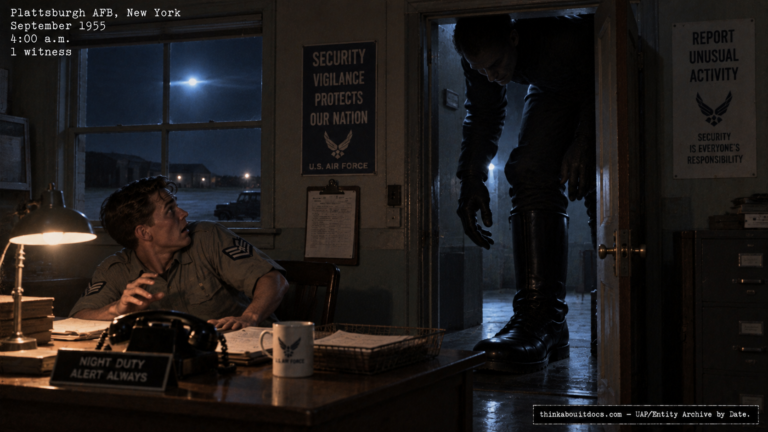
Archival rendering of Rex Heflin's August 3, 1965 sighting near Santa Ana, California, one of the most extensively analyzed UFO photograph cases on record.
THINK ABOUTIT UFO SIGHTINGS REPORT
1965: The Rex Heflin UFO Photographs
Rex Heflin wasn’t looking for anything unusual on the afternoon of August 3, 1965. He was a 38-year-old Orange County highway maintenance engineer, stopped near Myford Road and Walnut Avenue outside Santa Ana to photograph tree branches obscuring a railroad-crossing sign, a routine part of his job. A bright flash caught his eye instead, and a silver, dome-topped disc, roughly 20 feet across, passed his van at an estimated 150 feet, wobbling slightly as it moved. He grabbed his work Polaroid and fired off three exposures before it accelerated away, leaving behind a dark ring of what looked like smoke, which he photographed too. His radio, dead throughout the sighting, worked normally again the moment the object was gone. What followed was one of the most extensively analyzed UFO photographs in American history, and one of the more contested.
Date: August 3, 1965
Sighting Time: Approximately 12:30–12:37 p.m. PDT (Heflin was not wearing a watch; later photographic shadow analysis refined the estimate to approximately 12:37 p.m.)
Day/Night: Day
Location: Near the intersection of Myford Road and Walnut Avenue, unincorporated Orange County near Santa Ana, California, approximately half a mile outside the perimeter of El Toro Marine Corps Air Station
Urban or Rural: Rural
No. of Entity(s): Not Applicable
Entity Type: Not Applicable
Entity Description: Not Applicable
Hynek Classification: DD — Daylight Disc. A metallic object photographed in full daylight at close range.
Duration: Brief, on the order of seconds to roughly a minute; precise duration undocumented
No. of Object(s): 1
Description of the Object(s): A hat-shaped object, a disc with a central dome, silver/metallic in appearance, approximately 20 feet in diameter, exhibiting a slight gyroscopic wobble as it passed; Heflin reported a rotating or oscillating band of greenish-white light on the underside, resembling the sweep of a radar beam
Shape of Object(s): Disc with dome
Size of Object(s): Approximately 20 feet in diameter
Color of Object(s): Metallic silver; greenish-white light band on the underside
Distance to Object(s): Estimated altitude of approximately 150 feet as it passed
Height & Speed: Approximately 150 feet altitude; departed at high speed to the east after the sighting
Number of Witnesses: 1 (Rex Heflin); no independent corroborating witness has been identified despite the object’s reported flight path near a Marine Corps air station and a major freeway
Special Features/Characteristics: Heflin took three Polaroid photographs of the object and a fourth of a dark ring resembling smoke or vapor left behind after its departure; his vehicle radio failed twice during the sighting and functioned normally immediately afterward; the Los Angeles NICAP Subcommittee, led by Idabel Epperson, conducted a full field investigation including a background check on Heflin, site measurements by engineer John Gray, and photo analysis; JPL researcher Robert Nathan’s computer enhancement of first-generation prints found photographic evidence consistent with the reported light band and specifically ruled out a string-suspended model; Marine Corps intelligence personnel and USAF Captain Charles F. Reichmuth separately examined the photographs, with Reichmuth reportedly concluding Heflin did not appear to be perpetrating a hoax; roughly a month later, individuals falsely claiming to represent NORAD obtained and never returned three of Heflin’s four original photographs, a theft NORAD later denied any knowledge of; Ground Saucer Watch’s Bill Spaulding later claimed to find a line suggestive of a suspension string in copies of the images, a finding MUFON photo analyst Jeffrey Sainio rejected in a 1993 re-examination as either a copying artifact or a deliberately introduced mark, since no such line appeared in the original prints examined by Nathan, the newspaper, or NICAP
Case Status: Unexplained
Source: Richard Hall, The UFO Evidence, Volume II; NICAP Los Angeles Subcommittee investigation (Idabel Epperson, John Gray); JPL photo analysis by Robert Nathan; MUFON re-analysis by Jeffrey Sainio (1993); contemporaneous reporting in the Santa Ana Register, September 20, 1965
Summary/Description: On August 3, 1965, Orange County highway engineer Rex Heflin photographed a silver, dome-topped disc approximately 20 feet in diameter passing his work van at an estimated altitude of 150 feet near Santa Ana, California, taking three photographs of the object and a fourth of a smoke-like ring it left behind. His vehicle radio failed throughout the sighting and resumed normal function afterward. A thorough NICAP investigation and JPL photo analysis found no evidence of a suspended model or other simple hoax, though a month after the sighting, individuals falsely posing as NORAD representatives obtained and never returned three of his four original photographs. The Air Force’s later official explanation, that the object resembled a small vapor-trail test object thrown into the air and photographed for comparison, has been widely criticized as inadequate to the documented details of the case. No independent witness to the sighting has ever come forward.
Related Cases: None documented
Full Report
 Rex Heflin, an Orange County highway inspector, was at work in a county vehicle at approximately 12:37 p.m. when he saw a hat-shaped (disc with dome) object hovering above the road. He grabbed his Polaroid camera, normally used to record highway obstructions or other problems, and took three photographs of the metallic-appearing object and a fourth of a black “smoke ring” left behind by the object after it departed at high speed. He reported seeing a rotating band of light on the underside of the object, like the sweep of a radar beam.
 Heflin twice tried to radio his base during the sighting, but the radio would not work. It functioned normally after the object departed. One of the photographs was published by the Santa Ana Register on September 20, 1965; the story was then picked up by national newswire services.
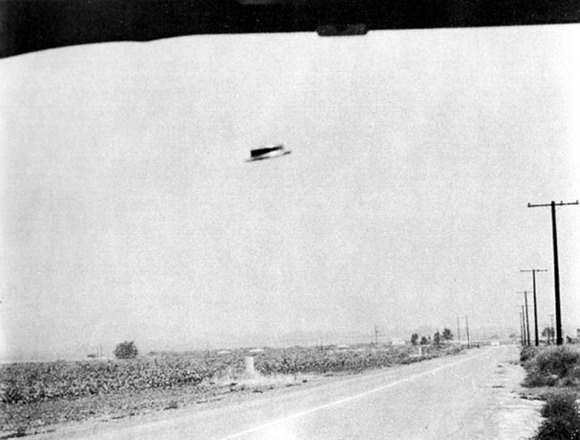 The Los Angeles Subcommittee of NICAP, headed by Idabel Epperson, conducted a thorough investigation of the case, including a detailed character and background check, on-site investigation and measurements by engineer John Gray, and photo analysis. Both Heflin and the newspaper cooperated fully in the investigation.
Computer enhancement and photo analysis was conducted by Robert Nathan at the Jet Propulsion Laboratory, working with first-generation prints and copy negatives made by the newspaper. Among other things, the analysis established photographic evidence to confirm the “light beam” on the underside of the object. The Air Force issued a statement declaring the photographs a hoax, which was strongly disputed by NICAP. Nathan specifically ruled out a model suspended by a string as the explanation.
Unknown parties later attempted to tamper with the evidence and manipulate information. The copy negatives were obtained from Heflin under false pretenses, by someone pretending to be from the North American Air Defense Command. Years later, Bill Spaulding of Ground Saucer Watch, using computer enhancement techniques, reported finding a linelike marking above the object, suggestive of a supporting string, implying the UFO was hoaxed using a small model. However, the alleged “line” clearly was either an artifact created by multigenerational copying of the photographs or a deliberately introduced marking to discredit Heflin. No such line was found in the originals by Nathan, the newspaper, or NICAP analysts.
In 1993, MUFON photo analyst Jeffrey Sainio re-examined Spaulding’s work and rejected the string hypothesis.
Technical data: Polaroid Model 101, 114mm focal length, variable aperture, built-in light meter, automatic settings; Type 107 black and white film, ASA 3000.
Conclusion, per Richard Hall in The UFO Evidence, Volume II: a highly credible, thoroughly investigated case that he considered to meet all the criteria for significant evidence of a real, structured, craft-like UFO.
RESEARCHER’S NOTES
The Heflin Photographs — 1965 and the Case Nobody Could Quite Close
- The circumstances of the photographs argue against premeditation. Heflin stopped his van to photograph an obscured railroad-crossing sign as part of his routine highway maintenance duties, not because he was watching the sky. He used his work-issued Polaroid, already in the vehicle for documenting road hazards. This context makes an elaborately staged hoax involving a suspended model considerably less plausible than it would be for someone who set out specifically intending to fake a sighting.
- Independent professional analysis repeatedly failed to find simple fakery. JPL’s Robert Nathan, working with first-generation materials, found no evidence of a suspended model and confirmed photographic evidence consistent with the reported light band. Nearly three decades later, MUFON’s Jeffrey Sainio independently re-examined the case specifically to test Ground Saucer Watch’s later “suspension string” claim and rejected it, tracing the alleged line to a copying artifact or deliberate later alteration rather than anything present in the original photographs.
- The Air Force’s own explanation is widely regarded as weak. Project Blue Book’s proposed explanation, that the resemblance could be produced by photographing a small thrown object such as a vapor-trail test tray, does not account for the reported radio interference, the object’s reported light-band behavior, or the independent photo analysis findings, and has drawn sustained criticism from researchers across the credibility spectrum for its thinness relative to the documented case details.
- The NORAD impersonation theft is a genuine unresolved anomaly in its own right. Someone falsely claiming Air Defense Command credentials obtained three of Heflin’s four original photographs and never returned them, a theft NORAD subsequently denied any knowledge of. Whatever the underlying object was, this specific act of deception, targeting the best surviving physical evidence in the case, remains itself unexplained and deserves to be weighed as a separate, concerning data point.
- No independent witness is the case’s clearest limitation. Despite a reported flight path passing near a major Marine Corps air station and, by some accounts, close to a busy freeway corridor in broad daylight, no second witness to the object itself has ever come forward. This single-witness status, however well the photographs themselves have held up under repeated independent technical scrutiny, remains the honest limiting factor on the case’s overall evidentiary weight.
Sixty years and multiple rounds of independent technical analysis later, the Heflin photographs remain in an unusual position: repeatedly tested for the simplest forms of fakery and repeatedly found wanting for evidence of one, while still resting on a single witness’s account and an official explanation few investigators, skeptical or otherwise, have found convincing. The theft of the original prints by someone impersonating a federal agency only deepens the case’s unresolved edges. It stands, honestly, as Unexplained.
“A highly credible, thoroughly investigated case that meets all the criteria for significant evidence of a real, structured, craftlike UFO.”
— Richard Hall, The UFO Evidence, Volume II