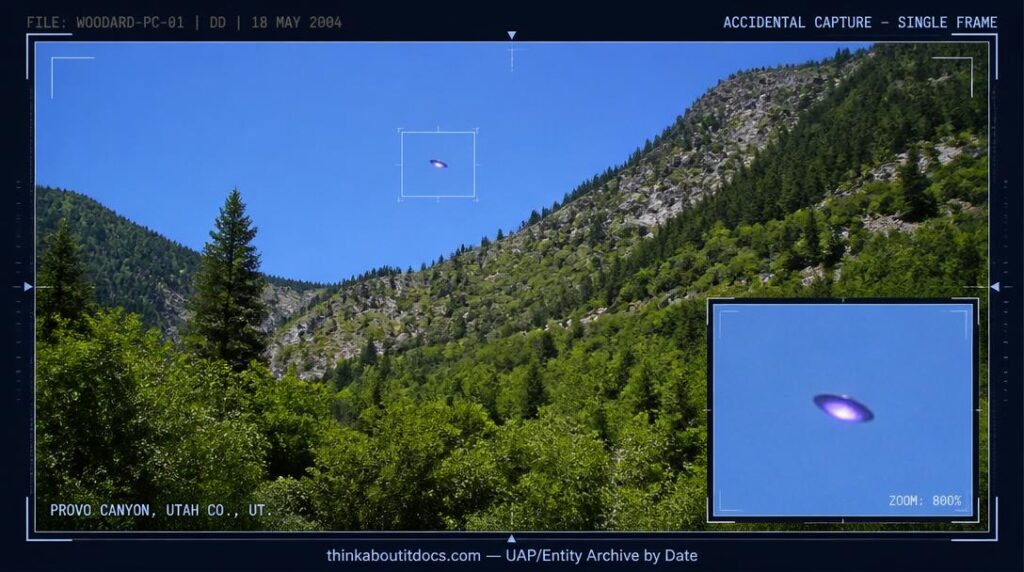
Photo librarian Tommy Woodard's digital camera captured this disc-like anomaly above the Provo Canyon tree line on May 18, 2004 — an object he did not see at the time of exposure.
THINK ABOUTIT UFO|UAP SIGHTING REPORT
2004: Photo Librarian Captures UFO on Film
On May 18, 2004, a 22-year-old photo librarian for the Utah Film Commission was shooting location stills in Provo Canyon when his digital camera captured something he did not see with his naked eye — a purple-glowing disc hovering at an angle above the tree line. The image made CNN Headline News, drew a dismissive assessment from the National UFO Reporting Center, an incredulous response from Hill Air Force Base, and a wire story from the Associated Press. It also produced exactly one frame of ambiguous photographic evidence and zero contemporaneous visual confirmation — placing it squarely in the category of accidental-capture images that generate more questions than they resolve.
The Provo Canyon photograph belongs to a distinct subcategory of the UFO evidence file: images discovered after the fact by witnesses who saw nothing unusual at the time of exposure. Whether these represent genuine captures of transient aerial phenomena, artifacts of digital imaging, or mundane objects frozen into ambiguity by focal length and compression, each must be evaluated on its own technical merits.
Date: May 18, 2004
Sighting Time: Daytime (exact time not recorded)
Day/Night: Daytime
Location: Provo Canyon, Utah
Urban or Rural: Rural
No. of Entity(‘s): None observed
Entity Type: Not Applicable
Entity Description: Not Applicable
Hynek Classification: DD (Daylight Disc) — Object captured in a daytime digital photograph; not observed visually at time of exposure
Duration: Not Applicable — object not observed in real time; single-frame capture only
No. of Object(s): 1
Description of the Object(s): A disc-shaped object hovering at an angle above the tree line, exhibiting a purple glow when digitally enlarged; appeared as a small black speck in the original frame
Shape of Object(s): Disc (saucer-like, tilted at an angle)
Size of Object(s): Described as approximately the same apparent diameter as the moon
Color of Object(s): Purple glow visible upon enlargement
Distance to Object(s): Not estimated
Height & Speed: Hovering above tree line; no motion observed
Number of Witnesses: 0 (object not seen visually; discovered upon review of photographs)
Special Features/Characteristics: Object not visible to the naked eye at time of capture; appeared only as a black speck upon initial photo review; disc shape and purple glow became apparent upon digital enlargement; unique to one frame out of approximately 100 photographs taken that day; witness had a prior childhood sighting of three gray spheres
Case Status: Insufficient Data — Single-frame digital capture with no visual confirmation; competing explanations (bird, artifact) not definitively excluded
Source: Tommy J. Woodard (witness/photographer); Associated Press / The Daily Herald (Utah), May 21, 2004; UFO Evidence; CNN Headline News
Summary/Description: Tommy Woodard, a 22-year-old photo librarian with the Utah Film Commission, was photographing potential film locations in Provo Canyon on May 18, 2004. Using a digital camera, he took approximately 100 photographs during the visit. He observed nothing unusual at the time. Upon later review, Woodard noticed a small black speck in one frame. When he zoomed in digitally, the speck resolved into what appeared to be a disc-shaped object with a purple glow hovering at an angle above the tree line. No other frame from the session contained a similar mark. Woodard contacted Hill Air Force Base to determine if military aircraft had been in the area; the inquiry was met with laughter. A representative of the National UFO Reporting Center suggested the object might be a bird. The image was featured on CNN Headline News and covered by the Associated Press.
Related Cases: 2004: Zion National Park UFO Photograph | 1961: Disc-Shaped UFO at SLC Airport
Detailed Report
Tommy J. Woodard was 22 years old and employed as a photo librarian with the Utah Film Commission when the incident occurred. On May 18, 2004, he traveled to Provo Canyon to photograph locations that might serve as settings for film productions. After completing his professional work, he took additional personal photographs on his way out of the canyon. Approximately 100 images were captured during the session.
Woodard saw nothing unusual in the canyon. It was only later, during post-shoot review, that he noticed a small black speck in one of the frames. Upon digitally enlarging the area, the speck resolved into what Woodard described as a disc-shaped object with a purple glow, hovering at an angle above the tree line. The object’s apparent diameter, when enlarged, seemed roughly equivalent to that of the moon.
Woodard described himself as a science-fiction fan and stated he was a “believer” — a characterization informed by a childhood sighting at age 10 during a baseball game, where he reported seeing three blurry gray spheres rotating in the sky before disappearing. The prior experience likely influenced his willingness to interpret the photographic anomaly as a UFO rather than a conventional object.
Woodard took the proactive step of contacting Hill Air Force Base to determine whether any aircraft, particularly F-16 jets from the 388th Fighter Wing, had been flying over or near Provo Canyon on May 18. Base spokeswoman Lt. Caroline Wellman acknowledged the inquiry and was awaiting response from the fighter wing as of the Associated Press publication date. The initial reaction from base personnel, per Woodard’s account, was laughter.
The image attracted media attention rapidly. The Associated Press ran a wire story authored by Alexandria Sage on May 21, 2004, which appeared in The Daily Herald (Utah). CNN Headline News featured the photograph. A representative of the National UFO Reporting Center in Seattle offered the assessment that the object resembled a bird — a suggestion Woodard rejected. Woodard also argued against the dust-speck explanation by noting that none of his other approximately 100 photographs from the same session contained a similar artifact.
Woodard submitted the original photograph to UFO Evidence for analysis. No subsequent laboratory analysis, image forensics, or definitive identification of the object has been publicly documented.
Researcher’s Notes
The Canyon Frame — Provo Canyon 2004 and the Limits of Accidental Capture
- The Accidental-Capture Problem: Photographs in which the anomalous object was not seen by the photographer at the time of exposure occupy a fundamentally different evidentiary position than images taken deliberately of a visually observed phenomenon. In accidental-capture cases, the photograph is both the evidence and the entirety of the sighting — there is no observational context, no behavioral description, no duration, and no witness perception to analyze. The photograph must stand alone, and single digital frames of distant, small objects are among the weakest forms of photographic evidence because they cannot distinguish between a large distant object, a small nearby object, an insect, a bird, or a digital artifact without additional reference data.
- The Purple Glow — Digital Artifact or Object Feature: The purple or violet coloration visible upon enlargement is consistent with several mundane digital imaging phenomena, including chromatic aberration at the edges of a lens’s correction zone, JPEG compression artifacts in areas of high contrast, and the color fringing that early-2000s consumer digital cameras routinely produced on small, high-contrast subjects against bright backgrounds. Without metadata analysis, lens specifications, and ideally the original RAW file (if one exists — many 2004-era consumer cameras did not save RAW), the purple glow cannot be reliably attributed to an intrinsic property of the photographed object.
- The NUFORC Bird Assessment: The bird hypothesis offered by the NUFORC representative, while dismissively received by the witness, is not trivially excludable. A bird in flight, captured at moderate distance in a single frame with motion blur and chromatic aberration, can produce disc-like shapes with apparent angular structure. Without a second frame showing the object in a different position, or a known reference object for scale comparison, the bird hypothesis remains on the table — not as a definitive explanation, but as one that has not been ruled out.
- Media Coverage vs. Investigation: The case is notable for generating significant media attention — Associated Press wire distribution, CNN Headline News — while receiving essentially no formal investigation. No image forensics laboratory analyzed the photograph. No radar data was obtained. Hill Air Force Base’s response, if it ever came, was not documented in any public source. The gap between media interest and investigative follow-through is characteristic of the early-2000s UFO-media cycle, where novelty and visual appeal drove coverage while the underlying evidence received no institutional scrutiny.
The Provo Canyon photograph survives as a visually intriguing single frame that cannot prove what it appears to show and cannot be definitively debunked by what it does show. The archive preserves it for completeness, alongside the honest assessment that one frame is not enough.
Media

Credit: Tommy J. Woodard / UFO Evidence