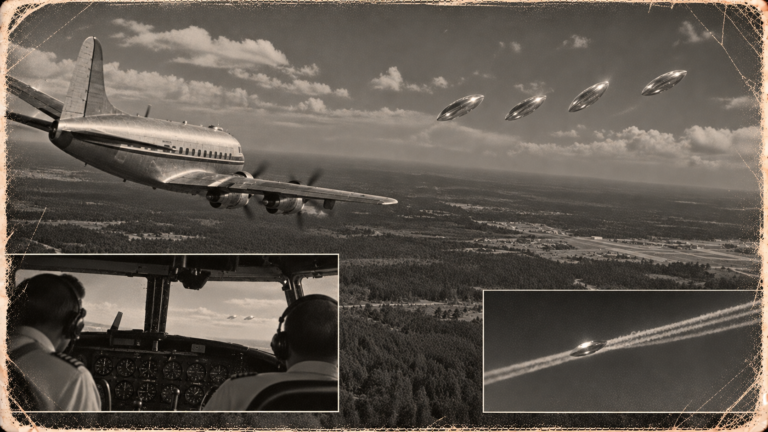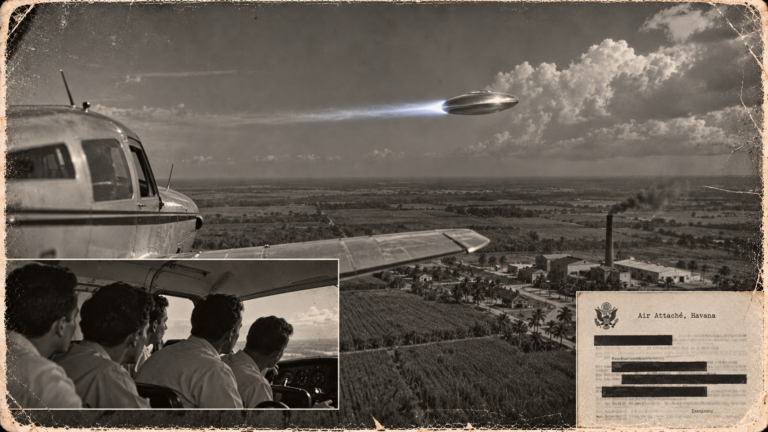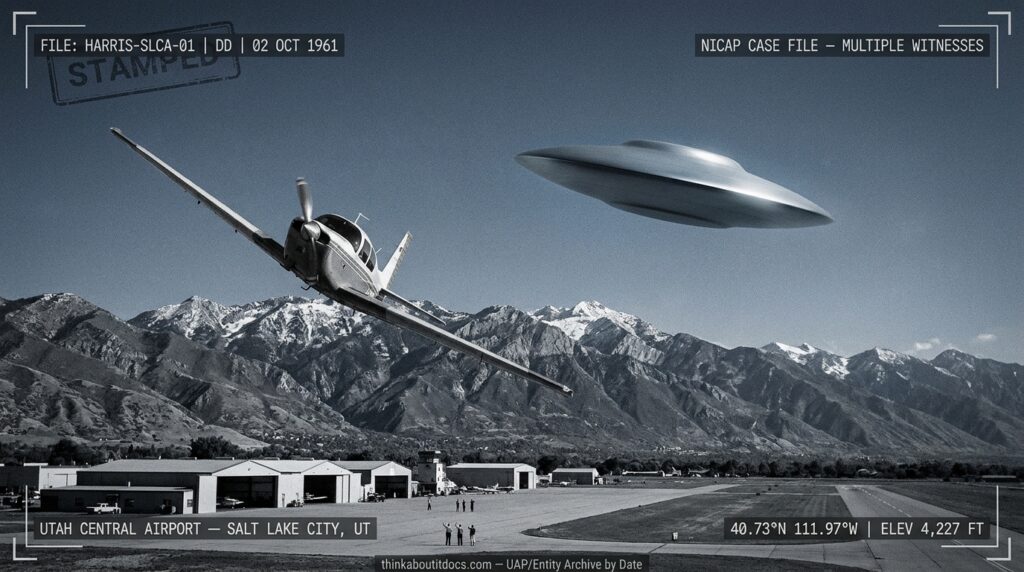
Private pilot Waldo Harris departed the traffic pattern at Utah Central Airport on October 2, 1961, to investigate a 50-foot featureless disc that 8 to 10 ground personnel were also watching.
THINK ABOUTIT UFO|UAP SIGHTING REPORT
1961: Disc-shaped UFO evades pursuit by pilot
On October 2, 1961, a licensed private pilot named Waldo J. Harris departed Utah Central Airport, climbed to altitude, and realized that the bright spot he had been casually dismissing as sun-reflecting aircraft was still hanging in the same position it had occupied before his takeoff roll. He turned toward it. What he found — a featureless disc of sandblasted aluminum, fifty feet across, hovering with a gentle rocking motion and capable of disappearing from sight in two to three seconds — was observed simultaneously by eight to ten ground personnel at the airport, described in real time over radio unicom, and documented on a signed NICAP report form. It is one of the cleanest daylight-disc encounters in the Utah file.
The Harris sighting stands out not for exotic claims but for institutional clarity: a named, credentialed pilot operating in controlled airspace, communicating observations as they occurred over open radio, with multiple independent ground witnesses confirming the object’s presence.
Date: October 2, 1961
Sighting Time: Daytime (exact time not recorded)
Day/Night: Day
Location: Utah Central Airport, Salt Lake City, Utah
Urban or Rural: Urban (airport environment)
No. of Entity(‘s): None observed
Entity Type: Not Applicable
Entity Description: Not Applicable
Hynek Classification: DD (Daylight Disc) — Metallic or whitish structured object seen in daytime
Duration: Extended observation over multiple approach-and-withdrawal cycles; final departure in 2–3 seconds
No. of Object(s): 1
Description of the Object(s): A disc-shaped craft approximately 50–55 feet in diameter and 8–10 feet thick, with the appearance of sandblasted aluminum; no visible wings, tail, doors, windows, or external control surfaces; upper and lower surfaces appeared identical
Shape of Object(s): Disc
Size of Object(s): Approximately 50–55 feet in diameter, 8–10 feet thick
Color of Object(s): Grayish; appearance of sandblasted aluminum
Distance to Object(s): Closest approach approximately 2 miles
Height & Speed: Hovered with rocking motion at pilot’s altitude; rose abruptly approximately 1,000 feet; departed at extreme speed, disappearing from sight in 2–3 seconds (pilot noted he could typically track the fastest jets for several minutes)
Number of Witnesses: Multiple — Waldo J. Harris (pilot, airborne) plus 8–10 ground personnel at Utah Central Airport; personnel at Provo airport monitored radio transmissions
Special Features/Characteristics: Hovered with gentle rocking/wobbling motion on its axis; rose abruptly 1,000 feet when approached; retreated to approximately 10 miles and resumed hovering; departed at velocity far exceeding military jet performance; observed to pass below the horizon in front of mountains, ruling out astronomical explanation; described in real time over radio unicom frequency
Case Status: Unexplained
Source: NICAP (National Investigations Committee on Aerial Phenomena); Richard Hall, The UFO Evidence (1964); signed NICAP report form dated October 10, 1961
Summary/Description: Private pilot Waldo J. Harris, a real estate broker, observed a grayish disc-shaped object hovering with a wobbling motion over the southern Salt Lake Valley while preparing for takeoff at Utah Central Airport. Harris departed the traffic pattern and approached the object in his Mooney Mark 20A aircraft. At approximately two miles distance, he observed a featureless disc approximately 50–55 feet in diameter and 8–10 feet thick with the appearance of sandblasted aluminum. The object rose abruptly 1,000 feet above him, retreated approximately 10 miles to the south and resumed hovering, then departed at extreme velocity, vanishing from sight in 2–3 seconds. Eight to ten ground personnel at Utah Central Airport observed the object simultaneously. Harris described his observations in real time over radio unicom frequency. He signed a NICAP report form on October 10, 1961.
Related Cases: 1952: Bethurum Encounter Near Salt Lake City | 1998: Sphere Over Salt Lake City
Detailed Report
Waldo J. Harris was a licensed private pilot and real estate broker based in the Salt Lake City area. On October 2, 1961, he was preparing to depart Utah Central Airport in his Mooney Mark 20A aircraft when he noticed a bright spot in the sky over the southern end of the Salt Lake Valley. Assuming it was sunlight reflecting from another aircraft in the area, Harris proceeded with his takeoff run.
After becoming airborne and trimming for his climb-out, Harris noted that the bright spot remained in the same position. He continued through his crosswind leg of the traffic pattern, and by the time he was about to turn downwind, realized the object had not moved at all. At that point, Harris departed the standard traffic pattern and flew directly toward the object to investigate.
As he closed the distance, Harris observed that the object had no wings, tail, or any external control surfaces projecting from what he had initially assumed was a fuselage. It appeared to hover with a slight rocking motion. When it rocked upward away from him, Harris could see that it was disc-shaped — approximately 50 to 55 feet in diameter and 8 to 10 feet thick. The surface had the appearance of sandblasted aluminum, with no visible windows, doors, landing gear housings, or openings of any kind.
At his closest approach — estimated at approximately two miles — the object responded to his presence. It rose abruptly about 1,000 feet above Harris’s altitude, giving him an excellent view of its underside, which appeared identical to the upper surface. The object then flew on a heading of approximately 170 degrees for about 10 miles, where it again stopped and resumed its rocking hover. Harris approached again, though less closely this time, and the object departed on a heading of approximately 245 degrees, climbing at about 18–20 degrees above the horizon. It disappeared completely from sight in 2 to 3 seconds. Harris noted that he could normally keep the fastest military jets in sight for several minutes, underscoring the extraordinary speed of the object’s departure.
Throughout the encounter, Harris described his observations over radio unicom frequency. Personnel at Utah Central Airport confirmed the object visually, with 8 to 10 people observing it from the ground. Personnel at Provo airport monitored the radio transmissions but reported they could not see the object from their location. After the initial departure, ground personnel reported seeing the object again and directed Harris to look. He turned back and saw it at much greater distance for only a second or two before it vanished completely. Ground observers reported the object went straight up during its final departure.
Harris noted specifically that the object at one point passed below the horizon in front of mountains to the south — a detail that rules out any astronomical misidentification. He signed a NICAP report form on October 10, 1961, and subsequently answered additional questions from a NICAP Subcommittee member.
Researcher’s Notes
The Airport Disc — Salt Lake City 1961 and the Anatomy of a Strong Daylight Case
- Classification Confirmation — DD: The Daylight Disc classification is correct and well-supported. The object was observed during daytime, displayed metallic structural characteristics, was seen at sufficiently close range by a trained aviation observer to permit detailed shape and size estimates, and exhibited flight characteristics — hovering, abrupt altitude changes, extreme-velocity departure — consistent with a structured craft under intelligent control. The Harris case meets every criterion Hynek established for the DD category.
- Witness Credibility and Documentation Quality: This case benefits from an exceptional combination of witness credibility and documentation standards. Waldo J. Harris was a licensed private pilot with aviation experience sufficient to accurately estimate distances, sizes, and relative speeds — and importantly, to know what aircraft look like from the air. His profession as a real estate broker placed him in a social position where a UFO report carried reputational risk, adding weight to his willingness to sign a formal NICAP report. The real-time radio narration, monitored by personnel at two airports, provides a contemporaneous record that eliminates the distortions of after-the-fact reconstruction. NICAP’s investigation, led by Richard Hall, produced documentation that meets research standards still relevant today.
- The Object’s Behavioral Intelligence: The disc’s responses to Harris’s approaches suggest awareness and reactive decision-making. On the first approach, it rose 1,000 feet — enough to establish visual dominance while remaining observable. On the second approach, it departed at extreme velocity on a specific heading. This pattern of graduated response — tolerate observation at distance, withdraw when closely approached, depart decisively when re-approached — is reported consistently across strong daylight disc cases and suggests behavior more consistent with intelligent piloting than with any known atmospheric or astronomical phenomenon.
- Speed as Evidence: Harris’s comparison to military jet tracking is the most analytically significant detail in the report. A pilot experienced in observing fast-moving aircraft in the same airspace states that he could normally keep the fastest jets in sight for several minutes. This object vanished from view in 2 to 3 seconds. Even a conservative interpretation of this comparison implies a departure velocity orders of magnitude beyond the performance envelope of any 1961 aircraft — or any publicly acknowledged aircraft today.
- Ground-Truth Confirmation: The independent ground observation by 8 to 10 airport personnel eliminates the most common skeptical explanations for pilot sightings: windshield reflections, atmospheric lensing, or cockpit-environment artifacts. The ground observers saw the same object from a different angle and at a different altitude. They continued tracking it after Harris lost visual contact. The mountain-crossing observation — the object passing below the horizon in front of terrain features — independently rules out astronomical or satellite misidentification. Multiple-witness, multi-platform confirmation of this quality is rare in the DD literature.
The Harris sighting at Utah Central Airport is the kind of case that gives serious investigators reason to continue working. A named, credentialed pilot. Real-time radio narration. Independent ground confirmation from multiple witnesses. Structural detail at close range. And a departure speed that no conventional framework can accommodate. The file remains open because the evidence, by any honest standard, demands it.