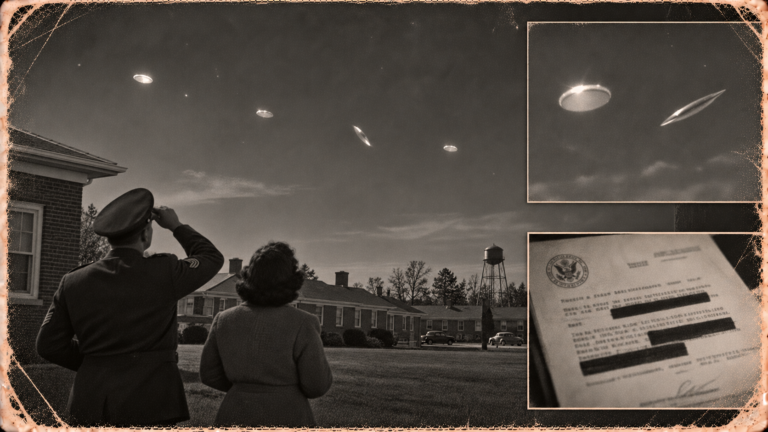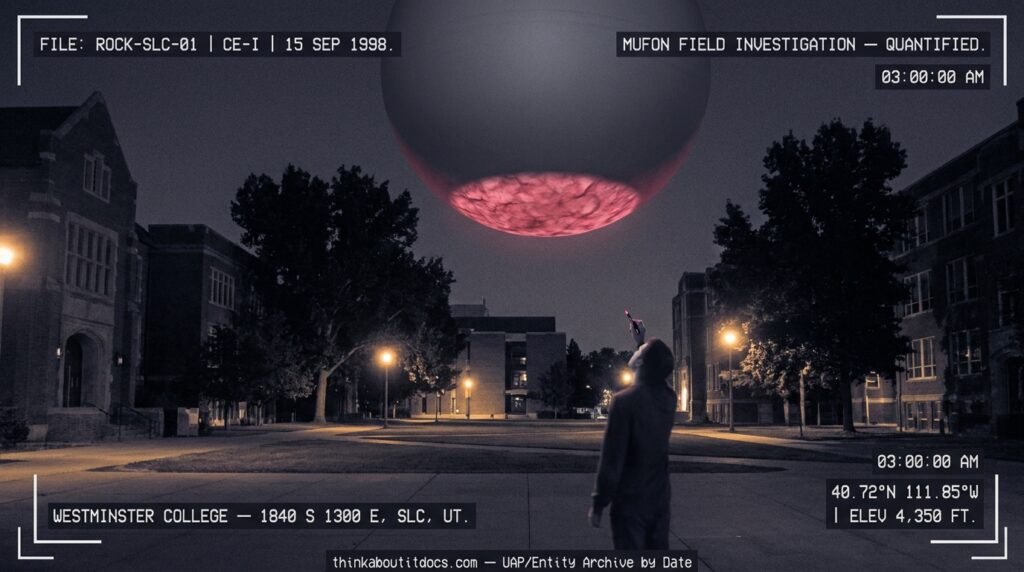
A 65-foot gray sphere with a cratered, reddish-pink underside passed 60 feet directly over witness Chris Rock at Westminster College on September 15, 1998, at 3:00 AM.
THINK ABOUTIT UFO|UAP SIGHTING REPORT
1998: Sphere seen over Salt Lake City, Utah
At three o’clock in the morning on September 15, 1998, a maintenance worker at Westminster College in Salt Lake City pointed a laser pointer at Jupiter and got a response — a gray, cratered sphere the size of a small building that appeared over an adjacent rooftop, locked itself motionless in the air for two seconds, then accelerated from zero to seventy miles per hour instantaneously and passed sixty feet over his head. The MUFON investigation that followed produced precise measurements, calculated speeds, and a witness description of the object’s underside that belongs not to casual skygazing but to close-range structural observation.
The case is a textbook demonstration of how quickly the Hynek classification system can be strained when a single sighting crosses multiple observational thresholds in the span of four seconds.
Date: September 15, 1998
Sighting Time: 3:00 AM MST
Day/Night: Night (early morning)
Location: Westminster College, 1840 South 1300 East, Salt Lake City, Utah
Urban or Rural: Urban
No. of Entity(‘s): None observed
Entity Type: Not Applicable
Entity Description: Not Applicable
Hynek Classification: CE-I (Close Encounter of the First Kind) — Observation of a structured object at close range (within 500 feet) with sufficient detail to exclude misidentification. Reclassified from NL; the 60-foot closest approach with structural detail of the underside meets CE-I criteria.
Duration: 3–4 seconds total observation
No. of Object(s): 1
Description of the Object(s): A gray, smooth, featureless sphere with a cratered underside described as “reddish, pinkish, with pits and pings and very much crater-like”; no visible seams, propulsion elements, or emissions
Shape of Object(s): Spherical
Size of Object(s): Approximately 65 feet in diameter (calculated average based on angular size at known distances)
Color of Object(s): Gray (upper surfaces); reddish-pink with cratered texture (underside)
Distance to Object(s): 260 feet at initial observation; 60 feet at closest approach (directly overhead)
Height & Speed: 40 feet above ground; calculated speed 53–70 mph based on 310 feet traversed in 3–4 seconds; instantaneous acceleration from stationary hover to full speed with no observable transition
Number of Witnesses: 1 (Chris Rock)
Special Features/Characteristics: Instantaneous acceleration from complete standstill to approximately 60–70 mph with no visible acceleration phase; completely silent throughout the encounter; cratered, reddish-pink underside contrasting with smooth gray upper surfaces; witness reported the object appeared aware of him; a “bang” sound was heard after the object passed behind a building, origin unclear
Case Status: Unexplained
Source: MUFON (published January 2003); witness report to NUFORC (Peter Davenport)
Summary/Description: Witness Chris Rock stepped outside at Westminster College in Salt Lake City at approximately 3:00 AM on September 15, 1998. After firing a laser pointer toward the western sky in the direction of Jupiter, a gray spherical object appeared within one to two minutes, hovering over an adjacent building at a measured distance of 260 feet and 40 feet above the ground. The sphere locked motionless for 2–3 seconds, then moved from west to north to northeast, passing directly over the witness at 60 feet distance. At its closest approach, the witness observed the underside in detail, describing it as reddish-pink and cratered. The object demonstrated instantaneous acceleration from standstill to approximately 60–70 mph with no observable transition. It was completely silent throughout. The witness pursued on foot but heard a “bang” and found the object gone. He reported the sighting to NUFORC within days.
Related Cases: 1961: Disc-Shaped UFO at SLC Airport | 2004: Provo Canyon UFO Photo
Detailed Report
Chris Rock was working at Westminster College at 1840 South 1300 East in Salt Lake City on the night of September 14–15, 1998. At approximately 3:00 AM Mountain Standard Time, he stepped outside into a cool, clear night with temperatures around 65°F and excellent visibility. Facing west, Rock fired a laser pointer into the sky in the general direction of Jupiter.
Within one to two minutes, a gray spherical object appeared in the western sky, hovering over an adjacent building at a distance that MUFON investigators later measured at 260 feet from the witness’s position and approximately 40 feet above the ground. The object had an apparent angular diameter of 7 inches at arm’s length at this initial distance. Upon seeing the object, Rock turned off the laser pointer.
The sphere sat motionless for 2 to 3 seconds with absolute stability — no bobbing, weaving, or oscillation of any kind. Rock described it as appearing “locked in place.” Then, in what the witness described as instantaneous — with no visible period of acceleration — the object was moving at approximately 60 mph. It traveled across the top of the adjacent building heading north, then turned northeast, passing almost directly over the witness.
MUFON’s investigation calculated the object’s speed based on the measured distances. With a total traversal of approximately 310 feet from initial position to last observed position, the calculated speed was 70 mph if the transit took 3 seconds, or 53 mph if it took 4 seconds — broadly consistent with the witness’s real-time estimate of 60 mph.
The moment of closest approach — 60 feet from the witness at 40 feet altitude — provided the most detailed observation. At this point, the sphere subtended approximately 21 inches at arm’s length. Rock observed the underside clearly, describing it as “reddish, pinkish, with pits and pings and very much crater-like.” The upper surfaces, by contrast, were smooth, gray, and entirely featureless. The object produced no sound at any point during the encounter and created no perceptible disturbance to the surrounding environment.
Rock reported a subjective impression that the object was aware of his presence. He attempted to follow it on foot as it continued northeast behind trees and a building. Before he could clear the tree cover, he heard a “bang.” When he reached open ground, the object was gone. He was unable to determine whether the sound was related to the object or coincidental.
Rock contacted Peter Davenport at the National UFO Reporting Center within a few days of the sighting. MUFON conducted a field investigation with measured distances, angular size calculations, and speed analysis, publishing their findings in January 2003.
Researcher’s Notes
The Westminster Sphere — Salt Lake City 1998 and the Problem of Instantaneous Acceleration
- Classification Upgrade — NL to CE-I: The existing page classifies this encounter as NL (Nocturnal Light), which would be appropriate for a distant luminous point observed at night. However, the witness observed structural detail — specifically the cratered, reddish-pink underside — at a distance of 60 feet. The Hynek CE-I classification applies to observations within 500 feet where sufficient detail is present to exclude misidentification. This case meets that threshold by a wide margin. At 60 feet, the 65-foot sphere would have filled most of the witness’s overhead field of view. The underside description — color, texture, surface features — represents structural observation, not light-point tracking. CE-I is the correct classification.
- The Laser-Response Sequence: The temporal proximity between the witness’s use of a laser pointer and the appearance of the sphere raises a question the source material does not adequately address. Whether the laser use and the object’s appearance were causally connected, coincidentally timed, or unrelated is impossible to determine from a single-witness observation. The witness did not claim a causal link, but the sequence — laser fired at 3 AM, sphere appears within one to two minutes — is noted here as a structural element of the account that researchers may find relevant in comparative analysis with other stimulus-response reports.
- Quantified Performance Data: The MUFON investigation is notable for producing calculated rather than estimated performance data. The 310-foot traversal, the 260-foot and 60-foot measured distances, and the resulting 53–70 mph speed calculation transform a subjective sighting into a case with quantified parameters. More significant than the absolute speed — which is modest by UAP standards — is the instantaneous acceleration from stationary hover to full velocity with no observable transition. The witness was explicit: the object was locked motionless, and then it was moving at 60 mph. No intermediate state was observed. This zero-to-speed performance, if accurately reported, represents a propulsion characteristic that is incompatible with any known aerodynamic, aerostatic, or ballistic system.
- Underside Observation — Physical Structure: The description of the sphere’s underside as “reddish, pinkish, with pits and pings and very much crater-like” — in contrast to the smooth, gray, featureless upper surfaces — describes a differentiated physical structure. The two-tone surface suggests an object with distinct upper and lower functional zones rather than a uniform body. This is consistent with a manufactured object and inconsistent with natural phenomena (atmospheric plasmas, ball lightning, and similar candidates present uniform luminosity rather than differentiated surface textures). The witness’s language — “pits and pings” — is specific and unpolished enough to suggest genuine observation rather than narrative construction.
- Single-Witness Limitation: The primary evidentiary weakness is the single-witness observation at 3:00 AM. Rock reported the sighting promptly to NUFORC and cooperated fully with MUFON’s field investigation, and there is no obvious motive or behavioral pattern suggesting fabrication. However, a single observer in a low-activity hour provides no independent corroboration. The case rests entirely on Rock’s account and MUFON’s after-the-fact measurements of the physical environment.
The Westminster College sphere is a case that rewards careful reading. Its quantified measurements, structural detail, and instantaneous-acceleration profile place it well above the typical anonymous night-light report, even as its single-witness limitation keeps it short of the multi-observer standard that elevates cases like the Harris 1961 sighting at the same city’s airport. The archive holds both and lets the evidence speak its own weight.
Media

Drawing by the witness of his sighting. (source: MUFON)