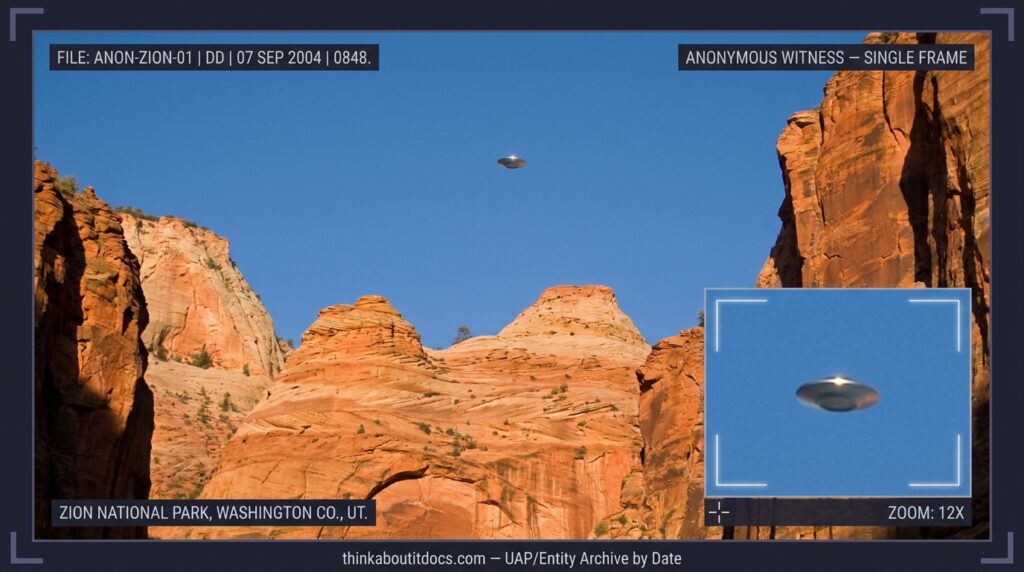
An anonymous tourist's Minolta DiMAGE A7 captured a metallic gray disc in frame 22 of 27 photographs taken at Zion National Park on September 7, 2004.
THINK ABOUTIT UFO|UAP SIGHTING REPORT
2004: UFO photographed in Zion National Park, Utah
On the morning of September 7, 2004, a tourist and his son stopped at Zion National Park near Cedar City, Utah, during a road trip through the Southwest. He took 27 photographs with a Minolta DiMAGE A7 digital camera. One frame — number 22 — contained a metallic gray disc against the park’s red-rock landscape. The photographer did not see the object at the time. He did not discover it until reviewing the images at home that evening. No other frame in the series contained anything unusual. No name was ever attached to the report.
Date: September 7, 2004
Sighting Time: 8:48 AM
Day/Night: Daytime
Location: Zion National Park, near Cedar City, Utah
Urban or Rural: Rural (National Park)
No. of Entity(‘s): None observed
Entity Type: Not Applicable
Entity Description: Not Applicable
Hynek Classification: DD (Daylight Disc) — Object captured in a daytime photograph; not observed visually at time of exposure
Duration: Not Applicable — accidental single-frame capture
No. of Object(s): 1
Description of the Object(s): A metallic gray disc-shaped object visible in one frame of a 27-photograph series; not observed by the photographer at the time of exposure
Shape of Object(s): Disc
Size of Object(s): Described by the existing page as approximately the same apparent diameter as the moon
Color of Object(s): Metallic gray
Distance to Object(s): Not estimated
Height & Speed: Not observed; single frame only
Number of Witnesses: 0 (object not seen visually; discovered upon photo review)
Special Features/Characteristics: Accidental capture; present in only one frame out of 27; photograph taken with a Minolta DiMAGE A7 digital camera; raw, unmodified original image submitted; camera metadata (EXIF) presumably available but not publicly analyzed
Case Status: Insufficient Data — Anonymous witness, single-frame capture, no investigation
Source: UFOEvidence.org (anonymous submission)
Summary/Description: An unnamed photographer and his son visited Zion National Park during a Labor Day weekend road trip through Arizona and Utah in 2004. On the morning of September 7, the photographer took 27 images with a Minolta DiMAGE A7 digital camera. Upon reviewing the photographs at home that evening, he discovered that frame number 22 contained a metallic gray disc-shaped object against the park’s landscape. No other frame in the series showed anything unusual. The photographer stated the image was raw and unmodified. He submitted the original photograph to UFO Evidence and reported searching unsuccessfully online for similar photographs or other witnesses who may have captured the same object.
Related Cases: 2004: Provo Canyon UFO Photo | 2005: Woodland Hills UFO
Detailed Report
The photographer described a road trip with his son during Labor Day weekend 2004, visiting several national parks in Arizona and Utah. They stopped briefly at Zion National Park, located near Cedar City in southwestern Utah. On the morning of September 7, beginning at approximately 8:48 AM (based on camera timestamp data), he photographed the park’s dramatic red-rock formations and canyon landscapes.
The camera used was a Minolta DiMAGE A7, a prosumer-grade digital camera notable for its 7-megapixel resolution and 28–200mm equivalent zoom range — a capable imaging device for 2004 that would have produced sufficient resolution for meaningful analysis of an anomalous object in the frame. Twenty-seven photographs were taken during the visit.
The photographer stated that he noticed nothing unusual during his time in the park. It was only upon reviewing the images at home that evening that he discovered the anomaly in frame number 22. The object appeared as a metallic gray disc-shaped form against the landscape. None of the other 26 frames contained a similar anomaly.
The photographer described the image as “raw” and “unmodified,” and submitted it directly to UFO Evidence. He reported having no prior UFO sighting experience and being genuinely surprised by the discovery. He searched online for similar photographs from the area and for other witnesses but found nothing.
No formal investigation was conducted. No image forensics analysis has been publicly documented. The EXIF metadata from the Minolta DiMAGE A7, which would contain exposure settings, focal length, and potentially GPS data, has not been analyzed in any publicly available source. The photographer’s identity remains unknown.
Researcher’s Notes
The Zion Frame — Cedar City 2004 and the Anonymous Accidental Capture
- Anonymous Witness — Evidentiary Impact: The photographer never identified himself. This is not an uncommon choice for casual submitters to online UFO databases, but it has significant consequences for evidentiary evaluation. Without a named witness, there is no possibility of follow-up interview, credibility assessment, camera equipment verification, or chain-of-custody documentation for the image file. The photograph exists as an orphaned artifact — technically analyzable but socially unanchored.
- Camera Specifications and Analytical Potential: The Minolta DiMAGE A7 was a well-regarded 2004-era prosumer camera with 7-megapixel resolution, a 7x optical zoom (28–200mm equivalent), and support for both JPEG and RAW file formats. If the original image file were available for forensic analysis — particularly in RAW format — meaningful assessments of the anomaly’s distance, size, reflectance characteristics, and consistency with the surrounding image data would be possible. In the absence of such analysis, the photograph remains visually suggestive but analytically unprocessed.
- Comparative Note — Utah 2004 Photo Cluster: This case is one of two accidental-capture disc photographs from Utah in 2004, alongside Tommy Woodard’s Provo Canyon image from May of the same year. Both involve digital cameras, daylight conditions, disc-shaped objects discovered after the fact, and no visual confirmation at the time of exposure. The temporal and geographic proximity is noted; however, the two cases appear entirely independent — different cameras, different witnesses, different locations, different seasons. Whether the co-occurrence represents anything beyond coincidence is unresolvable with available data.
- The Single-Frame Limitation: As with the Provo Canyon photograph, a single frame provides no kinematic data — no trajectory, no speed, no behavioral observation. It cannot distinguish between a distant structured craft, a nearby small object (bird, insect, thrown debris), or a digital imaging artifact without reference-point analysis and ideally a second frame for comparison. The photographer’s statement that none of the other 26 frames showed anything unusual is consistent with either a transient aerial object that was present for only the fraction of a second of exposure, or with a frame-specific artifact. Neither interpretation can be excluded.
The Zion National Park photograph is a one-frame mystery from an anonymous source — the minimum viable unit of a UFO photographic case. It is preserved here because the archive’s job is to hold the record, not to curate only the cases that meet an ideal standard. Some frames contain the universe. Some contain dust. And some, like this one, contain an honest “we don’t know.”
Media