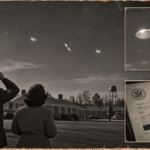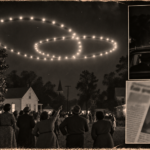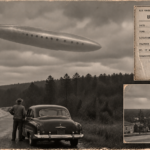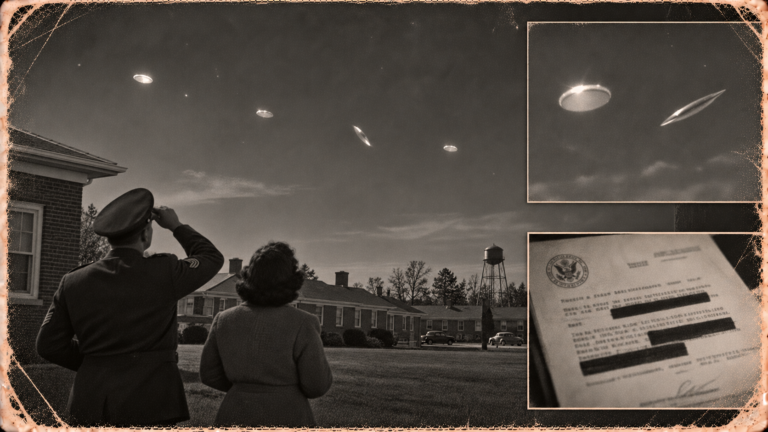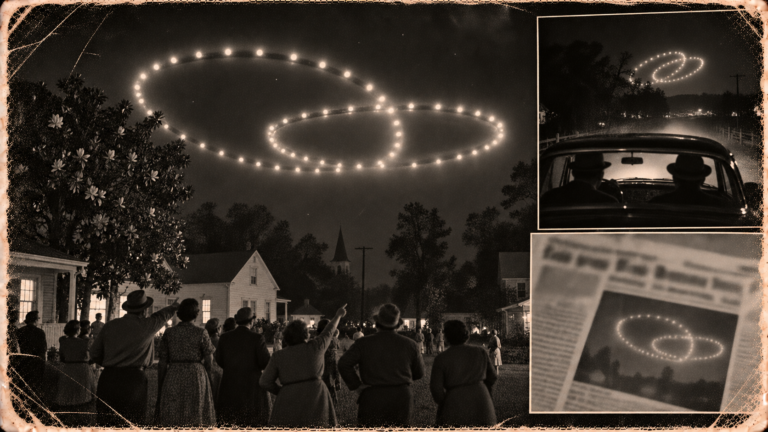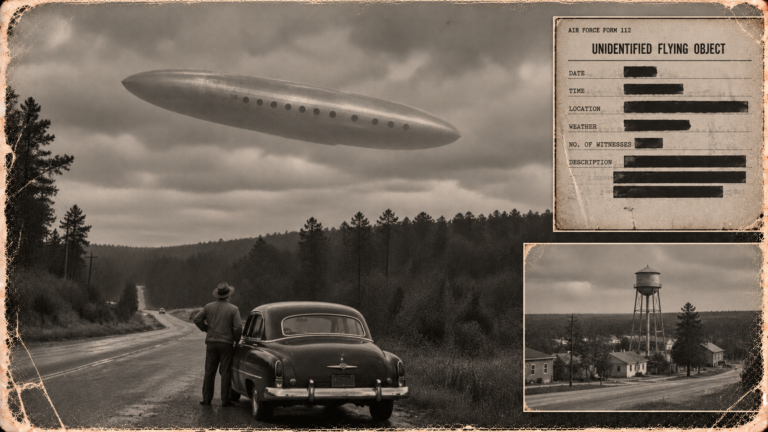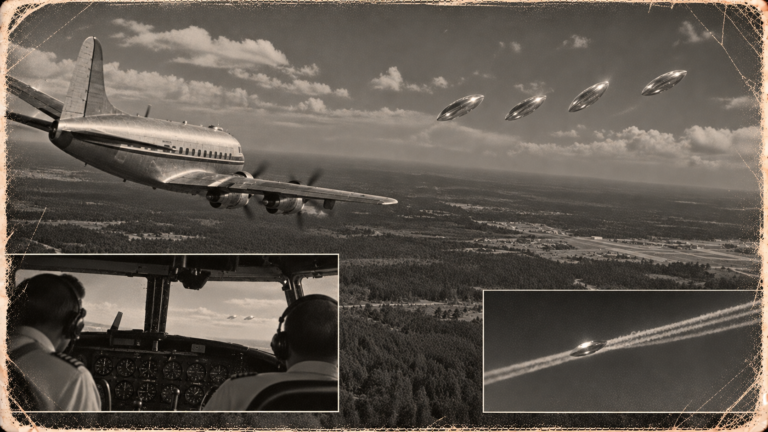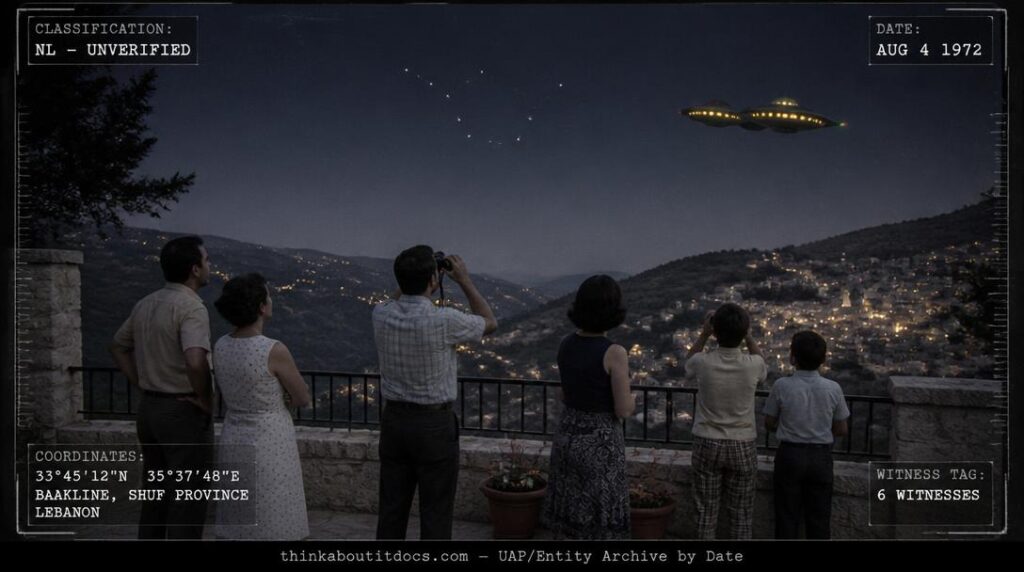
Recreation of the August 1972 Baakline, Lebanon sighting, in which Walter Hamady and five family members resolved a distant red light into a detailed, lit, double-saucer craft.
THINK ABOUTIT UFO|UAP SIGHTINGS REPORT
1972: The Stacked Saucers of Baakline, Lebanon — The Walter Hamady Sighting
On the evening of August 4, 1972, a University of Wisconsin art professor, his wife, and four family members trained two pairs of binoculars on what they took for a bright red star near the Big Dipper over the Shouf Mountains of Lebanon, and instead resolved a detailed, silently moving craft — two saucers stacked rim to rim, ringed with warm yellow windows, a lit dome on top, and a red and green light trailing behind — a sighting first preceded by an unexplained, localized power failure at the very house where they stood.
Date: August 4, 1972
Sighting Time: Undocumented — witness states only that it occurred “early in the evening,” around dusk
Day/Night: Evening, transitioning into night
Location: Baakline (also spelled Baaqline), Shuf (Chouf) Province, Lebanon — observed from a terrace at a family summer home in nearby Chemlan overlooking Beirut airport
Urban or Rural: Rural — a mountain village setting in the Shouf range, corrected from the original blank field
No. of Entity(‘s): Undocumented
Entity Type: Not Applicable — no entity described
Entity Description: Not Applicable
Hynek Classification: NL (Nocturnal Light) — corrected from the original DD (Daylight Disc). This sighting occurred at dusk transitioning into full night and was resolved through binoculars as a lit, structured object; it was never observed in daylight, so DD does not fit. See Researcher’s Notes.
Duration: Undocumented — witness did not track elapsed time and notes he cannot say how long passed before the power returned
No. of Object(s): Reported as multiple in the original filing, though the account describes what may be a single craft observed on two separate occasions that evening — once by the cousins before the main group arrived, and once later by the full group via binoculars. It is not established whether these were the same object or two distinct craft; see Researcher’s Notes.
Description of the Object(s): Two saucers placed on top of each other, with a perpendicular plane of windows running all the way around the craft. The interior light resembled ordinary warm, yellow house lighting. A lit dome sat on top of the craft, illuminated in the same manner as the windows. At the rear, or in the lee of its direction of travel, were two additional lights — Mr. Hamady could not recall their colors, but his wife recalled one red and one green. No exhaust, sound, or visible means of propulsion accompanied the object, and its movement was steady.
Shape of Object(s): Disc — specifically two discs stacked rim to rim
Size of Object(s): Undocumented
Color of Object(s): Warm yellow interior/window lighting on the craft body and dome; trailing lights described as one red and one green. The earlier, separate sighting by the cousins involved a bright red light only.
Distance to Object(s): Undocumented — no range estimate given; the object was resolved in detail only through 7×35 and 8×32 binoculars, suggesting a considerable distance to the naked eye
Height & Speed: Altitude undocumented. Speed described as steady, “about the speed of a propeller driven aircraft,” proceeding into the southeast before disappearing from view.
Number of Witnesses: At least 6 — Mr. and Mrs. Hamady, Mr. Hamady’s aunt, two cousins, and a cousin’s wife, using two pairs of binoculars (a Bushnell 7×35 and a Leica Trinovid 8×32)
Special Features/Characteristics: An unexplained, localized power failure affected only the witnesses’ house — not the neighboring village or the uncle’s own property — shortly before the cousins’ initial sighting of a bright red light that emitted a puff of black smoke before moving off to the southwest. Power outages were noted by the witness as not unusual in Lebanon generally, but the localized nature of this one, isolated to a single property, was not otherwise explained. The night was clear, with no clouds and only a light mountain breeze.
Case Status: Unexplained — a detailed, multi-witness, optically-corroborated sighting published in the APRO Bulletin, with no conventional explanation identified in the historical record
Source: APRO (Aerial Phenomena Research Organization) Bulletin, January/February 1973
Summary/Description: Mr. Walter Hamady, a professor of art, was one of several witnesses to the presence of an unidentified flying object over Baakline, Shuf Province, Lebanon, early in the evening of August 4, 1972. Mr. Hamady is a resident of the United States, but his exact location will not be pinpointed. At the time of his sighting he was visiting his uncle’s summer home at Chemlan, which overlooks the Beirut airport. At about dusk, Mr. Hamady, his wife Mary, and Mr. Hamady’s aunt went to Baakline, and as they pulled into the driveway of the house, Hamady’s cousins were very excited, exclaiming they had just seen a “flying saucer.” The small company made their way onto the terrace and saw a bright red light moving “straight off into space.” Two pairs of binoculars were on hand — a Bushnell 7×35 and a Leica Trinovid 8×32.
The first sighting, which occurred prior to Mr. and Mrs. Hamady’s arrival, was described by the cousin as follows: he, his wife, and his brother were sitting on the terrace enjoying the early evening when the power failed. They looked around and noted that the power at their uncle’s home was still on, as was that of the village. Power outages are not unusual in Lebanon, so there was no alarm felt. After a bit, Mr. Hamady’s cousin’s wife exclaimed, “Look at that beautiful red star, it must be Mars!” They all looked directly overhead and observed a very bright red star. As they admired it, it emitted a big puff of black smoke and began to move off to the southwest. They ran to get their binoculars, and shortly after, Mr. Hamady and his wife and aunt arrived.
After the object moved off, the power returned, but Mr. Hamady did not keep track of time and does not know how soon after the object left this occurred. The group continued sitting on the terrace, enjoying the cool evening and the usual mountain breeze. The night was clear, with no clouds and no wind beyond a slight breeze.
Mr. Hamady, his wife, aunt, and two cousins walked to the terrace railing and were admiring the town of Deir El Qamar, where a celebration was taking place and the entire village was brightly lit. Someone asked about the location of the Big Dipper, and Mrs. Hamady located the constellation, then was surprised to see a bright red light moving within it. She brought it to the attention of the others, and they trained their binoculars on it. Mr. and Mrs. Hamady passed their binoculars around, and one of the cousins called for his wife to join the group and bring her binoculars as well.
Hamady described the object seen through the binoculars as two saucers placed on top of each other, with a perpendicular plane of windows running all the way around the craft. There was a light inside that was not strange, simply resembling house lights at night, warm and yellow in appearance. On top of the craft was a dome, also lit in the same manner as the windows. At the rear, or in the lee of the direction it was moving, were two lights; Hamady could no longer recall their colors, but his wife recalled one was red and the other green. There was no exhaust, noise, or visible means of propulsion, and the movement was steady. The object proceeded steadily into the southeast, at about the speed of a propeller-driven aircraft, and disappeared from view.
Related Cases: Undocumented — no confirmed related case identified in the archive at this time
Detailed Report
This case carries unusual credibility for its era, both in its sourcing and its witness. It was documented at the time by the Aerial Phenomena Research Organization (APRO), a serious civilian ufology research group active from the 1950s through the 1980s, and published in its bulletin the following winter. The primary witness, Walter Hamady, was a real and independently verifiable figure — a University of Wisconsin-Madison art professor of Lebanese Druze descent, later well known in the book arts world as founder of The Perishable Press Limited, with documented family roots in Baaqline itself. The sighting unfolded in two stages. First, Hamady’s cousins, sitting on the terrace of a relative’s Chemlan summer home, experienced a localized power failure — affecting only their own property, not the neighboring village or their uncle’s house — shortly before spotting what they first took for the planet Mars: a bright red light that then emitted a puff of black smoke and moved off to the southwest. By the time Hamady, his wife Mary, and his aunt arrived, this object was gone and the power had returned. Later that evening, the full group, admiring a nearby village celebration from the terrace railing, noticed a bright red light moving within the Big Dipper and trained two pairs of binoculars on it. Through the optics, Hamady resolved a detailed structure: two saucer-shaped sections joined rim to rim, a continuous band of windows lit in ordinary warm yellow tones, a similarly lit dome on top, and two trailing lights at the rear, recalled by his wife as red and green. The object made no sound, produced no exhaust, and moved with steady, level flight at roughly the speed of a propeller aircraft before continuing southeast and out of view. No photograph exists, but the level of consistent structural detail recalled by multiple witnesses using two different sets of binoculars is unusual for a report of this vintage.
RESEARCHER’S NOTES
The Stacked Saucers — Baakline 1972 and the Case for a Structured Night Sighting
- Classification Assessment: The original filing listed this as DD (Daylight Disc), which does not fit the reported facts — the sighting occurred at dusk transitioning into full night, and the object was never observed in daylight. It has been corrected to NL (Nocturnal Light). That said, the level of structural detail recovered through binoculars — a stacked double-saucer body, a ringed window band, a lit dome — pushes well past a typical unstructured “point of light” NL case; this is closer to a resolved nocturnal structured-craft sighting than an ambiguous light, even though NL remains the closest available Hynek category for a night-time, non-close-encounter observation.
- Source Chain Assessment: This case is unusually well-anchored for its era: it was documented contemporaneously by APRO and published in a named bulletin issue, and the primary witness, Walter Hamady, is an independently verifiable public figure with a documented, traceable biography and confirmed family ties to the Baaqline area. This is a meaningfully stronger source chain than an anonymous, decades-later online submission.
- Evidentiary Weight: No photograph accompanies the report, but the account benefits from multiple witnesses independently confirming the same structural details — the window band, the dome, the trailing red and green lights — while viewing through two different pairs of binoculars. The localized power failure preceding the first sighting is a genuinely unusual detail; electromagnetic-effect disturbances reported alongside UFO sightings are a recurring theme in the broader literature, though no instrumented measurement of the outage exists here, only the witnesses’ observation that it affected a single property and no others nearby.
- Pattern and Comparative Context: Whether the earlier red light seen by the cousins and the later structured craft seen by the full group were the same object returning, or two separate objects, is not established by the account itself — the report simply moves from one sighting to the other without directly connecting them. This ambiguity is preserved here rather than resolved in either direction. The “two saucers stacked rim to rim with a lit dome” configuration is a recurring structural description across mid-20th-century contactee and structured-craft reports more broadly.
- Geographic and Historical Context: Baakline (Baaqline) sits in Lebanon’s Shouf Mountains, a historically Druze area, with Chemlan nearby overlooking Beirut’s airport approach. No air traffic, military exercise, or known aerial activity for the immediate area on this date has been identified in the historical record to explain the sighting.
Few reports from 1972 carry this combination of a verifiable, named witness, contemporaneous documentation by a serious research organization, and consistent structural detail confirmed independently by several people through two separate optical instruments. What began as a misidentified “star” resolved, under magnification, into something neither Hamady nor his family could otherwise explain. Absent a photograph or an identified conventional source, the case remains Unexplained.
“There was no exhaust, noise or visible means of propulsion, and the movement was steady.”