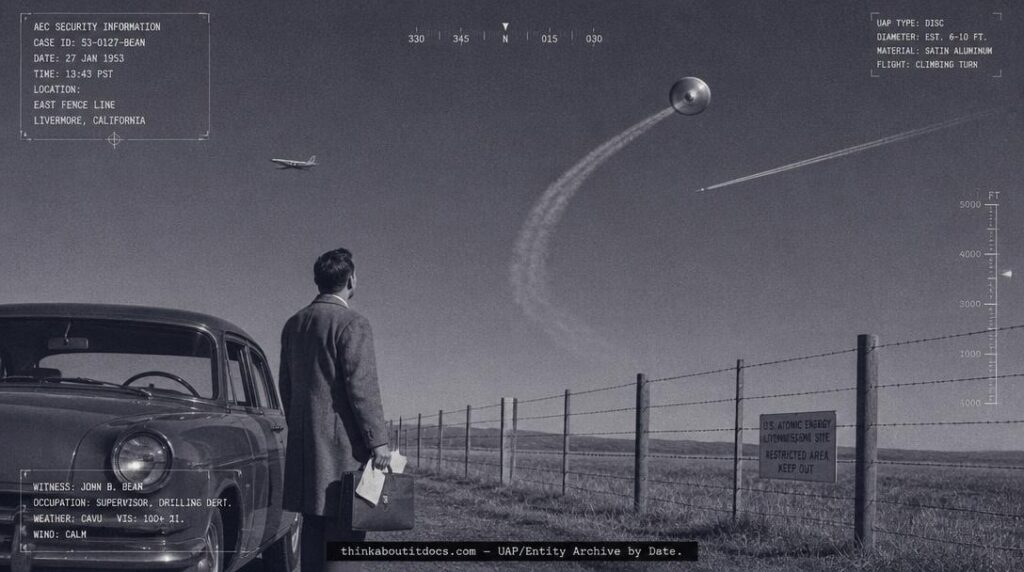
Archival rendering of John B. Bean's January 27, 1953 sighting near the Atomic Energy Commission's Livermore, California research facility.
THINK ABOUTIT UFO SIGHTINGS REPORT
1953: Round, Metallic Object Near Livermore
On the afternoon of January 27, 1953, John B. Bean — a flyer with 17 years of experience — had just stopped at the Purchasing Office of the Atomic Energy Commission’s research facility near Livermore, California, when a small whitish object crossing the Commission property caught his eye. What began as an object he first dismissed as drifting plant fiber turned into a nine-second sighting in which Bean had three different aircraft in view simultaneously — a descending DC-6, a contrail-streaked jet, and a perfectly round, satin-aluminum disc that outclimbed and outmaneuvered both by a wide margin, leaving no contrail and no sound, before vanishing on a rapid ascent.
Date: January 27, 1953
Sighting Time: 1:43 p.m. (1343 local time, noted by the witness immediately after the sighting)
Day/Night: Day (afternoon)
Location: Along the eastern fence line of the Atomic Energy Commission’s research facility, near Livermore, California
Urban or Rural: Rural
No. of Entity(s): Not Applicable
Entity Type: Not Applicable
Entity Description: Not Applicable
Hynek Classification: DD — Daylight Disc. A metallic or whitish object observed in the day performing controlled flight maneuvers.
Duration: Approximately nine seconds total, per the witness’s own careful estimate (roughly 3 seconds counted time during the object’s climb, 3–4 seconds of observed time, and 2–4 seconds of initial-reaction time)
No. of Object(s): 1 (the disc); two additional conventional aircraft, a DC-6 and a jet, were also in view during the sighting and used by the witness as speed and altitude comparisons
Description of the Object(s): A small, perfectly round object with a metallic sheen resembling satin-finished or brushed aluminum, initially mistaken for drifting plant fiber; it left no contrail despite a jet at a similar time leaving a distinct one, and made no audible sound
Shape of Object(s): Disc, perfectly round
Size of Object(s): Undocumented
Color of Object(s): Metallic sheen similar to aluminum with a satin (brushed) finish; light reflected from it was diffused and whitish rather than a sharp glint
Distance to Object(s): Undocumented precisely; the witness had unobstructed sightline from ground level near the Commission’s eastern fence
Height & Speed: Altitude undocumented; speed and rate of climb described by the witness, an experienced pilot, as exceeding that of two F-86 jet fighters he had observed performing near-vertical climbs the week prior
Number of Witnesses: 1 (John B. Bean, a flyer with 17 years of experience)
Special Features/Characteristics: Witness had three distinct aircraft in view simultaneously (the disc, a descending DC-6, and a westbound contrail-producing jet), allowing direct comparison of relative speed and maneuverability; the disc executed a shallow left turn, then a steep right turn, then an extremely rapid climb before disappearing from sight; no contrail was produced despite comparable atmospheric conditions to the jet, which did produce one; the witness reported the sky as CAVU (ceiling and visibility unlimited) at the time; the location adjoins a federal Atomic Energy Commission research facility
Case Status: Unexplained
Source: Richard Hall, The UFO Evidence, 1964 (NICAP), reproducing a letter from witness John B. Bean dated February 7, 1953
Summary/Description: John B. Bean, a flyer with 17 years of experience, was stopped along the eastern fence of the Atomic Energy Commission’s research facility near Livermore, California, on the afternoon of January 27, 1953, when he observed a small, perfectly round, satin-aluminum-finished object crossing the property. Over roughly nine seconds, the object executed a shallow left turn, a steep right turn, and an extremely rapid climb before disappearing, all while a DC-6 and a contrail-producing jet were simultaneously visible for comparison. The disc left no contrail and made no sound, and its rate of climb and turn exceeded anything the experienced witness had observed from conventional jet aircraft.
Related Cases: None documented
Full Report
John B. Bean’s Letter, Dated February 7, 1953
John B. Bean, a flyer with 17 years experience, made the following report in a letter dated February 7, 1953, as later reproduced by Richard Hall in The UFO Evidence (1964):
“On the afternoon of January 27, 1953, after stopping at the Purchasing Office of the Atomic Energy Commission Research Facilities near Livermore, California, I was driving north on the road which runs parallel to the eastern fence bounding the Commission properties. Immediately opposite the northeast corner of the fence, I pulled over to the side of the road in order to stop and check some papers which I had in my briefcase behind the front seat of my car. In order to do this, I opened the door and stepped out of the car, thus facing southward. Having finished removing the papers from the briefcase, I was about to climb into the car again when I heard the sound of airplane engines overhead coming in from an easterly direction. . . . It was a DC-6 letting down in the direction of Oakland Municipal Airport, which is to the west of Livermore. Estimated altitude of this aircraft was 2,500 to 3,000 feet.
“As the DC-6 proceeded westward, I was about to take my hand down from my eyes when I noticed a small, whitish object proceeding southward on a course which had just brought it across the Commission property. My initial reaction was that it was some sort of plant fiber floating in the air. Since this was the first clear, sunny day in several weeks and the atmosphere was very spring like, it was a perfectly natural reaction.
“It suddenly occurred to me that we are still in the middle of winter and, insofar as I knew, there were no plants which were giving off any white fibrous substance into the air at this time. As this realization came to me, I also noticed that this object was moving directly away from me at a very rapid rate of departure.
“It began a shallow left turn and at that point I could see that it was perfectly round and had a metallic sheen somewhat similar to that of aluminum with a satin finish. I believe another term for this type of finish on aluminum is known as brushed aluminum. It did not have a sharp glint which one often sees when light is reflected from a conventional aluminum aircraft. The light was more diffused and whitish in color. . . Having gathered my wits about me to this extent, I followed its course and suddenly it began to alter direction, at first seemingly heading due south again, and then suddenly making a steep right hand turn. It also began to climb at the most terrific rate of ascent that I have ever witnessed. I should like to say parenthetically at this point that only the week previously I had watched two swept-wing F-86’s chasing tails near Hamilton Field late one evening. The two F-86’s had remained relatively stationary over one spot and I had an excellent opportunity to watch them in several merry-go-rounds. A number of times they each climbed almost vertically, but their speed was insignificant compared to the speed at which this object was able to climb and execute a sharp right turn.
“The moment the object began its climb, I started a count of 1,000-2,000-3,000. By the time the count of 3,000 had been reached the object disappeared from sight.
“At this moment, coming in from the East on a due westerly heading, at an altitude somewhat lower than that at which I had sighted the disc, was a jet. It was leaving a very definite contrail all the way across the sky and was on a collision course with that of the disc prior to its rapid ascent. When I say collision course, I mean that directionally the two objects were on a collision course but that actually they were separated by several thousand feet of altitude. However, it occurred to me that the disc might have taken evasive action in order to avoid the jet.
“The jet proceeded on its course due west and to the south of the Atomic Energy Commission grounds and at a point approximately over Hayward or Castro Valley turned and headed due north.
“The interesting facts about this sighting were that I had three distinct types of aircraft within my sight range simultaneously so that it was possible to evaluate their relative speeds. Thus there was no question that the disc-like object had far more power and far more rapid maneuverability than the other two. An additional interesting factor to be kept in mind is that, where as the jet was leaving a distinct contrail at the higher altitude, the white disc left no contrail whatsoever. Neither of the two higher aircraft made any sound. However, both of them were well to the south of my position and the wind was blowing from me toward them at about 15 to 20 knots. Actually I imagine the correct direction of the wind was approximately north-northwest.
“As soon as the sighting was over, I glanced at my watch and noticed the time to be 1343. The date again was the afternoon of January 27, 1953 and the atmospheric conditions were CAVU.
“In closing, there is one other factor which may be of interest. The whole elapsed time from the original sighting to the disappearance of the disc was approximately nine seconds in my estimation. It may have been slightly longer, but certainly no shorter. Three of those seconds were counted time, three or four of them were observed time when I had my wits about me, and the other two to four were initial-reaction time.”
RESEARCHER’S NOTES
The Livermore Disc — 1953 and the Value of a Built-In Comparison
- An experienced witness with a built-in speed comparison. Bean’s 17 years of flying experience and his specific, recent reference point — F-86 fighter jets performing near-vertical climbs the week before — give this account an unusually strong basis for judging relative performance. He is not comparing the disc’s climb to a vague impression of “fast”; he is comparing it directly against jet aircraft he had personally and recently observed at close range.
- Three aircraft in view simultaneously is a rare evidentiary structure. Most sightings ask a witness to judge an unfamiliar object’s speed and altitude in isolation. Here, Bean had a DC-6 and a contrail-producing jet in his field of view at the same time as the disc, letting him make direct relative comparisons rather than absolute estimates. This significantly reduces (though does not eliminate) the room for simple misjudgment of scale or speed.
- The absent contrail is a specific, checkable detail. Bean explicitly notes that the jet, at a documented altitude, produced a distinct contrail, while the disc did not, despite operating in the same general airspace and atmospheric conditions around the same time. A conventional aircraft at comparable altitude and speed would be expected to produce a similar condensation trail under CAVU conditions; the disc’s absence of one is a concrete anomaly rather than a vague impression.
- Location adjoining a federal atomic research facility. The sighting occurred along the fence line of the Atomic Energy Commission’s Livermore research site, which would shortly thereafter grow into a major national laboratory. This proximity does not by itself explain the sighting, but it is worth noting for readers tracking a broader pattern of anomalous aerial activity reported near U.S. nuclear research and weapons facilities during the 1950s.
- Single witness remains the case’s central limitation. Despite the unusually careful, self-timed, and comparison-rich account, this remains a single-witness sighting with no independent corroboration located. The internal consistency and technical detail elevate its evidentiary weight relative to many contemporaneous reports, but they do not substitute for a second observer.
The Livermore sighting stands out among 1953 California cases for the precision of its own self-documentation: a named, experienced witness, a written report filed within days of the event, a specific timestamp, three aircraft available for direct comparison, and a concrete, checkable anomaly in the missing contrail. What John B. Bean watched climb away from the fence line of a federal research facility on a clear January afternoon has never been explained.
“It also began to climb at the most terrific rate of ascent that I have ever witnessed.” — John B. Bean, letter dated February 7, 1953