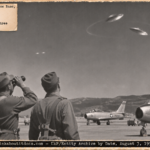
Hamilton AFB, August 3, 1952: two discs, then eight.
THINK ABOUTIT UFO|UAP SIGHTINGS REPORT
Hamilton AFB, California:
Two Silver Discs, Six More and a Dogfight in the Afternoon Sky, August 3, 1952
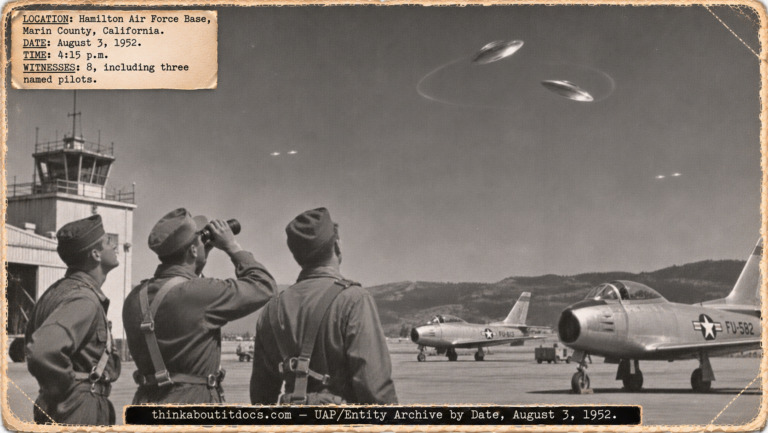
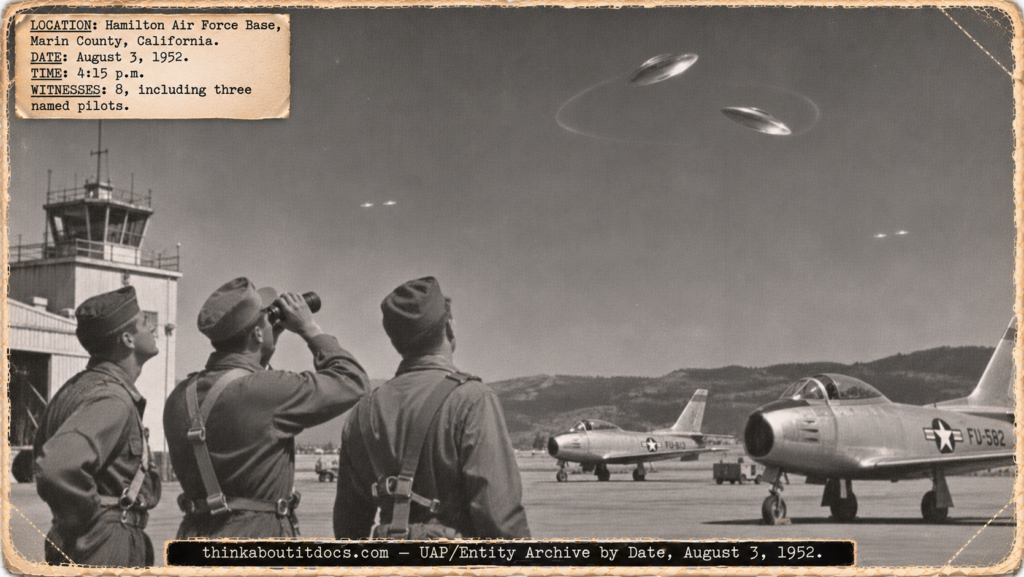
At 4:15 on the afternoon of August 3, 1952, three Air Force pilots at Hamilton Air Force Base in Marin County, California saw two huge silver discs high overhead. Through binoculars the objects looked circular, 60 to 100 feet across, drifting from east to west at about 12,000 and 18,000 feet. Then the higher disc dropped to the level of the lower one, and the pair began to maneuver like fighter planes in a dogfight.
Over the next hour and a quarter six more objects appeared in pairs about 15 to 20 miles west, and the group formed a diamond. When F-86 jets were dispatched, the objects sped away. The Hamilton AFB UFO sighting is a long daytime observation by trained pilots, cataloged by Project Blue Book as an Unknown. Astronomer Donald Menzel later argued that the pilots had seen weather balloons.
Date: August 3, 1952
Sighting Time: 4:15 p.m. (some summaries give 3:13 p.m.)
Day/Night: Day
Location: Hamilton Air Force Base, near Novato, Marin County, California, United States
Urban or Rural: Suburban (air base north of San Francisco)
No. of Entity(‘s): Not Applicable
Entity Type: Not Applicable
Entity Description: Not Applicable
Hynek Classification: Radar-Visual (RV)
Duration: About 1 hour 15 minutes
No. of Object(s): 8 (two discs first, then six more in three pairs)
Description of the Object(s): Two silvery circular or spherical objects that drifted and then circled and darted as if in a dogfight; the higher one dropped from about 18,000 to about 12,000 feet; six more objects later appeared in pairs and briefly formed a diamond
Shape/Size/Color of Object(s): Circular or spherical; silver; 60 to 100 feet in diameter (witness estimate)
Distance to Object(s): Overhead at about 12,000 and 18,000 feet; the six later objects were about 15 to 20 miles west of the observers
Height & Speed: About 12,000 and 18,000 feet; estimated 400 to 450 mph; the upper object dropped about 6,000 feet
Number of Witnesses: 8 per the NICAP case title; three named: Capt. Leslie R. Hadley, Capt. Wayne T. Perske and 2d Lt. Duane A. Swimley, all Air Force pilots
Special Features/Characteristics: Binocular observation; a “dogfight” maneuver between two objects; six more objects joined in pairs; a diamond formation about four miles across; reported tracked on radar; F-86s sent up; no sound reported
Case Status: Project Blue Book: Unknown (BBU). Menzel and Boyd attributed the sighting to weather balloons
Source: Brad Sparks, Blue Books Unknowns Catalogue, Case 762, p. 165; Loren E. Gross, UFOs: A History, August 1952, pp. 20-21; Michael D. Swords, “Intelligent Motions,” IUR 33:1 (2010); NICAP; Project 1947; Donald H. Menzel and Lyle G. Boyd, The World of Flying Saucers (1963); Chop Clearance List Item #33
Summary/Description: Two Air Force pilots and a third officer at Hamilton AFB watched two silvery discs at 12,000 and 18,000 feet for over an hour. The pair dove and circled as if in a dogfight, and six more objects joined in pairs before the group sped away as F-86s were sent up. Blue Book: Unknown.
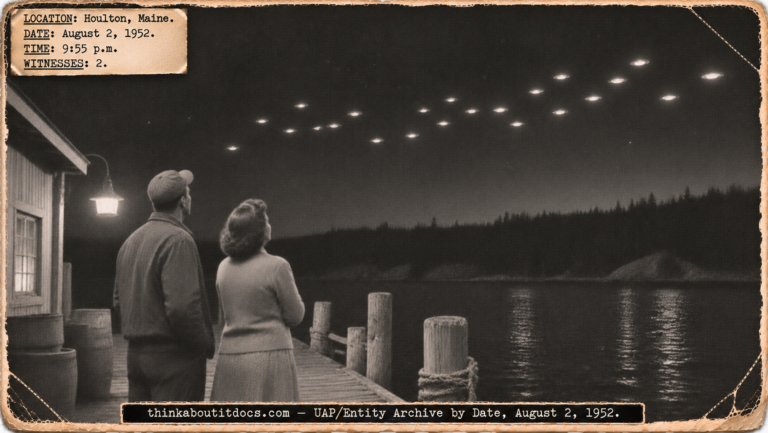
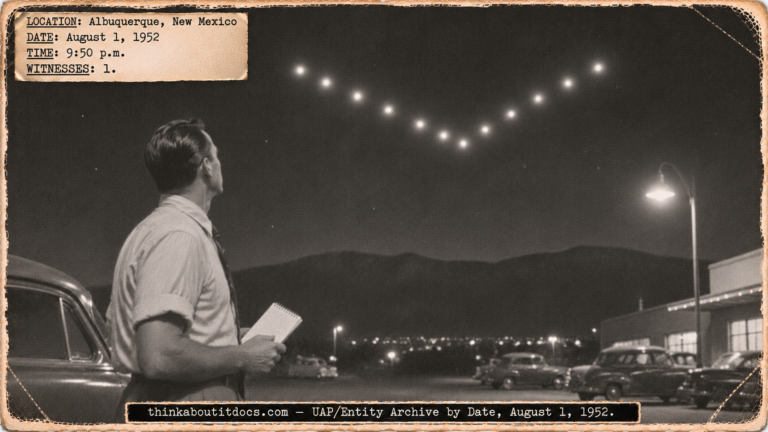
Related Cases: Albuquerque, New Mexico, August 1, 1952; Houlton, Maine, August 2, 1952; the 1952 Washington National Airport radar weekends
Detailed Report
The account comes from the Blue Book file as summarized by Brad Sparks, Loren Gross and NICAP. At 4:15 p.m. on August 3, 1952, three pilots on the ground at Hamilton AFB, Capt. Leslie R. Hadley, Capt. Wayne T. Perske and 2d Lt. Duane A. Swimley, saw two huge silvery discs. Using binoculars, they described them as circular or spherical, 60 to 100 feet in diameter, flying at about 12,000 and 18,000 feet from east to west on a track of roughly 15 miles. The observers estimated their speed at 400 to 450 mph.
The upper object then dove from about 18,000 feet to the level of the lower, and the two circled and darted in what the press called a dogfight. After they passed overhead the group was joined by six more objects, appearing in three pairs about 15 to 20 miles west. The six briefly formed a diamond about four miles across. The summaries say F-86 jets were dispatched and the objects accelerated away. No sound was reported. One summary notes that the objects were tracked on radar, without detail. The observation ran about an hour and a quarter, and near the end the objects were visible only intermittently against the sun.
Donald Menzel, the Harvard astronomer who spent decades arguing that flying saucers were misidentifications, took up the case in The World of Flying Saucers (1963, with Lyle Boyd). He wrote that “the objects looked like balloons, behaved like balloons, and weather balloons had been released in the area that day,” and concluded that the “machines” were weather balloons. He pointed out that the witnesses were looking toward the sun at distant objects and could not track one for long. Project Blue Book nevertheless carried the case among its Unknowns.
RESEARCHER’S NOTES
Pilots, Binoculars and Menzel’s Balloons
- Unknown versus weather balloons: Blue Book listed the case as an Unknown. Menzel and Boyd concluded it was weather balloons because balloons were released in the area that day. The two positions have not been reconciled in the sources reviewed: a balloon explanation has to account for objects that circled one another, dropped 6,000 feet in height and left when jets were sent up.
- Looking into the sun: Menzel notes the observers were looking into the sun at distant objects, which makes size, height and speed estimates unreliable. The pilots’ figures of 60 to 100 feet in diameter and 400 to 450 mph depend on an assumed distance.
- Eight witnesses, three names: NICAP titles the case “Eight Huge Objects Observed by 8 Witnesses and Radar.” The sources reviewed name only Hadley, Perske and Swimley, and the eight witnesses are not listed.
- The time: The sighting is given as 4:15 p.m. in Menzel’s text and the UAP Discovery summary and as 3:13 p.m. in one daily chronology. The 4:15 time is used here.
- Radar: Summaries say the objects were tracked on radar, but none of the sources I could read gives radar details.
Hamilton AFB is a long, clear-sky observation by pilots, and the Air Force was unable to explain it. Menzel’s balloon answer is the best-known counter-argument. The case remains Unknown, with the radar element the least documented part.
“Maneuvering like fighter planes in a dogfight.”
— Press account of the Hamilton AFB sighting, as quoted by Donald Menzel and Lyle Boyd in The World of Flying Saucers (1963)