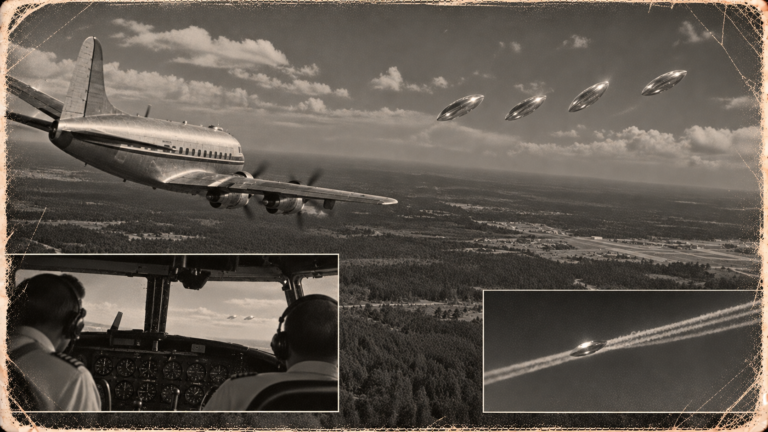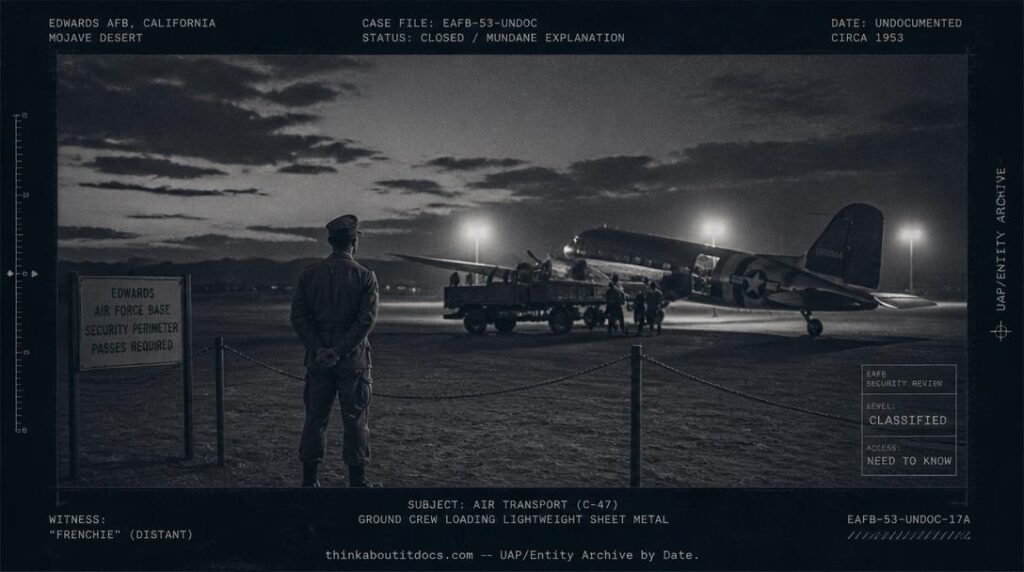
Archival-style rendering of the undated Edwards Air Force Base crash rumor, depicting the only firsthand-attributed detail in the account: lightweight metal seen from behind a security line.
THINK ABOUTIT UFO|ENTITY SIGHTINGS REPORT
1953: The Edwards Air Force Base “Crash”
(Unsubstantiated Crash-Retrieval Rumor)
The account promises a great deal and delivers almost no verifiable substance. An unnamed “reliable” radar operator at Edwards Air Force Base supposedly watched a UFO drop across his screen, was told by a duty captain that he “hadn’t seen anything,” and only later heard that something had crashed in the desert — a fifty-foot disc with a ring of portholes and a crew of four-and-a-half-foot beings, all shipped to Wright-Patterson. A separate, secondhand strand, collected by researcher William Hamilton III from a man known only as “Frenchie,” describes being called out to a crash south of the base, held at a security perimeter, and watching men load lightweight sheets of metal — no engine, no fuselage, no bodies — onto a transport plane.
Stitched together and capped with a paragraph about Wright Field concluding that saucers were interplanetary, the entry reads like a documented recovery. It is not. It has no agreed date, no named witness to a craft or a body, a borrowed “official conclusion” lifted from an unrelated 1948 episode, and a setting — the world’s premier flight-test base — that supplies an obvious mundane explanation. The archive keeps it as a specimen of the crash-rumor genre and labels it plainly.
Date: Unverified, circa 1953; the account itself gives no firm date
Sighting Time: Undocumented
Day/Night: Undocumented
Location: Edwards Air Force Base, Mojave Desert, California (a major USAF flight-
test base)
Urban or Rural: Rural (desert military installation)
No. of Entity(s): Claimed “crew” of unspecified number; no witness is recorded as having seen any being or body
Entity Type: Claimed small humanoids about 4.5 feet tall — hearsay only, not observed by any named witness
Entity Description: Said to be a crew approximately four and a half feet tall; no firsthand observation, no description beyond height
Hynek Classification: None — this is an unwitnessed, unsubstantiated crash-retrieval rumor; no witness observed live beings associated with a craft, so no Hynek classification applies (the prior “CE-III” listed on this site’s legacy page has been removed)
Duration: Not Applicable
No. of Object(s): 1 claimed (a disc that no named witness is recorded as having seen on the ground)
Description of the Object(s): Claimed to be a disc more than fifty feet in diameter with a row of portholes around the center; the only firsthand-attributed material is “Frenchie’s” description of lightweight sheet metal with no engine or fuselage visible, seen from behind a security perimeter
Shape of Object(s): Claimed disc
Size of Object(s): Claimed more than 50 feet in diameter
Color of Object(s): Undocumented
Distance to Object(s): “Frenchie” was held at an outer security perimeter, unable to approach
Height & Speed: The radar strand reports only a rapid descending blip; not quantified
Number of Witnesses: No named witness to a craft or body; an anonymous “reliable” radar operator (saw only a blip), and a secondhand account from “Frenchie” via William Hamilton III (saw only metal, from a distance)
Special Features/Characteristics: No firm date; conflicting 1952/1953 labels across the site’s own legacy metadata; a duty officer’s alleged “you didn’t see anything”; lightweight sheet metal but no engine, fuselage, craft, or body seen by any firsthand source; a closing “Wright Field concluded UFOs are interplanetary” paragraph that actually derives from the unrelated 1948 “Estimate of the Situation” episode; setting is a flight-test base where conventional crash recoveries were routine
Case Status: Explained — unsubstantiated crash-retrieval rumor, likely mundane
Source: Kevin D. Randle, A History of UFO Crashes (a catalogue and critical history of crash claims); secondhand “Frenchie” testimony via researcher William Hamilton III; inclusion here records the rumor, not an endorsement
Summary/Description: An undated rumor (variously placed in 1952 or 1953) holds that a UFO crashed in the desert at or near Edwards AFB, California: an anonymous radar operator saw a descending blip and was told he had seen nothing, then later heard of a crashed fifty-foot disc with portholes and a four-and-a-half-foot crew, shipped to Wright-Patterson; separately, a man called “Frenchie” reportedly watched lightweight sheet metal being recovered from behind a security line. No named witness saw a craft or body, the date is unsettled, and a closing “official conclusion” paragraph belongs to a different 1948 story. The setting is a flight-test base where conventional recoveries were routine. The account is logged as Explained (unsubstantiated crash-retrieval rumor, likely mundane).
Related Cases: 1952: The Heligoland, Germany “Crash” (unsubstantiated rumor) | 1948 & 1950: The Aztec, New Mexico Crash Hoax
Detailed Report
The entry assembles two separate anonymous or secondhand strands into the impression of a single documented event, and it is worth taking them apart. The first: a “reliable” person in a technical position was on radar duty at Edwards when he saw a UFO descend rapidly across his screen. When the object was confirmed “down,” a duty captain reportedly told him he hadn’t seen anything. Later, the operator learned that an object had crashed in the desert — said to be more than fifty feet across, ringed with portholes, and carrying a crew about four and a half feet tall, with the craft, debris, and bodies sent to Wright-Patterson. The crucial point is what this witness actually saw: a blip on a radar screen. He did not see a craft, a porthole, or a body; the disc, the portholes, and the crew are things he is said to have heard about afterward.
The second strand comes through researcher William Hamilton III, from a man identified only as “Frenchie,” who was stationed at Edwards and was called out of his barracks because something had crashed just south of the base. Frenchie was held at an outer security perimeter and could not approach, but saw men lifting large chunks of metal. Sheets of metal lay across the site, with no engine or fuselage visible; a large, lightweight piece reportedly required cutting a C-47’s door to load it, and could be lifted by two men. This is the only firsthand-attributed observation in the entry, and notably it contains no craft, no portholes, and no bodies — only lightweight sheet metal seen from a distance, behind a security line.
Before weighing it, the entry’s internal problems must be named. It cannot settle its own date: the page’s web address says 1953, while its title, its date field, and its tags all say 1952, and the account itself supplies no specific date at all. A report that does not know its own year, attached to a story with no named witness, is at the bottom of the reliability scale before analysis even begins.
Then there is the closing paragraph, which is the entry’s most misleading element. It states that the engineering division at Wright Field, “T-3,” had already concluded that UFOs were advanced craft using non-conventional propulsion, built of lightweight composite layers, and that the General Staff believed they were interplanetary. This is not a finding about any Edwards crash. It is a recognizable paraphrase of the famous 1948 “Estimate of the Situation” episode — the Air Materiel Command assessment, associated with General Nathan Twining’s late-1947 letter, that the flying discs were real, which the Air Force chief of staff reportedly rejected and ordered destroyed. Splicing that disputed 1948 institutional lore onto a 1952-or-1953 Edwards rumor manufactures an aura of official confirmation the rumor has not earned. It has been flagged here as the misattached material it is, rather than presented as a conclusion about Edwards.
With the borrowed authority stripped away, what remains points toward the mundane, and the setting is the key. Edwards Air Force Base was, in the early 1950s, the center of American experimental and classified flight testing — rocket planes, jet prototypes, drones, and instrumented research vehicles, flown and sometimes lost over the surrounding desert under tight security. A crash recovery conducted behind a perimeter, yielding sheets of lightweight metal with no engine or fuselage in view, and material trucked or flown to the Air Materiel Command at Wright Field, describes the ordinary handling of a downed experimental aircraft, a research drone, or a high-altitude balloon-borne instrument package at least as well as it describes a saucer. The very secrecy the story treats as sinister was routine at the Air Force’s premier test site, where a downed classified prototype would naturally be cordoned, recovered, and shipped to engineering analysis at Wright Field — exactly the chain the account describes.
None of this can be a forensic disproof, because there is nothing firsthand to examine: no named witness to a craft or a body, no date, no documentation, no recovered object available for study. But that absence is the finding. A dramatic crash with an alien crew that produced no firsthand witness to either, an unsettled date, a borrowed “official conclusion,” and a single concrete detail — lightweight sheet metal on a flight-test range — that fits a conventional recovery, is not a documented anomaly. The weight points away from a spacecraft, and the entry is filed accordingly.
RESEARCHER’S NOTES
The Edwards “Crash” — California and a Rumor With No Firm Date and Borrowed Authority
- Classification — why none applies. This site’s legacy page classified the case CE-III, but a close encounter of the third kind requires a witness to observe animate beings associated with a craft. No named witness here saw any being: the radar operator saw a blip and heard the rest; “Frenchie” saw metal from behind a perimeter; the “four-and-a-half-foot crew” is hearsay about bodies at a crash no firsthand source describes. An unwitnessed crash-retrieval rumor carries no Hynek classification, consistent with how the archive treats Heligoland, Aztec, and similar accounts. The field is set to none.
- The misattached “Estimate of the Situation” paragraph. The entry’s closing claim — that Wright Field’s “T-3” had concluded the objects were interplanetary — is the single most important thing to correct, because it is borrowed authority. That material describes the 1948 Air Materiel Command “Estimate of the Situation,” tied to General Twining’s 1947 letter and reportedly rejected and ordered destroyed by the Air Force chief of staff. It is an unrelated, disputed episode from years earlier, grafted onto an undated Edwards rumor to make it look officially confirmed. Recognizing the graft dissolves most of the entry’s apparent weight.
- The mundane candidate and why Explained. Edwards was the heart of U.S. experimental and classified flight testing; downed prototypes, drones, and instrument packages were recovered under security and sent to Wright Field as a matter of routine. “Frenchie’s” lightweight sheet metal with no engine or fuselage, recovered behind a perimeter, fits that ordinary process. Combined with the absent date, the absence of any firsthand witness to a craft or body, and the borrowed 1948 conclusion, this is enough to call the account Explained — an unsubstantiated crash-retrieval rumor with a likely mundane basis — while acknowledging that, with nothing firsthand to examine, the specific event behind it cannot be reconstructed.
- Why the entry stays in the archive at all. Labeling it plainly keeps a sourceless crash yarn from borrowing credibility from the documented cases elsewhere in the archive. Removing it entirely would leave a gap in the historical record of the crash-rumor genre; keeping it with its problems named serves readers better than silence would.
The Edwards crash is a textbook mid-century crash-retrieval rumor dressed in the trappings of documentation: a radar operator who saw only a blip, a perimeter witness who saw only metal, a crew no one is recorded as having seen, a year the page cannot pin down, and an “official conclusion” quietly imported from a different decade. Stripped of the borrowed 1948 authority, reclassified out of CE-III, and read against the routine recoveries of the Air Force’s premier test base, it stands as Explained — an unsubstantiated crash-retrieval rumor, almost certainly mundane in origin, kept in the record so that it is documented and defused rather than repeated as fact.
“You didn’t see anything.” — a duty captain’s reported response to the radar operator, Edwards AFB, circa 1953 (unverified, secondhand)