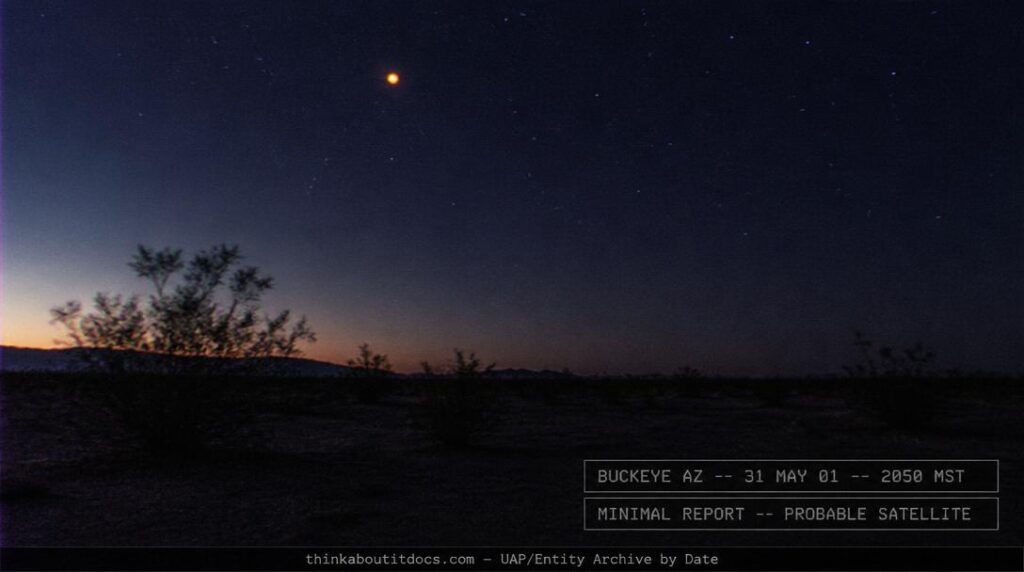
South of Buckeye, Arizona, May 31, 2001 — A bright orange object crosses the sky two minutes before a scheduled ISS pass. Minimal report, probable satellite or Iridium flare.
THINK ABOUTIT UFO|UAP SIGHTING REPORT
2001: Large Orange Object Spotted
On the evening of May 31, 2001, a single witness fifteen miles south of Buckeye, Arizona, stepped outside at 8:50 p.m. to watch for the International Space Station, which was due to pass overhead at 8:52 p.m., and instead observed a large bright orange object traveling south-southwest for approximately two minutes. The witness described the object as roughly ten times larger in apparent size than the ISS and slightly lower in altitude, moving somewhat faster. No other details, no source, and no investigation are documented. The report is among the thinnest in the archive.
Date: May 31, 2001
Sighting Time: 8:50 p.m. MST
Day/Night: Night
Location: Approximately 15 miles south of Buckeye, Arizona (Maricopa County)
Urban or Rural: Rural
No. of Entity(‘s): None observed
Entity Type: Not Applicable
Entity Description: Not Applicable
Hynek Classification: NL (Nocturnal Light)
Duration: Approximately 2 minutes
No. of Object(s): 1
Description of the Object(s): A large, bright orange object traveling in a south-southwest direction. No structural detail described. The witness compared it to the International Space Station in apparent size (approximately ten times larger) and altitude (slightly lower than ISS), and said it was moving slightly faster than the ISS
Shape of Object(s): Slightly oblong
Size of Object(s): Described as approximately ten times the apparent size of the ISS
Color of Object(s): Bright orange
Distance to Object(s): Described as somewhat lower in altitude than an ISS pass but not otherwise estimated
Height & Speed: Slightly lower and slightly faster than the ISS in its overhead pass trajectory
Number of Witnesses: 1
Special Features/Characteristics: The witness was specifically outside to observe the ISS, which was scheduled to pass at 8:52 p.m. — two minutes after the orange object was first seen. No sound, flashing lights, or structural features were reported. No behavior inconsistent with a linear satellite-like transit was described
Case Status: Insufficient Data — strong mundane candidate (satellite, Iridium flare, or ISS itself under atmospheric color-shifting conditions)
Source: Not identified (no source credited on the original page)
Summary/Description: On May 31, 2001, at 8:50 p.m., a single witness south of Buckeye, Arizona, went outside to watch for the ISS (due at 8:52 p.m.) and observed a large bright orange object traveling south-southwest for approximately two minutes. The object appeared roughly ten times the apparent size of the ISS and traveled slightly faster at somewhat lower altitude. No other details were provided. No source, witness name, or investigation is documented.
Related Cases: Not Applicable
Detailed Report
The witness stepped outside at 8:50 p.m. on May 31, 2001, at a location approximately 15 miles south of Buckeye, Arizona, to observe the International Space Station, which was scheduled to make a visible pass at 8:52 p.m. Before the ISS appeared, the witness looked up and saw a large bright orange object traveling in a south-southwest direction. The object was visible for approximately two minutes. The witness described it as slightly oblong, approximately ten times larger in apparent size than the ISS typically appears, and traveling somewhat lower and slightly faster than an ISS pass. No other details — no sound, no structural features, no unusual maneuvers — were reported. The witness did not indicate whether the ISS was subsequently seen at its scheduled time.
Researcher’s Notes
The Buckeye Object — South Phoenix 2001 and the Thinnest Reports in the Archive
- Source and Evidentiary Weight: This is one of the thinnest reports in the thinkaboutitdocs.com archive. No witness name is provided. No source is credited — the original page listed no submission venue, no reporting database, and no investigator. The entire observational content amounts to a few sentences: bright, orange, slightly oblong, two minutes, south-southwest. No follow-up has been conducted or documented. The report exists in the archive because it occupies a date and location in the chronological record, but it provides almost no material for analysis.
- The ISS Timing Coincidence: The strongest analytical datum is not what the witness saw but when they saw it. The witness went outside specifically to watch for the ISS and observed the orange object at 8:50 p.m. — exactly two minutes before the ISS was scheduled to pass at 8:52 p.m. The ISS is the brightest artificial satellite and can appear notably orange when low on the horizon due to atmospheric scattering (the same effect that makes the sun and moon appear orange near the horizon). A bright satellite pass observed two minutes before the expected ISS pass, traveling in a roughly similar trajectory, is a strong candidate for a misidentified satellite — possibly the ISS itself on a slightly earlier track than predicted, or a different bright satellite (such as an Iridium flare, which can produce brief orange flashes far brighter than the ISS). The witness’s statement that the object was “not as high as the International Space Station” is also consistent with a satellite lower in the sky, where atmospheric effects would produce orange coloring and apparent size magnification. The witness did not report whether the ISS was subsequently seen at 8:52, which would have been dispositive.
- Assessment: This report carries insufficient detail to support any conclusion other than noting the sighting. The strong temporal coincidence with a scheduled ISS pass, the orange color consistent with atmospheric scattering of a low-altitude satellite, and the absence of any described behavior inconsistent with linear satellite transit make a satellite or Iridium flare the cleanest mundane candidate. The archive retains the report, notes the probable explanation, and classifies it as Insufficient Data.
Not every entry in the archive stands on equal footing, and the record is honest about that. The Buckeye orange object occupies its date and its coordinates, and the archive holds it for what it is — a few sentences, a bright light, and a question that probably has a straightforward answer.