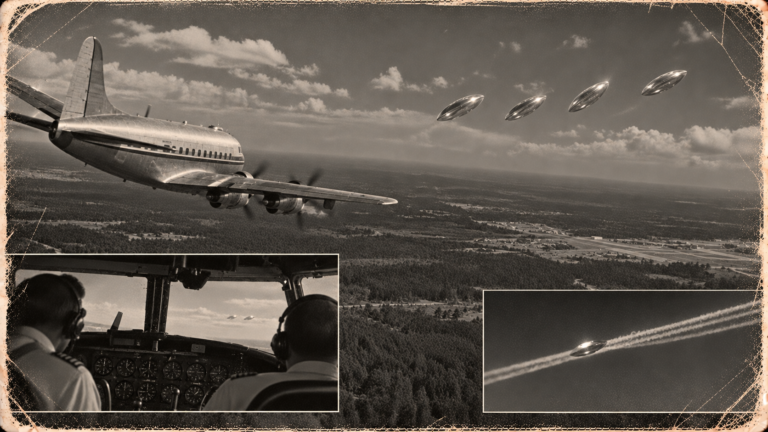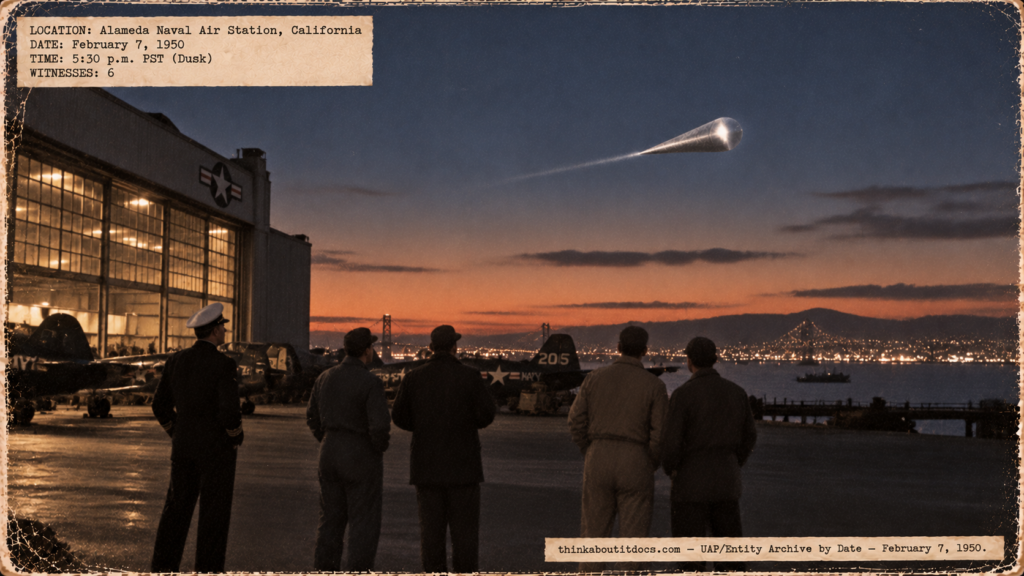
Six people at Alameda Naval Air Station watched a silver cone trailing vapor over San Francisco Bay on February 7, 1950; other Bay Area witnesses saw an airplane.
THINK ABOUTIT UFO|UAP SIGHTINGS REPORT
1950: Alameda Flying Ice Cream Cone UFO
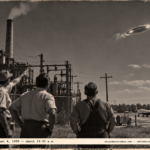
At about 5:30 p.m. on February 7, 1950, as the sun set over San Francisco Bay, a Navy lieutenant commander and five civilians at Alameda Naval Air Station watched what they called a giant “flying ice cream cone” drift slowly south at some 5,000 feet, trailing gray vapor from its tip. It hovered, tilted onto its side and moved off to the southeast. The press picked up the story the next morning, Army Intelligence at Hamilton Field opened an inquiry, and letters from people who had seen the same thing around the Bay started arriving.
The Alameda, California flying ice cream cone file is one of the few 1950 cases that comes with both the sighting and its likely solution. A Berkeley colonel saw an airplane beside the cone and thought a plane’s exhaust, lit red by the sunset, was the cause, and a San Jose shopkeeper watched a small single-engine plane pass over his street at 800 feet trailing red vapor. The Blue Book cards from San Jose and Berkeley note the plane. This report keeps both the witness accounts and the aircraft evidence.
Date: February 7, 1950
Sighting Time: About 5:30 p.m. PST at Alameda and Berkeley (1730); 5:47 to 5:57 p.m. at San Jose; about 5:50 p.m. from a commuter train near San Carlos and Palo Alto
Day/Night: Dusk (shortly after sunset)
Location: Alameda Naval Air Station, California, USA, and across the San Francisco Bay Area (San Leandro, Berkeley, Piedmont, San Jose, and a Southern Pacific train between San Carlos and Palo Alto)
Urban or Rural: Urban
No. of Entity’s: Not Applicable
Entity Type: Not Applicable
Entity Description: Not Applicable
Hynek Classification: DD (twilight sighting of a cone-shaped object)
Duration: About 10 minutes at Alameda; about 5 minutes at Berkeley
No. of Object(s): 1
Description of the Object(s): A cone-shaped object shaped like the base of an ice cream cone with a rounded top like a parachute canopy, trailing gray vapor from the cone tip; it hovered, moved to new positions, and changed from an upright to a horizontal attitude
Shape/Size/Color of Object(s): Conical; about 30 feet long by the press, one-half to three-fourths the size of an ordinary parachute by the Air Force report; bright silver at Alameda, fiery red or with a trail like sparks from other places
Distance to Object(s): Not measured; a Berkeley witness gave an elevation of 20 degrees and a bearing of south by west
Height & Speed: 2,500 to 5,000 feet at Alameda; 60 to 70 mph (Air Force report) or 75 to 95 mph (press); heading south, then southeast; San Jose’s plane was at about 800 feet
Number of Witnesses: 6 at Alameda (Lt. Cdr. J. L. Kraker and five San Leandro residents: H. A. Clark, William Page, C. Palmer, R. E. Strahl and R. T. Moore), plus at least four more who wrote in from Berkeley, San Jose, Piedmont and the Peninsula commuter train
Special Features/Characteristics: Navy officer among the witnesses; Army Intelligence inquiry at Hamilton Field; letters from other observers, several reporting an airplane; clear weather with 10-mile visibility; no balloons released from Alameda
Case Status: Explained (probable aircraft with a lit exhaust or vapor trail). The Blue Book cards from San Jose and Berkeley note a single-engine plane and a plane in the area, and none of the cards I saw carries a conclusion.
Source: Hq 78th Fighter Wing, Hamilton AFB, letter reports to Air Materiel Command (February 1950), with witness letters, San Francisco Chronicle (February 9, 1950), San Jose Evening News (February 9, 1950) and AP dispatches; Project Blue Book (Project 10073) record cards for Alameda, San Jose, Berkeley and Palo Alto; Loren E. Gross, UFOs: A History, 1950: January–March
Summary/Description: Six people at Alameda Naval Air Station, including Lt. Cdr. J. L. Kraker, saw a silver cone-shaped object trailing gray vapor drift south at 2,500 to 5,000 feet at about 5:30 p.m. on February 7, 1950. It hovered, tilted and moved off southeast. Similar sightings came from Berkeley, San Jose and a commuter train, several including an airplane. A retired Army colonel proposed that a plane’s exhaust, lit by the sunset, was the cause.
Related Cases: Kirtland/Albuquerque fireball (February 7, 1950); Teaticket, Massachusetts (February 5, 1950); Tampa, Florida (February 8, 1950); Davis-Monthan AFB, Arizona (February 1, 1950)
Detailed Report
Alameda
The Hamilton Field report to Air Materiel Command records the sighting at 1730 PST on February 7 over Alameda in clear weather with 10-mile visibility. Two civilian employees at the Alameda Naval Air Station power plant, both working the night shift and both living in San Leandro, described one object, conical, with the base like an ice cream cone and the top rounded like a parachute canopy, about half to three-quarters the size of an ordinary parachute and bright silver. It moved at 60 to 70 mph with no set heading, appearing to hover and then “lazily” move to another position and hover again. It changed from an upright position to a horizontal one in flight, and it disappeared to the southeast after ten minutes. Altitude estimates were 2,500 to 5,000 feet. One observer said the exhaust trail looked like a jet’s or a rocket’s, and the other saw none. The station’s assistant officer of the day interviewed both men and told Hamilton he was sure they had seen something worth reporting.
The Press Version
The San Francisco Chronicle and the AP reported six observers, five San Leandro residents (H. A. Clark, William Page, C. Palmer, R. E. Strahl and R. T. Moore) and Lt. Cdr. J. L. Kraker of the air station. They described a 30-foot ice cream cone passing over the station at about 5,000 feet, trailing a gray vaporous exhaust from its tip, tilting onto its side and heading southeast at 75 to 95 mph. The Navy said no weather balloons were up. Hamilton Field officers suggested that a vapor trail might have come from a plant, because the evening was cold.
More Reports From Around the Bay
Once the story ran, letters reached Hamilton. Col. Roland W. Pinger, retired, saw the cone from Berkeley at about 5:30 p.m. He pointed it out to three University of California students and his son, a Navy lieutenant. It looked bright red against the dark sky, its trail like sparks from a large exhaust, and it drifted south for at least five minutes, fading. An airplane was just to the right of the cone, heading north. Pinger’s own theory was that the plane emitted a cone of exhaust vapor, and that the sunset lit it red for him and gray or unlit for observers elsewhere. A San Jose shopkeeper saw a small comet-like object over the western hills at 5:47 p.m., and at about 5:57 it flew almost directly over First Street at about 800 feet, a small single-engine plane throwing red fire-like vapor from its tail, moving slowly with a slight propeller noise, and his employees saw it too. A commuter on the southbound Southern Pacific train saw a fiery cone-shaped object a mile or more west of the tracks near San Carlos at 5:50 p.m. that seemed to keep pace with the train and then gained speed and vanished toward Woodside. Two Piedmont nurses wrote that they saw an object dipping and floating eastward from the south.
The Cards and the Follow-Up
The Project 10073 cards record the Alameda report as two male civilians and the object as conical, 18 feet across, bright silver, hovering. The San Jose card records a civilian, an altitude of about 800 feet, propeller noise and the remark that the source saw a light single-engine plane giving a red vapor trail. The Berkeley card records Army and Navy officers, a conical shape with a trail like sparks, drifting for 5 minutes on a course of 180 degrees, and notes that the sources saw a plane in the area going in the opposite direction. The Palo Alto card records a female attorney on a train who saw a conical object with a fiery tail. Loren Gross adds that an Air Force intelligence captain named Starrett questioned Kraker and told him it had not been a flying saucer, and that Navy Intelligence later questioned Kraker again about talking to the press.
RESEARCHER’S NOTES
A Silver Cone, Six Witnesses and a Plane in the Frame
- An Explanation Inside the File: The San Jose shopkeeper and Colonel Pinger both saw an airplane in connection with the cone, and the San Jose and Berkeley cards say so. The likeliest solution is an aircraft trailing vapor that low-angle sunlight lit unevenly, but the file does not state a conclusion.
- Why Witnesses Differed: Observers at Alameda saw silver, gray vapor and hovering; Berkeley saw red and sparks; San Jose saw red vapor from a plane; the train rider saw fire. A single lit vapor trail seen from different angles against a sunset sky would look different from each place.
- The Alameda Witnesses: Kraker was a Navy officer, and the two power-plant employees were interviewed by the station’s assistant officer of the day, who told Hamilton he was impressed by their story. The Navy stated that no meteorological balloons were aloft.
- Size and Speed Don’t Agree: Thirty feet long (press), half to three-quarters of a parachute (Air Force), 18 feet across (card); 60 to 70 mph versus 75 to 95 mph; 2,500 to 5,000 feet. The estimates of a distant, unmeasured object in twilight vary widely.
- Date Mix-Up: Loren Gross dates the cone February 8, the day the story broke. The cards and the Hamilton report put the sighting on February 7.
- Press and Secrecy: The story ran in the Chronicle’s “Pie in the Sky” column and in AP wires, and Kraker’s later interview with a New York paper led to Navy questions about disclosing classified information, a small sign of the tension the Air Force felt about UFO publicity in early 1950.
The Alameda cone is a good example of what a well-investigated 1950 sighting could look like: a credible group of witnesses, a Navy officer among them, newspaper attention, and then the letters that started to fill in the rest. Several of those letters describe a plane. It is filed here as Explained, on the strength of the plane sightings and the card remarks, with the caution that the file itself offers no formal conclusion and that the Alameda witnesses’ own description of a hovering silver cone was never withdrawn.
“flying ice cream cone”
From the San Francisco Chronicle, February 9, 1950, as filed in the Project Blue Book Bay Area file.