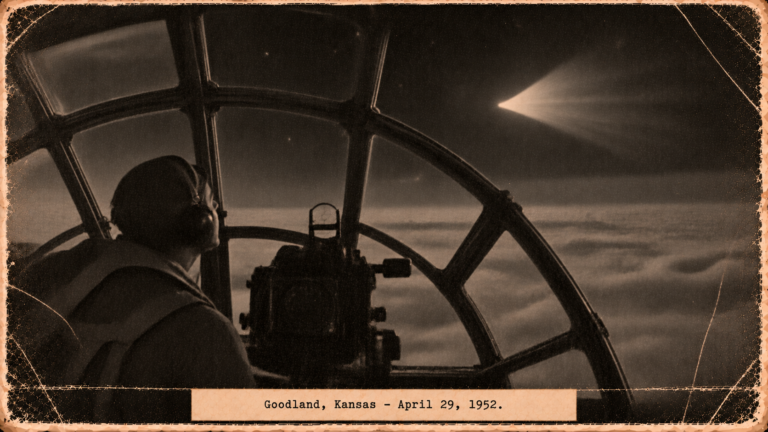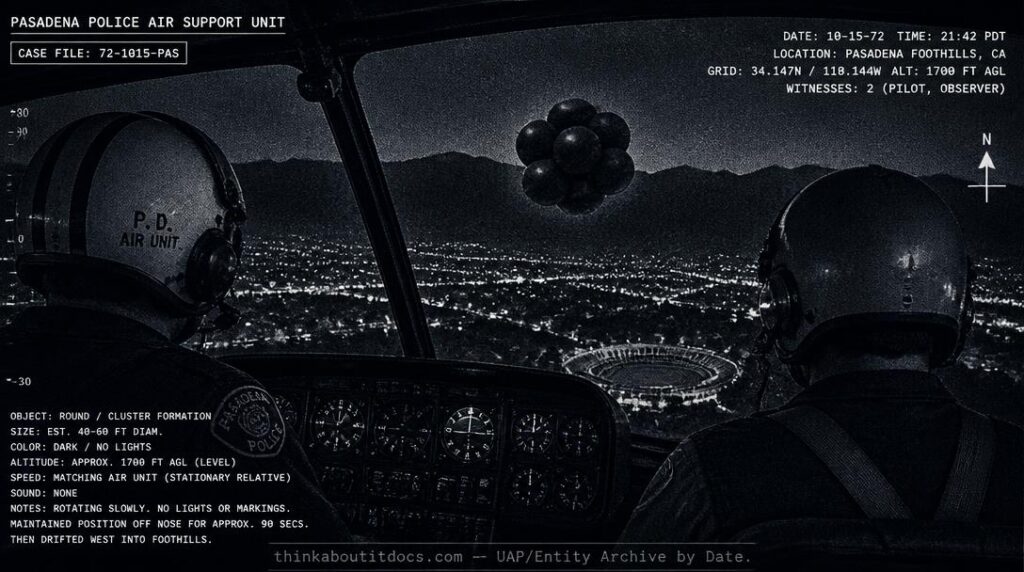
Archival rendering of the October 1972 Pasadena Police helicopter encounter, in which pilot Pat Spafford and an observer watched an unlit rotating object accelerate past supersonic speed near the Rose Bowl.
THINK ABOUTIT UFO SIGHTINGS REPORT
1972: Pasadena Police Helicopter UFO Encounter — Supersonic Acceleration
On night patrol near the San Gabriel foothills, Pasadena Police helicopter pilot Pat Spafford and his observer spotted what they first took for a military Sikorsky hovering low over a residential neighborhood. As they climbed to follow it west, a second object came into view roughly 300 meters away: a large, dark, rotating mass that resembled a cluster of balloons, showing no lights of its own, matching their 60 mph airspeed almost exactly. Near the Rose Bowl, it abruptly accelerated to a speed both crewmen described as faster than supersonic and vanished toward the Los Angeles skyline in seconds. LAX radar reported nothing. JPL reported no experiment in progress. The observer’s own incident report, filed that night, was never followed up on, as far as he ever learned.
Date: October 15, 1972 (approximate, per the witness’s own account, written decades later)
Sighting Time: During night patrol
Day/Night: Night
Location: Pasadena, California, northeast area near the San Gabriel foothills, with the object’s final high-speed departure occurring near the Rose Bowl
Urban or Rural: Urban / foothills (aerial observation from a police helicopter)
No. of Entity(s): Not Applicable
Entity Type: Not Applicable
Entity Description: Not Applicable
Hynek Classification: CE-I — Close Encounter of the First Kind. This site’s legacy field data listed NL (Nocturnal Light), but the witness explicitly states the object showed no lights of any kind; NL requires a luminous source, which this case does not have. Given the close observation distance (approximately 300 meters), sustained multi-minute duration, and clearly resolved structural detail (rotation, balloon-cluster appearance), CE-I is the more accurate classification.
Duration: Several minutes
No. of Object(s): 1 (in addition to the initially misidentified object the crew first believed was a military helicopter, which departed separately and is not treated as part of the anomalous sighting itself)
Description of the Object(s): A large, round, rotating object resembling a cluster of large balloons tied together, showing no lights of any kind, paced the helicopter at its exact airspeed of approximately 60 mph before accelerating to a reported faster-than-supersonic speed within seconds
Shape of Object(s): Round
Size of Object(s): Undocumented precisely; described only by comparison to a cluster of large balloons
Color of Object(s): No lights observed; described only by its rotating motion
Distance to Object(s): Approximately 300 meters
Height & Speed: Approximately 1,000 feet AGL; paced the helicopter at 60 mph before a sudden acceleration to a reported faster-than-supersonic speed
Number of Witnesses: 2 (pilot Pat Spafford and a Pasadena Police helicopter observer); Spafford is reported to have since passed away, leaving the observer as the only living witness at the time this account was submitted
Special Features/Characteristics: Object matched the helicopter’s exact airspeed for an extended period before its acceleration; the observer proposed illuminating the object with the helicopter’s “night star” searchlight per standard operating procedure, requiring the running lights to be shut off to avoid overloading the electrical system, but the pilot overruled this and kept the running lights on; LAX radar reported no contact when queried immediately afterward; JPL, contacted separately, reported no experiment in progress, with the JPL contact’s casual tone striking the witness as suggesting such calls were not unusual; both crew members filed a written incident report the same night; the witness states he never learned whether the report was forwarded or investigated further; approximately two weeks later, the Police Chief referenced the incident to the witness in an offhand remark about “giant Frisbees”
Case Status: Unexplained — though it should be noted this rests on a single surviving witness’s account, submitted to MUFON decades after the event, with no located institutional documentation (incident report, radar log, or JPL correspondence) beyond the witness’s own recollection
Source: MUFON, Submitter 15633
Related Cases: None documented
Report
 My date and times are approximate. I was assigned as a Police Helicopter Observer with the Pasadena Police Department and flying night patrol.
The pilot was Pat Spafford. In the northeast area of Pasadena, very close to the foothills, we observed what appeared to be a military Sikorsky helicopter hovering very low over a residential area. The helicopter was turning its landing light off and on. As we got closer, it gained elevation and started heading westbound. Being curious, we started to follow it. We were approximately 1,000 feet AGL.
The military helicopter then appeared to lose altitude quickly, as if it was going into autorotation. Then about 300 meters past it, we saw what first appeared to be a large object looking like a bunch of big balloons tied together. The object was going at our exact airspeed, which was about 60 mph. The object was round and appeared to be rotating. I saw no lights on it.
Pat began yelling over the intercom that he was seeing a UFO. I immediately shut off our running lights so I could activate our “night star” searchlight. The running lights were shut off because there would be too many amps going through the system with all the lights on and pop a breaker. Shutting off the running lights to power up the searchlight was standard operating procedure. Pat questioned what I was doing, and when I told him I was going to “light it up,” he said, “No,” and turned the running lights back on. We had a short argument about doing this or not, but he got the final word because he was the pilot.
We watched the object for a few minutes and it flew abeam us going west. We then noticed some fog coming into the L.A. basin, which was a signal for us to fly back to Brackett Field in Pomona, where we hangared the helicopter so as not to get caught in the fog.
As we approached the west end of the city near the Rose Bowl, this object gained speed and in just a few seconds accelerated toward the L.A. skyline and disappeared out of sight. The speed it went was faster than supersonic. We were both amazed at how fast it accelerated.
We came back to the hangar and immediately started making calls. Pat called LAX to see if they had any such object on their radar. He got a “negative” from them. I called JPL in Pasadena to see if they had any kind of experiment going on, and they said no. I was taken aback by the response I got from them, because the person I spoke to sounded like this was an everyday occurrence.
We both wrote an incident report and turned it in. I kept this to myself until one day, about two weeks later, the Police Chief saw me in the hallway and yelled, “Hey Al, did you see any more giant Frisbees?”
Since that time I have told this story to people but never made a big deal about it. I also never found out if anyone forwarded that report or investigated it further. I left the PD in 1979 to join the San Luis Obispo County Sheriff’s Department.
Just thought I would tell this story to someone who would enjoy hearing it. Pat Spafford passed away some time ago, but I’m sure there are plenty of people who will remember that story from the old days. I have attached a picture of myself with Pat Spafford taken around the time this happened; the photo ran in the Pasadena Star-News on February 13, 1972, several months before the sighting itself, and depicts the two of us together rather than the incident.
RESEARCHER’S NOTES
The Spafford-Pasadena Case — 1972 and the Value (and Limits) of a Professional Witness
- Professional witness credibility. The primary witnesses were a Pasadena Police Department helicopter crew. Their background in aerial observation and familiarity with local military and civilian aircraft provides a level of technical expertise that distinguishes this case from standard civilian reports, and their own initial misidentification of a separate object as a military Sikorsky demonstrates they were actively distinguishing known aircraft types rather than assuming anomaly at every turn.
- Classification corrected: CE-I, not NL. The witness is explicit that the object showed no lights at all, which rules out a Nocturnal Light classification by definition. The close observation distance, extended duration, and detailed structural description support CE-I instead.
- The acceleration is the case’s central technical anomaly. An object matching a helicopter’s exact 60 mph airspeed for several minutes, then accelerating to a reported faster-than-supersonic speed within seconds with no visible propulsion, no reported sonic boom, and no radar detection, describes flight characteristics well outside any known 1972 aircraft’s performance envelope.
- Radar non-detection cuts both ways and should not be overread. LAX’s negative radar report is presented in the account as evidence of anomalous stealth capability. It is worth noting plainly that a negative radar return is also consistent with a target too small, too low, or with too poor a radar cross-section to register on air-traffic radar not optimized for that purpose, an ambiguity the account itself does not resolve either way.
- This rests on a single surviving witness, decades after the fact. Pat Spafford, the pilot, is reported to have passed away, leaving the observer as the sole surviving source for this account, submitted to MUFON long after 1972. No incident report, radar log, or JPL correspondence from the time has been located independently; the witness himself states he never learned what became of the report he and Spafford filed. This does not diminish the account’s internal consistency or the witness’s evident sincerity, but it does mean the case now rests entirely on one person’s decades-old memory rather than any surviving contemporaneous documentation.
- The “giant Frisbee” and JPL nonchalance details suggest a broader, informal local pattern. The Police Chief’s offhand remark and the JPL contact’s casual tone both suggest, without proving, that reports of this kind may not have been entirely unfamiliar in the San Gabriel Valley area at the time, though neither detail rises to documented corroboration.
A police helicopter crew paced a large, dark, lightless, rotating object at exactly their own airspeed for several minutes over Pasadena, watched it vanish toward the Los Angeles skyline faster than sound in a matter of seconds, and got a negative from LAX radar and a strangely unsurprised “no” from JPL. Only one of the two witnesses is still alive to tell it, the paper trail was never found again, and the case remains, on the record available, unexplained.
“As we approached the west end of the city near the Rose Bowl, this object gained speed and in just a few seconds accelerated towards the L.A. skyline and disappeared out of sight. The speed it went was faster than supersonic.”
— Pasadena Police helicopter observer, describing the October 15, 1972 sighting