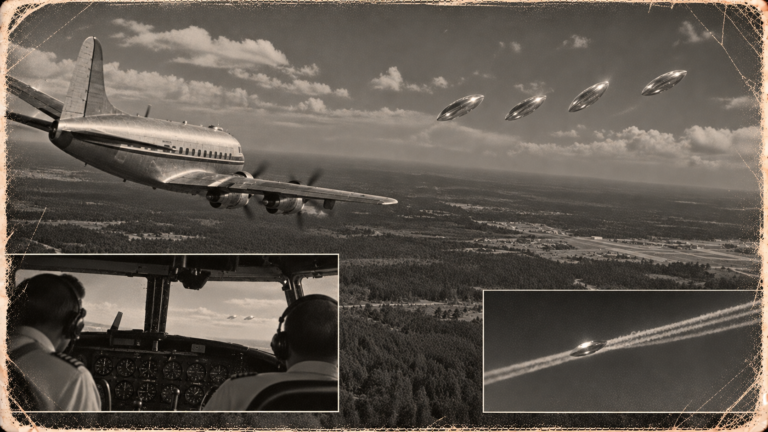
Princeton, Indiana, August 1973 — A saucer with a straight-sided cupola, rolled edge, and pickled-metal surface descends toward the woods of the Wabash River bottoms during a thunderstorm, its archaic Jules Verne profile illuminated by lightning. A dark laser-like cone descends from its underside.
THINK ABOUTIT UFO|UAP SIGHTING REPORT
1973 Princeton Indiana UFO: The CE1 Laser-Cone and Pickled Metal Saucer
In August 1973, a family driving home from Mt. Carmel through the Wabash River bottoms during a violent thunderstorm saw what they first took for headlights — two lights, low on the horizon, heavy in the infrared, the same spectral response you would get from car headlights. But as their angle of perspective changed, the lights rose above the trees. Then a bolt of lightning behind the object illuminated it fully, and the family saw what it was: a saucer. Not a sleek, modern, science-fiction saucer. Something that looked archaic, like something out of Jules Verne — with a cupola, a rolled edge, and a surface that resembled pickled metal, the burnished silver color of heat-treated steel. The witness, a technically literate man who understood optics and infrared spectral response, noted four lights dotted around the cupola and a super-dark cone descending from the object’s underside to a point below tree level — the inverse of a flashlight beam, resembling a laser on a much grander scale. The object moved smoothly and with determination through a storm that should have been tearing it apart. It descended into the woods. They never found it again.
Date: August 1973 — exact date not recorded
Sighting Time: Approximately 9:00 PM CDT
Day/Night: Night — during an active thunderstorm with lightning, rain, and high winds
Location: Wabash River bottoms between Mt. Carmel, Illinois and Princeton, Gibson County, Indiana — near the Public Service Indiana (PSI) power plant construction site
Urban or Rural: Rural — river-bottom farmland and woodlots between the Wabash River and Princeton
No. of Entity(‘s): None observed
Entity Type: N/A
Entity Description: N/A
Hynek Classification: CE-I (Close Encounter of the First Kind) — structured craft observed at approximately 500–600 feet distance, illuminated by lightning, with cupola, rolled edge, and surface detail visible
Duration: Approximately 5 minutes of active observation; 3–4 minutes from initial approach through hovering to descent into the woods
No. of Object(s): 1
Description of the Object(s): Saucer with a cupola and rolled edge. Surface described as pickled metal — the burnished silver color of heat-treated steel, with an industrial, archaic, Jules Verne aesthetic rather than a streamlined modern design. Four lights dotted around the cupola, same illumination intensity as car headlights but without visible beams. A super-dark cone descended from the underside, wide at the base of the saucer and narrowing to a point below tree level — the inverse of a flashlight beam, described by the witness as resembling a laser on a much grander scale.
Shape of Object(s): Saucer with cupola — classic saucer profile with a straight-sided cupola (not streamlined) and a rolled edge at the rim
Size of Object(s): Estimated 30–40 feet in diameter
Color of Object(s): Burnished silver — pickled/heat-treated metal appearance. Lights were car-headlight intensity, heavy in the infrared.
Distance to Object(s): Approximately 500–600 feet at closest approach; initially observed from greater distance
Height & Speed: Approximately 30–40 feet above tree-top level during observation; descended slowly into the woods. Moved on a northwest-to-southeast track. Smooth, determined motion unaffected by storm winds.
Number of Witnesses: 3 — family group (witness, wife, and oldest son age ~5 at the time, 15 at time of reporting)
Special Features/Characteristics: The dark cone — a super-dark inverted-beam structure descending from the underside, wide at the saucer and narrowing to a point below tree level. The witness, who had laboratory experience with lasers, compared it to a laser beam in a different light spectrum on a much grander scale. The pickled-metal surface texture — industrial, riveted-looking (though the witness clarified he did not actually see rivets), archaic. The object’s motion was completely unaffected by the storm — smooth and determined in high winds. Lightning provided the primary illumination; the UV-heavy spectral content of lightning may have affected color perception. The witness tested for electromagnetic interference by turning on his car radio but detected none; the engine did not stall.
Case Status: Unexplained
Source: Eyewitness testimony — first-person account from a technically literate witness with understanding of optics, infrared spectral response, and laser technology. No organizational filing (NUFORC, MUFON, or other) identified.
Summary/Description: A family of three driving through the Wabash River bottoms near Princeton, Indiana during a thunderstorm in August 1973 observed a saucer-shaped object with a cupola, rolled edge, pickled-metal surface, four cupola lights, and an inverted dark cone beneath it. The object was illuminated by lightning at approximately 500–600 feet distance and descended slowly into woods. It moved with smooth, determined precision completely unaffected by storm winds. The technically literate witness compared the dark cone to a laser and the surface to heat-treated metal.
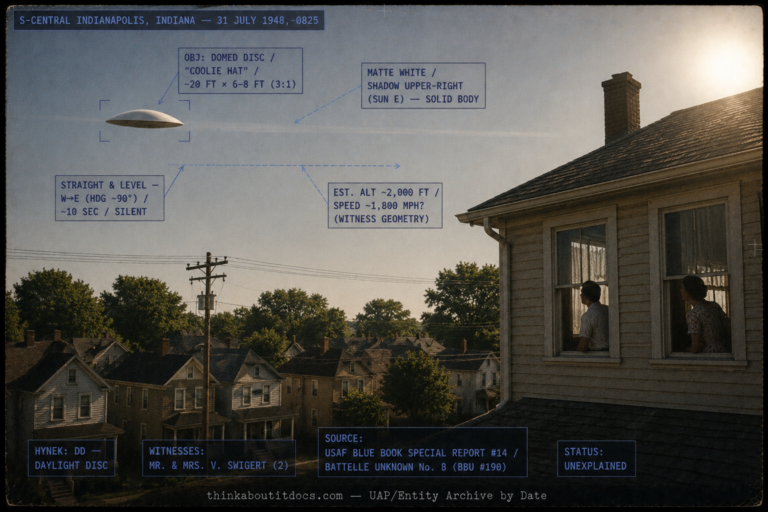
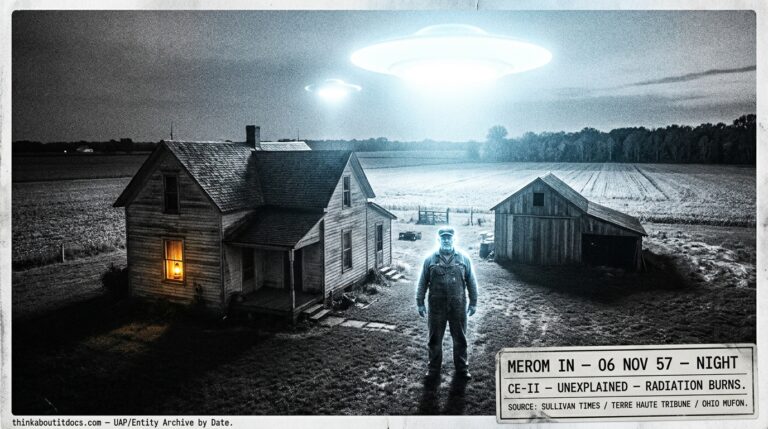
Related Cases: 1957 Merom Indiana CE-II (Wabash River corridor, 30 miles south) | 1977 Anderson Indiana NL (Indiana disc with structural detail)
Detailed Report
The Princeton sighting of August 1973 is a family encounter that benefits from an unusually technical witness — a man who understood optics, infrared spectral response, and laser physics, and who applied that knowledge in real time to what he was observing. His account is notable for its precision, its self-awareness about the limitations of perception, and its refusal to overinterpret the evidence.
The family had been visiting the witness’s mother-in-law in Mt. Carmel, Illinois, approximately 11 miles west of Princeton across the Wabash River. A storm had come up, a tree had blown down, and they decided to leave. After stopping for gas, they drove east through the Wabash River bottoms toward Princeton. This stretch of road passed near the construction site for the Public Service Indiana power plant on the right side.
The witness first noticed what appeared to be two headlights low on the horizon. He initially considered a temperature inversion but quickly dismissed this — during an active thunderstorm, the atmosphere is too turbulent for stable inversions. As the car’s angle of approach changed, the lights rose above the trees, eliminating the possibility of reflected headlights from Owensville Road. The objects were in the air.
Then lightning caught up with them. A substantial bolt behind the object illuminated it and its surroundings, and the family saw what they were looking at: a saucer. The witness’s reaction was matter-of-fact — the whole family witnessed it and nothing was said until they got home. His detailed technical observations followed: four lights dotted around a cupola, not portholes (because anyone inside would have been blinded by their intensity, which matched car headlights). Beneath the saucer, a super-dark cone that apexed below tree level — the inverse geometry of a flashlight beam. The witness, familiar with laser optics, compared it to a laser in a different light spectrum on a much grander scale.
The surface description is the most distinctive element: pickled metal, the burnished silver color of heat-treated steel, looking archaic and industrial — like something out of Jules Verne. Not streamlined. Straight up and down cupola with a little rolled edge. The witness almost said he could see rivets, then corrected himself — he did not actually see rivets, but the surface texture evoked that industrial quality.
The object moved on a northwest-to-southeast track, descending. Its motion was smooth and determined, completely unaffected by the storm winds. The witness estimated it at 30–40 feet above tree level, 500–600 feet away. He accelerated to try to reach the point where he believed it was landing, overshot his estimate, slowed down, and watched for 3–4 minutes. The object descended into the woods. He later returned to the area during rainstorms with his oldest son, looking for it in the clearings where popcorn and corn had been planted, but never found it again.
The witness tested for electromagnetic interference during the encounter — he turned on his car radio but heard no interference, and the engine of his 1971 Chevrolet Impala did not stall. He also noted that the UV-heavy spectral content of the lightning illumination would have shifted perceived colors, making reds appear black or other colors appear off-shade — a sophisticated optical observation that most witnesses would not think to make.
Researcher’s Notes
The Princeton Pickled Saucer — Gibson County 1973 and the Industrial Aesthetic
- Source Chain Assessment: The source chain is the case’s primary weakness. The account is a first-person narrative from a witness who is not identified by name. No NUFORC, MUFON, NICAP, or APRO filing has been identified. The page source is listed as “Eyewitness Testimony (Reputable Witness)” with no further attribution. The existing page treatment (hook paragraph, formatted template, and narrative) appears to have been built from a direct interview or oral account, but the interviewer is not identified. Despite the detailed technical quality of the testimony, the absence of any organizational filing or named investigator limits the case’s verifiability.
- Classification Rationale: CE-I is appropriate. The object was observed at approximately 500–600 feet — within the 500-foot CE threshold — with structural detail visible (cupola, rolled edge, surface texture, light arrangement, dark cone). Lightning provided full-spectrum illumination of the entire object and its surroundings. No physical effects were reported: no electromagnetic interference, no engine failure, no physiological symptoms. The dark cone is suggestive of a CE-II beam interaction with the ground, but the witness did not observe any ground effects, and the cone itself may have been an optical phenomenon rather than a physical beam.
- Technical Witness Quality: The witness demonstrates a level of optical and physical literacy that is rare in the CE literature. He correctly identifies the spectral response of the initial lights as heavy in the infrared (consistent with incandescent sources), correctly dismisses temperature inversion during an active thunderstorm, notes the UV-heavy spectral content of lightning and its effect on color perception, draws an informed comparison to laser optics, tests for electromagnetic interference in real time, and self-corrects on the rivet observation. This is not a witness guessing — this is a witness applying a technical framework to an anomalous observation. The quality of the testimony is high.
- Wabash River Corridor Pattern: Princeton sits on the Wabash River approximately 30 miles north of Merom, the site of the 1957 Rene Gilham CE-II radiation burn case. The Wabash River corridor in southwestern Indiana has produced multiple significant cases across decades. Whether this represents a genuine geographic pattern or a sampling artifact (more investigators active in this area, more reports filed) is indeterminate. The proximity to the PSI power plant construction site is noted but has no demonstrated connection to the sighting.
 A saucer that looked like Jules Verne built it, a dark cone that worked like a laser, and a witness who knew exactly what he was looking at — or at least exactly how to describe what he could not explain.
The Princeton pickled saucer is one of those cases where the witness’s precision exceeds the archive’s ability to verify.
The record holds the testimony.
The testimony deserves an investigator.