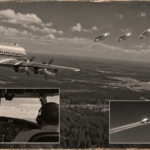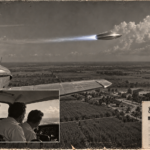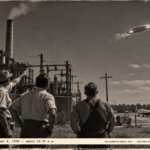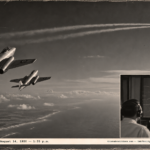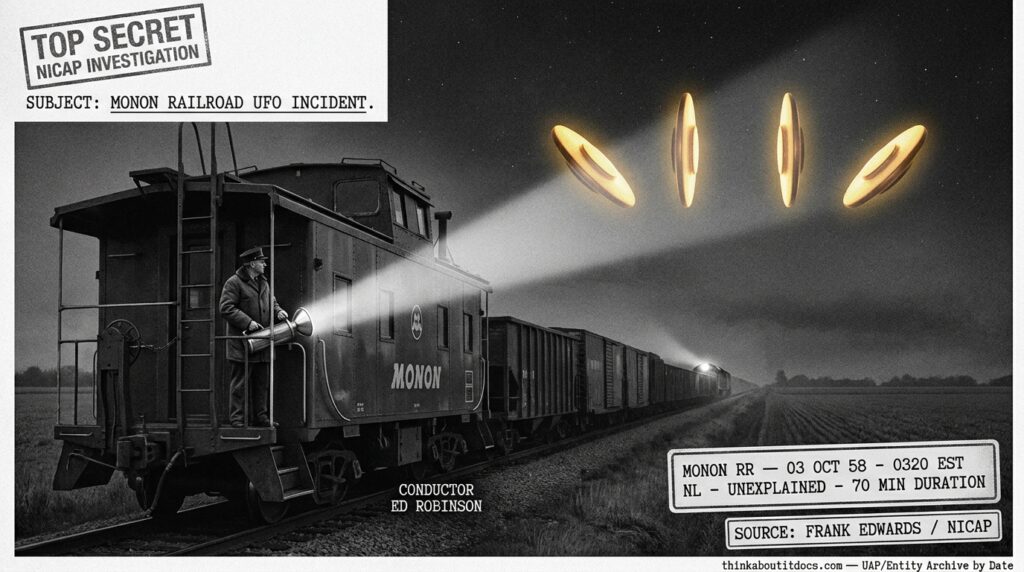
North-Central Indiana, October 3, 1958 — Four luminous objects fly edge-on up the tracks behind Monon Railroad freight train No. 91 as conductor Ed Robinson aims a sealed-beam flashlight from the caboose platform. Five crew witnesses observed for 70 minutes.
THINK ABOUTIT UFO|UAP SIGHTING REPORT
1958: The Monon Railroad UFO Incident
At 3:20 AM on October 3, 1958, five crew members of Monon Railroad freight train No. 91 — southbound from Monon to Indianapolis through the flat darkness of north-central Indiana — began watching four luminous objects that would follow their train for seventy minutes and thirty-eight miles. The objects flew in formation, crossed the tracks ahead of the train, reversed course, came back, descended to treetop level directly over the freight cars, scattered when hit with a sealed-beam flashlight, changed color from bright white to yellow to dirty orange as they slowed, and flew edge-on up the tracks behind the caboose at close enough range for the crew to estimate their dimensions: roughly 40 feet in diameter and 10 feet thick. Five professional railroaders — including a fireman with 450 hours of heavy bomber time in the U.S. Air Force — observed these objects from both ends of a half-mile-long train, communicating by radio throughout. The Lafayette dispatcher heard every word but never cut in. Frank Edwards published the crew’s testimony. NICAP documented the case. It remains one of the most sustained, multi-witness, multi-angle NL encounters in the Indiana archive.
Date: October 3, 1958
Sighting Time: Approximately 3:20 AM EST
Day/Night: Night — predawn darkness
Location: North-central Indiana — Monon Railroad tracks from Wasco (north of Monon) southbound through Frankfort to Kirklin, approximately 38 miles of track, 38 miles northwest of Indianapolis
Urban or Rural: Rural — open farmland and small crossroads communities along the railroad right-of-way
No. of Entity(‘s): None observed
Entity Type: N/A
Entity Description: N/A
Hynek Classification: NL (Nocturnal Light) — multiple luminous objects observed at night exhibiting structured shape (circular, 40 feet diameter, 10 feet thick when seen edge-on), color changes, formation flying, and apparent reactive behavior
Duration: Approximately 70 minutes (1 hour 10 minutes)
No. of Object(s): 4
Description of the Object(s): Four large, round luminous objects described as “big, round white things” with a soft fluorescent-light quality and fuzzy edges. When viewed edge-on at close range, circular on the bottom, approximately 40 feet in diameter and 10 feet thick. Color changed dynamically: bright white at speed, transitioning to yellow and then to dirty orange when slowing. No glare, did not illuminate surroundings when passing overhead. Silent or nearly so.
Shape of Object(s): Round/circular — disc-shaped when seen edge-on, with a measurable thickness
Size of Object(s): Approximately 40 feet in diameter, approximately 10 feet thick — estimated when flying edge-on approximately 200 yards behind the caboose at right-of-way width separation
Color of Object(s): Variable — bright white at speed, yellow at moderate speed, dirty orange when slow or hovering. Sequential illumination observed: front object lit first, then #2, #3, #4 in sequence. Color intensified with acceleration.
Distance to Object(s): As close as 200 feet above the train (first overhead pass); 200 yards behind the caboose (edge-on approach); 1–2 miles east during formation passes
Height & Speed: Variable — from a couple of hundred feet above the train to half a mile ahead; speed varied from hovering to “very fast” departures. Estimated 30–50 mph during close approaches; much higher during acceleration phases.
Number of Witnesses: 5 — Harry Eckman (engineer), Cecil Bridge (fireman, ex-USAF, 450 hours heavy bomber time), Morris Ott (head brakeman) in the locomotive cab; Ed Robinson (conductor) and Paul Sosbey (flagman) in the caboose. Lafayette dispatcher monitored all radio communications.
Special Features/Characteristics: Reactive behavior — objects scattered when illuminated by a five-cell sealed-beam flashlight from the caboose, then avoided close approach thereafter. Formation changes — initially flew in open V formation (two wings, two lights each, no lead); later flew edge-on in a linear formation with two center objects vertical and two outer objects tilted at matching angles. Sequential illumination — objects lit up in sequence (#1 through #4) during formation passes, twice observed. Color-speed correlation — color shifted from bright white to yellow to dirty orange as speed decreased. The objects hovered during the Frankfort switching stop, maintaining position up the tracks, then resumed following when the train moved.
Case Status: Unexplained
Source: Frank Edwards — published account based on crew interviews. NICAP documentation (Richard Hall, 1964). UFO Casebook archive.
Summary/Description: Five crew members of Monon Railroad freight train No. 91 observed four luminous disc-shaped objects over a 70-minute period covering 38 miles of track from Wasco to Kirklin in north-central Indiana on October 3, 1958. The objects exhibited formation flying, reactive evasion of a flashlight beam, dynamic color changes correlated with speed, sequential illumination, and close-range passes at approximately 200 feet altitude. When seen edge-on at close range, the objects appeared circular, approximately 40 feet in diameter and 10 feet thick. All five witnesses — observed from both the locomotive and caboose — maintained continuous radio communication throughout. The Lafayette dispatcher monitored the transmissions.
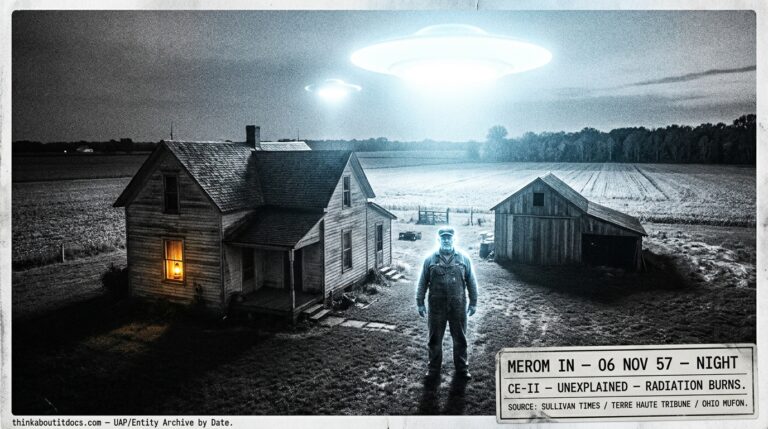
Related Cases: 1977 Anderson Indiana Gold-Ball Disc (rotating disc with rim lights) | 1957 Merom Indiana CE-II (same state, one year earlier)
Detailed Report
The Monon Railroad incident is one of the most thoroughly documented multi-witness nocturnal light encounters in the American archive. Five professional railroaders — men accustomed to night operations, distance estimation, and clear-headed communication under operational conditions — observed four anomalous objects from two separated vantage points (locomotive and caboose, half a mile apart) while maintaining continuous radio contact. The encounter lasted 70 minutes and covered 38 miles of track.
Freight train No. 91 was southbound from Monon to Indianapolis. In the diesel locomotive cab were engineer Harry Eckman, fireman Cecil Bridge, and head brakeman Morris Ott. In the caboose, half a mile behind 56 freight cars, were conductor Ed Robinson and flagman Paul Sosbey. The Lafayette dispatcher was monitoring the radio frequency throughout.
Cecil Bridge — a former Air Force man with 450 hours of heavy bomber time — spotted the objects first near Wasco, a rural crossroads. Four lights in an open V formation (no lead light, two wings of two lights each at roughly 45-degree angles) were moving ahead of the train. After approximately 15 seconds of observation, Bridge alerted Eckman and Ott. The objects crossed the tracks about half a mile ahead, moving slowly — perhaps 50 mph — and appeared as four big, white, soft lights.
The objects then reversed course and departed eastward, disappearing from view. When they returned, Bridge radioed the caboose crew. What followed was a sustained interaction spanning multiple behavioral phases: the objects descended to approximately 200 feet above the train and flew back along the freight cars toward the caboose, one after another; they retreated when Robinson shone a five-cell sealed-beam flashlight on them; they changed formation from V to an edge-on linear arrangement (two center objects vertical, two outer objects tilted at matching angles); they lit up in sequence during formation passes, front to rear; they changed color dynamically from bright white (at speed) through yellow to dirty orange (when slow); they hovered during the Frankfort switching stop, holding position up the tracks until the train moved; and they finally departed at high speed to the northeast near Kirklin.
Robinson’s observation from the caboose was particularly detailed. When the objects flew edge-on up the tracks at approximately 200 yards behind the caboose, at right-of-way width, he and Sosbey could clearly see they were disc-shaped — circular on the bottom, approximately 40 feet in diameter and roughly 10 feet thick. Two were oriented vertically, two tilted at matching angles. If flying flat, they would have nearly touched edges.
The most analytically significant behavioral detail is the flashlight reaction. When Robinson illuminated the objects with his sealed-beam flashlight, they jumped sideways out of the beam. When he hit them again, they scattered. After this, they never approached closely again. This apparent evasive response to directed light is a rare but documented behavioral pattern in the NL literature.
Researcher’s Notes
The Monon Railroad Objects — North-Central Indiana 1958 and the Flashlight Response
- Source Chain Assessment: The primary source is Frank Edwards, a respected broadcaster and UFO author who conducted direct interviews with the crew members. The account was documented by NICAP and included in Richard Hall’s 1964 compilation. The detailed first-person testimony attributed to Cecil Bridge and Ed Robinson is internally consistent and cross-corroborating — details observed from the locomotive (forward perspective) mesh precisely with details observed from the caboose (rear perspective). The Lafayette dispatcher’s passive monitoring of the radio traffic provides a potential corroborating witness, though no statement from the dispatcher is on record. The page as it stands is a wholesale reprint of the Edwards text — this should be replaced with original analytical prose, as delivered here.
- Classification Rationale — NL with Structural Resolution: NL is the technically correct classification because the observation occurred in predawn darkness and the objects were primarily characterized by their luminosity. However, this case pushes the boundary of NL into structural-object territory. The edge-on close-range observation from the caboose — 200 yards distance, treetop altitude, sufficient to estimate 40 feet diameter and 10 feet thickness — constitutes a level of dimensional resolution rarely achieved in NL cases. The objects had measurable depth, were circular on the bottom, and changed orientation (flat vs. edge-on). These are characteristics of structured craft, not point light sources.
- Reactive Behavior and the Flashlight Response: The flashlight evasion is the single most analytically significant element of this case. The objects jumped sideways when illuminated, scattered when hit a second time, and thereafter maintained distance. This behavior pattern — evasion of directed light — implies awareness of being observed and the capacity to respond to environmental stimuli. Conventional explanations for NL (atmospheric phenomena, distant aircraft, celestial objects) do not exhibit reactive evasion of flashlight beams. If the testimony is accurate, the flashlight response eliminates the entire conventional-explanation space.
- Witness Credibility Assessment: The witness pool is exceptionally strong. Five professional railroaders on duty, communicating by radio in real time, observed from two separated vantage points half a mile apart. Cecil Bridge’s 450 hours of heavy bomber time as a USAF aircrew member provides a trained aviation observer’s baseline. Railroad crews routinely operate at night, estimate distances to trackside objects, and maintain situational awareness. These are not passive bystanders but active operational personnel accustomed to the kind of vigilant observation the situation demanded. The dispatcher’s passive monitoring adds an implicit sixth participant who heard everything in real time.
Five men on a freight train, seventy minutes in the Indiana dark, four objects that scattered when you shone a light on them. The Monon Railroad case is one of those reports where the evidence does most of the talking. The record stands.
Media


Credit: NICAP / Hall (1964)