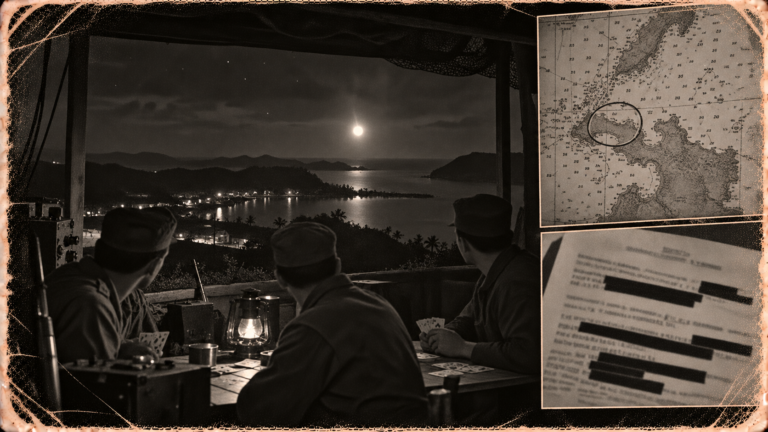
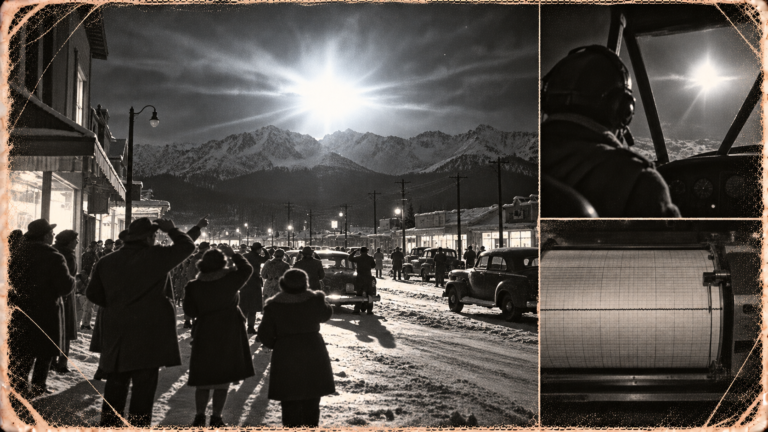
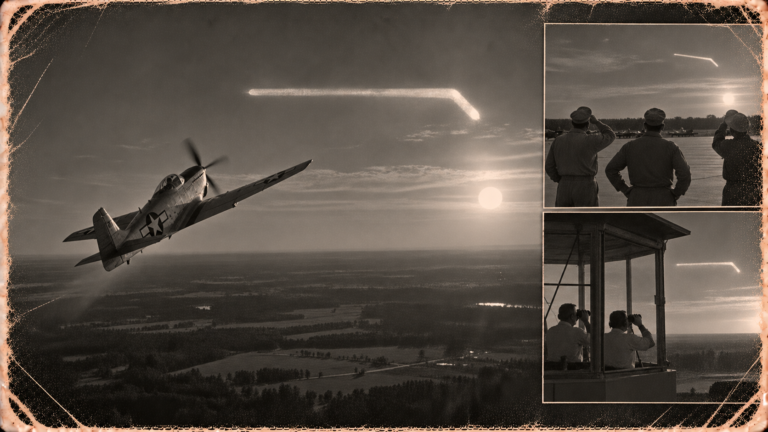
Reconstruction based on David Roeck's report to the APRO Bulletin.
THINK ABOUTIT UFO SIGHTING REPORT
1977 Anderson Indiana UFO: The Gold-Ball Disc and David Roeck Report
In July 1977, David Roeck was staying at a motel in Anderson, Indiana, when his traveling companion burst through the door to summon him outside. In the parking lot, Roeck looked up past the roofline and saw what he immediately recognized — not for the first time in his life — as something that was not a conventional earthly machine. A great frisbee-like disc was gliding gently across the sky at less than a thousand feet, slowly rotating clockwise, tilted at an angle. Around its rim, touching each other in a continuous ring, were spherical white lights with a distinctive gold-ball quality. A single spherical red light sat on the top center. There was no sound, no odor, no emission of any kind. The object traveled in an arc — not a straight line — for five minutes before moving out of view. Roeck, who had seen something similar ten years earlier, filed his report with the APRO Bulletin, where it was published in 1984 with the understated clarity of a man who had been through this before.
Date: July 1977 — exact date not specified
Sighting Time: 9:30 PM (page header says 9:39 PM; witness text says 9:30 PM)
Day/Night: Night — warm summer evening, temperature 70°–80°F
Location: Anderson, Madison County, Indiana — observed from a motel parking lot
Urban or Rural: Urban — city of Anderson, approximately 40 miles northeast of Indianapolis
No. of Entity(‘s): None observed
Entity Type: N/A
Entity Description: N/A
Hynek Classification: NL (Nocturnal Light) — luminous disc-shaped object observed at night. Structural details were visible but the observation was dominated by the rim-mounted spherical lights. NL is retained over DD because the sighting occurred after dark.
Duration: Approximately 5 minutes
No. of Object(s): 1
Description of the Object(s): Great frisbee-like disc with spherical white lights arranged continuously around the rim, all touching each other, described as having a gold-ball quality. A single spherical red light of approximately the same size was mounted on the top center of the craft. Slowly rotating clockwise. Tilted at an angle during transit. No sound, no odor, no emissions.
Shape of Object(s): Disc — frisbee-like profile
Size of Object(s): Described as a “great disc” — no precise dimensional estimate given
Color of Object(s): Gold-ball white spherical rim lights; single red spherical light on top center
Distance to Object(s): Estimated less than 1,000 feet altitude
Height & Speed: Less than 1,000 feet altitude; moving slowly, gliding gently across the field of view in an arcing trajectory
Number of Witnesses: Multiple — witness and traveling companion; no additional witness statements on file
Special Features/Characteristics: Arcing flight path — the object traveled in a curve, not a straight line. Slow clockwise rotation. The witness described the rim lights as spherical and all touching each other, forming a continuous ring. The witness also noted this was his second sighting of a similar craft, the first having occurred ten years earlier (approximately 1967). No sound, no electromagnetic effects.
Case Status: Insufficient Data
Source: APRO Bulletin, Vol. 32 No. 7 (September 1984) — David Roeck first-person account titled “1977 Disc in Indiana”
Summary/Description: David Roeck and a traveling companion observed a slowly rotating, tilted, frisbee-like disc with gold-ball white spherical rim lights and a central red spherical light gliding at less than 1,000 feet over Anderson, Indiana in July 1977. The object moved in an arcing trajectory for approximately five minutes before passing out of view. No sound, odor, or emissions were detected. Roeck reported this was his second such sighting in a decade. The account was published in the APRO Bulletin seven years after the event.
Related Cases: Witness’s prior sighting (~1967, location not specified) | 1958 Monon Railroad Incident (Indiana, multi-witness, rotating lights)
Detailed Report
The Anderson sighting of July 1977 is a brief but vivid account published as a first-person narrative by David Roeck in the APRO Bulletin seven years after the event. Roeck was staying in a motel in Anderson, Indiana, when his traveling companion rushed inside to alert him to something outside. In the parking lot, looking above the roofline, Roeck immediately saw what he recognized — from a prior experience ten years earlier — as an unconventional aircraft.
The object was a large, frisbee-like disc, tilted at an angle and slowly rotating clockwise at what Roeck estimated to be less than 1,000 feet altitude. Around the rim, in a continuous ring with each light touching the next, were spherical white lights with a distinctive gold-ball quality. A single red spherical light of approximately the same size sat on the top center. The disc was gliding gently, moving slowly, and traveled in an arc rather than a straight line. No sound was audible, no odor was present, and no emissions or exhaust were visible. The observation lasted approximately five minutes before the object moved out of view.
Roeck’s account is notable for its composure. Where most first-time witnesses describe shock, confusion, and delayed processing, Roeck writes with the familiarity of someone who had seen this before. He describes the “rush of recognition” and refers to “once again beholding a magnificent craft from a more advanced world, or whatever.” The parenthetical “or whatever” is a characteristic qualifier — the language of a witness who knows what he saw but does not presume to know what it was.
The seven-year gap between the sighting (1977) and publication (APRO Bulletin, September 1984) is unexplained. No investigation is documented. The traveling companion is not identified by name and did not provide an independent statement. No additional witnesses from the motel or surrounding area have come forward.
Researcher’s Notes
The Anderson Gold-Ball Disc — Madison County 1977 and the Repeat-Observer Question
- Source Chain Assessment: The source is the APRO Bulletin, Vol. 32 No. 7, September 1984 — a peer-reviewed ufological journal published by the Aerial Phenomena Research Organization under the direction of Jim and Coral Lorenzen. APRO was one of the two major civilian UFO research organizations of the era (alongside NICAP). Publication in the Bulletin implies editorial review but does not confirm field investigation. No investigator is named. No follow-up is documented. The seven-year reporting delay is notable and unexplained.
- Classification Rationale: NL (Nocturnal Light) is retained. The sighting occurred at 9:30 PM in July — full darkness. Although the witness described structural features (disc shape, rim arrangement, central red light), the dominant observational characteristics were the lights themselves. The object was not observed under conditions that would permit surface-detail assessment of a metallic hull. The tilted angle and slow rotation were inferred from the light pattern. NL is the most conservative defensible classification.
- Repeat-Observer Consideration: Roeck states this was his second sighting of a similar craft, with the first occurring approximately ten years earlier (~1967). Repeat observers are a contested category in ufological research. On one hand, a prior sighting provides a baseline for comparison and may sharpen observational acuity. On the other, repeat sighting claims raise questions about observer bias, pattern-seeking, and the possibility that mundane stimuli are being interpreted through the lens of a prior anomalous experience. Roeck’s composure and familiarity argue for genuine repeat observation. The absence of any detail about the 1967 sighting prevents evaluation.
- Physical Description Quality: Despite the brevity of the account, the physical description is unusually precise and internally consistent. The gold-ball quality of the rim lights, the continuous ring arrangement with each sphere touching the next, the single red sphere on the top center, the clockwise rotation, the tilted angle, and the arcing trajectory are all specific, non-generic details that resist easy conflation with conventional aircraft. The arcing flight path is particularly notable — aircraft and satellites travel in straight lines or gentle curves dictated by aerodynamic constraints; an arc implies powered maneuvering or gravitational-independent propulsion.
A motel parking lot, a traveling companion’s shout, and a disc that David Roeck had seen before. The record is thin — one published account, no investigation, no corroboration — but the description is sharp and the witness’s composure suggests genuine familiarity with the phenomenon. The archive notes it and moves on.
Report

“1977 DISC IN INDIANA”
by David Roeck