Blue Book File 4517, El Toro MCAS, California, November 11–12, 1956: 34 GCA scope photographs, captioned IC-UFOB, document a saturating central return, merging objects and an 8-hour event that Blue Book could not explain.
THINK ABOUTIT UFO|UAP SIGHTINGS REPORT
1956: El Toro Marine Corps Air Station, California — Eight Hours on the Scope
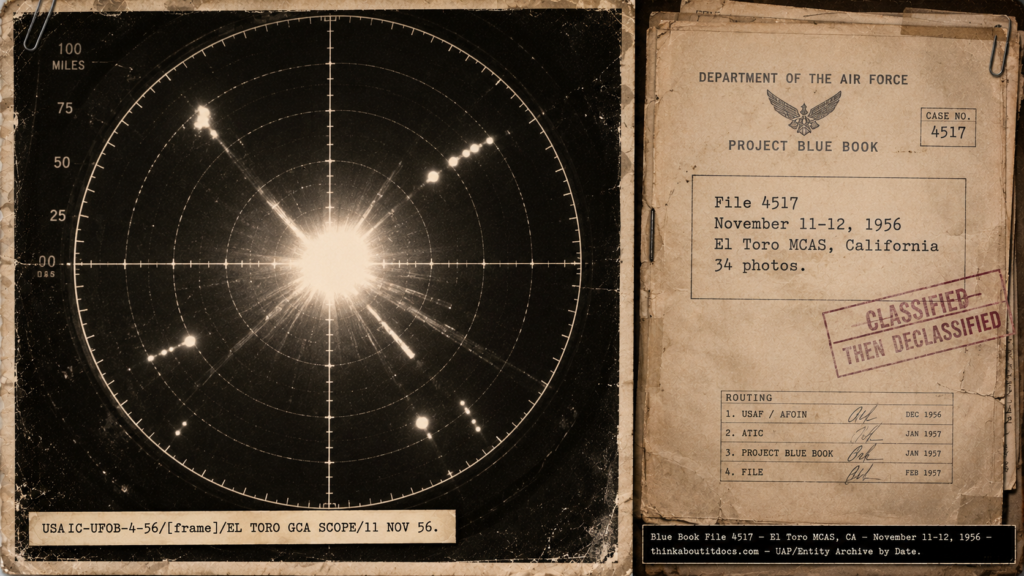
At 9:30 p.m. on November 11, 1956, radar at El Toro Marine Corps Air Station in Orange County, California began tracking unidentified targets. Over the next eight hours, operators watched and photographed what appeared on their GCA scope — and what they documented is now in the Blue Book files as File 4517: 34 individual photographs of the El Toro GCA radar scope, captioned USA/IC-UFOB-4-56/[frame]/EL TORO GCA SCOPE/11 NOV 56. “IC-UFOB” is the Air Force’s internal intelligence-collection category code for unidentified flying object cases. Blue Book formally tasked scope photography of this event.
The photographs show what the operators were watching. Early frames show a central return so saturated it blooms outward from the center of the scope — a return many times the intensity of a normal aircraft blip, with radial streaks extending in multiple directions. Later frames show the return contracting to a more defined but still anomalously bright central mass, with track lines extending toward the scope edge that are consistent with objects departing at speed. The operators watched targets move at speeds ranging from 50 knots to 15,000 mph. At times visual lights were observed in the areas where the radar contacts were being held. Smaller objects were seen to converge on the central return, merge into a single larger blip, and then separate — scattering rapidly across the display while the central return resumed its original size. Project Blue Book listed it as unknown. Thirty-four scope photographs document why.
Date: November 11–12, 1956
Sighting Time: 9:30 p.m. (PST) through approximately 5:30 a.m. (November 12)
Day/Night: Night (spanning into early morning)
Location: El Toro Marine Corps Air Station, Orange County, California (present-day Great Park, Irvine)
Urban or Rural: Military air station
No. of Entity(‘s): Not Applicable
Entity Type: Not Applicable
Entity Description: Not Applicable
Hynek Classification: RV (Radar-Visual) — radar contacts correlated with visual light observations in the same areas; 34 scope photographs in Blue Book File 4517
Duration: Approximately 8 hours (9:30 p.m. to approximately 5:30 a.m.)
No. of Object(s): Multiple; at least one large persistent central return, with smaller objects observed to merge with and separate from it
Description of the Object(s): The central return as photographed is extraordinarily bright — saturating the GCA scope phosphor in early frames, with bloom extending outward and radial streaks in multiple directions. This level of saturation is consistent with a very large radar cross-section or a return of unusual intensity at close range to the GCA antenna. Smaller returns converged on the central mass, merged, then separated and scattered rapidly. At times visual lights were observed in the areas corresponding to the radar contacts.
Shape/Size/Color of Object(s): Radar and visual only — no shape or color recorded beyond the visual lights in the areas of radar contacts
Distance to Object(s): Within GCA (Ground Controlled Approach) radar coverage of El Toro MCAS — GCA precision approach radar typically covers a range of approximately 10–20 nautical miles, meaning contacts were relatively close to the base
Height & Speed: Speeds ranging from 50 knots (helicopter-class) to 15,000 mph (approximately Mach 20). The extreme speed range — both ends observed in the same 8-hour event — is one of the case’s defining characteristics.
Number of Witnesses: El Toro MCAS GCA radar personnel (names not given in available summaries; identified in Blue Book File 4517)
Special Features/Characteristics: 8-hour duration. Extreme return intensity visible in scope photographs. Merging and splitting behavior of smaller returns around the central mass. Speed range from 50 knots to 15,000 mph. Visual light corroboration of radar contacts. Blue Book formally photographed the event: 34 scope photographs, File 4517, captioned USA/IC-UFOB-4-56/[frame]/EL TORO GCA SCOPE/11 NOV 56. The IC-UFOB designation is the Air Force Intelligence Collection category for UFO cases — formal tasking of scope photography indicates the event was treated as a significant intelligence matter, not a routine anomaly.
Case Status: Unexplained (Project Blue Book unknown, File 4517)
Source: Project Blue Book File 4517 (34 scope photographs, captioned USA/IC-UFOB-4-56, El Toro GCA Scope, 11 Nov 56); Weinstein catalogue; FUFOR Index; Dan Wilson (Blue Book file researcher); Brad Sparks (Blue Book unknowns researcher)
Summary/Description: El Toro MCAS GCA radar tracked multiple unidentified targets for 8 hours from 9:30 p.m. on November 11, 1956. Speeds ranged from 50 knots to 15,000 mph. Smaller returns merged with and separated from a large central return. Visual lights corroborated radar contacts. Blue Book formally photographed the event: 34 scope photos, File 4517, IC-UFOB category. Blue Book unknown.
Related Cases: 1956: November UFO|UAP & Entity Sightings Archive; 1956: Lakenheath-Bentwaters Radar-Visual (August 13–14, 1956); 1956: Westover AFB CPN-18A Radar, July 17, 1956
Detailed Report
El Toro Marine Corps Air Station in Orange County, California was in November 1956 one of the primary West Coast Marine aviation installations, home to fighter and attack squadrons and supporting the air defense network of the Southern California corridor. Its GCA — Ground Controlled Approach — radar unit provided precision approach guidance to aircraft landing at the base, operating at close range with high resolution.
At 9:30 p.m. on November 11, 1956, GCA radar operators began acquiring contacts they could not identify. The returns did not behave like aircraft. Over the next eight hours — through the night and into the early morning of November 12 — the operators continued to watch. They also began photographing the scope. Blue Book File 4517 contains 34 individual photographs of the El Toro GCA scope, each captioned USA/IC-UFOB-4-56/[frame number]/EL TORO GCA SCOPE/11 NOV 56. The designation IC-UFOB — Intelligence Collection, Unidentified Flying Object — is the Air Force’s formal category for UFO cases processed through the military intelligence system. Tasking scope photography at this scale indicates the event was being treated as a significant intelligence matter.
The photographs document a sequence. Early frames show a central return of extraordinary intensity — the phosphor of the GCA scope is saturated at the center, producing a bright bloom with radial streaks extending outward, consistent with a return many times stronger than a normal aircraft blip. A GCA precision approach radar at this period operated at close range; an overloaded scope return of this magnitude at that range implies either a very large radar cross-section, a very high radar reflectivity, or both. Later frames show the central return contracting to a more defined but still anomalously bright mass, with track lines extending toward the scope edge documenting movement at speed.
What the operators observed and reported: targets moving at speeds from 50 knots to 15,000 mph. Visual lights in the areas of radar contacts. And the most anomalous element — smaller radar returns converging on the central mass, merging into it to form a single larger return, then separating and scattering across the display while the central return resumed its original size. This cycle was observed multiple times during the 8-hour event.
Blue Book listed the case as unknown. The 34 scope photographs are the physical record of what those operators were watching.
RESEARCHER’S NOTES
What the Scope Photographs Tell Us
- The IC-UFOB designation: Every one of the 34 photographs is captioned with “IC-UFOB” — Intelligence Collection, Unidentified Flying Object. This is not an informal label applied after the fact. It is the Air Force’s formal intelligence-collection category assigned at the time of the event. The decision to formally photograph the scope and file 34 prints into the Blue Book system represents a level of institutional response well above what a routine anomaly would generate. Someone at El Toro judged this event significant enough to document on film frame by frame.
- What the scope saturation means: In the early photographs, the central return saturates the GCA scope phosphor — the display shows a blooming white mass rather than a discrete blip. On a precision approach radar of this era, a normal light aircraft produces a small, clearly defined return; a large airliner produces a somewhat larger one. A return that saturates the scope’s phosphor at the center and produces radial bloom streaks implies a radar cross-section or reflection intensity far outside the normal aircraft envelope. It cannot be explained as a processing artifact without also explaining why it appears across multiple sequential frames while conventional aircraft returns visible around the scope’s edge remain normally sized.
- The GCA radar as an instrument: A Ground Controlled Approach radar is a precision approach system, not a long-range search radar. Its range is typically 10–20 nautical miles; its resolution at that range is significantly better than a long-range surveillance radar. Contacts on a GCA scope are relatively close to the antenna — which makes the scope saturation in these photographs even more significant. The return is not being captured at the edge of the system’s range; it is being captured at relatively close proximity.
- The merging and splitting in context: Objects that converge on a point, merge their radar returns, then separate and scatter are exhibiting controlled formation rendezvous behavior. In a military context this is exactly what you’d see when aircraft join up and break formation. What makes El Toro anomalous is that no conventional formation of aircraft operates at 50 knots and 15,000 mph in the same event, and no conventional formation activity at a US military installation in 1956 would generate this level of Blue Book photographic documentation without being identified.
- Eight hours and the AP explanation: Anomalous propagation — radar mirages caused by atmospheric temperature inversions — is the standard dismissal for unusual radar returns. AP can produce false echoes that appear to move or hover. But AP does not typically sustain stable, trackable contacts over 8 consecutive hours. AP returns are characteristically unstable, variable and weather-dependent. They do not produce the merging/splitting behavior described, and they do not produce scope saturation of the kind visible in these photographs. Eight hours of consistent, patterned radar behavior, documented on 34 photographs, exceeds any AP event in the standard meteorological literature.
File 4517 is the El Toro case’s primary physical record. Thirty-four photographs of a GCA scope over an 8-hour event, formally captioned with the Air Force’s UFO intelligence collection designation, showing returns that saturate the scope phosphor at the center and document objects merging and separating in ways no conventional 1956 aircraft could reproduce. Blue Book called it unknown. The photographs are the reason.
Smaller objects appeared to join the larger object and merge with it to form a larger blip. A few seconds later the smaller objects would depart and dash all over the screen — leaving the larger blip in its original size.
El Toro MCAS GCA radar summary, November 11–12, 1956 — Blue Book File 4517 (34 scope photographs, IC-UFOB category); Weinstein; FUFOR Index; Dan Wilson; Brad Sparks; BBU unknown