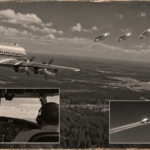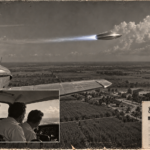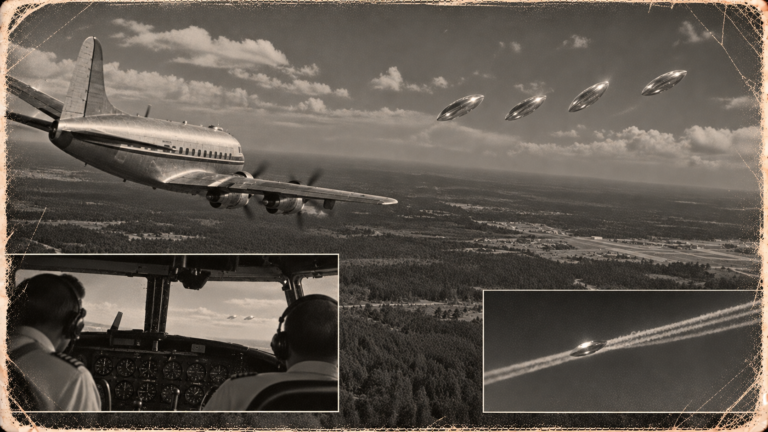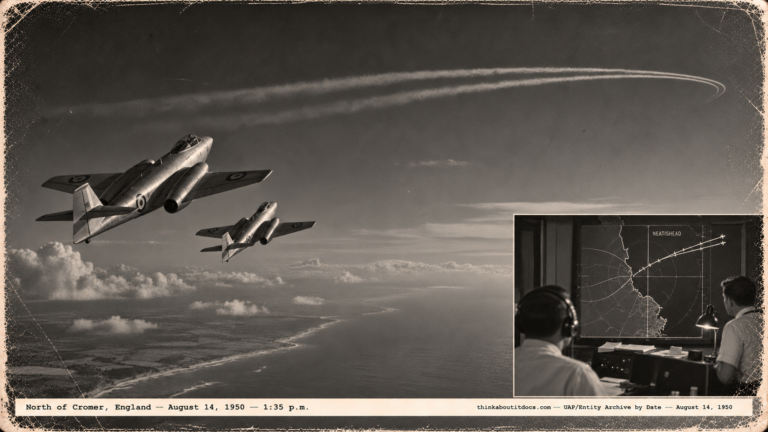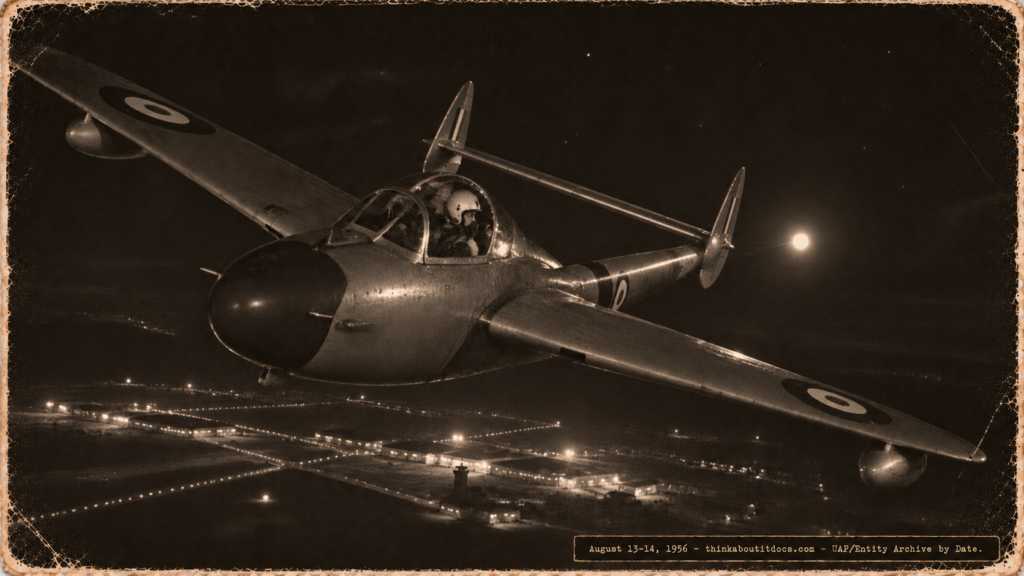
RAF Lakenheath, England, August 13-14, 1956: the Venom tried every maneuver — and the object stayed behind it for ten minutes.
THINK ABOUTIT UFO|UAP SIGHTINGS REPORT
1956: Lakenheath-Bentwaters, England: The Night a Venom Couldn’t Shake Its Tail
At 9:30 p.m. on August 13, 1956, the night supervisor of the Lakenheath Radar Air Traffic Control Center in Suffolk, England, received an unusual telephone call from the Ground Controlled Approach unit at RAF Bentwaters: “Do you have any targets on your scopes traveling at 4,000 mph?” What followed over the next several hours became the most thoroughly documented radar-visual UFO incident in Cold War military history, and the one the University of Colorado Condon Report called the most puzzling in the radar-visual files.
Bentwaters tracked four separate unidentified radar contacts. Lakenheath then acquired an object on two separate radar systems simultaneously — one of them making stop-and-go movements at 400 to 600 mph, starting and stopping with no detectable acceleration. A de Havilland Venom night fighter was scrambled. The pilot locked his fire-control radar and reported “the clearest target I have ever seen on radar.” Then the object moved swiftly behind the jet. For the next ten minutes the Venom tried every evasive maneuver available. It couldn’t lose it. When the pilot had to break off because of low fuel, the object briefly followed the Venom, then stopped and resumed its stationary watch over Lakenheath. A second Venom was scrambled but returned early with engine trouble. The contacts continued until about 3:30 a.m., when the object departed to the north at its standard 600 mph cruise, fading from radar at 50-60 miles out.
Date: August 13–14, 1956
Sighting Time: 9:30 p.m. (Bentwaters first contact) to approximately 3:30 a.m. (loss of Lakenheath contact)
Day/Night: Night
Location: RAF Bentwaters and RAF Lakenheath, Suffolk, England (and the airspace between them), both USAF-tenanted at the time
Urban or Rural: Military air bases / rural East Anglia
No. of Entity(‘s): Not Applicable
Entity Type: Not Applicable
Entity Description: Not Applicable
Hynek Classification: RV (Radar-Visual): simultaneous radar tracks on multiple ground systems plus airborne radar and visual contacts
Duration: Approximately 6 hours (9:30 p.m. to ~3:30 a.m.)
No. of Object(s): Multiple contacts; the Lakenheath phase involved what appeared to be a single persistent object
Description of the Object(s): The Lakenheath object appeared as a strong, steady radar return. Ground observers at Lakenheath described a bright visual contact. The Venom pilot described it visually and said his airborne fire-control radar confirmed a solid return. No shape description was obtained.
Shape/Size/Color of Object(s): No shape recorded. Bright visual appearance reported by ground observers and the Venom pilot.
Distance to Object(s): The Venom achieved half a mile separation before the object moved; the Lakenheath RATCC tracked the object consistently throughout the interception sequence
Height & Speed: The Lakenheath object operated at 15,000–20,000 feet during the intercept. Its cruise speed when moving was calculated at 400–600 mph with instantaneous starts and stops. Bentwaters contacts ranged from estimated 4,000 mph to one calculation of 18,000 mph for the initial fast-track. The slow group of echoes moved at 80–125 mph.
Number of Witnesses: Multiple: the Bentwaters GCA radar team; the Lakenheath RATCC night-watch supervisor and controllers; the Lakenheath GCA team; the C-47 pilot who saw the object pass beneath him; ground visual observers at Lakenheath; the pilot of Venom No. 1 (named in some accounts as First Officer Berkley); the navigator/radar operator of Venom No. 1; the crew of Venom No. 2
Special Features/Characteristics: Simultaneous tracking on three separate ground radar systems. The Lakenheath object made stop-and-go movements with no perceptible acceleration or deceleration. The Venom achieved gun lock; the object then moved behind the jet and maintained position for ten minutes despite all evasive maneuvers. The first Venom pilot was described as sounding “pretty scared.” RAF records of the incident were subsequently destroyed; the controller’s logbook was impounded by senior RAF officers immediately after the incident.
Case Status: Unexplained (Project Blue Book unknown; Condon Report Case #2, which concluded the probability of a genuine UFO involvement was “fairly high”)
Source: Condon Report, Case #2 (University of Colorado, 1968); Gordon D. Thayer, Journal of Aeronautics and Astronautics, September 1971; James E. McDonald, Flying Saucer Review, Vol. 16, No. 2, 1970; Brad Sparks; Project Blue Book files (BBU)
Summary/Description: Multi-hour radar-visual UFO incident at two USAF-tenanted RAF bases in Suffolk. Bentwaters tracked contacts at extreme speed; Lakenheath acquired a persistent object on two radar systems simultaneously. A Venom fighter achieved radar gun lock, then couldn’t shake the object from its tail for ten minutes. Condon Report Case #2. Blue Book unknown.
Related Cases: 1956: August UFO|UAP & Entity Sightings Archive; 1956: Wurtsmith AFB F-89D Radar Lock (January 11, 1956)
Detailed Report
The night of August 13, 1956 was clear over Suffolk — dry, largely cloudless, and, as observers noted, unusually rich in shooting stars from the Perseid meteor shower. At RAF Bentwaters, tenanted by the USAF, the GCA radar team began picking up unidentified returns starting at 9:30 p.m.
The first contact crossed 30 miles in about 30 seconds on a constant heading of 295 degrees, giving a calculated speed of 4,800 to 6,000 mph. “The size of the blip when picked up was that of a normal aircraft target,” and it “diminished in size and intensity to the vanishing point” as it moved off the scope. A few minutes later a group of 12 to 15 separate echoes appeared, moving as a cluster from the southwest at 80 to 125 mph before merging into a single very large return — described as “several times larger than a B-36 return under comparable conditions.” This merged echo remained stationary for 10 to 15 minutes, moved a short distance, stopped again, then moved off the scope at the 50-mile range limit. A third contact shortly after crossed the scope at an estimated 12,000 mph. A fourth, at about 10:55 p.m., moved from 30 miles east of Bentwaters to 30 miles west, apparently vanishing 2 miles east of the station and reappearing 3 miles to the west, implying a speed of some 18,000 mph if the transition was instantaneous. It was this fourth contact that prompted the phone call to Lakenheath.
The Lakenheath night-watch supervisor was skeptical but immediately ordered all controllers to begin scanning with full MTI — Moving Target Indicator mode, which filtered out stationary ground returns. Almost immediately, one controller found a stationary echo about 20 to 25 miles southwest of Lakenheath. The Lakenheath GCA radar confirmed it in the same position. For some minutes it sat motionless. Then, with no build-up, it began moving in a north-northeast direction at a steady 400 to 600 mph, making a series of course changes, each on a perfectly straight line, with stationary episodes of 3 to 6 minutes between each leg. No acceleration or deceleration was ever measured; the object appeared to start and stop instantaneously.
After 30 to 45 minutes of this behavior, RAF Waterbeach scrambled a de Havilland Venom night fighter. The Venom reached Lakenheath and was vectored toward the object, which was then stationary. Half a mile ahead, the pilot reported: “Roger, I’ve got my guns locked on him.” He added that it was “the clearest target I have ever seen on radar.” There was a brief pause. Then: “Where did he go? Do you still have him?” Lakenheath RATCC told him the object had made a swift circling movement and was now behind the Venom. The pilot confirmed the target was on his tail.
For approximately 10 minutes the Venom pilot attempted every evasive maneuver he had. The Lakenheath RATCC radar continuously showed two distinct echoes — the jet, and the object behind it — with separation greater than roughly 500 feet. The pilot could not shake it. “Pretty scared” was how the watch supervisor described the pilot’s voice. Running low on fuel, the pilot asked Lakenheath to tell him if the object followed him toward base. It followed him a short distance, then stopped and resumed a stationary aspect over Lakenheath.
A second Venom was dispatched but returned early with engine trouble before getting close enough to acquire the target. After a few more brief movements, the Lakenheath object departed to the north at about 600 mph and faded from radar at 50 to 60 miles, consistent with a departure below 5,000 feet. The time was approximately 3:30 a.m. on August 14.
RESEARCHER’S NOTES
What the Condon Report Actually Said
- Three independent radar systems: The Lakenheath object was tracked simultaneously on the Lakenheath RATCC CPS-5 radar and the Lakenheath GCA radar — two separate systems, different types, operating independently. It was also tracked on the Venom’s own airborne fire-control radar. Three simultaneous systems on the same target essentially rules out equipment malfunction as an explanation for any one of them.
- What the Condon Report concluded: Gordon Thayer’s analysis for the Condon Report called it “the most puzzling and unusual case in the radar-visual files” and said the probability of a “genuine UFO” — meaning a real, physical, unidentified object in the air — was “fairly high.” The Condon Report is routinely cited as having debunked UFO cases; this case is the most prominent exception.
- Meteor and anomalous propagation: Thayer’s analysis ruled out meteors directly, noting that the witnesses could already distinguish the unusually rich Perseid shower from the radar/visual contacts. He also found anomalous propagation (AP radar mirage) essentially impossible for the Lakenheath phase, since the stop-and-go movements with instantaneous starts would require two different radar systems to produce identical AP artifacts simultaneously, which is “almost inconceivable.” The No. 2 Bentwaters slow-moving group was the only contact he considered might have a partial AP explanation.
- The impounded logbook: Flight Lieutenant Freddie Wimbledon, the RAF Neatishead radar controller on duty that night, confirmed years later that his controller’s logbook was impounded by senior RAF officers shortly after the incident and he was told the matter was a national security issue. He publicly disputed Philip Klass’s radar-malfunction explanation, confirming the object did indeed appear to follow the Venom. The RAF and Air Ministry records were later found to have been destroyed.
- Klass’s malfunction theory: Philip Klass argued that a faulty MTI unit on the Lakenheath RATCC radar could produce false echo behavior. Thayer responded that a malfunctioning MTI producing the observed pattern would have to affect two different radar types identically — and the Venom’s independent airborne radar, a third separate system, also acquired the target, which is not explained by a ground-station MTI fault.
The Lakenheath-Bentwaters incident stands in a special category: a case examined rigorously by the only officially sanctioned scientific UFO study in American history, declared unexplained in that study, corroborated by independent senior radar witnesses who went public decades later, and confirmed in Blue Book files. The RAF records no longer exist. The American Blue Book file does. The two Venom pilots who flew that night described what happened in their own words to subsequent investigators. It remains unexplained.
“He — or it — got behind me and I did everything I could to get behind him and I couldn’t. It’s the damnedest thing I’ve ever seen.”
RAF Venom pilot, Venom No. 1, to Venom No. 2 after the Lakenheath intercept, night of August 13–14, 1956 — recorded by the Lakenheath RATCC night-watch supervisor; reported in Condon Report Case #2