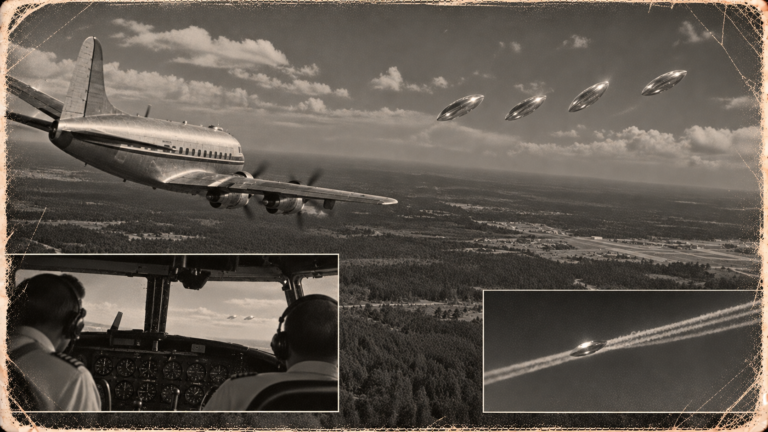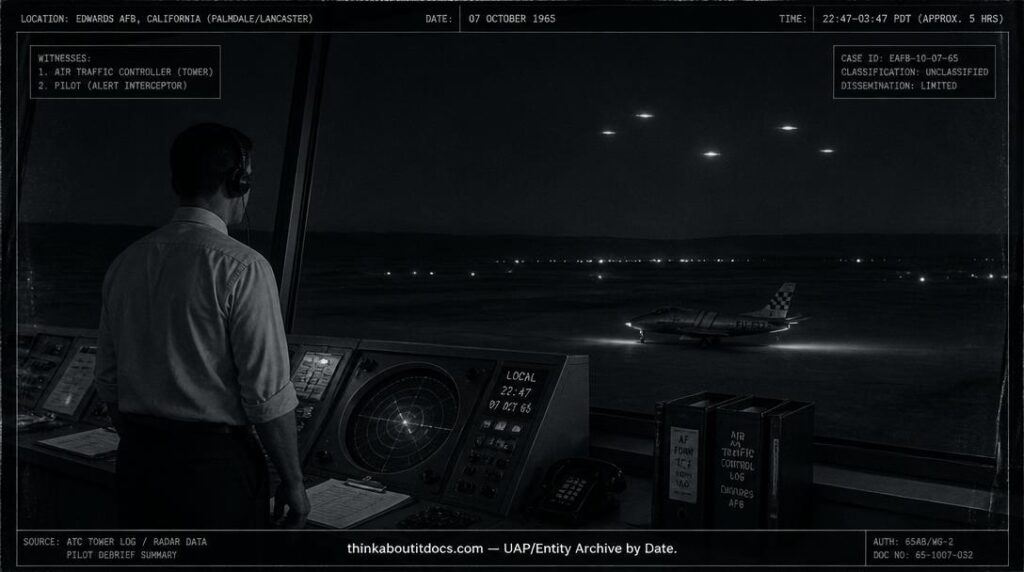
Archival rendering of the October 7, 1965 Edwards Air Force Base incident, documented on declassified Air Force audio tapes and radar records from four separate stations.
THINK ABOUTIT UFO SIGHTINGS REPORT
1965: Edwards Air Force Base Visited by UFOs — “The Incident”
On the night of October 7, 1965, Air Force personnel at Edwards Air Force Base in California’s Mojave Desert tracked up to twelve luminous objects visually and on radar from multiple stations, including Edwards itself, the San Pedro and Los Angeles Air Defense Sector installations, and George Air Force Base, which scrambled an F-106A interceptor that reportedly could not close the distance to objects flying near 40,000 feet. The event, given the internal designation “The Incident,” was captured on roughly forty hours of Air Force audio recordings across at least eight positions, of which about six hours were later declassified. Decades later, film producer Samuel M. Sherman built a commercial documentary around a restored and re-edited version of those tapes, adding narration and promoting the result as definitive proof of extraterrestrial visitation. This entry documents both the underlying Air Force record and Sherman’s separate promotional claims, and keeps the two distinct.
Date: October 7, 1965 (Project Blue Book case)
Sighting Time: Night, over an approximately five-hour period
Day/Night: Night
Location: Edwards Air Force Base, Palmdale/Lancaster area, Mojave Desert, California; radar contacts also reported at San Pedro, the Los Angeles Air Defense Sector, and George Air Force Base (Victorville)
Urban or Rural: Air Force base / rural desert installation
No. of Entity(s): Not Applicable
Entity Type: Not Applicable
Entity Description: Not Applicable
Hynek Classification: RV — Radar-Visual. This site’s legacy field data listed CE-I; however, the case involves objects tracked simultaneously on radar from multiple independent stations (Edwards, San Pedro, LAADS, and George AFB) and confirmed visually by military personnel, which is the defining profile of an RV case rather than a simple close-proximity visual encounter.
Duration: Approximately 5 hours for the overall event
No. of Object(s): Up to 12 luminous objects reported
Description of the Object(s): Described by named witness Chuck Sorrels, an Air Force air traffic controller on duty that night, as luminous objects that would remain stationary for a period before moving very fast to a new location, with an apparent capability to climb nearly straight up in short order; Sorrels stated his training and eyesight made clear the objects were not aircraft, helicopters, stars, satellites, weather balloons, or any other known aerial object
Shape of Object(s): Undocumented beyond “luminous”
Size of Object(s): Undocumented
Color of Object(s): Luminous; specific color not detailed in the sources reviewed for this entry
Distance to Object(s): Undocumented precisely; objects were tracked at long range on radar from multiple stations across the region
Height & Speed: Objects reportedly operated near 40,000 feet and were able to outdistance a scrambled F-106A interceptor sent up from George Air Force Base
Number of Witnesses: Multiple named and credentialed military personnel, including TSgt (later identified variously as Sgt.) Chuck Sorrels, an air traffic controller in the Edwards control tower, and Captain Darryl Clark, an alert pilot with the 329th Fighter Interceptor Squadron who was, that night, assigned to a nuclear-armed “Hot Bird” alert aircraft; additional personnel across at least eight recording positions are audible on the declassified tapes
Special Features/Characteristics: The Los Angeles Air Defense Sector reportedly requested that Edwards personnel wake the base’s designated UFO Officer, a position that existed at Edwards at the time, to assess the situation; the possible use of nuclear-associated alert aircraft became a live consideration during the event, given Captain Clark’s assignment that night; approximately 40 hours of audio recordings were reportedly made across multiple positions, of which about 6 hours were declassified by the Air Force; the declassified audio was later obtained, restored, and re-edited into a narrated documentary presentation by film producer Samuel M. Sherman, who added professional narration by veteran broadcaster Jackson Beck and presented the finished product to government agencies and, via the CSETI organization, to members of Congress
Case Status: Unexplained (Project Blue Book listed the case among its “Unidentified” files; no specific conventional explanation for this event has been documented in the sources reviewed, though Blue Book’s general program conclusion held that no evidence indicated any “Unidentified” case represented extraterrestrial vehicles)
Source: Project Blue Book files (declassified, 17 pages, via NICAP); declassified Air Force audio recordings; contemporaneous witness statements from Chuck Sorrels and Darryl Clark; Samuel M. Sherman’s promotional account of his tape restoration project (1998), treated here as a separate, non-independently-verified secondary source
Summary/Description: On the night of October 7, 1965, Air Force personnel at Edwards Air Force Base tracked up to twelve luminous objects visually and on radar from multiple stations across Southern California, prompting the scramble of an F-106A interceptor that reportedly could not close on objects operating near 40,000 feet. The event, internally designated “The Incident,” was recorded on Air Force audio tapes, of which roughly six hours were later declassified. Named witnesses, including air traffic controller Chuck Sorrels and alert pilot Captain Darryl Clark, are audible on the tapes. Decades later, film producer Samuel M. Sherman restored and re-edited the audio into a narrated documentary, which he has promoted as definitive proof of extraterrestrial visitation and presented to government agencies and members of Congress.
Related Cases: None documented
Detailed Report
Edwards Air Force Base, the Air Force’s premier flight-test facility in California’s Mojave Desert, has a documented history of unusual aerial reports going back to the 1950s, including cases noted by Edward Ruppelt, former chief of the Air Technical Intelligence Center. The October 7, 1965 event unfolded over roughly five hours and involved reports of up to twelve luminous objects observed both visually by Air Force personnel and on radar from multiple independent stations, including Edwards itself, the San Pedro installation, the Los Angeles Air Defense Sector (LAADS), and George Air Force Base at Victorville. George Air Force Base scrambled an F-106A Delta Dart interceptor in response; the aircraft reportedly could not close the distance to objects operating near 40,000 feet.
Major Struble of LAADS authorized recordings of the voice communications generated by the event, made on an auxiliary track of radar data tape reels that ran continuously as a matter of standard procedure. Given the roughly five-hour duration of the event and recordings made from at least eight separate positions, an estimated 40 hours of audio material was generated; the Department of the Air Force later declassified approximately six hours of it. Among those recorded is Chuck Sorrels, an Air Force air traffic controller who was on duty in the Edwards control tower that night. Sorrels has since stated in recorded interviews that the objects would remain stationary for periods before moving very quickly to a new position, with an apparent ability to climb nearly straight up, and that his training and firsthand observation left him confident the objects were not aircraft, helicopters, stars, satellites, weather balloons, or any other conventional aerial object.
Also present that night was Captain Darryl Clark of the 329th Fighter Interceptor Squadron, an alert pilot assigned that evening to one of the nuclear-armed “Hot Bird” aircraft maintained on standby to defend the western United States. Clark is audible on the original recordings describing his observations of the objects from the ground. Records associated with the incident indicate LAADS requested that Edwards personnel wake the base’s designated UFO Officer, a position that existed at Edwards at the time, to help assess the unfolding situation.
Decades later, film producer Samuel M. Sherman, who had pursued a long-standing personal interest in UFO research and had been working since the early 1990s toward a documentary on the subject, obtained the declassified audio. Sherman has stated that the released tapes were disorganized, containing overlapping and out-of-sequence fragments of conversation that he described as initially defying interpretation. Sherman spent an extended period cataloguing and reordering the audio into what he presents as its correct chronological sequence, then added narration written and read by veteran broadcaster Jackson Beck to guide listeners through the reconstructed timeline. Sherman has since promoted the finished production as conclusive documentation of extraterrestrial visitation, stated that he circulated it to multiple government agencies without receiving objection, and noted that the CSETI organization used his presentation in meetings with members of Congress. Sorrels participated in at least one such Washington presentation alongside Sherman’s material.
RESEARCHER’S NOTES
Edwards AFB, 1965 — Separating the Air Force Record from the Documentary Promotion
- The underlying case is genuinely well-documented. Unlike many military UFO claims, this event has actual declassified Air Force audio, named and credentialed witnesses (an on-duty air traffic controller and a nuclear-alert fighter pilot), multi-station radar corroboration, and surviving Blue Book paperwork. This places it among the better-documented military cases in this archive’s California record, independent of any later commercial promotion built around it.
- Sherman’s tape reconstruction is a separate, unverified claim layered on top of a real event. Samuel M. Sherman was a commercial film producer, not an audio forensics expert, a credentialed UFO investigator, or a disinterested party; he was actively producing and promoting a documentary product built around his reconstruction. His claim to have correctly reassembled a “scrambled” recording into accurate chronological sequence has not been independently verified by outside audio engineers or archivists, and should be treated as his own interpretive editorial work rather than as an established, peer-reviewed restoration.
- “No negative comments” is not the same as verification. Sherman’s claim that government agencies raised no objection to his finished production is a weak form of evidence; the absence of an official rebuttal to an unsolicited documentary sent to an agency does not constitute independent confirmation of its accuracy or conclusions, and should not be read as such.
- Blue Book’s Unidentified status is real but should not be overstated. This case appears to have been carried among Project Blue Book’s “Unidentified” files, meaning no conventional explanation was successfully applied at the time. However, Blue Book’s own overarching program conclusion explicitly held that no evidence indicated its “Unidentified” cases represented extraterrestrial vehicles specifically; an Unidentified classification reflects an absence of a conventional explanation, not a positive finding of alien origin, and Sherman’s promotional framing of the tapes as “ironclad proof” of extraterrestrial visitation goes well beyond what the Blue Book classification itself supports.
- The named witnesses’ core testimony stands on its own, separate from Sherman’s framing. Chuck Sorrels’s professional assessment as a trained air traffic controller, and Darryl Clark’s presence as a nuclear-alert pilot recorded describing the event in real time, carry evidentiary weight independent of how the later documentary characterized or narrated their words. Readers should weigh their testimony on its own terms rather than through the lens of Sherman’s promotional interpretation.
Strip away the documentary marketing, and what remains is a genuinely substantial military case: up to twelve luminous objects tracked on radar from four separate stations, an interceptor that couldn’t catch them, a control tower NCO and a nuclear-alert pilot recorded describing them in real time, and a Blue Book file that was never resolved. That core record deserves to be taken seriously on its own. Samuel Sherman’s later claim to have restored it into “ironclad” proof of alien visitation is a separate, unverified layer built on top of it, and this archive treats the two accordingly.
“My experience as an air traffic controller made it plain to me that these luminous objects were not planes, helicopters, stars, satellites, weather balloons or any other known aerial object.”
— Chuck Sorrels, Edwards AFB air traffic controller, October 7, 1965