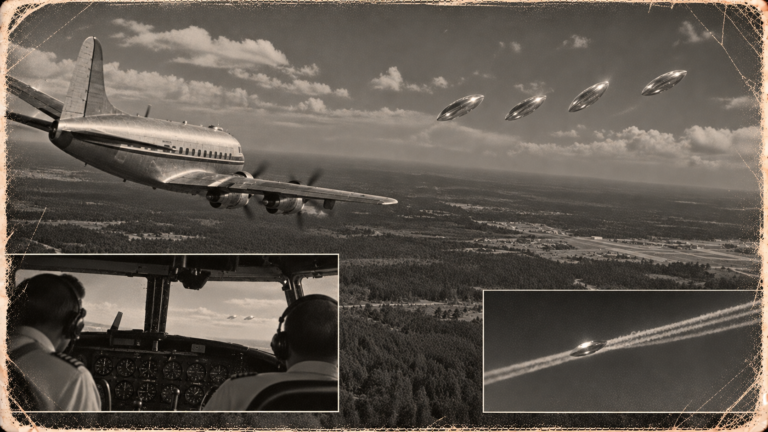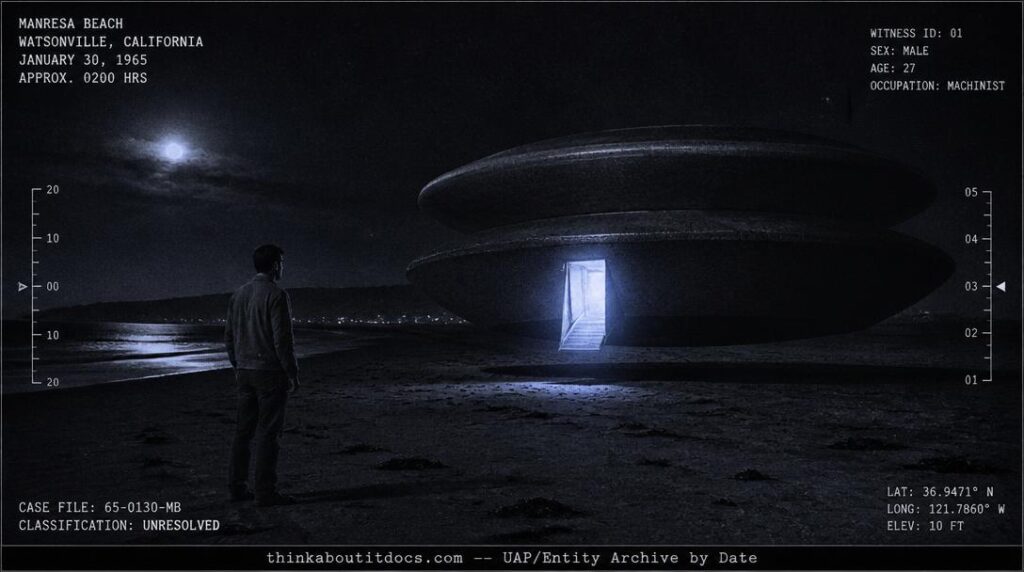
Archival rendering of Sid Padrick's January 30, 1965 claimed encounter near Watsonville, California, one of the few contactee-era cases with a surviving Air Force investigative report.
THINK ABOUTIT ABDUCTION REPORT
1965: Sid Padrick Contact Case
Sid Padrick, a 45-year-old TV and radio repairman and private pilot with 600 flying hours, told the Air Force he’d been invited aboard a landed flying saucer on a pre-dawn beach walk near Watsonville, California, on January 30, 1965, toured its fourteen rooms by a crew of nine calling itself peaceful observers, and returned home two hours later having met a being who introduced himself only as “Xeno.” The case is unusual among contactee-era claims for one reason above all others: the Air Force actually sent an investigator, and his report survives.
Date: January 30, 1965
Sighting Time: Approximately 2:00 a.m., returning to the beach around 4:05 a.m.
Day/Night: Night
Location: Manresa Beach, near Watsonville, California, per Padrick’s own account; the Air Force’s own investigative report instead identifies the location as La Selva Beach, a nearby but distinct beach, a discrepancy flagged here rather than resolved
Urban or Rural: Beach
No. of Entity(s): 9 (8 crew members encountered aboard the craft, plus the primary contact, “Xeno”)
Entity Type: Humanoid
Entity Description: All of the beings were about 5’9″ to 5’10” tall, estimated at 150 to 155 pounds, appeared to be 20 to 25 years of age, and all wore two-piece suits of a light bluish-white color matching the ship’s interior walls. Though they appeared quite human, Padrick noted their faces came to more of a point than ours, with sharp chins and noses, and their fingers appeared longer than ours. All had very light skin complexion. The men had short, wavy, dark auburn hair, while the single woman crew member had long hair of the same color tucked back under her clothing.
Hynek Classification: CE-IV — Close Encounter of the Fourth Kind. Direct contact and extended interaction with the witness, including a tour aboard the craft.
Duration: Just over 2 hours (approximately 2:00 a.m. to 4:05 a.m.)
No. of Object(s): 1 primary craft; Padrick additionally reported seeing a second craft, described as a “navigating craft,” displayed on a screen aboard the first
Description of the Object(s): Described by Padrick as resembling two very thick saucers inverted against each other, unlit and shadowy in outline as it first approached, containing 14 rooms with no square corners, illuminated throughout by a blue-white light that Padrick said seemed to come through the walls themselves
Shape of Object(s): Disc
Size of Object(s): Reported as approximately 50 feet in diameter and 30 feet high in Padrick’s most commonly cited account; other secondary sources describe it as approximately 75 feet in diameter, a size discrepancy across the case’s documented retellings that is flagged here rather than resolved
Color of Object(s): Unlit/dark exterior; interior illuminated with blue-white light
Distance to Object(s): Object reportedly descended to hover just a foot or two above the beach sand directly in front of the witness
Height & Speed: Approached at low altitude with a noise Padrick compared to a jet aircraft, then descended to hover just above the ground
Number of Witnesses: 1 (Sid Padrick); no independent witness to the contact itself has been identified, though a Monterey newspaper reported the city’s mayor saw a “bright object” over Monterey Bay, roughly 30 miles from Watsonville, the evening before
Special Features/Characteristics: Padrick reported being taken for a ride aboard the craft, briefly stepping outside at one point onto what he believed was a hillside near Leggett, California, roughly 175 miles northwest of Watsonville; he reported communicating primarily with “Xeno,” who spoke fluent American English and appeared to receive answers to Padrick’s questions via apparent telepathic contact with the rest of the crew; Padrick contacted Hamilton Air Force Base on February 4, 1965, and was interviewed in person four days later by Major Damon B. Reeder, who arrived to find Padrick already accompanied by a local newspaper reporter; Reeder assessed Padrick as above-average in intelligence with an excellent vocabulary, but grew suspicious upon learning Padrick intended to write a book about the experience, and privately felt Padrick was using the Air Force interview to lend the story credibility; Padrick’s planned manuscript was reportedly never published, and later accounts describe an unresolved legal dispute involving borrowed funds connected to the project; APRO investigators Jim and Coral Lorenzen found Padrick sincere but concluded the experience was most likely a psychological delusion rather than a physical event; researcher John Keel instead framed the case within his broader “ultraterrestrial” theory, noting that the name Xeno derives from the Greek word for “stranger”
Case Status: Insufficient Data — a single, uncorroborated witness account, complicated by a documented location discrepancy between the witness’s own account and the Air Force’s investigative report, a book/manuscript project that was never published, and a later financial dispute connected to that project
Source: Brent Raynes, Original Source; Major Damon B. Reeder investigative report, U.S. Air Force; Sam Vestal & Paul Cerny; Jerome Clark, The UFO Encyclopedia, Vol. 2 (1998); Coral and Jim Lorenzen, Encounters with UFO Occupants (1976, APRO); John A. Keel, Operation Trojan Horse (1996); Timothy Good, Beyond Top Secret: The World-wide UFO Security Threat
Summary/Description: Sid Padrick described seeing a disc-shaped craft, “like two real thick saucers inverted,” some 50 feet in diameter and 30 feet from the ground, near Watsonville, California, on January 30, 1965. Padrick claimed he cautiously walked toward the craft after being invited aboard by voice, was toured through its 14 rooms and introduced to eight crew members by a being calling himself “Xeno,” and was returned to the beach roughly two hours later. He reported the incident to Hamilton Air Force Base days later, prompting an in-person Air Force investigation whose investigator grew suspicious of Padrick’s stated plans to publish a book about the encounter.
Related Cases: 1952: George Adamski’s Desert Center/Blythe California Contact (comparable contactee-era single-witness contact structure)
Full Report
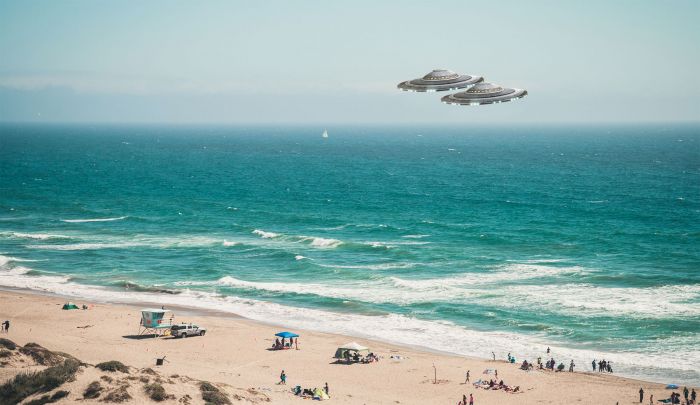 According to Sid Padrick, who at the time of his alleged encounter on January 30, 1965, was 45 years old, he was walking along Manresa Beach near Watsonville, California, reportedly because he was suffering from insomnia at the time. It was nearly 2 a.m., and he was a short distance, approximately 1,500 feet, from his house where his wife and three sons were sleeping soundly, when he claimed that something very unusual happened. His attention was attracted upwards by a noise similar to a jet aircraft at low altitude, but instead of a conventional aircraft, Padrick would later describe seeing a disc-shaped craft, “like two real thick saucers inverted,” some 50 feet in diameter and 30 feet from the ground. As he watched in wonderment, the object slowly came closer, eventually hovering a mere foot or two above the beach sand.
Padrick recalled later how he began to run toward home, when he heard a voice from the direction of the object. The voice, Padrick stated, told him not to be afraid and that they were not hostile. Initially, those words reportedly did not slow down his retreat, but then the voice repeated again that they were “not hostile,” and also invited him aboard. Padrick claimed that at this point his curiosity overcame his fear, at least somewhat, and he then began to cautiously walk toward the craft.
A door appeared and Padrick walked inside, and soon was conversing with a very human appearing gentleman wearing some sort of flying suit. The being spoke perfect American English, Padrick noted, and told Padrick that he could call him “Xeno,” and that he could ask any questions he desired. Padrick stated it took him about fifteen minutes to ask his first question, admitting he was too frightened. Padrick did ask what the purpose of their visit to earth was, and “Xeno” reportedly stated “observation only.” “Xeno” provided Padrick with a tour of the ship, which consisted of 14 rooms, and during the tour Padrick discovered there were eight other crew members, one of whom was a woman.
 All of the beings were about 5’9″ to 5’10” tall, estimated at 150 to 155 pounds, appeared to be 20 to 25 years of age, and all of them wore two-piece suits of a light bluish-white color, which happened to be the same color as the walls. Each room was illuminated by a blue-white light. “The light seemed to come through the walls,” Padrick stated, adding that none of the rooms had any square corners; they were rounded.
It seemed that only Xeno spoke English. During the tour, the other crew members paid little attention to Padrick, staying busy at their duty stations working complicated-looking instrument panels. Though they appeared quite human, Padrick noted their faces came to more of a point than ours, with sharp chins and noses, and their fingers appeared longer than ours. All had very light skin complexion. The men had short, wavy, dark auburn hair, while the woman crew member had long hair of the same color, tucked back under her clothing.
While aboard the craft, Padrick believes he was taken for a ride. At one point he got out for about three minutes and noticed they were on a hillside, which he later felt was a location near Leggett, California, some 175 miles northwest of Watsonville; he later felt he had found the exact spot.
At about 4:05 a.m., Padrick was returned and released back where his encounter had begun near Watsonville. A few days later, on February 4th, he phoned Hamilton Air Force Base and told them he had witnessed the landing of a spacecraft, adding he would only be willing to tell them more in person. Four days later, Major Damon B. Reeder paid Padrick a visit. Padrick showed the major where the encounter had occurred and told him the whole story. Major Reeder found Padrick to be above average in intelligence, with an excellent vocabulary, but grew suspicious when Padrick mentioned intending to write a book or article about the experience. Reeder felt Padrick was making the story up and intended to use the Air Force interview to make it appear more credible.
A newspaper story described how the mayor of Monterey, less than 30 miles from Watsonville, had seen a “bright object” over Monterey Bay on the evening of January 29th. APRO’s Jim and Coral Lorenzen felt Padrick was sincere but that his experience had been a psychological delusion of some kind. John Keel, however, felt Padrick had been another victim of what Keel termed earth-based “ultraterrestrials,” pointing out how such entities, like angels and elementals of earlier folklore, often present names drawn from ancient languages; Keel noted that Xeno, pronounced zee-no, derives from the Greek word for stranger.
Ufologist Leneesa Garroutte still remembers when she first met Padrick in 1965, when he came to Seattle and gave a lecture for the National Investigations Commission on Aerial Phenomena, headed by Robert Gribble. While in Seattle he stayed with Garroutte and drew sketches of the craft for her two daughters.
RESEARCHER’S NOTES
The Padrick Contact — 1965 and the Rare Case With an Actual Air Force Report
- A genuine, surviving official investigation sets this case apart. Unlike most contactee-era claims, this one produced an actual multi-page Air Force investigative report from a named officer, Major Damon B. Reeder, who traveled to interview the witness in person. That report survives and is a documented primary source, a rarity for cases of this type.
- Location and size discrepancies flagged, not resolved. Padrick’s own account places the encounter at Manresa Beach; the Air Force’s investigative report instead names La Selva Beach, a nearby but distinct location. Separately, the craft’s reported diameter varies across sources between roughly 50 and 75 feet. Neither discrepancy has been resolved in the sources reviewed for this entry, and both are presented here as documented inconsistencies rather than smoothed into a single confident figure.
- The investigator’s own suspicion is directly on the record. Major Reeder’s assessment, that Padrick was likely fabricating the account to lend it credibility ahead of a planned book, is not an outside skeptic’s inference; it is the conclusion of the one official who actually met Padrick face to face and investigated the claim in person. This carries real evidentiary weight and should not be treated as an incidental detail.
- The unpublished manuscript and later financial dispute compound the credibility concern. Padrick’s planned book was never published, and later accounts describe an unresolved legal dispute involving borrowed funds connected to the project. Combined with Reeder’s contemporaneous suspicion of a commercial motive, this pattern is worth weighing carefully rather than setting aside.
- Professional assessments split along familiar lines, and both deserve to be heard. APRO’s Lorenzens, generally sympathetic investigators, still concluded the account was more likely psychological than physical, while judging Padrick personally sincere rather than a deliberate hoaxer. John Keel’s alternative “ultraterrestrial” framing does not require Padrick to be lying, but does not treat the account as literal extraterrestrial contact either. Neither professional assessment endorses the case as a straightforwardly documented physical encounter, and that context matters.
What makes the Padrick case worth preserving is not that it resolves cleanly in either direction, but that it is one of the few contactee-era claims with an actual named Air Force investigator’s report attached to it, and that investigator’s own on-the-record suspicion, paired with an unpublished manuscript and a later financial dispute, gives readers real material to weigh rather than only Padrick’s own account. It remains, honestly, Insufficient Data.
“It took 15 minutes for me to ask the first question. I was so darned scared.”
— Sid Padrick, describing his 1965 encounter with the being who called himself Xeno