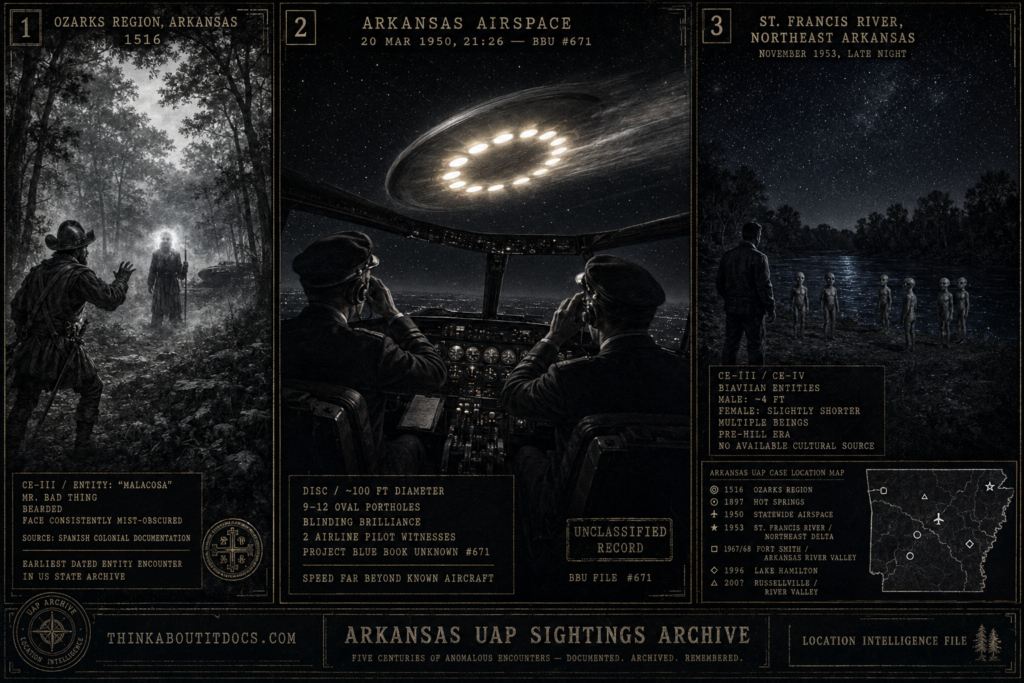
Arkansas UAP archive: 1516 Ozarks Mr. Bad Thing CE-III entity encounter (Spanish colonial documentation, earliest dated entity encounter in US state archive), March 20 1950 Arkansas airspace Project Blue Book Unknown 671 pilots disc with 9-12 blinding portholes, and November 1953 St. Francis River Biaviian contact with multiple four-foot humanoid beings. 7 documented cases 1516–21st century.
Arkansas UFO|UAP & Alien Sightings Archive
Arkansas carries one of the most chronologically extreme anomalous records in the United States archive — a span that opens in 1516 in the Ozark Mountains with a CE-III entity encounter and runs to the twenty-first century, covering five centuries of documented high-strangeness in a single state. The 1516 Ozarks case — a bearded entity of unusual aspect, its facial features consistently indistinct or mist-obscured, associated with a craft, documented in Spanish colonial records under the Nahuatl designation “Malacosa” or Mr. Bad Thing — is not a UFO sighting in the modern sense. It is a pre-modern CE-III record from a period before any cultural framework for such an encounter existed in the European or Indigenous vocabulary of the region, and its archival survival through colonial documentation gives it a source credibility unusual for events of that era. The modern era opens with the Hot Springs airship of May 6, 1897 — part of the documented national airship wave of 1896-1897 — and then leaps to March 20, 1950, when two pilots observed a 100-foot disc-shaped craft with 9 to 12 symmetrical oval portholes arranged in a circle on its underside, blinking with a brilliance that forced them to avert their eyes, crossing their flight path at speeds far exceeding any known aircraft of the period. The 1950 case was filed as Project Blue Book Unknown #671.
The state’s deepest entity case is the November 1953 St. Francis River contact near the Missouri border, in which multiple Biaviian beings — four-foot males, slightly shorter females, humanoid in appearance — were encountered at close range late at night in the northeast Arkansas bottomland. The Biaviian contact tradition is a specific and self-consistent thread in the contactee literature, and the St. Francis River account places it in the rural Arkansas Delta in a pre-Hill era with no available cultural contamination source for the entity type described. The 1967 or 1968 Fort Smith triangle — a hovering triangular object over North 36th Street, observed at night with sufficient duration and proximity for detailed description — adds to a state record that carries craft observations from six separate decades. The Russellville Nuclear One Power Plant sightings add the nuclear installation dimension that appears consistently in UAP records nationally. Arkansas’s seven documented cases span from 1516 to the early twenty-first century across the Ozark highlands, the Arkansas River valley, the northeast Delta, and the River Valley nuclear corridor.
- 1516: Mr. “Bad Thing” comes to the Ozarks Region
- 1897: Hot Springs, Arkansas Sighting
- 1950: Pilots observe fast-moving, disc-shaped UFO
- 1953: St. Francis River, Northeastern Arkansas Sighting
- 1967 or 1968: Triangular Hovering Object over Fort Smith, Arkansas
- 200?: Russellville, Arkansas: UFOs Over Nuclear One Power Plant
- 1996: Sighting at Lake Hamilton Arkansas Jr. High School
- 1950: Stuttgart, Arkansas Airliner UFO
- 1950: Pine Bluff, Arkansas — Six Witnesses and a Bright Silver Disc
Executive Summary
Five Centuries and the Ozark Corridor — Arkansas’s Long Anomalous Record
Arkansas’s UAP and entity record is unusual in the national archive for one specific reason: its temporal depth. No other state carries a credibly sourced entity encounter from 1516 alongside a Project Blue Book Unknown from 1950 and a nuclear plant NL from the twenty-first century within the same seven-case archive. The 1516 Ozarks Mr. Bad Thing case is the oldest dated entity encounter in the state-level United States archive, and its survival through Spanish colonial documentation rather than retrospective personal testimony gives it a source foundation that most pre-1947 cases cannot match. The entity description — bearded, facial features consistently obscured by mist or otherwise indistinct, associated with a craft — has no obvious cultural contamination source in 1516 Ozarks. The 1950 Blue Book Unknown #671 is the state’s strongest instrumentally-relevant case: two professional pilots, a 100-foot disc with a distinctive porthole arrangement, speeds beyond any known aircraft of the period, filed with the Air Force and retained as Unknown despite standard debunking pressure. Together these two cases bookend a record that covers five centuries and suggests the Ozark Mountain corridor — one of the most geologically ancient landscapes in North America — has been a site of anomalous activity across the full documented span of human observation in the region.