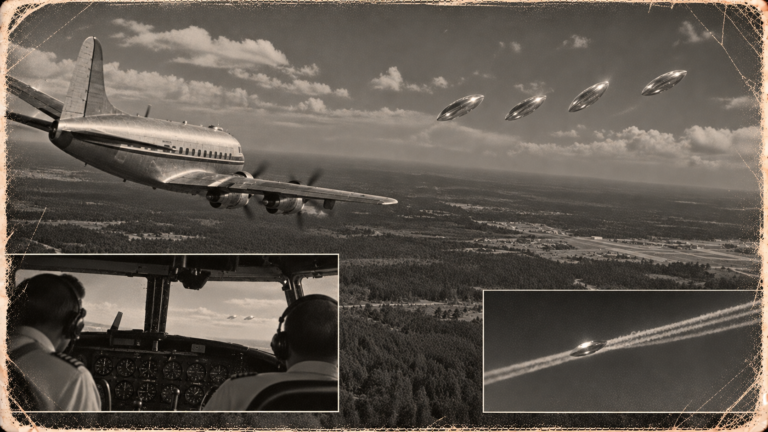
July 8, 1947 — Two independent groups of witnesses, miles apart, watched the same oscillating object over Muroc Army Air Field. thinkaboutitdocs.com.
THINK ABOUTIT UFO|UAP SIGHTINGS REPORT
1947: The Muroc Double Sighting: Two Groups, One Object
Just before noon on July 8, 1947, at Muroc Army Air Field, California — the same base where Chuck Yeager would break the sound barrier three months later — experimental test pilot Capt. John Paul Stapp and colleagues watched an object fall from high altitude, oscillate strangely, and drift toward Mt. Wilson before disappearing behind distant peaks. What makes this case rare isn’t Stapp’s own observation, remarkable as it was. It’s that five to eight miles away, an entirely separate group — Muroc’s commanding officer, an engineer, and his wife — independently watched what appears to be the same object, at the same time, behaving the same way. Two groups of named military personnel and civilians, unaware of each other, corroborating one event: a level of independent cross-confirmation this archive rarely sees in its 1947 record.
Date: July 8, 1947
Sighting Time: 11:50 AM – 12:00 PM
Day/Night: Day
Location: Muroc Army Air Field (Area 3, Rogers Dry Lake), California
Urban or Rural: Rural (military installation)
No. of Entity(‘s): Not Applicable
Entity Type: Not Applicable
Entity Description: Not Applicable
Hynek Classification: DD (Daylight Disc)
Duration: 90 seconds (Group 1’s observation); 8 minutes total (Group 2’s observation)
No. of Object(s): One (observed independently by two separate groups)
Description of the Object(s): Initially mistaken for a falling parachute; oval when close to the horizon, with two thick fins or knobs on its upper surface that appeared to rotate or oscillate; no propellers visible
Shape/Size/Color of Object(s): Round to oval, silver or aluminum-white, thin and metallic, reflecting sunlight; roughly 25 feet wide by Group 1’s estimate, comparable to a pursuit aircraft’s size by Group 2’s
Distance to Object(s): Group 1 observed from a ground-based truck; Group 2 observed from 5-8 miles away
Height & Speed: Fell from below the 20,000-foot test-aircraft altitude at roughly three times the rate of a standard ejection-seat test descent, drifting horizontally at under 50-80 mph; Group 2 observed it descend to ground level before rising again
Number of Witnesses: At least six across two independent groups: Capt. John Paul Stapp, a Mr. Lenz from Wright Field, and two others in Group 1; Col. Signa A. Gilkey, Maj. Richard R. Shoop, and Shoop’s wife in Group 2
Special Features/Characteristics: Two entirely separate, unconnected groups of witnesses, miles apart, independently described the same object’s oscillating, fin-like features and its unusual descent-then-rise behavior; no sound or trail reported by either group
Case Status: Unexplained
Source: FOIA; Jacques Vallée, Magonia 60
Source Status: VERIFIED — two entirely independent groups of named military personnel and civilians, separated by five to eight miles, describing the same object’s behavior at the same time; independent cross-corroboration of this kind is rare in this archive’s 1947 record.
Summary/Description: During a P-82 ejection seat test, Capt. John Paul Stapp and colleagues watched a round, silver object fall from high altitude, oscillate, and drift toward Mt. Wilson before disappearing behind distant peaks. Five to eight miles away, Col. Signa A. Gilkey, Maj. Richard R. Shoop, and his wife independently watched an apparently identical object descend to ground level, then rise and move off, for a total of eight minutes.
Related Cases: Occurred the same day as the July 8 Roswell press release, the Sand Point NAS sighting, and William Rhodes’s Phoenix photographs — see this archive’s July 1947 Part 2 monthly index.
Detailed Report
Between 11:50 AM and noon on July 8, 1947, at Area 3 of Rogers Dry Lake, Muroc Army Air Field, AAF experimental test pilot Capt. John Paul Stapp, a Mr. Lenz from Wright Field, and two other observers were stationed at an observation truck for a P-82 ejection seat test. During the test, they noticed a round, silver or aluminum-white object, initially mistaken for a falling parachute, descending from below the test aircraft’s 20,000-foot altitude — but at roughly three times the rate a standard ejection-seat test descent would produce, immediately marking it as anomalous.
The object, about 25 feet wide by Stapp’s group’s estimate, drifted horizontally toward Mt. Wilson at a slow speed, under 50-80 mph. As it neared the horizon, its shape resolved into more of an oval, with two thick fins or knobs visible on its upper surface, which appeared to rotate or oscillate. No propellers were visible. After about 90 seconds, the object slowly disappeared below the distant mountain tops.
Independently, five to eight miles away, Muroc’s commanding officer Col. Signa A. Gilkey, engineer Maj. Richard R. Shoop, and Shoop’s wife saw what appears to have been the same object. Their description matches closely: thin, metallic, aluminum-colored, roughly the size of a pursuit aircraft, reflecting sunlight and oscillating. Their vantage point let them observe additional behavior — the object descended all the way to ground level, then rose again and moved off into the distance, for a total observed duration of eight minutes. Neither group reported any sound or vapor trail.
The two groups had no apparent means of communicating with each other during the sighting, and their independent accounts — consistent in general shape, coloration, oscillating behavior, and lack of sound — were both preserved through separate channels (FOIA documentation and Jacques Vallée’s Magonia case files) before being cross-referenced as describing the same event.
RESEARCHER’S NOTES
Why This Case Is Taken Seriously
- Genuine independent corroboration: Two groups, separated by miles, with no apparent contact during the sighting, describe the same object’s unusual behavior — this is a rarer and stronger form of corroboration than two witnesses standing together.
- Highly credentialed witnesses: Capt. John Paul Stapp was a career Air Force physician and test pilot who would go on to become one of the most famous aerospace medicine researchers in American history. Col. Gilkey was the base’s own commanding officer.
- Occurred during a controlled test: Group 1’s witnesses were actively monitoring the sky for a specific, known object (an ejection seat) at a specific altitude — a context that makes an anomalous object’s sudden appearance harder to dismiss as simple misidentification of something mundane.
- Consistent physical description across both groups: Size, color, reflectivity, oscillation, and absence of sound or trail all match between the two independent accounts.
- What the record does not include: A photograph, a radar track, or a clear resolution of what the “fins or knobs” actually were. The object’s behavior — falling, then leveling into horizontal drift, then in Group 2’s account descending to the ground and rising again — remains unexplained by any conventional aircraft or device known to have been in use at Muroc that day.
Independent cross-corroboration between two unconnected groups of witnesses is uncommon in this archive’s 1947 record, and the credentials of the witnesses involved — a career test pilot and the base’s own commanding officer — add further weight. This archive lists the case as Unexplained.
Thin, metallic, aluminum-colored, the size of a pursuit aircraft, reflecting sunlight and oscillating.
From the independent account of Col. Signa A. Gilkey and Maj. Richard R. Shoop, describing the same object witnessed separately by Capt. John Paul Stapp’s group, July 8, 1947, Muroc Army Air Field.