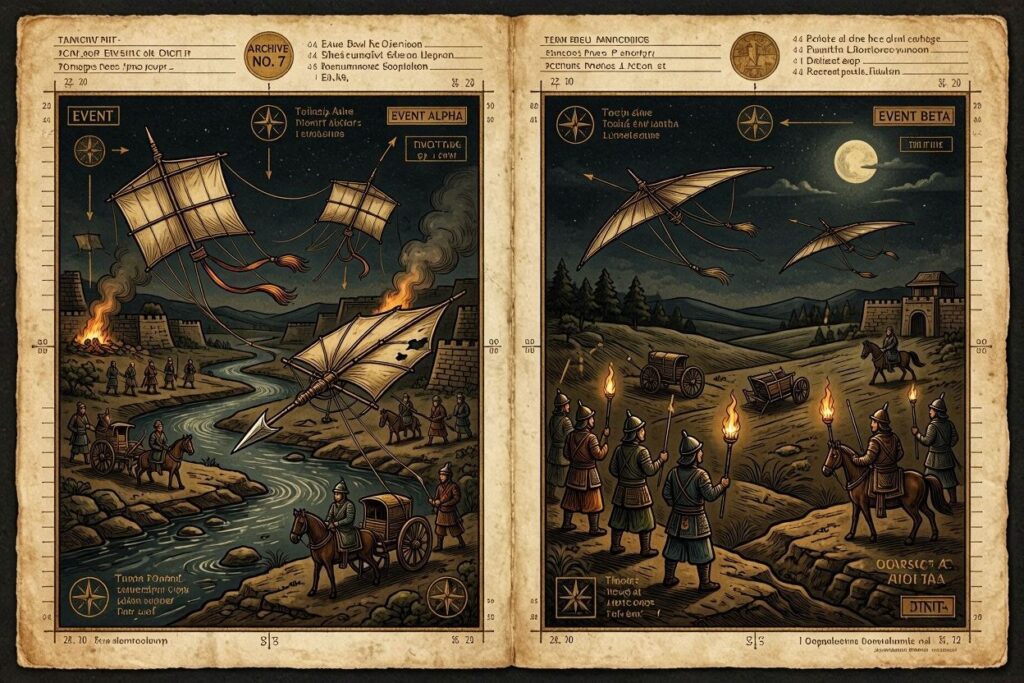
329–332 BC: Alexander the Great's flying shields — Jaxartes River and the Siege of Tyre. Two events, one army, objects that spat fire and crumbled walls. The ancient record as dossier.
THINK ABOUTIT UFO | UAP | SIGHTING REPORT
329 BC: Alexander the Great records two great ‘flying shields’
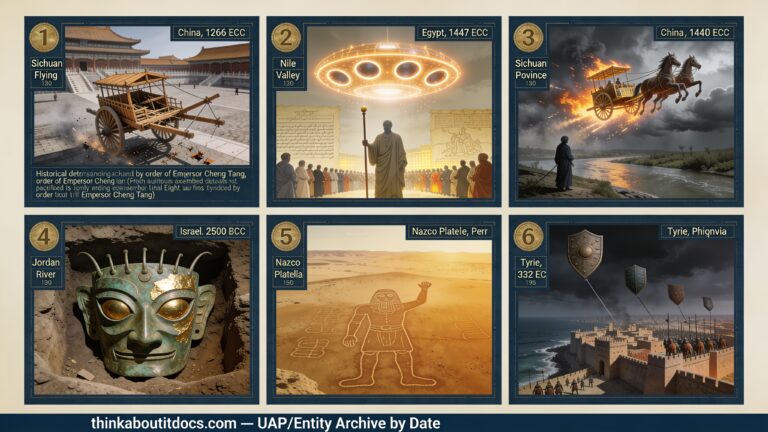
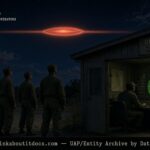
In 329 BC, on the banks of the Jaxartes River in Central Asia, the most feared army in the ancient world stopped moving. Not because of an enemy force — but because of two objects in the sky. The account, filtered through centuries of transmission and reaching the modern record via the Italian researcher Alberto Fenoglio writing in CLYPEUS, describes what the chronicler called “great shining silvery shields, spitting fire around the rims” — objects that dived repeatedly at Alexander’s column until the war elephants, the cavalry horses, and the infantry refused to advance. The army of the man who had conquered Persia, Egypt, and the Hindu Kush was held in place by aerial phenomena. What makes the account more analytically interesting is that it was not a single event: a companion report places five of the same objects over the Siege of Tyre in 332 BC, where they allegedly circled in triangular formation, and where the largest among them discharged what the chronicle describes as lightning that struck and crumbled the city’s walls — walls that had resisted every siege engine Alexander possessed for seven months.
Date: 329 BC (Jaxartes River, Central Asia); companion event 332 BC (Siege of Tyre)
Sighting Time: Night (Jaxartes River); unspecified daytime (Tyre)
Day/Night: Night (329 BC); Day (332 BC)
Location: Jaxartes River, Central Asia (329 BC); Tyre, Phoenicia — present-day Lebanon (332 BC)
Urban or Rural: Rural — desert river campaign (329 BC); Urban siege perimeter (332 BC)
No. of Entity(‘s): Multiple — described as “animate beings” associated with the craft
Entity Type: Unknown — associated with craft; not independently described
Entity Description: Referred to only as animate beings associated with the flying shields; no physical description preserved in available source chain
Hynek Classification: CE-III (Close Encounter III) — close observation with animate beings associated with the object
Duration: Several minutes — long enough for repeated diving passes at the army (329 BC) and sustained circling over the city until its fall (332 BC)
No. of Object(s): 2 (Jaxartes River, 329 BC); 5 (Siege of Tyre, 332 BC)
Description of the Object(s): Shining silvery circular objects described as shields, spitting or emitting fire around their rims; one exceedingly large lead craft with others half its size; in triangular formation at Tyre
Shape of Object(s): Circular / shield-like (329 BC); triangular formation of circular objects (332 BC)
Size of Object(s): One exceedingly large; others approximately half that size
Color of Object(s): Shining silver
Distance to Object(s): Close enough to dive at the army column and to discharge energy that struck city walls
Height & Speed: Very swift disappearance aloft after events concluded
Number of Witnesses: Entire army of Alexander the Great — tens of thousands of soldiers, war elephants, cavalry; forces on both sides of the Tyre siege walls
Special Features/Characteristics: Caused panic and refusal to advance in war elephants, cavalry horses, and infantry (329 BC); discharged lightning-like energy that crumbled fifty-foot walls previously resistant to all siege engines (332 BC); objects hovered over Tyre until the city was completely stormed then vanished swiftly upward
Case Status: Insufficient Data
Source: Alberto Fenoglio, CLYPEUS Anno III, No. 2 (citing Giovanni Gustavo Droysen, Storia di Alessandro il Grande); Bruno Mancusi, UFO Updates mailing list, April 18, 2003
Summary/Description: Two accounts — separated by three years and two geographic theaters — describe identical objects designated “flying shields” interacting with the armies of Alexander the Great. In 329 BC at the Jaxartes River, two large shining silvery circular objects spitting fire around their rims dived repeatedly at Alexander’s column, causing mass panic among war animals and troops and halting an army crossing. In 332 BC at the Siege of Tyre, five similar objects in triangular formation circled the besieged city while both armies watched, then the largest discharged energy that destroyed walls which had resisted siege engines for seven months, opening the city to assault. In both events the objects departed by ascending rapidly and disappearing into the sky.
Related Cases: 218 BC — Cannae, Italy: Flaming shields seen in the sky (Livy) | 214 BC — Rome: Large round shields observed crossing the sky (Livy) | 480 BC — Battle of Salamis: Lights reported over the Greek fleet | 1561 — Nuremberg mass aerial battle (multiple witnesses, broadsheet documentation) | 1566 — Basel celestial phenomena
DETAILED REPORT
The source chain for this case is typical of ancient accounts — long, indirect, and contested at critical junctions. The modern pathway runs: Alberto Fenoglio, writing in the Italian UFO journal CLYPEUS in the late 1950s or early 1960s, cites Giovanni Gustavo Droysen’s 19th-century Storia di Alessandro il Grande as the basis for the Tyre account. Droysen (1808–1884) was a major German historian of the Hellenistic period, and his history of Alexander is a legitimate scholarly work. However, the specific passage describing the flying shields at Tyre — and the chronicle attributed to an unnamed source — does not appear in standard critical editions of Droysen’s text, and no independent verification of the original chronicle has been established in the modern academic literature. The 329 BC Jaxartes account circulates through the same channel. This makes the case analytically complex: the Droysen attribution may be a genuine discovery of an obscure passage, a misattribution, an embellishment added in the Italian popular press of the 1950s, or a mistranslation of something in Droysen’s apparatus that described a natural phenomenon. None of these possibilities has been definitively established.
What is not in dispute is the historical context. The Siege of Tyre in 332 BC was one of the most significant military engineering operations of the ancient world. The island city had never fallen to a land-based assault. Its walls were indeed approximately fifty feet high, and Alexander’s siege engines were repeatedly destroyed or countered. The siege lasted seven months before the city fell — and ancient sources, including Arrian and Diodorus Siculus, do record unusual events during the siege, though none in surviving standard texts describes the flying shields precisely as Fenoglio’s account does. The Jaxartes River campaign of 329 BC was Alexander’s push into Bactria and Sogdia — modern Tajikistan and Uzbekistan — against the Scythian and Persian remnants. The terrain was flat steppe and river country, isolated, with no city infrastructure. A large panicking army halted by aerial phenomena in that specific theater is geographically and contextually plausible as an account type even if the original documentation is inaccessible.
The behavioral signature of the objects in both accounts is analytically notable. At Jaxartes, the objects dove at the army — an active, directed engagement with a human force, not passive observation. The result was incapacitation of the military column through animal panic. At Tyre, the objects circled and observed, then delivered a directed energy discharge against the city’s fortifications that resolved a months-long military stalemate in a single pass, after which they departed. In both cases the objects were not hostile to Alexander’s forces specifically — at Jaxartes they appeared to halt him; at Tyre they appeared to assist him. The apparent contradiction has been noted in the literature but not resolved. The classification as CE-III rests on the reference to animate beings associated with the craft, which appears in the source text but with no physical description attached.
The terminology clypeus — Latin for shield — was applied broadly in Roman-era writing to circular aerial objects and appears in multiple classical sources across the relevant period, most notably in Livy’s accounts of aerial phenomena observed during the Second Punic War. The consistency of the descriptor across centuries and cultures suggests either a genuine recurring observation type or a conventional literary borrowing, and the record does not currently permit distinguishing between them.
RESEARCHER’S NOTES
The Flying Shields of Alexander — Central Asia & Phoenicia, 332–329 BC and the Problem of the Broken Chain
Two events, three years apart, involving the same army and the same class of object. The accounts share internal coherence but rest on a source attribution that has not been verified against a primary text, making this one of the most analytically frustrating cases in the ancient record — compelling in structure, unresolved at the foundation.
- Source Chain Assessment: The credibility of this case rests entirely on the Fenoglio-Droysen attribution, and that attribution has not been independently verified against a primary text. Giovanni Gustavo Droysen’s history of Alexander is extant and available in scholarly editions, but the specific passage describing flying shields at Tyre as quoted by Fenoglio in CLYPEUS does not appear in standard critical versions. Three explanations are in play: the passage exists in an edition or manuscript variant Fenoglio accessed that has not been cross-referenced; Fenoglio misattributed material from a different classical source; or the account was constructed or embellished in the Italian popular press context of the 1950s UFO wave. Bruno Mancusi’s 2003 entry to the UFO Updates mailing list, which is the proximate source for the modern English-language version, did not resolve this question. Until a direct textual verification is produced, the source chain must be assessed as Plausible rather than Verified, and the case held at Insufficient Data.
- Pattern Context and Comparative Cases: The tactical interaction signature — objects diving at an army, causing animal panic and column halt — has a parallel in the 480 BC Battle of Salamis accounts and in multiple Roman-era prodigy reports catalogued by Livy and Julius Obsequens. The specific combination of war animal incapacitation and aerial phenomena is not unique to this case; a structurally similar account from 218 BC at Cannae describes flaming shields seen in the sky before the battle. Whether these represent independent observations of the same phenomenon, a literary tradition of inserting aerial prodigies into battle narratives for rhetorical purposes, or genuine recurring events cannot be determined from the existing record. What is analytically notable is that the ancient world had a consistent vocabulary for circular shining aerial objects — clypeus, shield, disc — and applied it across cultures and centuries in contexts that cluster around military engagements and large assemblies of witnesses.
- Physical Evidence and Evidentiary Weight: The most extraordinary element of the Tyre account — that the largest object discharged energy that destroyed fifty-foot walls previously resistant to all siege technology — carries no physical evidence corroboration and cannot be assessed against material remains. Tyre was extensively destroyed in the assault and rebuilt repeatedly in subsequent centuries; no anomalous structural evidence has been identified at the site. The directed energy description is also the element most susceptible to embellishment in transmission: a dramatic military turning point acquiring a miraculous explanation is a well-documented pattern in ancient historiography. This does not confirm or refute the account — it means the directed energy component carries a lower evidentiary threshold than the behavioral description of the objects, which is the more analytically durable element.
- Geographic and Historical Context — The Clypeus Pattern: The Roman-era use of the word clypeus as a descriptor for anomalous aerial objects creates a taxonomic thread running from roughly 300 BC through the 1st century CE that is documented in multiple independent Latin texts. Livy records shield-sightings in 218 BC, 214 BC, and 173 BC. Julius Obsequens catalogued dozens of similar events in his Liber Prodigiorum, drawing on earlier annalistic sources. The Alexander accounts — if authentic — would push the documented clypeus-type observation back to the 4th century BC and into a non-Roman military and cultural context, which would be analytically significant: it would suggest the phenomenon was not a Roman literary convention but a geographically and culturally independent observation type. This is the strongest argument for taking the Fenoglio-Droysen text seriously pending source verification, and the strongest reason to prioritize locating the original passage.
The Alexander flying shields cases sit at the precise intersection of what makes ancient UAP accounts both compelling and analytically frustrating: the scenario is historically specific, the witness pool is theoretically enormous, the behavioral description fits patterns documented in multiple independent ancient sources, and the source chain is broken at the critical junction. Fenoglio’s CLYPEUS attribution to Droysen has not been verified in the primary text, and until it is — or until a comparative textual analysis locates the passage in an alternate edition or source — the case cannot be moved past Insufficient Data. What can be said is that the Roman-era clypeus pattern to which this account belongs is one of the most consistently documented aerial anomaly types in classical antiquity, and that the specific details preserved here — two events, three years apart, involving the same army, with different but related behavioral signatures — carry an internal coherence that is more consistent with genuine observation accounts than with simple literary fabrication. The record holds it open.