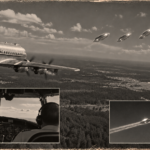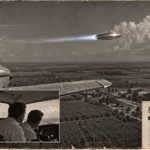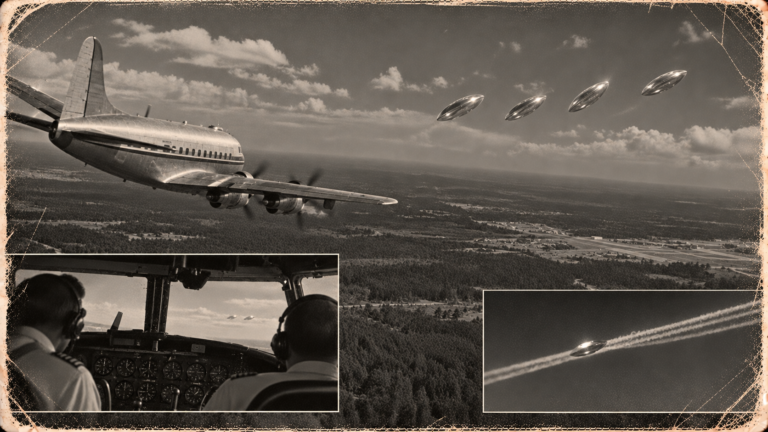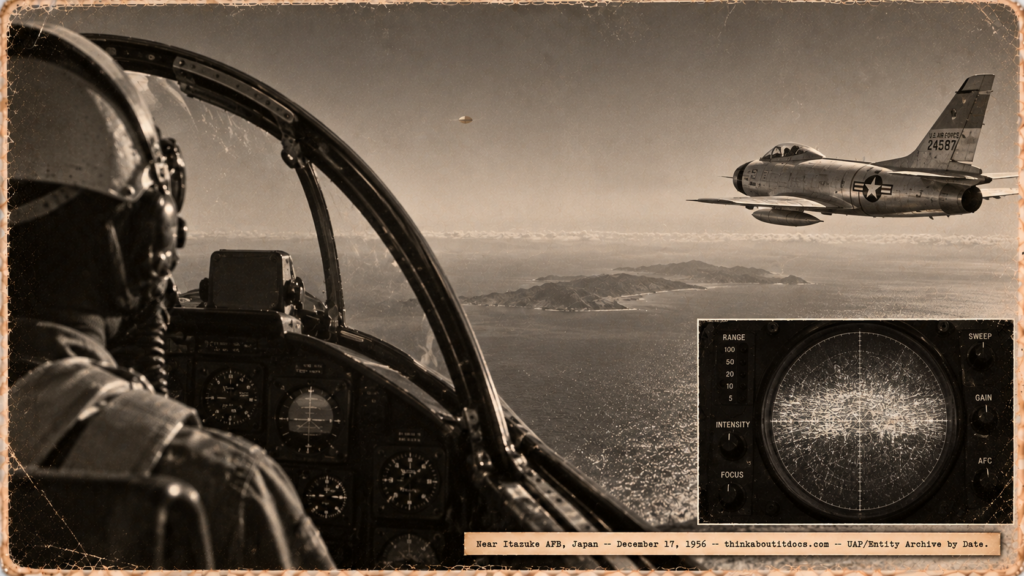
East of Tsushima, December 17, 1956: the F-86D closed to 5 nautical miles, got 3-4 minutes visual on a tan round-topped object — then both jets were jammed simultaneously as it departed at 1,500 knots.
THINK ABOUTIT UFO|UAP SIGHTINGS REPORT
1956: Near Itazuke AFB, Japan — The Object That Jammed Both Jets
At 3:20 p.m. on December 17, 1956, a USAF F-86D all-weather interceptor near Itazuke Air Force Base in Kyushu, Japan acquired an unidentified contact on airborne radar at 20 nautical miles. The pilot achieved lock-on at 15 nautical miles and began a steady overtake — both aircraft and object heading 270 degrees, westbound, through the entire engagement. He got visual contact at 8 nautical miles. He closed to 5 nautical miles. And then he couldn’t close further. The object began pulling away. At 12 nautical miles the radar displays went dark — not a mechanical failure, but interference consistent with electronic countermeasures, radar jamming. Not on one aircraft. On both the interceptor and his wingman, simultaneously.
By the time the radar returned no signal, the pilot estimated the object’s speed at 1,500 to 1,800 knots — roughly twice the F-86D’s maximum speed. The object was described as tan in color and round on top. Total engagement: 7 to 8 minutes on radar, 3 to 4 minutes visual. The position was approximately 34°00’N, 131°00’E, slightly east of the island of Tsushima in the Korea Strait. Project Blue Book listed it as unknown. Of all the intercept cases in the 1956 archive — and 1956 produced more than any prior year — Itazuke is the only one where the object appears to have actively interfered with the pursuing aircraft.
Date: December 17, 1956
Sighting Time: 3:20 p.m. local time (Japan Standard Time)
Day/Night: Afternoon (daylight)
Location: Approximately 34°00’N, 131°00’E — slightly east of Tsushima Island, Korea Strait, Japan; near Itazuke Air Force Base, Kyushu, Japan
Urban or Rural: Airborne over the Korea Strait
No. of Entity(‘s): Not Applicable
Entity Type: Not Applicable
Entity Description: Not Applicable
Hynek Classification: RV (Radar-Visual) — airborne radar contact with simultaneous visual observation, plus active electromagnetic interference affecting two independent aircraft simultaneously
Duration: Radar observation 7–8 minutes; visual observation 3–4 minutes
No. of Object(s): 1
Description of the Object(s): Described by the pilot as tan in color and round on top. No further structural detail given — the visual contact was made at 8 nautical miles and the pilot closed only to 5 nautical miles before the object began pulling away.
Shape/Size/Color of Object(s): Round top; tan color; size not determinable at 5-nautical-mile minimum distance
Distance to Object(s): Initial radar contact at 20 nautical miles; lock-on at 15 nautical miles; visual contact at 8 nautical miles; closest approach 5 nautical miles; radar contact lost at 12 nautical miles on departure
Height & Speed: Altitude not specified. Both aircraft and object maintained heading 270 degrees (westbound) throughout the engagement. The object matched the F-86D’s overtake speed during the chase, then accelerated away. Estimated speed at radar disappearance: 1,500 to 1,800 knots (approximately 1,725 to 2,070 mph; Mach 2.3 to 2.8 at altitude). The F-86D’s maximum speed was approximately 692 mph (Mach 0.9). The object was moving at roughly 2.5 to 3 times the interceptor’s maximum speed on departure.
Number of Witnesses: At minimum two: the F-86D pilot (intercepting aircraft) and his wingman (who experienced the same ECM-type interference simultaneously). The wingman’s visual contact status is not specified in the available summaries.
Special Features/Characteristics: The defining feature of this case is the simultaneous radar interference on both aircraft. The Blue Book summary describes it as “interference resembling ECM” — electronic countermeasures, the military term for deliberate radar jamming. Both the intercepting F-86D and the wingman experienced this interference at the same time. This is the only case in the 1956 Blue Book record where an unidentified object appears to have actively and simultaneously disrupted the electronics of two pursuing aircraft. The object also maintained a steady 270-degree heading throughout the engagement, suggesting controlled directed flight rather than erratic or evasive maneuvering — it simply flew faster than the intercept could sustain.
Case Status: Unexplained (Project Blue Book unknown)
Source: Weinstein catalogue; FUFOR Index; Project Blue Book files (BBU); The UFO Evidence (NICAP), Section I (Category 3, 9 — radar-visual, airborne radar jamming)
Summary/Description: F-86D near Itazuke AFB, Japan achieved airborne radar lock on a tan, round-topped object at 15 nautical miles and closed to 5 before the object accelerated away at 1,500–1,800 knots. At 12 nautical miles, both the intercepting aircraft and wingman experienced simultaneous ECM-type radar interference. Blue Book unknown. The only 1956 intercept case with active jamming.
Related Cases: 1956: December UFO|UAP & Entity Sightings Archive; 1956: Wheelus AFB, Libya F-86D Radar Intercept (October 17–18, 1956); 1956: Lakenheath-Bentwaters Radar-Visual (August 13–14, 1956)
Detailed Report
Itazuke Air Force Base on the island of Kyushu was in December 1956 home to USAF fighter-interceptor units operating in the Far East Air Forces — the air defense command structure covering Japan, Korea and the western Pacific. The base had a long history of UFO-related incidents; the area around Kyushu and the Korea Strait had produced radar contacts and intercept attempts going back to the late 1940s, including the significant October 1948 Fukuoka incident.
At 3:20 p.m. local time on December 17, 1956, an F-86D Sabre-dog all-weather interceptor acquired an airborne radar contact at 20 nautical miles. The F-86D’s APG-37 fire-control radar — the same system used in the Wurtsmith and other 1956 intercept cases — painted a return and the pilot moved to engage. Lock-on was achieved at 15 nautical miles. Both the F-86D and the object were heading 270 degrees — due west, over the Korea Strait toward the general area of Tsushima Island. The overtake was steady.
At 8 nautical miles the pilot achieved visual contact. He described the object as tan in color and round on top. He continued closing. At 5 nautical miles the closure stopped — the pilot could not reduce the range further. The object was matching the F-86D’s maximum pursuit speed exactly, holding the gap at 5 miles. Then it began to pull away.
At 12 nautical miles — as the object was accelerating away — all radar indications disappeared from the scope. Not a loss of signal from range, but interference: the Blue Book summary describes it as resembling ECM, electronic countermeasures. The wingman, flying in formation, experienced the same interference simultaneously on his own radar. Two independent aircraft systems, both disrupted at the same moment.
The pilot estimated the object’s speed at the moment of radar loss at 1,500 to 1,800 knots. The F-86D’s maximum speed was approximately 600 knots. The object was departing at roughly two and a half to three times the interceptor’s top speed, on a steady heading, without any of the erratic maneuvering typical of evasion. It had simply waited — matching speed precisely at 5 nautical miles — and then left.
Total radar observation time: 7 to 8 minutes. Total visual time: 3 to 4 minutes. Project Blue Book listed the case as unknown.
RESEARCHER’S NOTES
ECM from an Unidentified Source — What That Means
- What ECM is: Electronic countermeasures in the 1956 Air Force context refers to deliberate electronic interference with an enemy’s radar systems — jamming. It was a defined category of electronic warfare that Cold War planners took extremely seriously. When the Blue Book summary describes the interference as “resembling ECM,” it is using the language of intentional electronic attack. The pilot and wingman’s radar systems were not simply degraded by range or terrain — they were actively disrupted by something in the environment at the moment of closest approach to the object.
- Simultaneous interference on two independent aircraft: The wingman’s radar was affected at the same time as the primary interceptor. These are two separate aircraft, each with its own independent electronics package, experiencing the same disruption simultaneously. Equipment malfunction cannot explain simultaneous failure on two platforms. Natural electromagnetic interference — ionospheric disturbance, solar activity — does not produce sudden onset interference on precisely two aircraft at a specific moment during an intercept sequence and then clear. The simultaneous nature is the most anomalous element of the case.
- The 5-nautical-mile hold: The object maintained exactly 5 nautical miles of separation for the duration of the visual contact, neither pulling away nor allowing closer approach. This is not the behavior of an object unaware of pursuit — it is the behavior of an object that matched the interceptor’s maximum speed precisely and held position. The departure, when it came, was at 1,500 to 1,800 knots on a steady heading — not an evasive maneuver but an acceleration along an existing track.
- The Tehran comparison: The 1976 Tehran UFO incident is the most widely cited case of apparent active electronic interference during a UFO intercept — an F-4’s weapons system and communications failed as it approached the object. Itazuke 1956 is a 20-year predecessor to that pattern: two aircraft, radar interference coinciding with the intercept, Blue Book unable to explain it. The Iran case produced a Defense Intelligence Agency report calling it an “outstanding report” with “high reliability.” Itazuke produced a Blue Book unknown with no published DIA follow-up that has been located.
- The Far East pattern: Itazuke and the surrounding airspace had a documented history of unusual radar contacts. The October 15, 1948 Fukuoka case — an F-61 Black Widow achieving six separate radar firing solutions on an object that outmaneuvered it each time over the Korea Strait — occurred in nearly the same airspace. The December 1956 contact was heading 270 degrees from a position east of Tsushima, which places it over the Korea Strait in the same general corridor. The repetition of anomalous radar-intercept events in this specific airspace across nearly a decade is a pattern worth noting.
- Pilot identification: The pilot’s name is not given in available Weinstein/FUFOR summaries. The Blue Book file would carry the pilot’s name, aircraft serial number, unit designation (likely the 68th Fighter Interceptor Squadron, which was the primary F-86D unit at Itazuke in 1956 per Korean War veteran records), and the full debrief transcript. Those details would substantially strengthen the case.
The Itazuke case closes the 1956 military radar-intercept record with its most technically complex event. Lakenheath-Bentwaters had a Venom that couldn’t shake what had locked onto it. Wheelus had an F-86D that reached fire-control Splash against a target it never saw. Itazuke had an F-86D and its wingman jammed simultaneously by something that had been holding 5 nautical miles of separation, tan-colored and round on top, before accelerating away westbound at Mach 2.5. Blue Book called it unknown. It remains so.
Interference resembling ECM was experienced by both the observing aircraft and wingman. The pilot estimated the speed of the object upon radar disappearance at 1,500 to 1,800 knots.
Project Blue Book file summary, F-86D intercept near Itazuke AFB, Japan, December 17, 1956 — Weinstein; FUFOR Index; BBU Files (unknown)