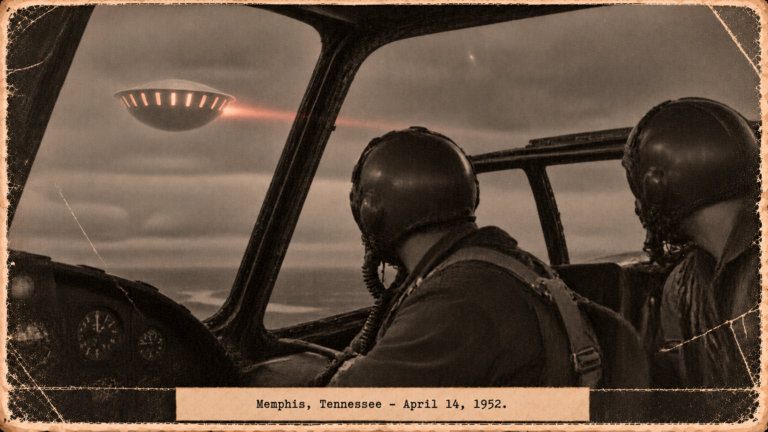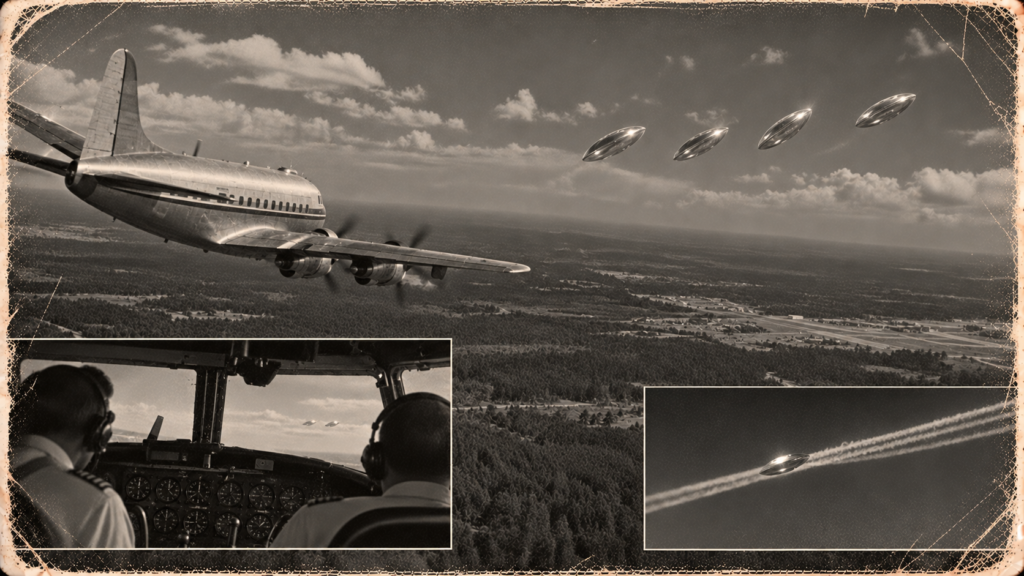
Near Pope AFB, North Carolina, October 15, 1950: two airline pilots chased four shiny discs; an Army captain reported a crossing object minutes later.
THINK ABOUTIT UFO|UAP SIGHTINGS REPORT
1950: Pope AFB, North Carolina
Miami Airlines Pilots Chase Four Discs, and an Army Captain Reports a Crossing Object Five Minutes Later
“My co-pilot looked at me and said: ‘Do you see what I see?'” Twenty minutes out of Raleigh on the afternoon of October 15, 1950, Miami Airlines Capt. George A. Woodward and co-pilot William Bardsley saw four shiny, round objects about 100 feet across, flying in a line near Pope Air Force Base and Fort Bragg, North Carolina. They turned the DC-4 toward them. The objects backed away, sank slowly, then shot off in a burst of speed, with the pilots in pursuit for an estimated three minutes at about 180 mph.
Five minutes later, an Army Reserve infantry captain watching a jet’s contrail at 35,000 to 40,000 feet saw an oblate, aluminum-looking object cross the jet’s path in a straight line. He wrote a report “in spite of the termination of inquiry into this subject,” calling it a strong likelihood that he had seen one of the pilots’ objects. The Pope AFB UFO sighting survives in Project Blue Book as an unidentified airliner chase backed by a second, independent observer.
Date: October 15, 1950
Sighting Time: 4:20 p.m. EST (airline pilots); 4:25:40 p.m. EST (Army Reserve captain)
Day/Night: Day
Location: Near Pope Air Force Base and Fort Bragg, North Carolina (the pilots reported it to CAA offices at Lumberton, N.C., and Florence, S.C.)
Urban or Rural: Rural
No. of Entity’s: Not Applicable
Entity Type: Not Applicable
Entity Description: Not Applicable
Hynek Classification: Daylight Disc (DD)
Duration: Pilots: pursued for an estimated 3 minutes; Army captain: 10 to 12 seconds
No. of Object(s): Four (pilots); one (Army captain)
Description of the Object(s): Pilots: shiny round objects that looked like balloons at first, thicker in the middle and tapering at the edges “like two saucers fitted together,” in a line; they backed away, descended slowly, then took off in a burst of speed. Army captain: an oblate, spheroid object that crossed a jet’s flight line and moved northwest in a perfectly straight line
Shape/Size/Color of Object(s): Round/oblate; about 100 feet in diameter (pilots); shiny, aluminum or chrome-like
Distance to Object(s): About five miles away (pilots); undetermined (Army captain)
Height & Speed: Not stated for the objects; DC-4 pursuit speed estimated at 180 mph; the Army captain’s own conjectural calculation, using assumed locations, gave about 1,200 mph
Number of Witnesses: 3 (two pilots and one Army Reserve officer)
Special Features/Characteristics: Four objects flying in line, about 25 feet apart according to the newspaper account; evasive, accelerating departure when approached; no contrail or trail on the Army captain’s object, which crossed the jet’s own contrail
Case Status: Unexplained. Blue Book’s index lists the pilot case as unidentified.
Source: Raleigh News and Observer, October 17, 1950 (clipping forwarded by Headquarters Third Army, October 24, 1950, Control No. A-1917); report of an Army Reserve captain to the Director of Intelligence, USAF (name redacted); Project Blue Book record card; Berliner; FUFOR Index
Summary/Description: Two Miami Airlines pilots reported four shiny discs near Pope AFB and chased them; five minutes later an Army Reserve captain reported an object crossing the contrail of a jet. Both accounts were forwarded to Air Materiel Command.
Related Cases: Same week in the Carolinas: Warrenton (October 21) and Bonlee (October 23); same day in Tennessee: Oak Ridge Kerr Hollow Gate encounter; see the October 1950 archive.
Detailed Report
On Sunday, October 15, 1950, Miami Airlines DC-4 Capt. George A. Woodward and co-pilot William Bardsley, both of Miami, took off from Raleigh bound for Miami at 4 p.m. EST. Twenty minutes later, Woodward told a reporter, “I saw four shiny objects that looked like balloons.” As quoted in the Raleigh News and Observer, he continued: “My co-pilot looked at me and said: ‘Do you see what I see?’ I told him I did and we headed toward them.”
The objects “appeared to be about 100 feet in diameter, of some shiny substance like aluminum or chrome. They were thicker in the middle and tapered off, like two saucers fitted together. They were in line about 25 feet [apart] and about five miles away. We chased them but they backed away, descending slowly, then took off in a burst of speed.” Woodward, who had been flying twelve years, said he had never seen such objects and was not sure what they were, but they were neither planes nor balloons. The sighting was near Pope Air Force Base and Fort Bragg. The crew reported it to the Civil Aeronautics Administration offices at Lumberton, North Carolina, and Florence, South Carolina. The Florence office said it had received similar reports, the latest about three weeks earlier.
Headquarters Third Army at Fort McPherson, Georgia, sent the clipping to Air Materiel Command at Wright-Patterson AFB on October 24, 1950. Blue Book’s record card lists the source as an airline pilot, the time as 1620 EST, and the objects as about 100 feet in diameter that “descended slowly then took off in burst of speed.”
The second report is an Army Reserve infantry captain’s letter to the Director of Intelligence, USAF, submitted, he wrote, “in spite of the termination of inquiry into this subject.” At 4:25 p.m. EST he was following the sound and clearly defined contrail of a jet moving northeast at 35,000 to 40,000 feet; the aircraft itself was not visible. At 4:25:40 an object “oblate and spheroid in shape” crossed the jet’s line of flight and continued northwest for a total observation of 10 to 12 seconds. It appeared to be built of aluminum or a similar substance; speed and altitude were unknown; it left no trail and flew a perfectly straight line.
The captain acknowledged that the sparse detail made the report poor intelligence material, but said there was “a strong likelihood” that his object was one of the four the Miami Airlines pilot had reported. He then offered a calculation: if the pilots broke off a three-minute, 180-mph pursuit to the north, the objects would have been about ten miles north of Pope AFB at 4:23; taking Chapel Hill as the place of his own sighting, 47 miles away, the objects would have covered that distance in 2 minutes 20 seconds, or roughly 1,200 mph. He called conjecture “not a suitable basis for inquiry,” offered it only as a suggested method of evaluation, and asked that the material be handled as classified.
RESEARCHER’S NOTES
A Two-Witness Case Built on Assumptions
- The pilots’ names: Blue Book’s index and earlier compilations list “Daniel” and “Woodward.” The newspaper names Capt. George A. Woodward and co-pilot William Bardsley, and the Third Army clipping was filed with the case. Both are recorded in the archive entry.
- The 1,200 mph figure: It is the captain’s own arithmetic, resting on three assumptions: where the pilots turned, how fast the DC-4 flew, and that his sighting is the same object. He says so himself. It is not an observed speed.
- “Looked like balloons”: Woodward’s first impression was balloons, and he rejected it after pursuing them. Four balloons would not back away and accelerate on command, but the clipping gives no measured data to test that.
- No radar or ground check: No Pope AFB radar or base report is in the file, and the Blue Book index has long listed the pilot report as unidentified with “no supporting data.” The record cards, clipping and captain’s letter now supply that data.
- Timing: The pilots’ sighting at 4:20 and the captain’s at 4:25:40 sit about five minutes apart, which is what makes his link plausible; the clipping gives only approximate times and “20 minutes” after a 4 p.m. takeoff.
Pope AFB is a simple, strong case on its face — two airline pilots, four round objects, a pursuit — with an independent second report that fits the timing. What it lacks is any measurement. It stays unidentified because no one has offered an explanation that fits both accounts, not because anyone has proved what the objects were.
“My co-pilot looked at me and said: ‘Do you see what I see?'”
— Capt. George A. Woodward, Miami Airlines, quoted in the Raleigh News and Observer, October 17, 1950