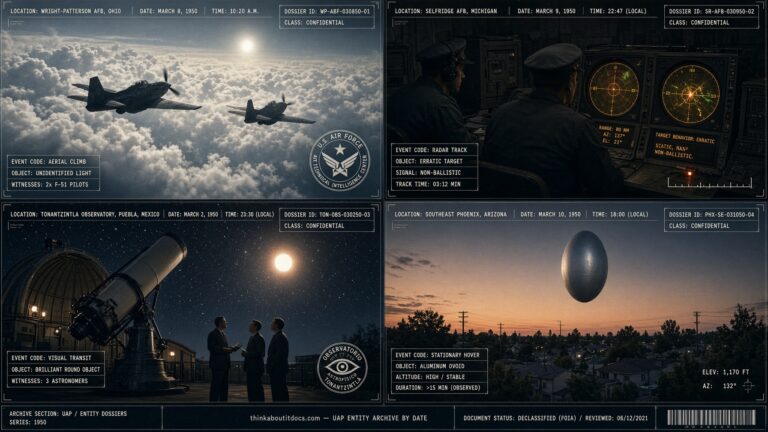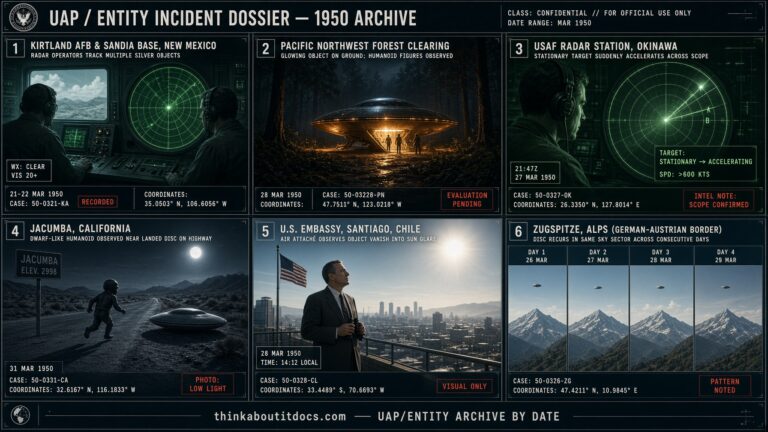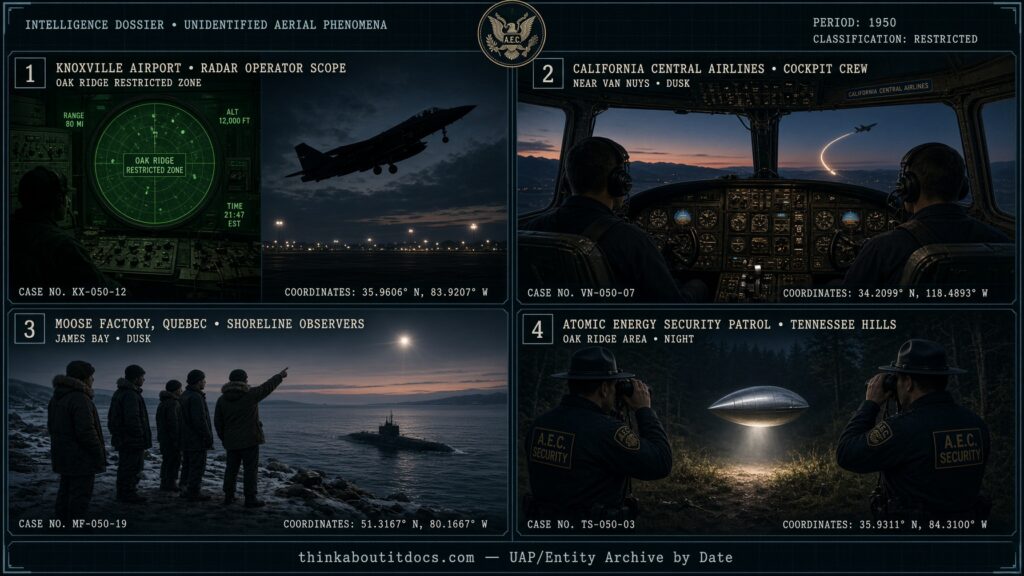
Four cases from October 1950, headlined by the Oak Ridge/Knoxville Flap at the AEC's Tennessee nuclear facility.
1950: October UFO|UAP & Entity Sightings Archive
October 1950 is dominated by the Oak Ridge/Knoxville Flap — nearly two weeks of radar detections, fighter intercepts, and close-range sightings by Atomic Energy Commission security troopers guarding one of the country’s most sensitive nuclear facilities, documented in full in the standalone report linked below. Out of the Carolinas come three more reports in ten days: Miami Airlines pilots pursuing four shiny discs near Pope AFB, a ring of maneuvering lights over Warrenton, and an ex-Air Force pilot who watched a dirigible-shaped craft hover over Highway 421 near Bonlee. The month also brought a near-collision between a California Central Airlines flight and a glowing object near Van Nuys, a polished disc with a blue flame crossing a Cuban Bonanza’s path, a strange multi-incident report from Moose Factory, Quebec, and a still-unexplained child disappearance in Bennington, Vermont.
Date: October 1950
Location: Moose Factory, Quebec, Canada
Time: Various
Summary: Locals reported several different incidents over this period. Three Indigenous witnesses reported seeing a “water going object” they identified as the top of a submarine in James Bay near the mouth of the Moose River; a strange red light hung almost stationary over the area. Other witnesses observed two “airplanes,” one large and one small, that stood still in the sky. Three huge explosions shook every building in the area over a span of two minutes. Later, several residents reported encountering “strange white men” who ran to hide in the forest when observed. The Royal Canadian Mounted Police were notified.
Source: HBCC UFO Research
Date: October 1950 (a Thursday; exact date not stated)
Location: Mazabuka district, Northern Rhodesia
Time: 4:15 a.m.
Summary: Residents of the Mazabuka district were awakened by a loud explosion that shook several buildings. Fearing that a dynamite truck in the railway goods yard had blown up, they searched the area and found nothing that could account for the blast. Several Africans reported seeing a bright flash in the sky just before the explosion; the reverberations lasted about 15 seconds and the noise was heard at Kafue, fifty miles away. An official at the meteorological station suggested a large meteorite that broke up before reaching the ground. The Air Force report rated the information C-2 and the cause a meteorite.
Source: East African Standard (newspaper), via U.S. Air Force Report No. R-646-50, dated November 10, 1950; Project Blue Book record card
Date: October 3, 1950
Location: Pomona, California
Time: Unknown
Summary: A disc-shaped UFO was reported by a scientist.
Source: NICAP chronology (reference key “VI”)
Source Status: No fuller source for this entry has been located; it is preserved as recorded in the NICAP chronology.
Date: October 5, 1950
Location: Between Van Nuys and San Fernando, California
Time: Just before 8:00 p.m.
Summary: A California Central Airlines flight had just left Burbank-Hollywood Airport bound for Oakland and was still climbing through 4,500 feet, about five minutes into the flight, when Captain Cecil Hardin called out to Co-pilot Jack Conroy. Conroy turned to see a glowing object heading directly toward the aircraft; at the last moment, the object swerved and ducked underneath the plane. Conroy said the encounter happened too quickly to judge its speed or size accurately, and the object showed no obvious means of propulsion; both pilots reported seeing several bright lights on the craft as it passed beneath their window. See the Full Report.
Source: California Central Airlines crew statements
Date: October 7, 1950
Location: Kauai, Hawaii
Time: 7:25 p.m. local time
Summary: A civilian watched a luminous object cross the sky from south to north, starting about 20 degrees above the horizon in the direction of Ahukini and last seen about 30 degrees up toward Anahola. At first the object appeared one-quarter the diameter of the moon; above Kapaa it looked six-tenths of the moon’s diameter, then shrank as it moved toward Anahola, where it disappeared into or above high cumulus clouds. It was circular with indefinite edges and glowed with a soft, luminous white light. The witness first thought of a shooting star but discounted that because the object held a level course at an even rate of speed, and its soft light was unlike the brilliance of a falling star. Weather conditions were not reported. Project Blue Book evaluated the sighting as a meteor.
Source: Air Intelligence Information Report, Intelligence Division, Military Air Transport Service (MATS), October 26, 1950; Project Blue Book record card
Date: October 10, 1950
Location: New Orleans, Louisiana (northeast part of the city)
Time: 7:16 a.m.
Summary: A father and son watched a noiseless, brilliantly bright object travel northward in clear, sunny skies for five to ten minutes, at an altitude they put at no less than a mile. One witness compared its apparent size to a joint of stovepipe; the other described a saucer seen edge-on, 30 to 40 feet long. It glowed with a whitish-blue light that left both men seeing “peculiar” spots for a minute or two afterward, and one said it looked like faceted lights glistening like a diamond. It faded into a speck of light and vanished without dropping below the horizon. The family’s domestic ducks, used to ordinary aircraft, showed alarm at the silent object. One witness, a military veteran, said he was familiar with the look of normal aircraft. The Office of Special Investigations interviewed the two men on October 13 and 24 and found no meteorological condition or physical evidence to explain the sighting. The New Orleans States carried an account on October 10 describing a slow, extra-bright object that blinked like a star, looked 20 to 24 inches long from the ground, and was extremely high.
Source: Office of Special Investigations, 9th OSI District (Barksdale AFB), Spot Intelligence Report DO #9, November 7, 1950; New Orleans States, October 10, 1950
Source Status: The witnesses’ names are redacted in the released file.
Date: October 10 or 11, 1950
Location: Charity Hospital, New Orleans, Louisiana
Time: Unknown (observed for about two hours)
Summary: A woman watching from a hospital window reported twelve shiny, apparently metallic objects with round bodies and short wings, diving and spinning in the sky for about two hours. They were more than a mile away but “not extremely high,” noiseless, left no exhaust trails, kept no formation, and appeared bright gray to opalescent. She said she had flown as a passenger on private planes many times. Project Blue Book evaluated the report as Insufficient Data, noting that the file gave no date, time, or motion sequence and that, if the sighting took place at night, astronomical bodies were the probable cause.
Source: Office of Special Investigations, 9th OSI District (Barksdale AFB), Spot Intelligence Report DO #9, November 7, 1950 (witness: Mrs. Markopolaus, as typed); Project Blue Book record card
Source Status: Blue Book’s record card gives only “10 or 11 October 1950”; the witness reported the sighting to OSI on October 12.
Date: October 11, 1950
Location: Lark, Utah
Time: About 10:10 p.m.
Summary: A compressor operator working on the Lark Tunnel and a companion, whose name is unknown, watched what looked like a meteor cross the sky, then realized it looked more like a rocket or plane. It began as a long, thin line of fire crossing the sky at a terrific rate of speed; the line widened, then seemed to dip and explode. The front end of the object broke away, and the main body stayed in the sky for a moment before fading out completely. The witness put it 40 to 50 miles away, toward the Provo River southwest of Lark. He telephoned the 115th CIC Detachment at Fort Douglas on October 17, explaining that he had not known which agency to call. Project Blue Book evaluated the sighting as a meteor.
Source: Office of Special Investigations letter, November 6, 1950, forwarding the 115th CIC Detachment report; Project Blue Book record card
Date: October 12, 1950 (continuing into October 13)
Location: Knoxville (McGhee-Tyson Airport radar) and Oak Ridge, Tennessee
Time: 11:25 p.m. EST
Summary: Radar operators of Detachment 2, 662nd Aircraft Control and Warning Squadron at McGhee-Tyson Airport picked up their first target over the restricted Oak Ridge flight zone at 11:25 p.m., followed in quick succession by more. The blips moved at 100 to 125 mph, mostly between 1,500 and 3,000 feet, and varied in strength from light-aircraft returns to C-47-sized returns. The Atomic Energy Commission and Atlanta flight control both reported no aircraft in the area. A fighter of the 5th All Weather Fighter Squadron (52nd All Weather Fighter Wing), flown by Lt. Wolf, was airborne at 11:39 p.m.; the ground scope showed three clean intercepts, yet neither the pilot nor the observer saw anything and the fighter’s own radar found nothing. After it landed at 12:14 a.m., targets reappeared and the sequence repeated into the early morning, with radar contacts reported to Selfridge Field at 1:00 a.m. and to Eastern Air Defense Force headquarters at 2:10 a.m. Ground observers at Oak Ridge saw nothing, but AEC guards were alerted and began setting out searchlights. The radar officers told investigators they had seen the same pattern before without any adequate explanation, and suggested atmospheric or technical interference. Blue Book’s record card calls the radar sighting probably spurious because the interceptors made no contact, with a handwritten note reading “radar malfunction.” The first incident in a nearly two-week sequence of radar and visual sightings around the facility. See the Full Report.
Source: Army CIC Summary of Information, Knoxville, October 13 and 21, 1950; 662nd AC&W Squadron radar log; NICAP chronology; McDonald list; Project Blue Book record card
Source Status: The McDonald list and NICAP give “eleven, and possibly more” targets and a 11:30 p.m. scramble; the Army CIC radar log itself tracks about five targets (H-47 through H-51) and records the fighter airborne at 11:39 p.m. Both figures are preserved here.
Date: October 12, 1950
Location: K-25 area, Oak Ridge, Tennessee
Time: Late Thursday evening
Summary: A saucer-looking object was reported over the K-25 area near the NEPA Project site, described as round, roughly the size of a four-room house, silver, with a blister on top and visible windows. The object rose slowly about 100 feet, moved forward, rose again about the same distance, and then departed at high speed. The Knoxville Journal published the account on October 26, 1950, as a rumor circulating through government offices in Oak Ridge; the AEC and NEPA public-information offices gave no official comment and said no official information had been passed to them. None of the sources the Journal questioned had seen the object themselves; they had spoken to someone who said they had. The object was placed late on October 12 or early on October 13, the same night as the Knoxville radar detections. See the Full Report.
Source: The Knoxville Journal, October 26, 1950 (clipping forwarded by Headquarters Third Army); Project Blue Book files
Source Status: Second-hand report: the newspaper’s informant described the object but, by the paper’s own account, had not been a witness to it.
Date: October 13, 1950
Location: Oak Ridge, Tennessee
Time: Radar plots midnight to 1:00 a.m.; investigators’ meeting about 2:00 p.m.
Summary: The radar plots continued after midnight exactly as the night before, again with no visual sightings. At about 2:00 p.m. that afternoon, investigators from the Eastern Air Defense Force, the Office of Special Investigations, the AEC Security Division, and Army CIC met at the Knoxville radar site. They rejected unidentified aircraft, balloons, flocks of birds, objects launched from the AEC site, and light aircraft from Oliver Springs airport as explanations, but could reach no conclusion on the cause. See the Full Report.
Source: Army CIC Summary of Information, October 13, 1950; NICAP chronology
Source Status: Continuation of the October 12 radar entry above.
Date: Mid-October 1950
Location: Bennington, Vermont
Time: Unknown
Summary: Eight-year-old Paul Jepson disappeared from a farm; his mother, who worked as an animal caretaker, had left him playing happily near a pig sty while she tended the animals, and returned a short time later to find him missing. An extensive search of the area found nothing.
Source: Unknown
Source Status: The available source describes no object, craft, or other unusual phenomenon in connection with the disappearance; it appears in UFO compilations and is preserved here as originally recorded.
Date: October 15, 1950
Location: Kerr Hollow Gate, Oak Ridge, Tennessee
Time: Approximately 3:20 p.m. EST
Summary: AEC Security Patrol Trooper Edward D. Rymer was on duty at the Kerr Hollow Gate when he and a passing Maxon Construction employee watched what looked like a skywriter, 12,000 to 15,000 feet up and about a mile east by north of the gate. Silver and dull, the size of a four- or five-passenger plane, it trailed grayish smoke a quarter of a mile long and then began a controlled, nearly vertical descent far slower than any aircraft could dive. A second, identical object appeared about 50 feet behind it. At about 1,500 feet both changed from a bullet shape to a bladder or pear shape and shrank as they came down; the second vanished near 500 feet. The first came to rest hovering five or six feet above the road about 60 yards from the gatehouse, now only a few inches across, with a ribbon-like tail that lengthened at times to nearly 20 feet and showed a dark line down its center. When Rymer walked toward it, it rose over a nine-foot chain-link fence, a light pole, and a willow tree and climbed away to the southeast, looking larger as it left. It returned twice within about ten minutes; Capt. Zarzecki and caretaker John Moneymaker also saw it. The Air Technical Intelligence Center could not explain the close-range sighting. A Maxon electrician who stopped at the gate saw a distant white object for about five minutes and took it for a toy balloon. AEC Geiger counters taken to the spot read nothing. Radar crews logged a fighter making unsuccessful passes at a good target four miles inside the east boundary at 3:17 p.m., but reported nothing on the scope at the location the ground observers phoned in. The incident often cited as the point at which “the dam broke” during this flap. See the Full Report.
Source: Army CIC Summary of Information, October 21, 1950, with enclosed AEC Security Division statements; Berliner; Hynek, UFO Report, pp. 142-143; Project Blue Book (BBU 819)
Source Status: Earlier compilations list this case as October 13 or 15; the Army CIC and AEC documents place it on October 15.
Date: October 15, 1950
Location: Near Pope AFB, North Carolina
Time: 4:20 p.m. EST
Summary: Miami Airlines DC-4 Capt. George A. Woodward and co-pilot William Bardsley, twenty minutes out of Raleigh bound for Miami, saw four shiny, round objects about 100 feet across, in a line, which looked at first like balloons. Thicker in the middle and tapering at the edges “like two saucers fitted together,” they appeared about five miles away. The pilots turned toward them; the objects backed away, descended slowly, then took off in a burst of speed, and the pilots pursued them for an estimated three minutes at about 180 mph. Woodward, a pilot of twelve years, said the objects were neither planes nor balloons. The crew reported the sighting to the CAA offices at Lumberton, North Carolina, and Florence, South Carolina; Florence said it had received similar reports, the latest about three weeks earlier. See the Full Report.
Source: Raleigh News and Observer, October 17, 1950 (clipping forwarded by Headquarters Third Army, October 24, Control No. A-1917); Project Blue Book record card; Berliner; FUFOR Index (BBU 821)
Source Status: Blue Book’s index and earlier compilations name the pilots as “Daniel” and “Woodward”; the newspaper names Capt. George A. Woodward and co-pilot William Bardsley.
Date: October 15, 1950
Location: North Carolina, near the Pope AFB area
Time: 4:25 p.m. EST
Summary: An Army Reserve infantry captain tracking a jet and its contrail at 35,000 to 40,000 feet saw an oblate, spheroid object cross the jet’s line of flight and continue northwest in a perfectly straight line. It looked aluminum or similar, left no trail, and was in view for 10 to 12 seconds. He submitted his report “in spite of the termination of inquiry into this subject,” noting that its paucity of detail made it poor intelligence, but that the object was probably one of those seen five minutes earlier by the Miami Airlines pilots. His own arithmetic, assuming the pilots’ objects flew from Pope AFB to Chapel Hill, put their speed near 1,200 mph, which he offered only as a suggested method of evaluation and called conjecture. See the Full Report.
Source: Report of an Army Reserve captain to the Director of Intelligence, USAF (name redacted); NICAP chronology
Source Status: The captain’s speed figure rests on his own assumptions about where the two sightings took place and is not an observed speed.
Date: October 16, 1950
Location: K-25 Plant, Oak Ridge, Tennessee
Time: Approximately 1:30 p.m. (also recorded as 3:20 p.m./1520 EST); reappeared about 2:55 p.m.
Summary: AEC Patrol Trooper John Isabell and four civilian employees observed a silver-white spherical object hovering over the K-25 controlled area. A Blair Gate trooper first saw it at about 1:30 p.m. racing northeast in a straight line, round and the apparent size of a baseball; at 2:55 p.m. it came back from the northeast much lower and slower, circling and spinning rapidly, and he flagged down a car of troopers so they could confirm it. FBI Special Agent William S. Price documented that the radar station picked up an indistinct target every three to four sweeps. An F-82 sent to intercept instead had its airborne radar pick up an unrelated light aircraft; ground observers reported the F-82 passed directly beneath the reported “silver disc” while pursuing the light plane, but its crew saw nothing unusual. See the Full Report.
Source: NARA documents; Fran Ridge; Dan Wilson; AEC Security Patrol Incident Report No. 1424-50
Date: October 16, 1950
Location: NEPA Project, Oak Ridge, Tennessee
Time: 7:56 p.m. to 8:04 p.m.
Summary: Contract guards at the NEPA project, who had been told to report anything odd, independently reported a recurring noise like the blast of a jet fighter whose thrust had suddenly increased. Each noise lasted about 3.5 seconds, recurred frequently over the eight-minute span, and seemed to leave in a nearly vertical climb; no guard could see anything in the sky and the Knoxville radar recorded nothing. A senior ORC instructor, Major L. E. Ronninger, who had been out of town and did not know of the sightings, then recalled hearing the identical noise with his daughter at about 2:00 p.m. on October 15 and searching the sky in vain for a jet. See the Full Report.
Source: Army CIC Summary of Information, October 1950, with enclosed AEC Security Division statements
Source Status: The CIC chronology lists the Ronninger noise under October 13, but his own statement places it at about 2:00 p.m. on October 15.
Date: October 20, 1950
Location: Oak Ridge, Tennessee
Time: 4:55 p.m.
Summary: Larry Riordan, Superintendent of Security for the X-10 control zone, was driving to a residential area when he saw an object he initially took for a balloon that had lost its basket — round, wrinkled at the bottom with something hanging below, roughly 8-10 feet long, lead or gunmetal colored. He wasn’t certain it was a standard weather balloon but considered it might have been a gas-bag balloon from the nearby University of Tennessee Agricultural Research Farm; seeing it only briefly while driving, he could not be sure whether it was moving. Earlier the same afternoon, at 3:27 p.m., the Knoxville radar unit had detected targets nearby and scrambled a fighter piloted by Lt. Wolf, who radioed that the objects were 20-25 miles from the airport but could not identify them; a roughly ninety-minute search turned up nothing. See the Full Report.
Source: Oak Ridge historical accounts; not listed in the Blue Book compilation
Date: October 20, 1950
Location: New Haven, Connecticut
Time: 2315Z (about 6:15 p.m. EST)
Summary: A civilian watched a starlike object ten times brighter than Venus, with a steady orange glow and no blinking, sound, trail, or exhaust, fly west toward New York City at an estimated 400 to 700 mph and 20,000 feet or higher. It turned before disappearing after about 20 seconds. Project Blue Book evaluated the sighting as an aircraft, noting that the short duration and all other data fit that explanation.
Source: Project Blue Book record card (record returned to originator)
Date: October 21, 1950
Location: West Warrenton, North Carolina
Time: 8:30 p.m.
Summary: Col. and Mrs. Claude Bowers, Mr. and Mrs. Selby Benton, Mr. and Mrs. Spencer Scott, Bill Boyce, Mrs. B. G. White, and others saw two large circles of lights, each seeming to try to out-maneuver the other; more than once one circle passed through the center of the other. The lights appeared close to the earth and not far from the Bowers home. Two of the witnesses drove toward them but could get no closer than when they started. The local newspaper called it the first report of its kind in the area. Project Blue Book evaluated the sighting as astronomical (stars or planets). See the Full Report.
Source: Raleigh Times and Raleigh News and Observer, October 25-26, 1950 (clippings forwarded by Headquarters Third Army, October 30, Control No. A-1917); Project Blue Book record card
Source Status: The articles say “Saturday night,” which works out to October 21; the record card’s date of information is hard to read.
Date: October 23, 1950
Location: Highway 421, two miles west of Bonlee, North Carolina
Time: 12:42 p.m.
Summary: Ex-USAF pilot Frank M. Risher of Greensboro, driving southeast on Highway 421, saw an aluminum object shaped like a dirigible, as large as two B-36 fuselages stacked one atop the other, with no control surfaces, propulsion, trail, or exhaust visible. It first looked like a water tank in Bonlee until it started to move. It crossed the highway from the southeast, about two miles away beneath an overcast 600 to 700 feet up, hovered for 35 seconds, and then flew away to the south-southeast into the clouds, in a sighting lasting about 40 seconds. He saw three portholes about a third of the way down from the top; a handwritten footnote on his statement says four portholes that appeared dark against the light metallic surface. Project Blue Book marked the card “Unidentified.” See the Full Report.
Source: Air Force Form 112, 9th Air Force (Tactical), with signed statement by Frank M. Risher; Berliner; Project Blue Book record card (BBU 824)
Source Status: Some compilations give the hover as three to five seconds; the Blue Book card and the Air Force report both say 35 seconds.
Date: October 24, 1950
Location: Oak Ridge, Tennessee
Time: Radar targets appeared 6:23 p.m.; fighter scrambled 6:26 p.m.; visual sighting reported 6:30 p.m.; radar contact lost 7:20 p.m.
Summary: FBI documents describe a further round of visual sightings at Oak Ridge alongside a Knoxville radar track. An unidentified object appeared at roughly 5,000 feet in the same general area as an earlier witness sighting; a fighter scrambled minutes after the radar detection saw nothing, and the radar target was tracked for about an hour before disappearing. The final documented incident of this flap. See the Full Report.
Source: Fran Ridge, FBI documents
Date: October 28, 1950
Location: Genesee Mountain, Colorado
Time: Unknown
Summary: Two photographs and a negative of an unidentified object over Genesee Mountain were forwarded by the 3415th Technical Training Wing at Lowry AFB, Denver, on November 29, 1950, and analyzed by Air Materiel Command photographic specialists on December 15. The image of the object is blurred and not sharply defined, while the foreground branches are sharp, so the blur was not caused by camera movement; for the lens to have produced it, the object would have to be closer than the foreground vegetation. The photographer said the shot was taken at high speed and described a shiny object whose underside was in shadow, but the negative shows no such density difference against the sky. The negative is also fogged and pock-marked, and the analysts suggested that foreign material such as paper from a filmpack could account for the image. They concluded that it could not be confirmed as a photograph of an unconventional aircraft, or that the image was formed photographically by the camera. A covering indorsement added that a witness who went to the trouble of taking the picture probably saw some phenomenon, but that no definite conclusions could be drawn.
Source: Lowry AFB letter to Air Materiel Command, November 29, 1950; Air Materiel Command photographic evaluation, December 15, 1950; Blue Book file (Exhibit 7)
Source Status: The photographer’s name, the time of the sighting, and the original report form are not in the files available; the October 28 date comes from the file label.
Date: October 31, 1950
Location: 5 miles west of Central Najasa, Camaguey Province, Cuba
Time: 3:35 p.m. local time (2035Z)
Summary: Four men flying in a Beechcraft Bonanza at 5,500 feet — the pilot, a prominent Cuban sugar planter, an engineer-pilot named Roy Carver, and two Cuban engineers — saw a circular, highly polished aluminum disc pass at high speed, slightly larger than a DC-3 and an estimated 70 to 80 feet across. A cone-shaped blue flame with a reddish edge, like an acetylene cutting torch and eight to ten times the disc’s diameter in length, streamed from its rear. It flew a straight, horizontal course at an estimated 7,000 feet and over 1,000 mph, vanishing into clouds in about three seconds. The pilot radioed Camaguey tower at once. The U.S. Air Attaché in Havana, who had known the pilot for about six years, interviewed him and wrote, “there is no doubt in my mind but that these men saw the object as described.” See the Full Report.
Source: Air Attaché, Havana, letter L-209-50, November 8, 1950, with translated signed statement of the four observers; Project Blue Book record card
Source Status: The pilot’s name is redacted in the English translation; the record card lists garbled coordinates (“Lat 78°30′ Long 21°6′”), apparently transposed.
EXECUTIVE SUMMARY
A Nuclear Facility Under Watch
October 1950’s defining story is the Oak Ridge/Knoxville Flap — a rare case where the witnesses were, almost without exception, trained security and military personnel operating within a single, consistently monitored perimeter, producing an institutional paper trail across FBI, AEC, Army CIC, and Air Force records that few 1950-era sightings can match. Radar crews, fighter pilots, and AEC troopers all took part, and the Army’s own files record a trooper walking to within 50 feet of a hovering object that rose over a chain-link fence and a willow tree.
The month’s other anchor cases are daytime sightings by experienced flyers: two Miami Airlines pilots who chased four discs near Pope AFB, an Army Reserve captain who reported a crossing object minutes later, an ex-Air Force pilot at Bonlee, and four men in a Bonanza over Camaguey, Cuba, whose story was vouched for by the U.S. Air Attaché in Havana. Alongside them, the Blue Book files show how many October reports were set aside as meteors, aircraft, or stars — Kauai, Lark, New Haven, Warrenton — while the Moose Factory entry and the Bennington child disappearance are preserved from the original record, the former for its unusually varied mix of separate reported phenomena, the latter because the source material describes no unusual phenomenon at all.
“No unusual objects were seen visually or on radar for the next two days. Then the ‘dam broke.'”
— Contemporary account of the October 1950 Oak Ridge, Tennessee flap