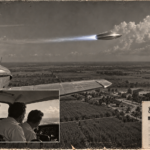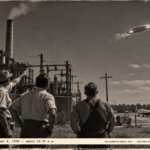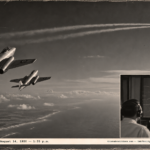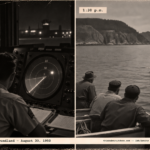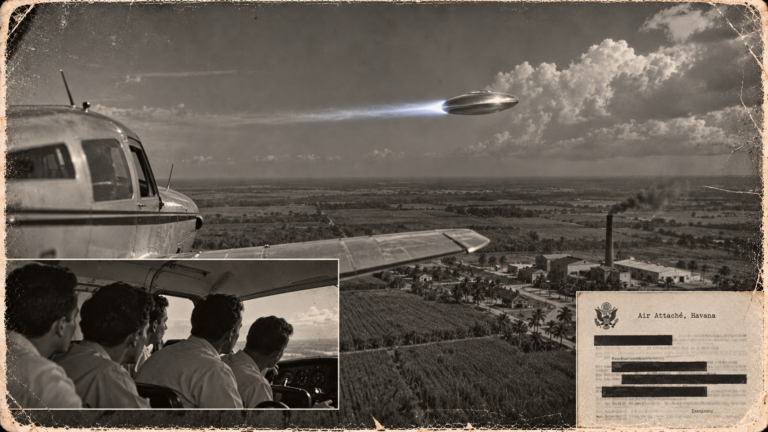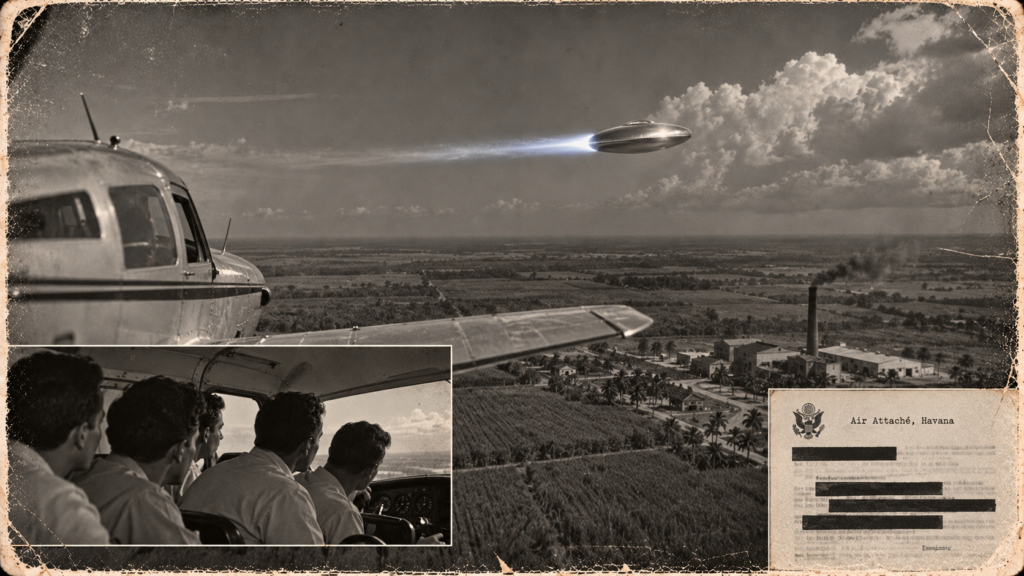
Camaguey Province, Cuba, October 31, 1950: four men in a Bonanza watched a polished disc trailing a blue flame cross their path.
THINK ABOUTIT UFO|UAP SIGHTINGS REPORT
1950: Camaguey, Cuba
Four Men in a Bonanza and a Polished Disc Trailing a Blue Flame
At 3:35 on the afternoon of October 31, 1950, four men in a single-engine Beechcraft Bonanza were crossing Cuba’s Camaguey Province at 5,500 feet when a highly polished aluminum disc flashed past their right wing, trailing a blue flame eight to ten times its own diameter in length. It crossed their field of view in about three seconds and vanished into a cloud bank — but the pilot radioed the Camaguey control tower immediately, and what the men said they saw would travel from a sugar plantation airstrip to the desks of Air Force intelligence in Washington.
This Camaguey, Cuba UFO sighting reached Project Blue Book through the U.S. Air Attaché in Havana, who had known the pilot for about six years and personally interviewed him. His verdict, sent to Air Materiel Command with the observers’ signed statement: “there is no doubt in my mind but that these men saw the object as described.” What they described — a circular disc slightly larger than a DC-3, with a torch-like blue flame streaming from its rear — remains unexplained in the file.
Date: October 31, 1950
Sighting Time: 3:35 p.m. local time (2035Z)
Day/Night: Day
Location: 5 miles west of Central Najasa, Camaguey Province, Cuba (en route from Central Andreita toward Central San Germán); the Blue Book record card lists garbled coordinates, “Lat 78°30′ Long 21°6′,” apparently transposed
Urban or Rural: Rural (sugar-cane country)
No. of Entity’s: Not Applicable
Entity Type: Not Applicable
Entity Description: Not Applicable
Hynek Classification: Daylight Disc (DD)
Duration: About 3 seconds
No. of Object(s): One
Description of the Object(s): A circular, highly polished object that could be described as an aluminum disc, slightly larger than a DC-3, with no particular light or brilliance around its edge and no color other than its metal surface, except for an intense blue flame from the rear
Shape/Size/Color of Object(s): Circular disc; estimated 70 to 80 feet in diameter; aluminum color with a blue, cone-shaped flame
Distance to Object(s): About 10 miles when first seen, according to the signed statement (the Air Attaché’s summary says it passed their right wing); the size estimate rests on the 10-mile figure
Height & Speed: Estimated altitude about 7,000 feet; speed described as “terrific,” estimated at over 1,000 mph (the Air Attaché says faster than the speed of sound)
Number of Witnesses: 4 (the pilot, an engineer who is also a pilot, and two engineers)
Special Features/Characteristics: Cone-shaped blue flame with a reddish tint on its outer border, like an acetylene torch used to cut metal, 8 to 10 times the length of the disc’s diameter; perfectly straight, horizontal flight; vanished behind clouds; reported immediately by radio to the Camaguey airport tower
Case Status: Unexplained by the observers. The Blue Book record card copy does not show a legible evaluation, and the file offers no explanation.
Source: Air Attaché, Havana, letter L-209-50, November 8, 1950, with translated signed statement of the four observers; Project Blue Book record card
Summary/Description: Four men flying a Bonanza over Camaguey Province saw a polished aluminum disc, slightly larger than a DC-3, cross their path at extreme speed with a blue torch-like flame trailing from its rear, and radioed the tower at once. The U.S. Air Attaché vouched for the witnesses.
Related Cases: Other October 1950 daylight disc reports: Pope AFB, North Carolina (October 15) and Bonlee, North Carolina (October 23); see the October 1950 archive.
Detailed Report
On October 31, 1950, at about 3:35 p.m., a Beechcraft Bonanza (registration CUN 275) was flying at 5,500 feet on a compass heading of 120 degrees from Central Andreita toward Central San Germán in Camaguey Province, Cuba. The plane belonged to and was piloted by a prominent, wealthy Cuban who traveled between his sugar properties in the province. With him were Roy Carver, an engineer who was also a pilot, and two other Cuban engineers.
About five miles west of Central Najasa, all four saw a circular object that they described as a highly polished aluminum disc. It first appeared a little behind the tip of the plane’s right wing, on a compass course of about 90 degrees, at what they later worked out to be an altitude near 7,000 feet and a distance of some ten miles. It flew a straight, horizontal line for the whole time it was in view — about three seconds — until it disappeared behind a bank of clouds directly in front of the plane, at the intersection of the two courses.
Working from the ten-mile distance, the four estimated that the disc measured 70 to 80 feet across, giving the impression of an object slightly larger than a DC-3. It showed no unusual brilliance or color along its edge. From its rear, however, streamed an intense blue flame with a reddish tinge on its outer border, “such as is found in an acetylene torch like the ones used to cut metal.” The flame was cone-shaped and eight to ten times as long as the disc was wide. They calculated its speed at over a thousand miles an hour.
None of the occupants, all engineers or pilots, could say whether it was a meteor, though the course it described made them doubt it. The pilot reported the sighting by radio to the control tower at Camaguey airport right away. The four later signed a statement in Spanish, translated into English for the Air Force.
The Air Attaché at the U.S. Embassy in Havana forwarded the statement to the Commanding General, Air Materiel Command (attention MCIS), on November 8, 1950, as required by the Air Force intelligence letter AFOIC-CC-1 of September 8, 1950, on reporting unconventional aircraft. His covering letter adds that the observers estimated a disc 70 to 80 feet across; that all four were “reliable men” who saw the object “very distinctly”; that it “passed their right wing, slightly above their cruising altitude”; and that they judged it not a meteor because it traveled horizontally. In a comment he said he had known the pilot for about six years, that a Lieutenant General had introduced them, and that he had talked with him personally: “there is no doubt in my mind but that these men saw the object as described.” A copy went to the Director of Intelligence, USAF.
RESEARCHER’S NOTES
What the Air Attaché’s File Does — and Does Not — Establish
- Witness standing: Four men, including two pilots, with a named engineer-pilot (Roy Carver) and a pilot-owner vouched for by a U.S. attaché of six years’ acquaintance. The attaché’s endorsement is a character reference, not an investigation; no one measured anything.
- Estimates stack on one guess: The 70-to-80-foot size and the 1,000-mph speed both derive from the assumed ten-mile distance, which no instrument checked in a three-second look. Change the distance and the size and speed change with it. The attaché’s letter has the object passing the right wing, which is hard to square with a ten-mile distance.
- The flame: The blue, reddish-edged, cone-shaped flame is the case’s signature detail. The witnesses compared it to a cutting torch; no one suggests an explanation, and neither does the file.
- Meteor question: The observers doubted a meteor because the path was horizontal. That is their judgment, never tested by an astronomer in the file. No radar, tower reply, or second observer is recorded.
- Garbled coordinates: The record card’s “Lat 78°30′ Long 21°6′” cannot be right for Cuba; Camaguey sits near 21° north and 78° west, so the figures look transposed. The statement’s own location (five miles west of Central Najasa) is the one to use.
- Paper trail: The report moved through the Air Force’s September 1950 reporting directive, a sign that attachés abroad were still feeding sightings to Wright-Patterson well after the 1949 closing of Project Grudge.
The Camaguey report is unexplained but thinly documented: four credible witnesses and one dramatic, specific image — a polished disc with a blue torch flame — lasting three seconds. Its strength is who saw it and how quickly they reported it; its weakness is that every number comes from a single brief look.
“The impression received was that the object in question was slightly larger than a DC-3.”
— Signed statement of the four observers, October 31, 1950 (English translation, Air Attaché, Havana)