December 1956: radar jammed at Itazuke, seven Pan Am experts confirm 4,000 mph, and a Guam F-86D can't match a UFO's turn radius.
1956: December UFO|UAP & Entity Sightings Archive
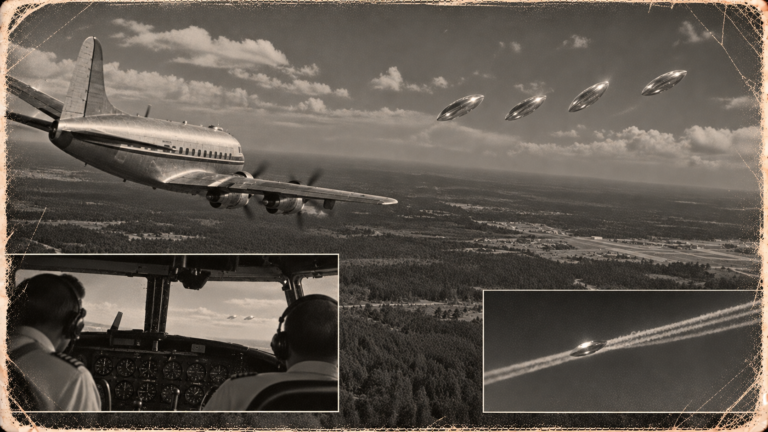
December 1956 closes the year with the most technically sophisticated intercept in the twelve-month record. On December 17, an F-86D pilot near Itazuke Air Base in Japan achieved airborne radar lock on a tan, round-topped object at 20 nautical miles, closed to 5 nautical miles, watched it pull away at 1,500 to 1,800 knots — and then had his radar jammed. His wingman experienced the same interference simultaneously. The jamming — electronic countermeasures-class interference on both aircraft at once — is what distinguishes Itazuke from the year’s other radar-intercept cases. It is a Blue Book unknown and, with Lakenheath-Bentwaters and Wheelus AFB, one of the three strongest military aviation radar cases of 1956.
Around it: an E-M police radio failure in North Dakota on December 1; a USAF F-86D pilot over Guam who couldn’t match the turning radius of a round white object beneath his aircraft on New Year’s Eve; and an entity encounter in Pennsylvania investigated by Dr. Berthold Schwarz. The Pan American radar case — Donald Freestone, six confirming colleagues, egg-shaped return at 4,000 mph southwest of Miami — belongs to November 8 and is on the November monthly; the December page had it as a misdated duplicate. The year ends where it began: radar returns, intercepts, and objects that depart faster than anything following them.
Date: CORRECTIVE NOTE — Pan American Airways / Donald Freestone radar case is November 8, 1956, NOT December
Location: Miami International Airport / 65 miles SW of Miami
Time: 11:15 a.m. to 11:35 a.m., November 8, 1956
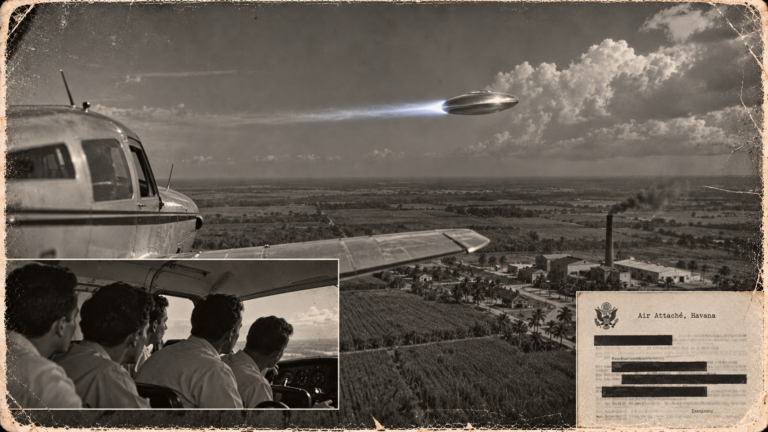
Summary: The original December page carried a “South Florida, Pan American radar, Donald Freestone, 6 confirming operators” entry attributed to Dan Wilson. This is confirmed as the same event as the UFOE Section VIII November 8, 1956 Miami case. Full details: 11:15–11:35 a.m., Donald Freestone testing weather radar equipment, egg-shaped return 65 miles SW at 7,000–8,000 ft, figure-eight double pattern on scope, 4–5× normal aircraft size, moved 550–650 mph, stationary pause, departed SSW covering 20 miles in ~6 antenna rotations at ~4,000 mph. Six Pan Am colleagues confirmed. Homestead AFB placed on alert. Retained here only as a corrective note so editors know this entry was on the December page.
Source: The UFO Evidence (NICAP), Section VIII
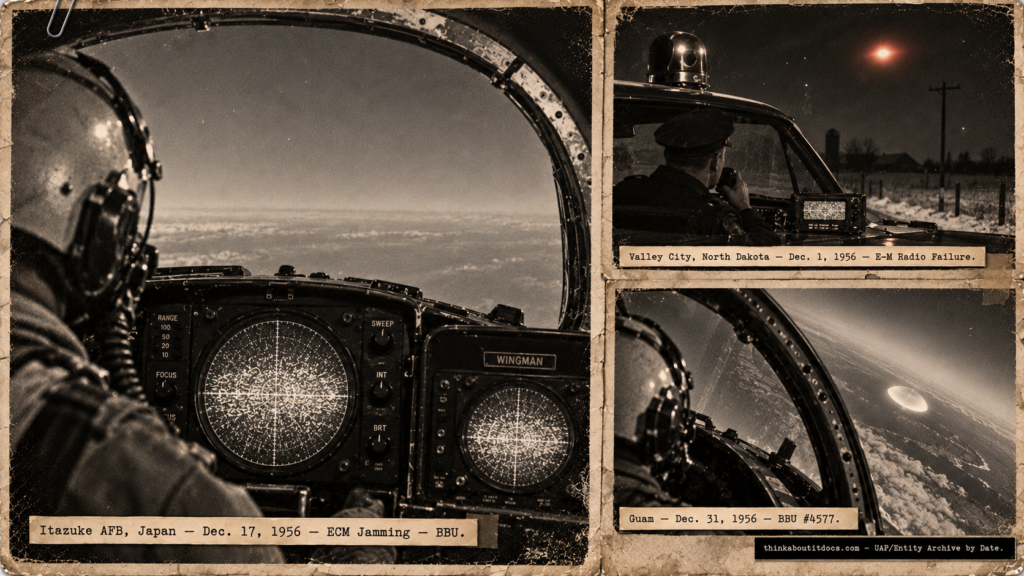
Date: Dec. 1, 1956
Location: Valley City, North Dakota
Time: 12:20 a.m.
Summary: A police officer observed one round red-to-orange object at approximately 1,000 feet altitude performing rapid up-and-down and sideways movements and hovering. As the police car approached the object, the car lost radio contact with the Valley City station. Valley City simultaneously lost contact with Jamestown, South Dakota. All radio contact was restored after the object left the area.
Source: Blue Book files; Dan Wilson (BBU)
Date: Dec. 17, 1956
Location: Near Itazuke AFB, Japan (approximately 34°00’N, 131°00’E — slightly east of Tsushima Island)
Time: 3:20 p.m. local time
Summary: An F-86D pilot acquired an airborne radar contact at 20 nautical miles. He achieved lock-on at 15 nautical miles on a steady overtake. Both the F-86D and the object were heading 270 degrees throughout the chase. Visual contact was made at 8 nautical miles; the pilot closed to 5 nautical miles and could close no further. The object then began pulling away. At 12 nautical miles all radar indications disappeared. The pilot estimated the object’s speed at radar disappearance as 1,500 to 1,800 knots. The object was described as tan in color and round on top. Throughout the engagement, both the observing aircraft and his wingman experienced interference resembling electronic countermeasures (ECM) — radar jamming — simultaneously. Radar observation time: 7 to 8 minutes. Visual observation time: 3 to 4 minutes. [Full Report]
Source: Weinstein; FUFOR Index; BBU Files (BBU)
Source Status: The original live page had two entries for this case: a vague “Far East, Asia” Cat. 3/9 entry from UFOE Section I, and this detailed Weinstein/FUFOR/BBU entry. Both are the same December 17 Itazuke incident. Merged into one entry here under the confirmed date and location. The NICAP UFOE index card is retained as a secondary source reference.
Date: December 17, 1956
Location: Conashaugh, Pennsylvania
Time: 9:00 p.m.
Summary: Mrs. Marie Carow went outside after dark carrying a five-cell flashlight and discovered two small figures standing motionless on her back lawn. One was approximately 3.6 feet tall and stocky; the other approximately 3 feet tall and slender. Both wore helmets and close-fitting suits of glistening silvery material. Both appeared to be of fair complexion. Mrs. Carow illuminated them with her flashlight for approximately 3 minutes, then went back inside to tell her husband. When she returned outside 15 minutes later, the figures were gone.
Source: J.E. Myer and Dr. Berthold Schwarz
Source Status: Dr. Berthold Schwarz was a credentialed psychiatrist who investigated UFO-related cases throughout the 1950s and 1960s and published in peer-reviewed contexts. His involvement lends investigative credibility to the account. Single witness (husband was not present for the observation).
Date: Dec. 27, 1956
Location: Los Angeles, California
Time: Unknown
Summary: A real estate investor observed three spherical UFOs reflecting sunlight.
Source: The UFO Evidence (NICAP), Section VII
Date: Dec. 31, 1956 [possibly Jan. 1, 1957]
Location: Guam
Time: 2:10 a.m.
Summary: USAF 1st Lieutenant Ted Brunson, flying an F-86D jet interceptor, observed a round, white object fly beneath his aircraft. The F-86D was unable to execute a turn sharp enough to follow the object.
Source: Berliner; FUFOR Index (BBU #4577)
Date: Late 1956
Location: Near Hughenden, Queensland, Australia
Time: Afternoon
Summary: A young girl crossing a paddock on her family farm felt a strange force and heard a soft hum, then felt herself being lifted from the ground and lost consciousness. She awoke in a large room with two men in silver-white ski suits who did not communicate with her. The room had a colored galaxy display on one wall, an arched doorway to a corridor, and porthole-like windows. She lost consciousness again and found herself in a different paddock on the farm. A large saucer-shaped object was hovering above her. It ascended rapidly to the west and disappeared.
Source: Keith Basterfield
Source Status: Keith Basterfield is a credentialed Australian UFO researcher. The witness is unnamed (minor at time of event). Filed under December as placed on the original page.
Date: Late 1956 (specific date not established; approximately noon)
Location: Border between North and South Dakota, USA (approximately 45°57’N / 103°36’W), near Ellsworth AFB, Rapid City, South Dakota
Time: Approximately noon
Summary: First Lieutenant Lyod (later Colonel Lyod) was navigator aboard an RB-36H reconnaissance aircraft of the 718th Squadron, Ellsworth AFB, South Dakota, cruising at approximately 435 mph at 40,000 feet in straight and level flight. The left scanner in the aft compartment reported on intercom that a metallic disc was approaching from the left side; it took up a fixed position off the left wingtip less than 300 feet away, flying in formation with the RB-36H. The object was circular, approximately 100 feet in diameter, with a dome on top resembling an observation dome ringed with portholes. Multiple crew members photographed it with their standard-issue 35mm cameras. A ground radar site confirmed the object was flying in formation with the aircraft. On landing, all logs, equipment and photographs were surrendered to an intelligence unit called Reci-Tech (Reconnaissance Technology). The crew was debriefed, reminded of their top-secret clearances, and instructed not to disclose the incident for 12 years. A second debriefing from higher-headquarters officers followed weeks later with the same 12-year instruction. Colonel Lyod received a third reminder at his 1960 discharge. [Full Report]
Source: Dr. Richard F. Haines, “RB-36H Navigator Describes UFO Encounter in Late 1956”; Colonel Lyod testimony; Jan Aldrich / Francis Ridge, NICAP A-Team (July 30, 2009); NICAP report archive (nicap.org/reports/560000dakotas_report.htm)
Source Status: NICAP Categories 8, 9, 11 (photographs by crew, ground radar confirmation, UFO flew in formation with military aircraft). The aircraft is RB-36H, not RB-47 as some secondary summaries state. Source: Dr. Richard Haines files and NICAP A-Team report. Standalone strongly recommended — see Flags.
Date: Late 1956 — CORRECTIVE NOTE: Castle AFB case is October 7, 1956
Location: Castle AFB, near Modesto, California
Time: 10:45 p.m. (October 7, 1956)
Summary: The live page filed this as “Late 1956.” The case is confirmed as October 7, 1956 (Brad Sparks BBU Case 1207; Richard Hall, Uninvited Guests; Loren Gross, The Fifth Horseman of the Apocalypse: UFOs, a History: 1956 November–December). Civilian and tower reports of a lighted elliptical object approximately 100–120 feet in diameter prompted the scramble of two F-86 interceptors from Castle AFB. The object maneuvered in and out of a cloud bank; the pilots split to fly one above and one below the overcast. Partial radar confirmation. Debriefing officers arrived from another base and told the pilots not to discuss the sighting; civilians were told the pilots were chasing ducks or geese.
Source: Brad Sparks, Blue Book Unknowns Catalogue, Case 1207; Richard Hall, Uninvited Guests (1988), pp. 242–244; Loren E. Gross, The Fifth Horseman of the Apocalypse: UFOs, a History: 1956 September–October, Supplemental Notes (2003), pp. 36–42
Source Status: MOVED TO OCTOBER — It is retained here as a corrective note so editors know the case was on this page and where it has been moved.
EXECUTIVE SUMMARY
Itazuke: When the Radar Jams Back
The Itazuke AFB case of December 17 is the last major military radar-intercept event of 1956 and the one most technically distinguished from those that preceded it. Every other radar case in the year’s record involved objects that outran or outmaneuvered the intercepting aircraft. Itazuke adds a layer none of the others have: the object jammed both the intercepting F-86D and its wingman simultaneously. ECM-class radar interference from an unidentified aerial object — affecting two independent aircraft systems at the same moment — has no conventional explanation consistent with the object’s other behavior. It is a Blue Book unknown.
Valley City, North Dakota on December 1 adds another documented police E-M case to the year’s running tally — radio contact lost on a police car approaching a hovering red-orange object, all communications restored after departure. Guam on December 31 gives the year its final military pilot account: an F-86D that couldn’t match a round white object’s turning radius at 2:10 in the morning. The Pan American Airways radar case that had appeared on this page as a December entry — Donald Freestone, six confirming operators, egg-shaped return at 4,000 mph southwest of Miami — is confirmed as November 8, 1956 (UFOE Section VIII); the primary entry is on the November monthly. 1956 ends without resolution on any of it.
Interference resembling ECM was experienced by both the observing aircraft and wingman. The pilot estimated the speed of the object upon radar disappearance at 1,500 to 1,800 knots.
F-86D pilot, near Itazuke AFB, Japan, December 17, 1956 — Weinstein; FUFOR Index; Project Blue Book files (BBU unknown)