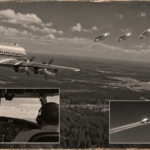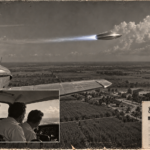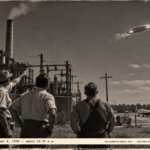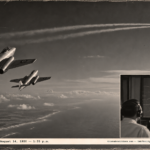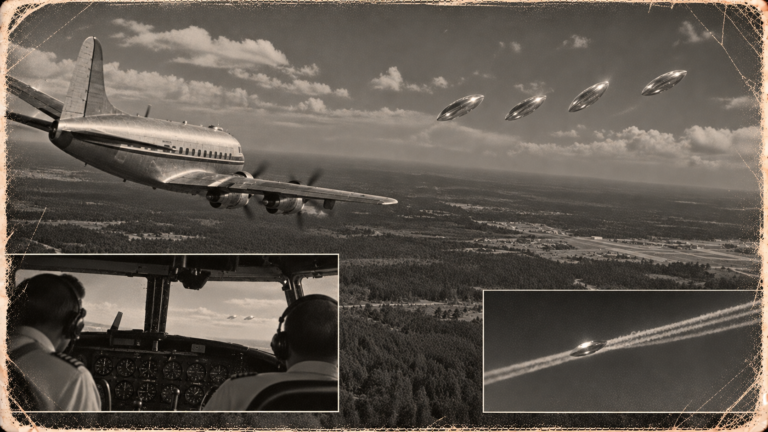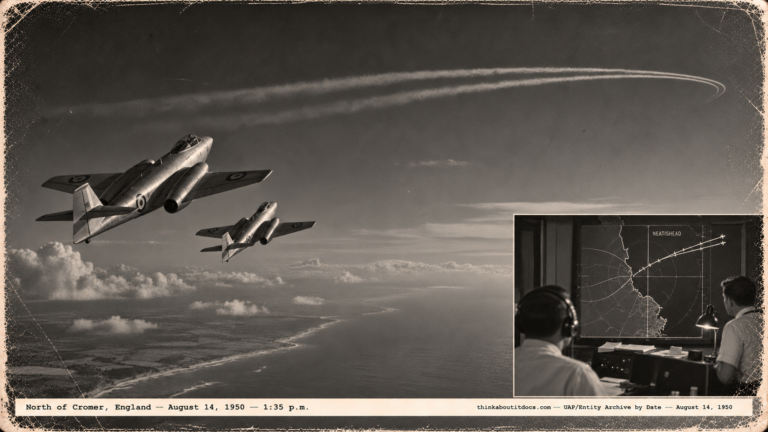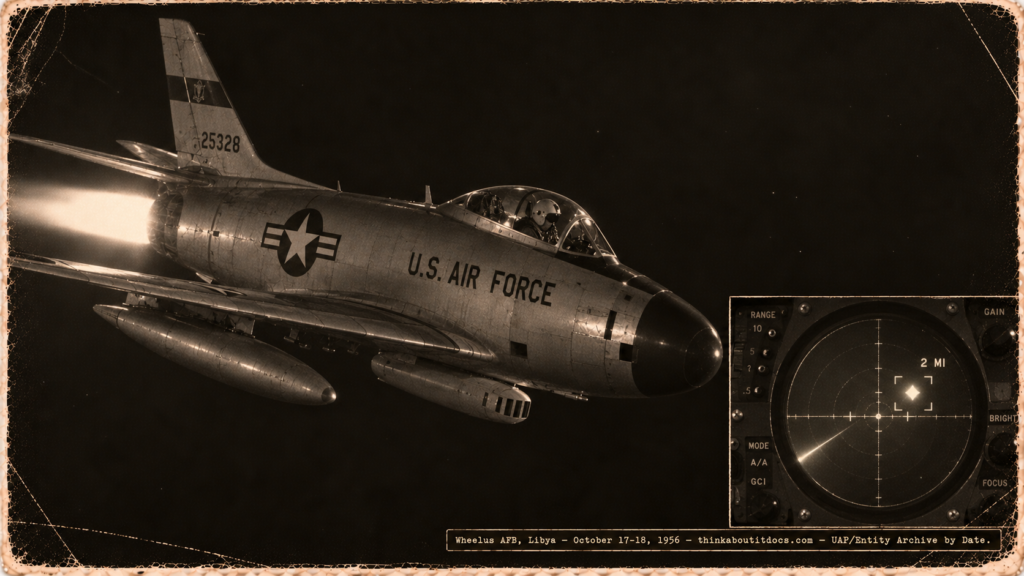
Wheelus AFB, Libya, October 17-18, 1956: the F-86D's fire-control radar showed Splash at 2 miles — the pilot saw nothing.
THINK ABOUTIT UFO|UAP SIGHTINGS REPORT
1956: Wheelus AFB, Libya: The Night F-86Ds Reached Splash and Hit Nothing
On the night of October 17-18, 1956, the 663rd Aircraft Control and Warning Squadron at Wheelus Air Force Base in Tripoli, Libya acquired two separate unidentified radar tracks. They were slow-flying — unusual in itself for a Cold War intercept trigger — but they were solid: both gave bright returns on the ground radar. F-86D interceptors were scrambled. The pilots made radar contact. They ran repeated intercept passes using the E-4 fire-control system, cycling through every phase of the engagement sequence. At 1:46 a.m. on October 18, one F-86D — call sign F/Blue 2 — got radar contact at 2 miles from one of the targets. Two minutes later, at 1:48 a.m., it achieved Splash.
Splash is the fire-control system’s terminal engagement phase — the point at which the system has completed its tracking solution against the target. The pilots never saw anything. No visual contact was made during any intercept pass by any aircrew. At 1:48 a.m. the last radar contact on either track ended. Whatever the 663rd’s ground radar had been holding for hours, and whatever the F-86D’s airborne fire-control system had just locked onto, was gone — and it had never been identified.
Date: October 17–18, 1956
Sighting Time: 11:17 p.m. local time (October 17) through approximately 1:48 a.m. (October 18)
Day/Night: Night
Location: Wheelus Air Force Base, Tripoli, Libya (Mediterranean coast, approximately 8 km east of Tripoli city center)
Urban or Rural: Military air base
No. of Entity(‘s): Not Applicable
Entity Type: Not Applicable
Entity Description: Not Applicable
Hynek Classification: Radar-only (no visual contact made despite multiple intercept passes and fire-control system lock-on)
Duration: Approximately 2.5 hours (11:17 p.m. to 1:48 a.m.)
No. of Object(s): 2 separate tracks
Description of the Object(s): Two radar tracks described as slow-flying unidentified objects. Both produced bright radar returns on both ground radar (663rd AC&W Squadron) and the airborne fire-control radar of the F-86D interceptors. No visual appearance was recorded because no aircrew ever saw the objects despite closing to within 2 miles.
Shape/Size/Color of Object(s): Unknown — radar only
Distance to Object(s): F/Blue 2 closed to 2 miles (29 degrees azimuth, 28 nautical miles from ground radar) at 1:46 a.m. before achieving Splash at 1:48 a.m.
Height & Speed: Described as “slow-flying” — specific altitude and speed not given in available summaries; the slow speed was noted as unusual and is what distinguished these tracks as unidentified
Number of Witnesses: Multiple: 663rd AC&W Squadron ground radar personnel; multiple F-86D aircrew (at minimum F/Blue 2 and others making “repeated” passes)
Special Features/Characteristics: Two independent simultaneous targets. Both gave bright returns on both ground and airborne radar. The F-86D fire-control system cycled through all engagement phases to Splash — the terminal tracking solution — without visual acquisition of either target. The last radar contact ended at 1:48 a.m. with no explanation of where either target went.
Case Status: Unexplained (Project Blue Book unknown)
Source: McDonald list; FUFOR Index; Project Blue Book files (BBU)
Summary/Description: Two separate slow-flying radar unknowns were tracked at Wheelus AFB, Libya by the 663rd AC&W Squadron on October 17-18, 1956. F-86D interceptors made multiple passes using the E-4 fire-control system, cycling to Splash, without any visual contact. Blue Book unknown.
Related Cases: 1956: October UFO|UAP & Entity Sightings Archive; 1956: Lakenheath-Bentwaters, England: Radar-Visual Intercept (August 13-14, 1956)
Detailed Report
Wheelus Air Force Base in 1956 was one of the largest U.S. military installations outside the continental United States — a sprawling Mediterranean coast facility east of Tripoli housing fighter-interceptor units, gunnery ranges and a major Strategic Air Command presence. At its peak it housed over 15,000 military personnel and dependents. The 663rd Aircraft Control and Warning Squadron was part of the air defense infrastructure that made Wheelus a critical node in the NATO Mediterranean surveillance network.
At 11:17 p.m. on October 17, 1956, the 663rd’s ground radar acquired two separate tracks it could not identify. The objects were flying slowly — the opposite of what typically triggered an intercept scramble in the Cold War environment, where fast-movers were the threat. But the returns were solid and bright, too consistent for weather clutter or equipment anomaly. F-86D Sabre-dog interceptors were launched.
The F-86D was a purpose-built all-weather interceptor carrying the Hughes E-4 fire-control system — an early airborne radar and fire-control computer that could acquire a target, compute an intercept course, guide the aircraft to firing position and trigger the weapons system automatically, without the pilot needing to visually acquire the target. The system was designed for night interception of bombers that could not be seen. It was a sophisticated piece of 1950s aerospace technology and it worked: the pilots ran repeat intercept passes and their airborne fire-control radar was tracking the same objects the ground was holding.
Over the course of approximately two and a half hours, the squadron ran multiple intercepts against the two tracks. At 1:46 a.m. on October 18, F/Blue 2 — one of the F-86Ds — had closed to 2 miles from one of the targets, at 29 degrees azimuth and 28 nautical miles from the ground radar. The fire-control system was tracking. At 1:48 a.m., the system achieved Splash on that target.
At 1:48 a.m., all radar contact ended. Both tracks — the one F/Blue 2 had just locked onto and the second — were gone from every radar. No pilot had seen anything through the canopy at any point during any of the multiple passes.
RESEARCHER’S NOTES
What “Splash” Means — and What It Doesn’t
- The E-4 fire-control system: The Hughes E-4 (later E-4B) in the F-86D combined an airborne search radar, an analog fire-control computer and an unguided rocket pod — the Mighty Mouse FFAR pack. The system’s engagement sequence ran from radar acquisition through computed intercept geometry to fire-control solution. “Splash” in this context means the fire-control computer had completed its solution — the weapons system had “painted” the target through all required phases. In at least some F-86D operational documentation, Splash indicates the rockets were fired. In others it refers only to the solution being completed. The Blue Book file would specify which meaning applies here. Either way, what happened at 1:48 a.m. represents the closest any 1956 air defense engagement came to an actual weapons exchange with an unidentified target.
- The Tehran parallel: The 1976 Tehran UFO incident is the most documented case of an aircraft weapons system appearing to fail when an attempt to engage an unidentified target was made — an F-4’s weapons system went offline as it closed on the object, then reset when the pilot broke off. Wheelus 1956 is the obverse: the weapons system completed its cycle normally — but there was nothing visible on the other end. Two different anomalous outcomes of the same attempt to treat an unidentified radar return as a target.
- Two independent tracks: The presence of two separate tracks makes equipment malfunction a much harder explanation. A single return could be a spurious echo, side lobe, or processor artifact; two separate, simultaneous, bright, slow-moving returns that are also acquired by multiple airborne fire-control radars on independent passes require either coordinated equipment failure on multiple systems or a physical explanation for what was in the airspace.
- The “slow-flying” anomaly: In the 1956 air defense environment, high-speed targets were the threat, and interception procedures were calibrated for them. A slow-flying target that nonetheless gives a bright radar return and does not respond to radio challenge or navigation light conventions is a genuinely unusual signature — not a rogue aircraft (which would have responded to challenge), not a drone (there were very few and they were identifiable), not a balloon (which would not give a bright consistent return and would not hold two independent tracks over 2.5 hours in a stable configuration).
- What the Blue Book file would add: The case is known through the McDonald list and FUFOR index — index-level summaries from the Blue Book microfilm. The original file would contain the 663rd’s mission report, the radar operator logs, the pilot debrief transcripts for each F-86D crew, and the official Blue Book evaluation. Without those, the case rests on the summary. What the summary says is nonetheless specific: two tracks, multiple intercepts, E-4 to Splash, no visual, contacts ended at 1:48 a.m.
The Wheelus AFB October 1956 case is the 1956 archive’s most extreme radar-intercept event in terms of engagement depth — closer to an actual weapons system employment against an unidentified target than anything else in the year’s record, including Lakenheath-Bentwaters, where the Venom pilot achieved gun lock but broke off for fuel. The objects the 663rd tracked were never identified, never seen, and vanished completely at the moment of fire-control completion. The file remains open.
F-86D aircraft made radar contact with the objects and made repeated intercepts with the E-4 weapons system through all phases to Splash — without any visual contact being made by the pilots.
663rd Aircraft Control and Warning Squadron, Wheelus AFB, Tripoli, Libya, October 17–18, 1956 — McDonald list; FUFOR Index; Project Blue Book files (BBU)