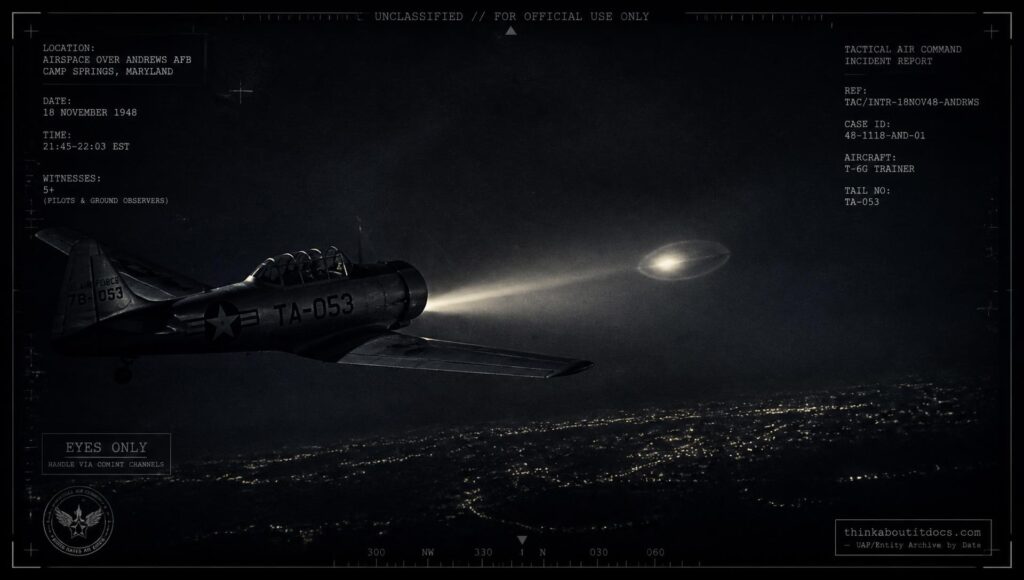
November 18, 1948 — Andrews AFB, Maryland. Two Air Force pilots chased a maneuverable object for 18 minutes; it answered their landing light signal with a dull glow before outrunning them.
THINK ABOUTIT UFO SIGHTINGS REPORT
1948: The Andrews AFB Pursuit
Two Air Force reserve pilots spent nearly twenty minutes chasing a glowing, oval object through the night sky over Andrews Air Force Base — diving on it, trying to box it in against the city lights, even flashing their landing light directly at it. The object answered with a dull glow of its own, then simply outran them. At least five separate people, in the air and on the ground, watched it happen. This is one of the best-documented pursuit cases of the entire early UFO era, and it made it into Edward Ruppelt’s own book.
Date: November 18, 1948
Sighting Time: 21:45-22:03
Day/Night: Night
Location: Andrews Air Force Base / Camp Springs, Maryland
Urban or Rural: Military airfield, suburban Washington, D.C. area
No. of Entity(s): Not Applicable
Entity Type: Not Applicable
Entity Description: Not Applicable
Hynek Classification: RV — Radar/Visual equivalent for an intercepted visual pursuit; classified here as a close-range, multi-witness visual case with active aircraft pursuit rather than a standard radar-visual case, given the absence of a documented ground-radar component in the surviving record.
Duration: Approximately 18 minutes (21:45-22:03)
No. of Object(s): 1
Description of the Object(s): A whitish-gray, oval, lighted object, smaller than the pursuing T-6 aircraft, responding to a direct landing-light signal with a visible dull glow of its own.
Shape of Object(s): Oval
Size of Object(s): Smaller than a T-6 trainer aircraft (the T-6 had a wingspan of roughly 42 feet)
Color of Object(s): Whitish-gray, with a lighted quality; described as producing a dull glow when signaled
Distance to Object(s): At closest approach, approximately 300-400 feet from the pursuing T-6
Height & Speed: Altitude varied between 1,700 and 7,000 feet during its circling maneuvers over the base; speed varied from as slow as 80 mph up to 500-600 mph during its final departure, at one point tracked climbing above 8,000 feet
Number of Witnesses: At least 5 — USAF reserve pilots Lts. Jackson and Combs aboard the pursuing T-6; two independent ground observers; a separate reserve pilot in another aircraft over the base who saw the object directly overhead; and USAF Staff Sgt. John J. Kushner, who independently observed the object from the ground
Special Features/Characteristics: The object actively and repeatedly evaded a pursuing aircraft over an 18-minute encounter, at one point specifically maneuvering to come up behind the T-6 that was chasing it, rather than simply fleeing in a straight line — behavior suggesting either an unusually agile natural phenomenon or some form of active, aware maneuvering; the crew deliberately attempted an identification technique, positioning the object against the backdrop of ground-level city lights to silhouette it for better visual assessment; the crew then signaled the object directly with their aircraft’s landing light from close range (300-400 feet), and the object responded with a visible dull glow — a detail that, if accurately observed, would constitute one of the more suggestive “apparent response to stimulus” cases in the early UFO record; the object’s recorded speed profile, ranging from as low as 80 mph up to 500-600 mph within the same encounter, describes a flight envelope inconsistent with any single class of conventional 1948-era aircraft, which would not typically be capable of both extremely low-speed maneuvering flight and high-speed evasion within the same short encounter; the case is corroborated across three independent vantage points — the pursuing aircraft, a second aircraft, and multiple ground observers — reducing the likelihood that the sighting reflects a shared misperception limited to a single observation angle.
Case Status: Unexplained
Source: Declassified FOIA case records; Edward J. Ruppelt, The Report on Unidentified Flying Objects, Doubleday, 1956, p. 46
Related Cases: 1948: November UFO|UAP & Entity Sightings Archive | 1948 Mantell Incident (another 1948 case involving an aircraft actively pursuing an unidentified object) | 1948 Gorman Dogfight (a similarly structured aerial pursuit case from the same year)
Detailed Report
Shortly before 10:00 PM on November 18, 1948, USAF reserve pilots Lts. Jackson and Combs, flying a T-6 trainer aircraft at roughly 150 mph out of Andrews Air Force Base near Camp Springs, Maryland, spotted a highly maneuverable, whitish-gray, oval, lighted object crossing over the base. The object was smaller than their own aircraft and moved through a repeating circular pattern over the base, ranging in altitude between roughly 1,700 and 7,000 feet, tracking from northeast to southwest and back again.
Jackson and Combs pursued the object, attempting to identify it through direct aerial engagement over the following several minutes. They made three or four passes at it while climbing, then attempted a dive at 240 mph to close the distance — but the object responded by dropping in altitude and then rising up behind their own aircraft, continuing to circle the base rather than being caught or driven off. This behavior pattern, actively repositioning relative to its pursuer rather than simply outrunning it in a straight line, is among the case’s most analytically significant details.
At one stage of the pursuit, the crew managed, with some difficulty, to position the object against the backdrop of ground-level city lights, hoping the silhouette would let them make out physical details more clearly. Closing to within an estimated 300 to 400 feet, they then flashed the T-6’s landing light directly at the object. According to the case record, the object responded to this signal with a visible dull glow of its own — before accelerating away to the northeast, climbing above 8,000 feet and reaching an estimated 500-600 mph, and disappearing from view.
Across the roughly eighteen-minute encounter, the object’s recorded speed varied dramatically — from as slow as 80 mph during its circling maneuvers up to 500-600 mph during its final departure — describing multi-directional, essentially omni-directional flight with vertical maneuverability and high-acceleration evasive behavior throughout.
The sighting was not limited to the pursuing aircraft’s two-man crew. A separate USAF reserve second lieutenant, flying another aircraft over the northeast corner of Andrews AFB at 1,000 feet, independently saw the object directly overhead. On the ground, USAF Staff Sgt. John J. Kushner separately and independently observed the object as well, along with at least one additional ground observer referenced in the surviving case documentation.
RESEARCHER’S NOTES
The Landing Light Signal
- On why the landing-light exchange is the case’s most striking detail: Deliberately signaling an unidentified object and recording an apparent responsive change in its own light output is a rare and specific claim within this archive’s broader record. Most cases describe passive observation; this one describes an active attempt at communication or provocation, followed by a documented change in the object’s behavior. Whether that “response” reflects genuine awareness, coincidental timing, or an artifact of the crew’s own expectations shaping their perception in the moment, this archive cannot determine — but the detail is specific enough, and embedded in an otherwise carefully sequenced account, that it resists easy dismissal as simple embellishment.
- On the object’s flight envelope: The recorded range of speeds within a single continuous encounter — from 80 mph hovering-adjacent maneuvering up to 500-600 mph high-speed departure — is difficult to reconcile with any known aircraft type from 1948. Conventional aircraft of the era were generally optimized for either low-speed maneuverability or high-speed flight, not both simultaneously within the same brief encounter, particularly while also executing the kind of tight, repositioning maneuvers described (dropping altitude, then rising up behind the pursuing T-6).
- On the strength of multiple independent vantage points: This case benefits from corroboration across genuinely separate observational positions — not simply multiple people looking at the same thing from the same location, but two different aircraft crews and at least two ground-based observers, including a named staff sergeant, all reporting consistent observations of the same object’s behavior. This significantly reduces the likelihood that the case reflects a single misidentified object or phenomenon viewed and interpreted differently by a single observer.
- On the case’s inclusion in Ruppelt’s own account: Edward Ruppelt, who later headed Project Blue Book and had direct access to the full case files of the era, included this incident in his own 1956 published account — a meaningful institutional endorsement of the case’s documentary seriousness, coming from someone with every professional incentive toward measured, skeptical treatment of the material he chose to include.
For eighteen minutes over a military airfield outside the nation’s capital, two Air Force pilots chased something that refused to simply run away — it circled back, it slipped behind them, and when they finally flashed a light directly at it, it flashed something back before disappearing into the night at speeds their own aircraft couldn’t match. Five witnesses, three vantage points, one object that behaved, for a few minutes in November 1948, like it knew exactly what was happening — and left without answering the only question that mattered.