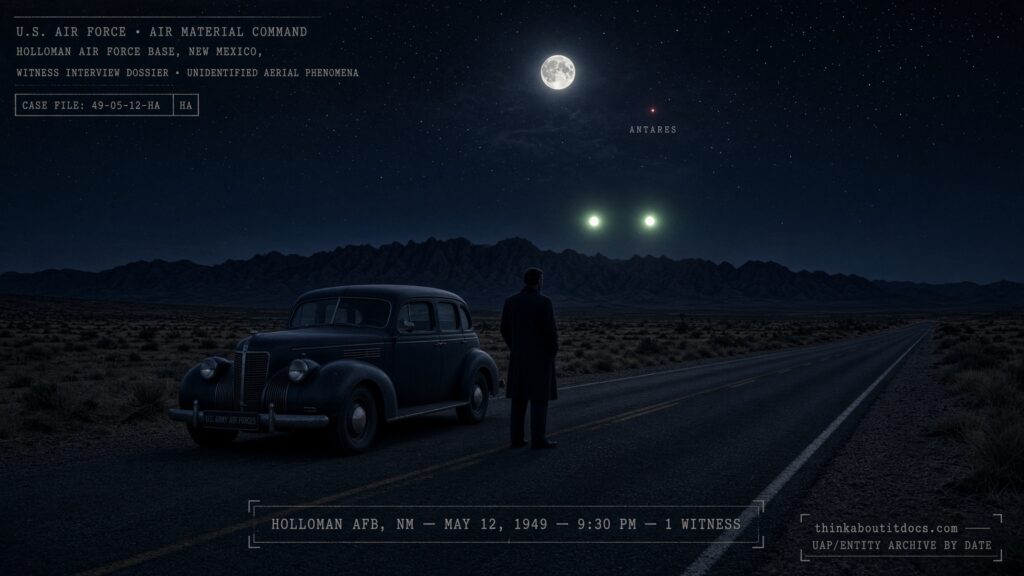
May 12, 1949 — Harvard astronomer Dr. Donald Menzel's own unresolved sighting near Holloman AFB, New Mexico.
THINK ABOUTIT UFO|UAP SIGHTINGS REPORT
1949: The Holloman AFB Sighting — Dr. Donald Menzel
On the night of May 12, 1949, a Harvard astronomer being driven along a lonely New Mexico highway watched two small white lights brighten above a mountain ridge and vanish one after the other — and said nothing more about it publicly for the rest of a career spent telling other people what they hadn’t really seen. Dr. Donald Menzel would go on to become American ufology’s most prominent scientific skeptic; this is his own sighting, logged quietly in the Blue Book microfilm files and never resolved.
Date: May 12, 1949
Sighting Time: 9:30 p.m. (MST)
Day/Night: Night
Location: Highway 70, just outside Holloman AFB, New Mexico, en route to Alamogordo
Urban or Rural: Rural
No. of Entity(‘s): Not Applicable
Entity Type: Not Applicable
Entity Description: Not Applicable
Hynek Classification: NL (Nocturnal Lights)
Duration: Approximately 4 minutes
No. of Object(s): 2
Description of the Object(s): Two small, round, white lights, each possibly with a faint greenish tinge, roughly 0 to 1st stellar magnitude, the left slightly brighter than the right; both appeared “fuzzy” at first and sharpened in edge contrast as they brightened, as though rising above a haze layer
Shape of Object(s): Round, point-source lights
Size of Object(s): Calculated diameter approximately 2,300 ft (Menzel’s own field estimate at the time was closer to 4,000 ft, or ¾ mile)
Color of Object(s): White, possibly with a slight greenish cast
Distance to Object(s): Calculated at approximately 180 miles, based on the near-absence of parallax shift over Menzel’s roughly 3-mile driving baseline
Height & Speed: Low over the Sacramento Mountain ridge line, about 5°-6° elevation, roughly over Moore Ridge (summit 7,264 ft); no perceptible speed — both lights brightened, then vanished in sequence
Number of Witnesses: 1 (Dr. Donald H. Menzel)
Special Features/Characteristics: Scientist/Professional Witness, Sequential Disappearance, Precise Astronomical Reference Points, Sober Analytical Observation
Case Status: Unexplained
Source: Sparks; Blue Book NARA Microfilm Roll 88, pp. 904, 920-921; Roll 91, pp. 424-425; Maxwell Roll 6, pp. 241-249
Summary/Description: Dr. Donald H. Menzel, an Air Force contract solar astronomer from the Harvard Observatory, was being driven by military car from Holloman AFB toward Alamogordo along Highway 70 (heading roughly ENE). Shortly after leaving the base, he noted a bright reddish Antares roughly 6°-8° to the lower left of the nearly full moon, both rising above the ridge line ahead. Soon after, he saw a small round white light low over the ridge, about 3°-4° above it and to the lower left of the moon and star — then a second, identical light appeared to its right, in a horizontal line about 3° apart. Each light was white, possibly with a slight greenish cast, and increased in brightness as though emerging above a haze layer, both appearing “fuzzy” at first and then sharpening. The lights vanished one after the other before the car could be stopped to allow closer observation. Menzel calculated that at the car’s speed (50 mph) over the several minutes of observation, the roughly 3-mile baseline should have produced a noticeable shift in the lights’ azimuth if they were nearby — but he noted no more than 1°-2° of apparent movement, from which he derived a distance of about 180 miles and, from the objects’ angular size, a “diameter” of roughly 2,300-4,000 ft.
Related Cases: Not Applicable
Detailed Report
Menzel’s account stands apart from the vast majority of nocturnal-light reports in this archive because of how it was recorded: not as a vague recollection of “lights in the sky,” but with reference stars, calculated elevations and azimuths, and an explicit method for estimating distance. He was traveling by military car along Highway 70, a road he knew well from his contract work at Holloman AFB, and he used the rising moon and the star Antares as fixed points of reference before the anomalous lights appeared. His description of the sequence — first one light low over the ridge, then a second appearing to its right in a horizontal line, both brightening as if emerging from haze before sharpening in outline — reads like the notes of someone accustomed to describing faint astronomical objects precisely.
The most consequential part of his account is the parallax calculation. Menzel reasoned that if the lights were close to the highway, the car’s own motion over several minutes should have shifted their apparent position against the ridge line by a measurable amount. He recorded a shift of no more than 1°-2° — which, if his baseline and timing were accurate, implies the lights were roughly 180 miles away, and therefore extremely large and extremely bright to be visible at all. He never proposed a specific identification for what he saw, either at the time or in his later published skeptical writing.
No institutional follow-up investigation is documented in the sources available for this report; the account survives through Blue Book’s own microfilm records and later research compilation by Brad Sparks, rather than through any Menzel-authored publication.
RESEARCHER’S NOTES
The Skeptic’s Sighting — Holloman AFB 1949 and the Irony of Personal Testimony
- Classification issues/corrections: This case is correctly filed as NL (Nocturnal Lights) rather than any Close Encounter tier — the lights were never closer than an estimated 180 miles by Menzel’s own calculation, and no object, entity, or physical effect was involved. There is no classification dispute in the source record; the difficulty lies entirely in the parallax math, not in the tier assigned.
- Source chain assessment: The account survives through Blue Book’s own microfilm archive rather than a Menzel-authored publication, and was later compiled and cross-referenced by researcher Brad Sparks. That chain — official file to independent researcher — is a stronger provenance than the secondhand or magazine-relayed sourcing common elsewhere in this archive, though it also means the account was never subjected to Menzel’s own published scrutiny.
- Pattern context/comparative cases: Menzel would go on to publish multiple books (Flying Saucers, 1953; The World of Flying Saucers, 1963; The UFO Enigma, 1977) offering conventional explanations — mirage, temperature inversion, misidentified aircraft or astronomical objects — for a wide range of other people’s sightings. No source consulted for this report shows him applying that same explanatory effort to his own May 12, 1949 case.
- Physical evidence/evidentiary weight: There is no physical evidence in this case — no photograph, no instrument reading, no second witness. Its evidentiary weight rests entirely on the credibility and self-reported rigor of a single trained observer, which is real but inherently limited; a witness’s professional background raises the floor of a report’s credibility without raising its ceiling of proof.
- Geographic/historical context: Holloman AFB and the surrounding White Sands/Alamogordo corridor were, in May 1949, an active center of guided-missile and high-altitude balloon research (Project Mogul, Skyhook flights, V-2 launches), and also lay within range of the New Mexico green fireball wave then under separate AFOSI investigation around Los Alamos and Sandia Base. Menzel’s sighting is geographically and temporally adjacent to that wave but is not linked to it in any source consulted here.
The record shows a single, credible, and unusually well-documented witness describing two lights whose behavior — sequential brightening and disappearance, and a distance calculation that places them far beyond any conventional aircraft or flare — was never explained, including by the witness himself, who spent much of the rest of his career explaining away similar reports from others. This case remains open not because of any dramatic claim within it, but because no one, including its own observer, ever closed it.
“Each light was white, possibly slight greenish tinge… apparently sharpening in edge contrast.”
From Dr. Donald Menzel’s account of the May 12, 1949 Holloman AFB sighting.