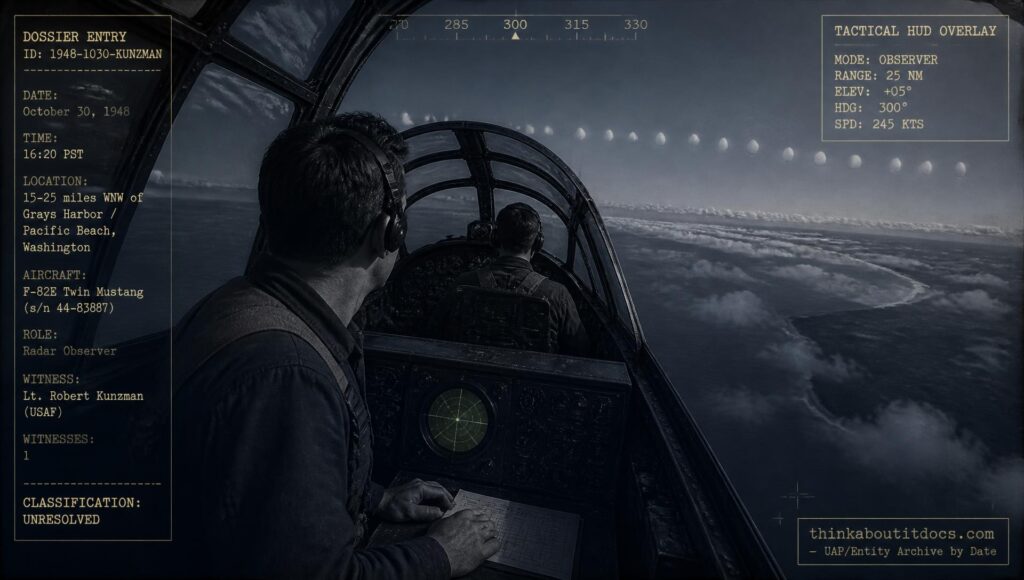
October 30, 1948 — off the Washington coast. Radar observer Lt. Robert Kunzman watched 10-20 egg-shaped objects in formation, corroborated by ground radar losing contact at the same moment his sighting ended.
THINK ABOUTIT UFO SIGHTINGS REPORT
1948: The Pacific Beach Formation — Lt. Robert Kunzman’s Radar-Visual Encounter
A trained Air Force radar observer, flying an active intercept mission, watched a compact group of yellow lights burst apart into a long, disciplined line of 10 to 20 white, egg-shaped objects — and ground radar lost the target at the exact same moment his own visual sighting ended. This is one of the most thoroughly documented radar-visual cases of the entire 1948 wave, complete with an official Air Force Office of Special Investigations follow-up.
Date: October 30, 1948
Sighting Time: Approximately 16:20-16:30 PST
Day/Night: Day, late afternoon
Location: Approximately 15-25 miles west-northwest of Grays Harbor/Pacific Beach, Washington
Urban or Rural: Airborne, over coastal Pacific waters off Washington state
No. of Entity(s): Not Applicable
Entity Type: Not Applicable
Entity Description: Not Applicable
Hynek Classification: RV — Radar/Visual. A structured formation of objects was independently confirmed by both direct visual observation from an aircraft and by ground-based radar tracking, meeting the defining criteria for this classification.
Duration: Radar contact of unstated duration; visual observation approximately 20 seconds
No. of Object(s): 10-20 (or possibly up to 25) individual objects
Description of the Object(s): Initially appeared as a compact group of yellow objects before bursting into an in-line formation of white, egg-shaped objects; the objects turned translucent partway through the encounter before disappearing.
Shape of Object(s): Egg-shaped
Size of Object(s): Not specified
Color of Object(s): Yellow initially, then white; became translucent before vanishing
Distance to Object(s): Initially at the 10 o’clock position relative to the aircraft; crossed to the 1 o’clock position, then to 3 o’clock, then back to 2:30, at an estimated 5 miles distance during part of the encounter
Height & Speed: Maintained the F-82’s approximate altitude of 8,000 feet throughout; estimated relative velocity, based on the angular movement observed, was roughly 500-1,000 mph greater than the F-82’s own 240 mph airspeed
Number of Witnesses: 1 direct visual witness (radar observer 2nd Lt. Robert L. Kunzman), plus ground radar operators at the 634th Aircraft Control and Warning Squadron, Neah Bay, Washington, who independently tracked and then lost the same target
Special Features/Characteristics: The sighting began during an active Ground Controlled Intercept (GCI) mission, meaning Kunzman was a trained radar specialist actively engaged in a real interception exercise, not a casual observer; the objects’ behavior was highly structured — an initial compact grouping that burst into a disciplined in-line formation, crossed directly in front of the aircraft while maintaining consistent altitude and horizontal flight, then doubled back and paralleled the F-82’s course at high speed before turning translucent and disappearing, rather than simply fading due to distance; pilot Maj. Homer William Morris, flying the same aircraft, did not see the objects despite Kunzman’s alert — a significant detail suggesting either a narrow visual angle, Morris’s attention being occupied by flying the aircraft, or some other factor limiting the sighting to Kunzman alone; ground radar at Neah Bay lost contact with the target at the same moment the visual sighting ended, an independent corroboration of the encounter’s timing from a source entirely separate from Kunzman’s own observation; the Air Force Office of Special Investigations (AFOSI) formally interviewed radar controllers at the nearby 635th AC&W Squadron at Pacific Beach, who reported tracking “no unidentified objects at high rate of speed” — a statement that leaves open the possibility of unidentified objects at moderate speed, and which notably does not address the 634th Squadron at Neah Bay, the unit that had actually done the tracking during the encounter itself, and which AFOSI did not interview.
Case Status: Unexplained
Source: James McDonald list; Project Blue Book, Maxwell Microfilm Roll 4, pp. 630-657; National Archives and Records Administration (NARA), Roll 88, pp. 144-149
Related Cases: 1948: October UFO|UAP & Entity Sightings Archive | 1948 Gorman Dogfight (same month) | 1948 Estimate of the Situation (this case falls within the wave the Estimate reportedly predicted for mid-October 1948)
Detailed Report
On the afternoon of October 30, 1948, an F-82 fighter was flying a Ground Controlled Intercept mission, headed north at 8,000 feet and 240 mph, roughly 15 to 25 miles west-northwest of Grays Harbor and Pacific Beach, Washington. The mission was being directed by the Air Defense Command’s radar site at the 634th Aircraft Control and Warning Squadron, Neah Bay, Washington, part of the 505th AC&W Group based at Everett.
The aircraft’s radar observer, Air Force 2nd Lt. Robert L. Kunzman of the 318th All Weather Fighter Squadron, 325th Fighter Group, McChord AFB, was working toward an assigned interception point when he spotted a single compact group of yellow objects at his 10 o’clock position, to the west-northwest. As he watched, the group burst apart into an in-line formation of what he counted as roughly 10 to 20 (some records suggest as many as 25) white, egg-shaped objects. His first instinct was that he might be looking at a flock of seagulls — a natural, cautious first assumption that speaks to his effort to rule out mundane explanations before treating the sighting as anomalous.
The formation crossed directly in front of the aircraft, moving from the 10 o’clock position through to roughly 1 o’clock (to the north-northeast), continuing in its line formation while heading west to east, maintaining a consistent altitude around 8,000 feet, then dropping back toward the 3 o’clock position to the east. Throughout this maneuver, the objects held the same altitude and remained in level, horizontal flight — behavior inconsistent with birds, which do not maintain such rigid formation discipline over an extended visual arc, particularly while an observer is actively tracking and reassessing them.
The formation then doubled back, heading north, paralleling the F-82’s own course while accelerating to high speed and climbing back toward the 2:30 position relative to the aircraft. At this point, the objects began turning translucent, at least in part, before disappearing — not simply fading gradually with increasing distance, a distinction the surviving case notes make explicitly, since some intervening fog with roughly 5 miles of visibility could reasonably account for a distance-based fade, but the described transition to translucency reads as a distinct visual phenomenon rather than a straightforward optical effect of distance and haze.
A rough velocity estimate can be derived from the available angular data: if the objects covered roughly 15 degrees of apparent sky (from the 3 o’clock to 2:30 position) at an estimated 5 miles distance, in a timeframe of perhaps 5 to 10 seconds, the resulting relative speed would be in the range of 500 to 1,000 mph faster than the F-82’s own 240 mph airspeed — placing the objects’ absolute speed well into the range that would have been extraordinary for any conventional aircraft of the era.
Kunzman called the sighting to the attention of his pilot, Maj. Homer William Morris, but Morris did not see the objects himself. At the same moment the visual sighting concluded, ground radar at Neah Bay also lost contact with the target it had been tracking — an independent data point corroborating the timing of the encounter’s end from a source entirely separate from Kunzman’s own account.
The case subsequently received formal attention from the Air Force Office of Special Investigations, which interviewed radar controllers — but at the 635th AC&W Squadron based at Pacific Beach, not the 634th Squadron at Neah Bay that had actually performed the tracking during the incident itself. The Pacific Beach controllers reported tracking “no unidentified objects at high rate of speed,” a statement that, read carefully, does not rule out unidentified objects at moderate speed, and which in any case comes from a unit not directly involved in the original tracking.
RESEARCHER’S NOTES
A Trained Eye, and an Investigation That Interviewed the Wrong Squadron
- On why Kunzman’s specific role matters: A radar observer on an active GCI intercept mission is, functionally, a trained specialist in distinguishing genuine aerial targets from clutter, weather returns, and misidentification — this was literally his professional function at the moment of the sighting. His own initial hedge toward “seagulls” before rejecting that explanation demonstrates active critical engagement with what he was seeing, rather than an uncritical leap to an extraordinary conclusion.
- On the significance of Morris not seeing the objects: Rather than weakening the case, the pilot’s failure to see what his radar observer reported is a detail worth taking at face value rather than treating with suspicion — sightings visible from one crew position and not another, due to viewing angle, aircraft structure, or simply where a person’s attention is focused while performing their own separate flying duties, are unsurprising and don’t inherently undercut the primary witness’s account.
On the investigative gap: The fact that AFOSI’s follow-up interviewed the 635th Squadron at Pacific Beach rather than the 634th Squadron at Neah Bay — the unit that had actually performed the original radar tracking — is a documented procedural gap in the case’s own official investigation, not a conclusion this archive is drawing independently. It means the negative statement on record (“no unidentified objects at high rate of speed”) did not come from the personnel with direct knowledge of the incident, and the investigative record is accordingly incomplete on its own terms.
- On the ground radar’s simultaneous loss of contact: The independent timing correlation between Kunzman’s visual sighting ending and ground radar separately losing its target is one of the stronger corroborating details available in this case — two entirely separate observation systems (one visual, from the air; one electronic, from the ground) reaching the same endpoint at effectively the same moment, without either observer being aware of what the other was recording in real time.
A trained radar officer, mid-mission, watched a knot of yellow lights unfold into a disciplined line of 10 to 20 objects, hold formation across a wide arc of sky, then vanish into translucency at the exact instant a ground radar station, entirely unaware of what he was seeing, lost its own independent track on the same target. The official follow-up investigation, when it finally came, asked the wrong radar squadron. What Robert Kunzman saw that October afternoon off the Washington coast remains, seven decades later, exactly what the case file called it: Unknown.