Fall 1948 — the Estimate of the Situation concluded UFOs were interplanetary. General Hoyt Vandenberg rejected it and ordered it destroyed; no copy has ever resurfaced.
THINK ABOUTIT UFO DOCUMENT REPORT
1948: The Estimate of the Situation — The Document That Was Burned
Somewhere in the fall of 1948, a group of Air Force intelligence officers finished writing a classified document that reached a conclusion the U.S. government has never officially repeated since: that the flying discs sweeping across America since Kenneth Arnold’s sighting were most likely interplanetary. It went by a deliberately unremarkable name — the Estimate of the Situation. It climbed the chain of command to the Air Force’s Chief of Staff. He rejected it, ordered it destroyed, and within months the officers who had championed it were quietly reassigned. No copy has ever resurfaced. What survives is the testimony of the people who read it before it went into the incinerator — and the last case they folded into it, a sighting by Los Alamos scientists on September 23, 1948.
Date: Drafted mid-to-late 1948; the last documented case incorporated was September 23, 1948; approved by Colonels William Clingerman and Howard McCoy in late September or early October 1948; formally rejected by General Hoyt S. Vandenberg shortly thereafter
Sighting Time: Not applicable — institutional document, not a single sighting (though see the anchoring Los Alamos case below)
Day/Night: Not applicable
Location: Drafted at the Air Technical Intelligence Center, Wright-Patterson AFB, Dayton, Ohio, by Project Sign personnel under project director Capt. Robert R. Sneider; submitted to the office of General Charles Cabell, Air Force Director of Intelligence, and ultimately to Air Force Chief of Staff General Hoyt S. Vandenberg at the Pentagon, Washington, D.C.
Urban or Rural: Not applicable
No. of Entity(s): Not applicable
Entity Type: Not applicable
Entity Description: Not applicable
Hynek Classification: Not applicable — this entry documents an institutional/historical event, not a UFO sighting, and carries no Hynek classification. (The anchoring Los Alamos sighting itself would be classified DD — Daylight Disc.)
Duration: Not applicable
No. of Object(s): Not applicable to the document itself
Description of the Object(s): Not applicable — the Estimate was a compiled analysis of numerous cases, including the June 1947 Kenneth Arnold sighting, Fred Johnson’s same-day Mount Adams corroboration, the July 1948 Chiles-Whitted encounter, and the September 23, 1948 Los Alamos sighting, among others, rather than a description of any single object
Number of Witnesses: Not applicable to the document; Edward J. Ruppelt and Dewey Fournet, among others, later confirmed having personally seen the physical document itself
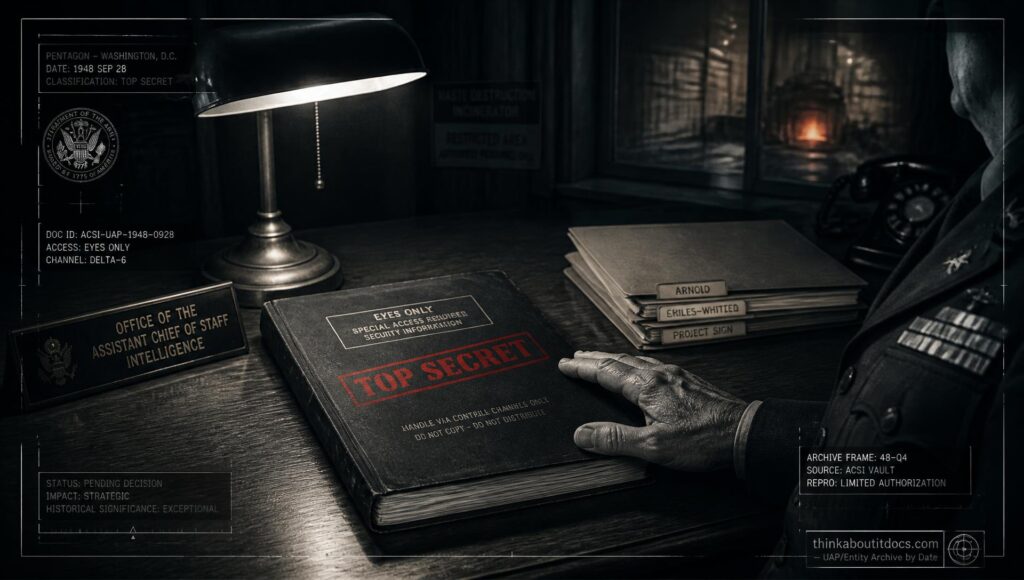
Special Features/Characteristics: Ruppelt, in his 1956 book, described the physical document he personally saw as “a rather thick document with a black cover,” printed on legal-sized paper and stamped TOP SECRET across the front; the Estimate reportedly argued that UFO reporting frequency might correlate with the close approach of Mercury, Venus, or Mars to Earth, speculating these planets might serve as launching points, and predicted a wave of sightings in mid-October 1948; when it reached General Charles Cabell’s office, the Pentagon reportedly went into an “uproar,” with intense internal debate between officers sympathetic to the interplanetary hypothesis and those who rejected it outright; Cabell ultimately passed the document to General Vandenberg, who rejected it for lacking sufficient proof and, according to Ruppelt, had the document “declassified and relegated to the incinerator” some months later, with only a small number of copies — one of which Ruppelt personally saw — kept as informal mementos; the Air Force officially denied the document’s existence for years afterward, even after the Air Force itself had cleared Ruppelt’s account of it for publication; no copy has surfaced in any subsequent declassification effort or FOIA request, leading some researchers to call it the “Holy Grail of ufology.”
Case Status: Historical/Institutional (not applicable as a sighting classification); document status: presumed destroyed, unrecovered
Source: Edward J. Ruppelt, The Report on Unidentified Flying Objects, Doubleday, 1956, Chapter 3; corroborating accounts from Dewey Fournet (Pentagon UFO liaison in the 1950s) and other surviving Project Sign personnel; Michael Swords, scholarly research on Project Sign and the Estimate of the Situation
Related Cases: 1948: September UFO|UAP & Entity Sightings Archive (the anchoring Los Alamos sighting) | 1947: The Letter That Founded Project Sign | 1947 Kenneth Arnold Sighting | 1948 Chiles-Whitted Case | 1948 Mantell Incident (Ruppelt’s “three classics” of 1948 that convinced Sign personnel UFOs were real)
Detailed Report
By the fall of 1948, Project Sign — the Air Technical Intelligence Center’s dedicated UFO investigation project, established directly out of the September 23, 1947 ATIC letter documented elsewhere on this archive — had spent roughly a year accumulating case files. Project director Capt. Robert R. Sneider, working with colleagues including Deyarmond, Loedding, and Truettner, compiled the most compelling of these cases into a single classified analysis. Its cornerstone was the July 24, 1948 Chiles-Whitted encounter, a pilot sighting this archive documents in its own dedicated report, but the document ranged across the full history of the wave — reportedly including the original June 1947 Kenneth Arnold sighting and Fred Johnson’s same-day Mount Adams corroboration.
The most recent case incorporated into the document, according to historians who have studied Project Sign’s internal records, was the September 23, 1948 sighting at Los Alamos, New Mexico — a group of Los Alamos Scientific Laboratory personnel, including named witnesses Angier and Fairchild, who watched a sun-reflecting glint from a flat, circular metallic object appear high in the northern sky, resembling a dime held on edge and slightly tipped, as if only about 50 feet away. That this specific sighting, by credentialed scientists at one of the nation’s most sensitive research facilities, was the case that closed out the document’s evidentiary record is itself a notable detail — a strong, professionally credible sighting serving as the final data point before the report moved into the approval process.
The completed Estimate concluded that the phenomena were real and most likely of interplanetary origin. It reportedly went further than a simple conclusion, offering supporting speculation: that the timing of UFO reports might correlate with the close approach of Mercury, Venus, or Mars to Earth, suggesting those planets might serve as launching points for the observed craft, and predicting a further wave of sightings around mid-October 1948. The document was approved by Colonels William Clingerman and Howard McCoy, Sneider’s immediate superiors, in late September or early October 1948, and forwarded to the office of General Charles Cabell, the Air Force’s newly appointed Director of Intelligence.
Per multiple historical accounts, the Pentagon’s reaction was immediate and sharply divided — described by researchers as an “uproar,” generating intense internal debate. Some officers were sympathetic to, or at least intrigued by, the interplanetary conclusion; others rejected the very premise as impossible. Cabell, uncertain how to proceed given this split, ultimately passed the Estimate up to his own superior: General Hoyt S. Vandenberg, Air Force Chief of Staff.
Vandenberg rejected it. According to Ruppelt, who later personally saw a surviving copy, “the general wouldn’t buy interplanetary vehicles” and judged that “the report lacked proof.” A delegation from ATIC traveled to the Pentagon specifically to argue for the document’s conclusions but failed to change his mind. The Estimate, as Ruppelt put it, “died a quick death.” Some months later, per Ruppelt’s account, it was formally declassified and sent to be incinerated, with only a handful of copies — Ruppelt’s among them — retained informally as what he called “mementos of the golden days of the UFO’s.”
The aftermath reshaped the entire trajectory of official American UFO investigation. Over the following months, Project Sign personnel who had championed the extraterrestrial hypothesis were gradually reassigned elsewhere, until those skeptical of the phenomenon became the project’s majority. Sign was formally reorganized into Project Grudge in early 1949, a project explicitly oriented toward debunking rather than investigating — a posture that, through its eventual successor Project Blue Book, would broadly define the U.S. government’s public stance on UFOs for the following two decades.
RESEARCHER’S NOTES
The Holy Grail That Went Up in Smoke
- On why this document’s evidentiary status is unusual: Very little in the entire history of American UFO investigation carries as much institutional weight as the Estimate of the Situation, and almost none of that weight rests on the document itself, since it no longer exists in any recoverable form. Its existence and contents are known entirely through the testimony of people who read it before its destruction — principally Ruppelt, whose 1956 book, cleared for publication by the Air Force itself, is the primary source virtually every subsequent account draws from, corroborated by Dewey Fournet and other surviving Sign personnel in later interviews. The Air Force’s own multi-year public denial that the document ever existed, followed by its clearance of Ruppelt’s book describing it in detail, is itself a strange contradiction in the official record that this archive notes without resolving.
- On why the destruction matters more than the conclusion: Whether the Estimate’s interplanetary conclusion was correct is, in an important sense, a separate question from why its destruction became such a pivotal moment in the field’s history. What made the episode so consequential was institutional, not evidentiary: a formal government analytical body reached a specific conclusion through its own internal process, that conclusion was overruled not on the documented evidence’s merits but by a single senior officer’s standard of proof, and the personnel who had reached that conclusion were subsequently reassigned until the project’s institutional character shifted toward skepticism. That sequence — investigate, conclude, get overruled, get reorganized around the overruling — became the template many researchers point to for understanding decades of subsequent official UFO policy.
- On the planetary-approach speculation specifically: The Estimate’s reported argument linking UFO sighting frequency to the close approach of Mercury, Venus, or Mars, and its specific prediction of an October 1948 wave, is a testable claim in principle — and this archive notes it honestly as a documented feature of the Estimate’s reasoning without independently verifying whether the predicted October wave materialized as forecast, a question beyond the scope of a single month’s archive page.
A group of intelligence officers looked at everything from Kenneth Arnold’s sighting to a group of Los Alamos scientists watching a dime-sized glint in the northern sky, and concluded, in writing, at the Top Secret level, that the answer was probably interplanetary. One general disagreed, and ordered the paper burned. What’s left is a black-covered document nobody can produce, a conclusion nobody can verify, and a single line from the man who saw it with his own eyes: the situation was the UFOs, and the estimate was that they were interplanetary.