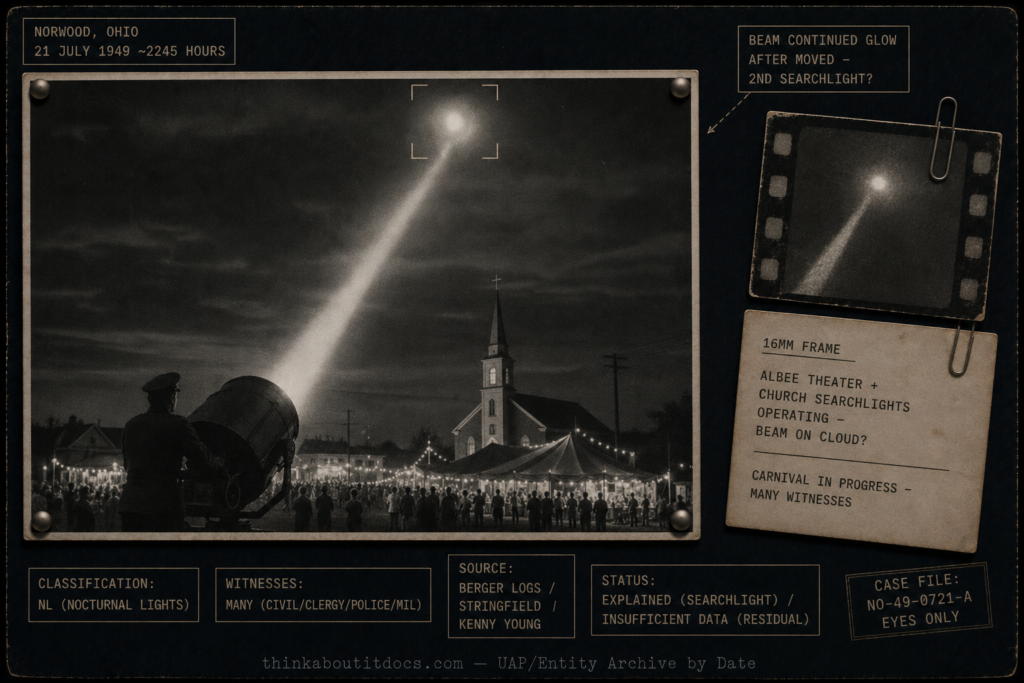
The Norwood Searchlight Incident, Norwood, Ohio, August 19, 1949–March 10, 1950 — a carnival searchlight that seemed to catch a glowing object overhead; classified NL, status two-tier (searchlight-explained mass episode, residual reports Insufficient Data).
THINK ABOUTIT UFO | UAP SIGHTING REPORT
1949: The Norwood Searchlight Incident — Norwood, Ohio
On the night of August 19, 1949, a parish carnival in the little city of Norwood, Ohio, became the stage for one of the stranger episodes of the early saucer era. The Ss. Peter & Paul Church had bought an eight-million-candlepower army-surplus searchlight to draw a crowd to its Jitney Carnival, and a young ROTC sergeant named Donald R. Berger was sweeping it across the sky when the beam suddenly caught — and seemed to stop on — a stationary circular object hanging overhead. The pastor looked. Hundreds of carnival-goers looked. By morning three Cincinnati newspapers were fielding calls about “comets” and “strange lights,” and a managing editor and a clergyman had driven a report straight to Air Force intelligence at Wright Field. Over the next seven months the object — or something like it — was logged ten times, photographed by a police sergeant, and captured on movie film that appeared to show the searchlight beam bending into it. It is a case with a strong mundane candidate sitting right beside a handful of details that candidate never quite covers.
Date: August 19, 1949 (principal mass episode); series of approximately 10 sightings continuing to March 10, 1950
Sighting Time: First contact 8:15 p.m. on August 19; Berger logged the object until about 11:00 p.m., with related reports continuing through the night to roughly 6:30 a.m.
Day/Night: Night
Location: Norwood, Ohio (an incorporated city surrounded by Cincinnati), Hamilton County — about 50 miles south of Wright Field, Dayton
Urban or Rural: Urban
No. of Entity(‘s): None reported
Entity Type: Not applicable
Entity Description: Not applicable — aerial light/object sightings, no occupants
Hynek Classification: NL (Nocturnal Lights)
Duration: Recurring over a seven-month span; the August 19 observation by Berger ran roughly 8:15 to 11:00 p.m.
No. of Object(s): Generally one; on at least one early-morning observation, two stationary objects were reported
Description of Object(s): A stationary, circular/disc-like luminous object caught and held in the searchlight beam; reported to continue glowing after the beam was moved away. On film the beam appeared to bend or be “pulled” into the object; a weather-bureau observer separately described two objects resembling “weather ceiling balloons” that held position against a strong wind.
Shape: Circular / disc-like
Size: Reported as large or “massive” (uncalibrated; no reliable scale)
Color: Luminous / glowing white in the beam
Distance: Not established
Height & Speed: High and essentially stationary; the reported failure to move against a 25–32 mph wind was among the puzzling features
No. of Witnesses: Multiple — hundreds at the August 19 carnival, and across the series civilians, clergy (Rev. Gregory Miller), police (Sgt. Leo Davidson), scientists, and military personnel
Special Features/Characteristics: The object was “found” by a sweeping searchlight; it reportedly kept glowing when the beam moved off; Berger’s own log notes the possible presence of a second searchlight that night; photographs were taken by Norwood Police Sgt. Leo Davidson on October 23, 1949; two reels of 25-ft motion-picture film were kept by Rev. Gregory Miller (last seen at WCPO Channel 9 in 1952); film stills were published by Leonard Stringfield and examined by Dr. Richard Haines and by Ray Stanford
Case Status: Two-tier — Explained (searchlight beams on cloud/haze) for the August 19 mass episode and the beam-interaction imagery / Insufficient Data for the residual reports (continued glow after the beam moved, stationary objects against the wind) and the much-degraded film
Source: Sgt. Donald R. Berger’s contemporaneous logs (1949–1950); contemporaneous Cincinnati press — The Cincinnati Post, The Cincinnati Enquirer, The Cincinnati Times-Star (August 1949); Leonard H. Stringfield, Saucer Post 3-0 Blue; investigation and compilation by Kenny Young; NICAP case directory; photo analysis by Dr. Richard Haines
Summary/Description: During the Jitney Carnival at Ss. Peter & Paul Church in Norwood on August 19, 1949, Sgt. Donald R. Berger of the University of Cincinnati ROTC was operating an 8-million-candlepower army-surplus searchlight the parish had bought to attract crowds. At about 8:15 p.m. his sweeping beam fell on a stationary circular object in the sky; Rev. Gregory Miller and many others observed it, and Berger began keeping a written log of each appearance. Hundreds at the carnival saw the lights, and the next morning all three Cincinnati papers carried reports of “strange lights” and “comets.” A local paper offered an explanation — searchlights from the Albee Theater in Cincinnati and the Norwood church bouncing off clouds — but sightings reportedly continued past 11:00 p.m., after Berger had stopped, until about 6:30 a.m., and a weather-bureau official described two stationary objects holding against a strong wind. Convinced the beam had found “some definite object,” Cincinnati Post managing editor Robert Linn and Rev. Miller reported the matter to Air Force intelligence at Wright Field. The series ran to roughly ten sightings through March 10, 1950, and produced still photographs (Sgt. Leo Davidson, October 23, 1949) and movie film, stills from which were later published by Leonard Stringfield and analyzed by researchers.
Related Cases: 1942 — the “Battle of Los Angeles” (searchlight-illuminated, contested aerial objects with mass witnesses) | 1952 — Washington, D.C. nocturnal-lights flap | Regional Project Grudge–era light reports near Wright Field, Ohio
Full Report
The Norwood case is best understood as two things layered on top of each other: a textbook mass “mystery light” event with an obvious candidate cause, and a small set of residual observations that the obvious cause does not fully explain.
The obvious cause is searchlights. The Ss. Peter & Paul Church had purchased a powerful army-surplus searchlight specifically to pull a crowd to its August carnival, and it was demonstrably in operation, swept across the sky by Sgt. Berger. A second commercial searchlight, at the Albee Theater in Cincinnati, was also running that night, and Berger’s own log allows for a second beam in play. A powerful searchlight striking a cloud or a layer of haze produces exactly what hundreds of Cincinnatians reported to the newspapers and the weather bureau the next morning: bright, drifting, comet-like patches of light with no obvious source. When a sweeping beam crosses a denser patch of cloud it can appear to “find” and rest on a glowing circular spot. For the August 19 mass event, this is a strong and contemporaneous explanation, and it was offered at the time.
The residual observations are what have kept the case alive. Berger recorded that when he moved the searchlight away, the object continued to glow — though the possible second searchlight he himself noted could account for that. A weather-bureau official described, in the early morning hours, two objects that looked like “weather ceiling balloons” holding position despite a wind of 25 to 32 miles per hour; stationary lights against a strong wind are not what a beam-on-moving-cloud produces. The sightings reportedly persisted after Berger ceased operating, past 11:00 p.m. and on toward dawn, when it seems unlikely the carnival and theater searchlights were still sweeping. And the event recurred — by Kenny Young’s count, around ten times over seven months, with witnesses including police and scientists, which is more than a single carnival night of beams on clouds would predict.
The photographic record is the case’s most cited and least conclusive element. Norwood Police Sgt. Leo Davidson took still photographs on October 23, 1949. Two reels of 25-foot motion-picture film were kept by Rev. Gregory Miller and were last reported at the WCPO Channel 9 studios in 1952, after which the originals dropped from view. Still frames reached the veteran Cincinnati investigator Leonard Stringfield, who reproduced them in his book Saucer Post 3-0 Blue, and the imagery was later examined by Dr. Richard Haines, a serious photo-analyst, and by Ray Stanford. Stanford, working from a copy several generations removed from the original, argued that the film showed the searchlight beam being “pulled” into the object and bent by some 26.5 degrees. That is a dramatic claim, but it rests on heavily degraded material and an enthusiastic interpretation, and an apparent bend in a beam crossing layered haze is precisely the sort of thing that can arise from atmospheric scattering and photographic artifact rather than from any object acting on the light.
Running beneath the whole affair is the question Kenny Young pressed: why does a well-publicized, mass-witnessed, seven-month series, reported directly to Wright Field by a newspaper editor and a clergyman, leave no apparent trace in the Project Grudge files? Grudge in 1949 was inclined to explain sightings away, and Norwood — with its demonstrable searchlights — would have been an easy and welcome candidate to dismiss. Its absence from the record is itself a small mystery, though it may say more about the disorganized state of Grudge at the time than about the case.
RESEARCHER’S NOTES
The Norwood Searchlight Series — Ohio 1949 and the Beam-on-Cloud Problem
- Classification. This is NL (Nocturnal Lights): luminous, essentially structureless objects observed at night, with no occupants and no instrumented detection. The photographic and motion-picture record does not change the Hynek category, which describes the observation type rather than the recording medium. The searchlight interaction is the case’s distinctive feature, but a beam terminating in or appearing to bend toward a luminous patch is still, at root, a nocturnal-light observation.
- Source chain. The provenance is a mix of strong and soft. On the strong side: a contemporaneous observer’s log (Berger), same-day coverage in three established Cincinnati newspapers, and a direct period report to Air Force intelligence at Wright Field. On the softer side: the film originals are lost, surviving only as later-generation copies; the custodial chain ran through Rev. Miller to Stringfield, a Cincinnati investigator whose crash-retrieval work is treated cautiously elsewhere but who here functioned as custodian and publisher; and the most dramatic photo interpretation comes from Ray Stanford, an enthusiastic rather than neutral analyst. Dr. Richard Haines’s involvement lends analytical weight, but no definitive published conclusion from him is in hand.
- Pattern context. Norwood belongs to a recognizable category of mass “mystery light” events generated or amplified by searchlights — the 1942 “Battle of Los Angeles” being the era’s most famous instance, where searchlight-lit objects over a nervous city produced enduring controversy. Such cases are notoriously bimodal: a real, mundane light source (the beam) interacting with real but ambiguous targets (clouds, haze, possibly balloons), observed by large numbers of people primed to see something extraordinary. The result is a genuine event that is also genuinely hard to fully resolve, which is exactly Norwood’s profile.
- Physical / evidentiary weight. Mixed, and honestly bounded. The case has real strengths — many credible witnesses, a contemporaneous log, immediate press coverage, and surviving (if degraded) imagery — but its central engine was a known, powerful, deliberately operated searchlight, which provides a sufficient explanation for the bulk of what was reported on the famous first night. The residual items (continued glow, stationary objects against wind, the seven-month recurrence, the beam-bend film) are intriguing and not cleanly accounted for, but they rest on thin or lost evidence. The fair disposition is two-tier: the mass searchlight episode is best regarded as Explained by beams on cloud and haze, while the residual reports and the unrecoverable film remain Insufficient Data — interesting, unresolved, but not demonstrably anomalous.
The Norwood Searchlight Incident is a case where the most exciting interpretation and the most likely one were both available from the very first night. A church carnival’s powerful surplus searchlight, joined by at least one other beam, almost certainly produced the glowing, drifting lights that hundreds of Cincinnatians reported and that the newspapers explained the next day. What lingers are the handful of details that explanation does not reach — a glow that outlasted the beam, objects that hung against the wind, a seven-month recurrence, and a strip of film, now lost, that some swore showed the beam being drawn into the object. Stripped of the more enthusiastic claims, it stands in the record as a largely explainable mass searchlight event carrying a small, stubborn residue of the genuinely unresolved.
Report
The Norwood Searchlight Incident of 1949, as it has been called, is an outstanding series of 10 visual sightings of a strange aerial object that took place in or near the Norwood, Ohio area from August 19th of 1949 to March 10th of 1950.The alleged observation of a massive object by searchlight operator Donald R. Berger, and meticulously detailed in his logs, remain one of the more curious events in UFO history.
This case is exceptional not only because of the dramatic event reported, but also because of the caliber of witnesses involved. The series of incidents were said to have been witnessed by civilians, by clergy, by scientists, by police officers and military officials.
Photos were taken on October 23, 1949 by Norwood Police Sgt.Leo Davidson, and 2 reels of 25-ft. motion picture film were kept in the possession of Reverend Gregory Miller, last seen at WCPO Channel 9 TV studios in 1952.
Still frames from the movie film were given to investigator Leonard Stringfield and published in his book “SAUCER POST 3-0 BLUE.” That photo from his book was scanned and enhanced for this report. Using this same photo, an earlier analysis had been made by Dr. Richard Haines.
 |  |
(click on image for full size)
Images enhanced, cropped and enlarged by Kenny Young
©2003 All Rights Reserved, Do not duplicate, copy or use in any way without permission
An additional photo was found in the possession of RAY STANFORD, who states: “This is several generations down from the original16 mm movie film, but it seems to rather clearly show that while the beam was projecting several degrees away from the object, when it got within a certain event horizon of the object, it was simply bent or ‘pulled’ the beam directly into the object, seemingly bending it about 26.5 degrees, as measured in the photo plane! This frame has always amazed me since I first saw it in the mid-’50s. Several persons, back then, who had seen the actual movie said that at one time the object seems, indeed, to ‘suck’ the beam squarely into it!”I have included two versions with special filtration. The second (middle) image makes the dramatic bend of the light beam especially clear and easy to measure (on the top of the beam). The second (last) version seems to show what might be interpreted to be a focus effect of the light within the beam. Note the dark diamond shape (bright in the original) between the object and the place where the beam bends.”
 |  |  |
PHOTOS COURTESY OF RAY STANFORD
NORWOOD AND PROJECT GRUDGE Could someone help explain if any reference to the 1949 Norwood Searchlight/UFO incident does or does not appear in Project Grudge files?
The Norwood case involves 10 visual sightings by multiple civilian, clergy, police, scientist and military witnesses over a 7-month duration, facilitated by the use of a powerful searchlight ran by Army Sgt. Donald R. Berger. The first sighting took place during “The Jitney Carnival” of 1949 and witnessed by hundreds The following morning, three local newspapers- The Cincinnati Post, The Cincinnati Enquirer and The Cincinnati Times Star- all had articles regarding ‘strange lights’ and ‘comets seen over the city’ from the previous evening.
There was an explanation for the occurrence, according to one local newspaper. The Albee Theater in nearby Cincinnati, accompanied by the Ss. Peter & Paul Church in Norwood, were operating searchlights. It was said that the hundreds of persons calling newspapers and weather bureau officials were simply observing these searchlight beams ‘bouncing off of clouds.’
Despite this, the sightings began in earnest after 11:00 p.m. (Berger logs indicate that he observed the UFO from 8:15 p.m. to 11:00 p.m.) and continued to flummox Cincinnati residents until 6:30 a.m. the following morning. It seems unlikely searchlights would be operating all night long until daylight, and further still, one weather bureau official recounted his early-morning observation of two objects that looked like “two weather ceiling balloons” that weren’t moving despite a wind speed of 25 to 32-miles per hour.
Even the Berger logs indicate the possible presence of a second searchlight from that evening, whether Berger knew there was another searchlight at work or not. “When I moved the searchlight away, the object continued to glow,” Berger wrote in his 1949 logs that were later kept in the possession of Rev. Gregory Miller until 1954, when he imparted them to UFO investigator Leonard Stringfield.
Meanwhile, during the festival in Norwood, Robert Linn, the managing editor of the Cincinnati Post, along with church pastor Rev. Gregory Miller, were certain that Berger’s searchlight had found and been bouncing off of “some definite object.” They entered into agreement and reported the situation to intelligence officials at Wright Field in nearby Dayton, Ohio.
The August 19th episode is a mass-witness case, reported in all three local newspapers of Cincinnati, Ohio, a city not far south of Dayton, home of the airbase. A possible explanation is publicly toyed with: the deception caused by two searchlight beams strolling the dark skies. It seems as if Grudge folks would have likely been aware of the events at Norwood on August 19, 1949 – either from all the reportage or from the direct report to the airbase itself, by Robert Linn and Rev. Miller. Why does the Norwood Case not factor in to their investigation when, in fact, far ‘lesser’ cases may have been prominently addressed? If Project Grudge had sought to dismiss UFO sightings as psychological phenomena, they had a good case with the Norwood searchlight events at this stage of the situation.
Thanks
Kenny Young
sources: Kenny Young; E-mail: ufo@fuse.net; http://www.nicap.org/norwooddir.htm