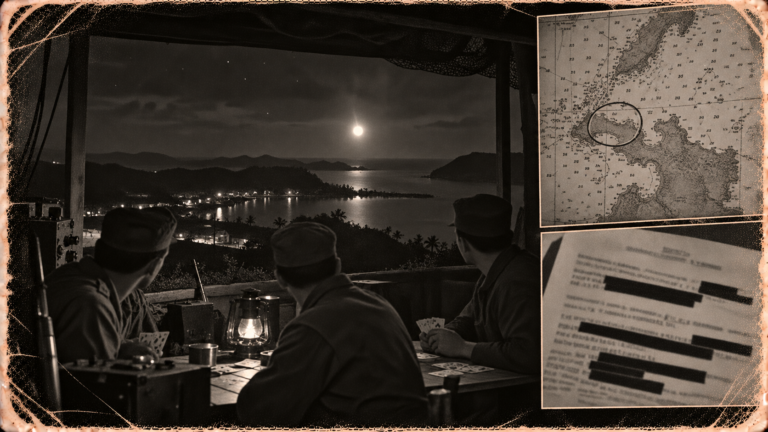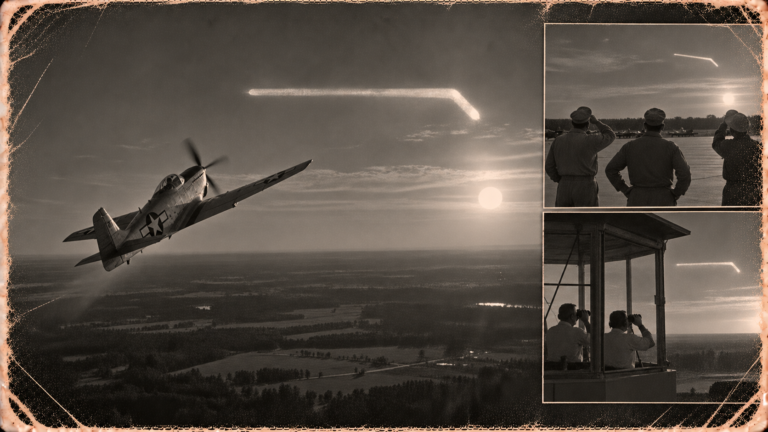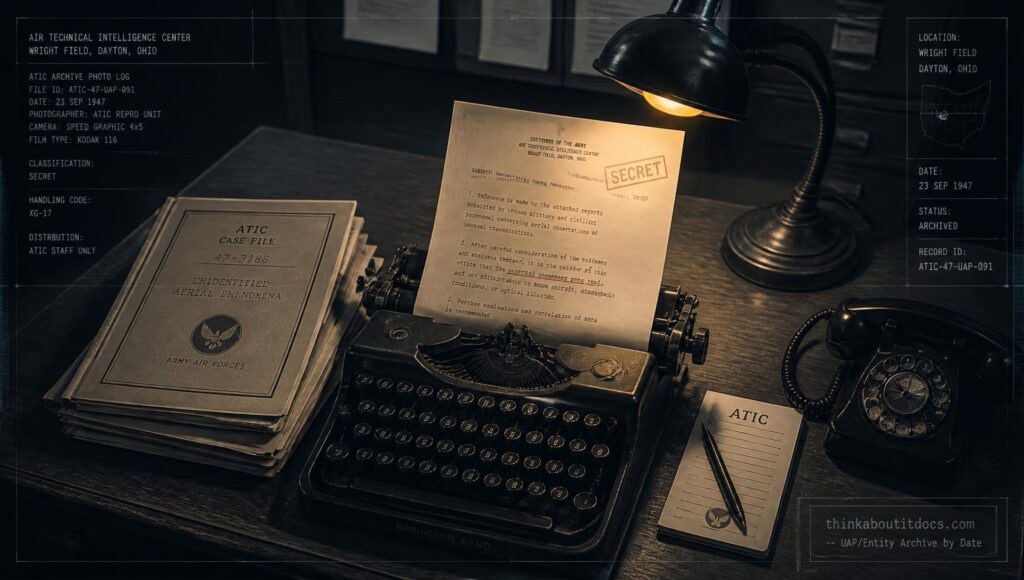
September 23, 1947 — the Air Technical Intelligence Center's letter to the Army Air Forces, concluding "the reported phenomena were real," directly founded Project Sign, the ancestor of Project Grudge and Project Blue Book.
THINK ABOUTIT UFO SIGHTINGS REPORT
1947: The Letter That Founded Project Sign
This is not a sighting. It’s the document that made every sighting matter to the U.S. government. On September 23, 1947 — three months after Kenneth Arnold, seven weeks after the Roswell press release — the Air Force’s own specialized intelligence center put it in writing to the Commanding General: the reports were real. What followed was Project Sign, then Grudge, then Blue Book — a continuous, twenty-two-year institutional lineage that traces back to a single classified letter most people have never heard of.
Date: September 23, 1947
Sighting Time: Not applicable — institutional document, not a sighting
Day/Night: Not applicable
Location: Originated at the Air Technical Intelligence Center (ATIC), Wright Field, Dayton, Ohio; addressed to the Commanding General, Army Air Forces, Washington, D.C.
Urban or Rural: Not applicable
No. of Entity(s): Not applicable
Entity Type: Not applicable
Entity Description: Not applicable
Hynek Classification: Not applicable — this entry documents an institutional/historical event (the founding of an official government investigative body), not a UFO sighting, and carries no Hynek classification.
Duration: Not applicable
No. of Object(s): Not applicable
Description of the Object(s): Not applicable — the letter itself was a preliminary study summarizing the broader body of 1947 UFO reports, not a description of any single object
Number of Witnesses: Not applicable
Special Features/Characteristics: The letter was issued in direct response to a verbal request from the Commanding General of the Army Air Forces for a preliminary study of UFO reports; it concluded, in its own words, that “the reported phenomena were real”; it urged the establishment of a permanent, dedicated project at ATIC to investigate and analyze future reports, specifically requesting a project priority, a registered code name, and full security classification; the request was granted in full, resulting in Project Sign, assigned a 2A priority — one tier below the highest priority any Air Force project could receive; per Edward Ruppelt’s later account, ATIC’s internal working assumption at the time was not whether the phenomenon was real, but whether the objects were of Soviet or interplanetary origin — both possibilities considered serious enough to justify a secrecy-shrouded, high-priority project; only senior ATIC personnel were assigned to Project Sign.
Case Status: Historical/Institutional (not applicable as a sighting classification)
Source: Edward J. Ruppelt, The Report on Unidentified Flying Objects, Doubleday, 1956, Chapter 2 (Ruppelt later served as director of Project Blue Book and had direct access to the project’s records); corroborated in general outline across the standard historical literature on U.S. government UFO investigation (Wikipedia’s Project Sign entry; Britannica; Michael Swords’s scholarly research on Project Sign)
Related Cases: 1947: September UFO|UAP & Entity Sightings Archive | 1947 Kenneth Arnold Sighting (the event that made this letter necessary) | 1947 Roswell UFO Incident | 1947 Radar Pick-ups of High Speed Targets in the Far East (case-level evidence of the kind ATIC was evaluating)
Detailed Report
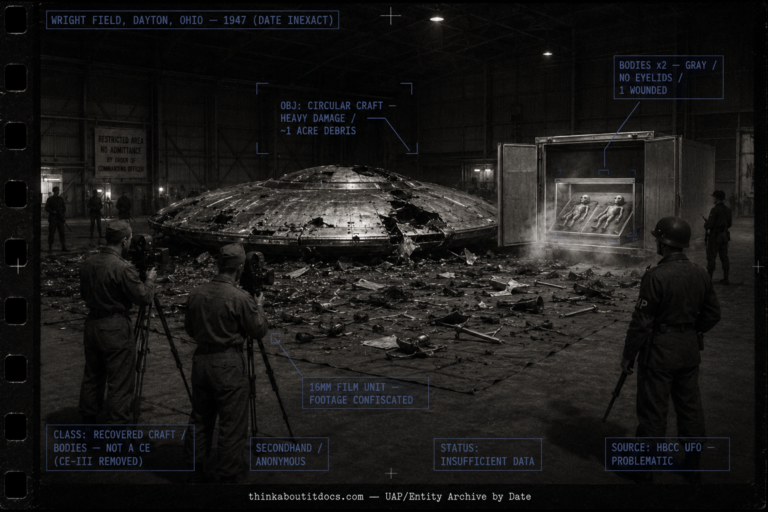
By September 1947, the Army Air Forces had spent three months absorbing an extraordinary volume of unidentified flying object reports, beginning with Kenneth Arnold’s sighting on June 24 and accelerating through the national “flying disc” craze of that summer, the Roswell incident and its subsequent press retraction, and a steady stream of military and civilian sighting reports from installations across the Pacific, the continental United States, and occupied territories. The Commanding General of the Army Air Forces verbally requested that the Air Technical Intelligence Center — one of the Air Force’s most specialized intelligence units, based at Wright Field in Dayton, Ohio — conduct a preliminary study of the accumulated reports.
ATIC’s response came in the form of a letter, dated September 23, 1947. According to Edward Ruppelt’s later account — Ruppelt himself went on to direct Project Blue Book and wrote with direct access to the project’s internal records — the letter’s central conclusion was stated plainly: “the reported phenomena were real.” This was not a claim that the objects had been identified, nor an endorsement of any particular explanation. It was, rather, an assertion that whatever was being reported represented a genuine phenomenon requiring serious, sustained institutional investigation, rather than a wave of hoaxes, misidentifications, or mass hysteria that could be dismissed without further study.
The letter went further than simply reporting a finding. It actively urged the Army Air Forces to establish a permanent project at ATIC dedicated to investigating and analyzing future UFO reports, and it made specific administrative requests: a project priority, a registered code name, and a full security classification. Every one of these requests was granted. The resulting effort, Project Sign, received a 2A priority designation — one step below 1A, the highest priority classification any Air Force project could carry at the time, reflecting the seriousness with which the request was treated at the institutional level.
Ruppelt’s account is specific about what question ATIC’s personnel considered open and what question they did not. The letter’s authors were not debating whether UFOs existed; per Ruppelt, “the question ‘Do UFO’s exist?’ was never mentioned.” The operative question, as ATIC’s intelligence specialists understood it in September 1947, was whether the reported objects originated from the Soviet Union or from some non-terrestrial source — either possibility serious enough, on its own, to justify a secrecy-shrouded, high-priority investigative project staffed only by senior ATIC personnel.
Project Sign operated through most of 1948 before being reorganized into the more skeptically postured Project Grudge, which was itself succeeded in 1952 by Project Blue Book — the long-running program, headquartered at Wright-Patterson Air Force Base, that would eventually compile more than 12,000 case files before its 1969 termination. The institutional lineage from Sign through Grudge to Blue Book is continuous and well-documented; all three traced their origin to this single September 1947 letter and the ATIC assessment it recorded.
RESEARCHER’S NOTES
A Word Choice That Outlived Its Author’s Intent
- On why this document belongs in a chronological UFO archive despite being institutional rather than observational: This archive exists to document the record of what was seen, when, and where — but the September 23 ATIC letter is arguably as consequential to that record’s later development as any individual sighting, because it is the mechanism by which the U.S. government transformed a summer of scattered public reports into a sustained, official, classified investigative apparatus that would persist for over two decades. Every subsequent government statement, denial, declassification, and case file that this archive draws upon for post-1947 American cases exists because of the institutional structure this letter created.
- On Ruppelt’s own retrospective caveat about the word “phenomena”: Ruppelt, writing roughly a decade after the letter was issued, noted pointedly that the choice of the word “phenomena” had not aged well — by the time he wrote his account, the confident expectation at ATIC in 1947 that an answer would be found “within a few months or a year” had given way to a much longer and less conclusive institutional history. This retrospective honesty from the very Air Force officer who inherited responsibility for the investigation is itself a data point worth weighing: an insider’s account acknowledging that early confidence had not been vindicated, rather than a triumphant retelling.
- On the source chain specifically: This entry rests substantially on Ruppelt’s 1956 published account rather than on the original letter text itself, which this archive has not independently located or reproduced. Ruppelt’s position as a former director of Blue Book with direct institutional access lends his account considerable credibility, but a researcher seeking the primary document itself would need to pursue declassified Air Force records directly, likely through the National Archives’ Project Blue Book holdings.
- On the “Soviet or interplanetary” framing: That ATIC’s own working framework in September 1947 excluded the possibility of mundane misidentification entirely — treating the choice as binary between foreign adversary technology and non-terrestrial origin — is a striking detail. It suggests that, at the specific institutional level responsible for evaluating the raw case volume, the more mundane explanations that would later dominate Blue Book’s public-facing conclusions were not considered adequate to explain the phenomenon as it appeared to trained intelligence analysts in the fall of 1947.
One sentence in one classified letter — “the reported phenomena were real” — set in motion Project Sign, then Grudge, then Blue Book: twenty-two years, more than 12,000 case files, and a bureaucratic and cultural legacy that outlasted every person who wrote or signed it. Whatever the truth behind any individual 1947 sighting, this document is the moment the United States government decided the question was worth asking formally, permanently, and in secret.